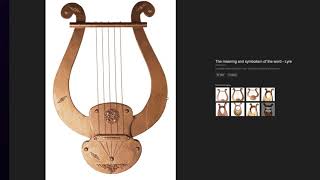
In this lecture, J. Anthony Allen surveys the musical culture of ancient Greece, beginning with a brief overview of the region’s geographic extent and the archaeological evidence—especially painted pottery—that reveals the instruments used. He introduces the principal instruments: the aulos, a double‑pipe flute associated with Dionysian worship and primarily played by women; the lyre, linked to Apollo and taught to both men and women of the upper class, serving religious, ceremonial, and secular functions such as weddings and poetic recitation; and the kithara, a larger lyre employed in sacred ceremonies and theatrical performances. Allen highlights how music was woven into Greek religion, philosophy, poetry (e.g., the Iliad and Odyssey), and theater, noting the gendered expectations for instrument mastery. He acknowledges the difficulty of reconstructing the actual sound of ancient Greek music, given the limited physical evidence, and signals that further exploration of the philosophical connections will follow in the next video.
Chapters
All right, on to ancient Greece. So ancient Greece is where we get our earliest records of music happening in a culture. We should point out that ancient Greece is a little bit different than current Greece. So looking at this map, Greece is primarily this area, and ancient Greece was quite a bit bigger. It went up into, you know, what is now a little bit of Albania, I think, Macedonia, Bulgaria. So it had some bigger stretches up here, and I think it maybe even touched into what is modern day Turkey. But what we're looking at here is ancient Greece, so it's quite a bit bigger. And what we find there is lot of archaeological remains that tell us about the music that was happening in particular images on clay pots. So we see images kind of carved into these clay pots and these have been found and we can kind of start to understand quite a bit about the music that was happening there, especially the instruments. There were a number of instruments that were popular there at the time. The lyre, which we've already talked about, but also the alos and the kithara. We'll talk more about those in just a second. They also had a few different kinds of harps, pipes, even horns, and an early form of an organ, although I can't find any pictures of that. Percussion instruments as well were found there. So let's look at a couple of these new instruments really quick. This is an aloska. Okay, so it's like a double reader, or not double readed, a double piped flute, I guess. So you would blow in here and then you would finger with both hands, like one hand here and one hand there, and you could play two notes at a time. You kind of see something similar to this in like, you know, someone trying to be like a virtuoso saxophone player. They can put two saxophones in their mouth and play one with each hand. Hand. You see that kind of trick all the time. But it's funny that it goes back to like one of our earliest instruments. So the alos was used in worship primarily. Primarily for. So almost all music at the time had religious purposes. Now remember, this is ancient Greece, so we're talking about the Greek gods and things like that. So Dionysus was the God of fertility and wine. And often the alos was used in songs and music to worship Dionysus. Now, another instrument, the lyre, that we already know, the lyre was used primarily in the worship of Apollo. So Apollo was the God of light, prophecy, learning, and the arts, especially music and poetry. So unlike the alos, the lyre was common to be learned by Both men and women. And it was pretty standard practice, like pretty much every, I suppose every upper class person was expected to be able to play the lyre. It was, you know, part of society. The alos, however, was a little bit more rare and also was primarily expected to be learned by women. It was more of a female associated instrument. And the lyre we used for some non religious purposes as well, including weddings and to accompany some of the poetry at the time. Now the poetry at the time, we know you probably have heard of these epic poems that were happening in particular the Iliad and the Odyssey. So often when those were recited, they were accompanied at least in part by someone playing a lyre. And then let's also talk about the kithara, which is really just a really big lyre. I couldn't find another picture of it other than this kind of crude drawing. But this one we know it was used for some kind of sacred ceremonies. I don't know exactly who it was used to, to worship, but it was also used in theater performances. Remember, the Greeks were big on theater. That's where we get the tragedy and comedy. Those two masks you've seen before, probably that symbol. So there was a lot of music happening there, right? And it was really, it was really kind of baked into the culture. So the philosophy, the poetry, the theater that was coming out of this place and time that you've probably heard of, you probably studied the poetry in the theater in school, but maybe not the music. And rightly so, actually, to be fair, because we don't really know what the music sounded like all that much. You know, we know what these instruments are, but it's near impossible for us to really figure out what they sounded like. But they were so linked into the philosophies at the time that that can give us a little bit of a clue. So let's dive a little bit deeper into that in the next video.