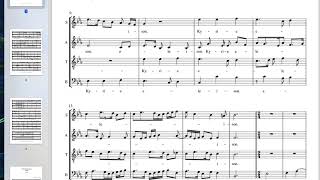
In this segment of the lecture, the presenter introduces polyphony, defining it as the simultaneous occurrence of multiple independent musical lines, in contrast to the earlier monophonic chant where all voices sang the same melody. Using a visual score excerpt, the speaker demonstrates a non‑polyphonic passage (all lower voices moving together) and then points to a section where each voice follows a distinct line, illustrating polyphony. The discussion highlights the etymology of the term (poly‑ meaning "many"), relates the concept to everyday listening experiences (orchestra, rock band), and notes its historical emergence about a century after the chant period. The presenter emphasizes the acoustic richness polyphony provided in large cathedral spaces, citing Johann Sebastian Bach as a later master of the technique, and encourages listeners to experience such music in historic cathedrals. The segment concludes by signaling a transition to four additional musical “inventions” that followed.
Chapters
Okay, so polyphony, Polyphony makes its way into chant at this period in history. Now, this piece that we're looking at here is from a little bit later, about a hundred years later than when we're talking about, but it shows what polyphony is. So let me first just define what this thing is. So if you can't read music at all, don't worry, we're not going to focus on reading this. Okay, Let me just show you. You'll be able to see just by looking at it what polyphony is and what it isn't. So here, See this first line, Just this bit here? This is no polyphony, okay? Everybody is singing the same thing. At least all of the lower voices, they're all singing the same thing. Okay, now let's go down here. Look at this. There's all these different lines, right? This is polyphony. Polyphony means there's more than one line happening at a time. That's all it means. So before, when we heard chant and all the examples we heard, we heard primarily one main thing happening at a time. But when we get to polyphony, we have several things happening at a time. Like poly. Right? Like poly, P, O, L, Y means multiple. So different voices have a different part, right? And this is something that you probably know from music just by listening to music, right? Like when you listen to an orchestra or a rock band or anything, you know, the bass player has a different part than the guitar player, which has a different part than the singer. Right? That is polyphony. Okay? Prior to this point in history, we didn't have that. We had everybody play the same thing. So. And this kind of intricate weaving of lines is something that sounded rather good in these big, big cathedrals, right? And still does, frankly. If you listen to, like, the music of Bach, it's all over polyphony, right? It's happening all over the place. And it just filled these big spaces just beautifully. And again, still does. If you get a chance to listen to some of that in one of these big old cathedrals, it is a beautiful thing to experience. So that's what polyphony is, multiple lines happening at once. Okay, let's move on and talk about these kind of four other inventions that popped up. Inventions is a weird word, but I guess it's an invention.