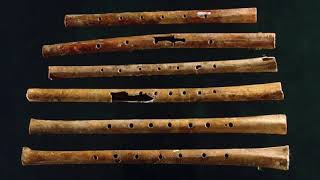
In this lecture the presenter defines "antiquity" as the period preceding the Middle Ages, roughly from 400 BC to 500 AD, and explains that while music undoubtedly existed throughout human prehistory, concrete evidence from this era is scarce. He notes the absence of a standardized notation system, the reliance on oral transmission, and the limited surviving written or visual sources. The talk introduces the field of musical archaeology, describing how researchers uncover ancient flutes, visual depictions of musicians, and fragmentary notations to infer musical practices. He emphasizes that the pitch systems and musical concepts of antiquity likely differed markedly from modern ones, and that interpreting the scant evidence is fraught with uncertainty, leaving us unable to accurately reconstruct how ancient music sounded.
Chapters
Okay, so we're gonna start all the way back in the antiquity. So what is the antiquity? The antiquity is a word that we use to talk about in general. Just kind of ancient times. Okay, so we're talking about. Well, the, the most common definition is what came before the Middle Ages. So the Middle ages started around 500 and went all the way up till the fall of Rome, which was about 1500. So 500 to 1500 was the middle Ages. So we're talking about the stuff that happened before that. So I guess 500 back to year zero, back to maybe around 400 BC or BCE, however you like to call that. So that's the anti Antiquity. It's in general a really long time ago. That's what we think about. We think about a really long time ago. When we're talking about antiquity now, we don't have a lot of evidence of what was happening back then. Right. There weren't people writing down, you know, stories and music. You know, like there wasn't a notation system. There were some sort of notation systems. People were writing some stuff down. We don't really know if we currently know how to read it correctly. You know, there's some debate about that. So there's not a lot of evidence for what this music actually sounded like. What we do have evidence for is that music was being made back then. If you think about it, music's been being made probably since the earliest humans. There were people beating sticks on rocks and probably figuring out how to sing, and that singing was enjoyable. So I think it's very safe to say that music existed, you know, as long as human beings have existed. However, we don't know what it was and we don't know anything about it. So this going back to this antiquity thing is kind of the earliest traces we have of music. So there's very little if any notation. It primarily survived at that time through an oral tradition. So, you know, you would explain how to do something to your kids, they would explain how to do it to their kids. It was basically a game of telephone. So we get into. So in order to study this, and we're not going to spend a ton of time on it, but we get into a kind of archeology, right? And there is. This is actually really fascinating. I found the other day, I don't know what I was doing, but I stumbled across someone, a person and his job title. I think he had a university position and his job title was musical archaeologist, meaning he was an archaeologist who is someone who looks for evidence of the past by, you know, digging things up and finding relics and things like that. But he was specifically looking for traces of music in antiquity. Fascinating. I don't know this person. I just saw that title somewhere and thought, wow, I'm so glad that title exists. But we have things like this, like what I have here on the screen. These are ancient flutes that have been found. Clearly, they're flutes, right? They were designed to be played as flutes. They have finger holes, they're hollow, so you can blow in them and make different pitches. Right? Now, what those pitches are are going to be very different than what we would expect pitches to be. Our pitch system is probably very different than what they were using back then. So what these musical archaeologists do is they look for remains of musical instruments. They also look for visual images of musicians and instruments. That's another clue we can get about what was happening at this time. Drawings of musicians and music making. There are some writings about music and musicians that exist from this time. And there is a very, very small amount of notation. So notation can exist back from this time, but it's very complicated and hard to understand. The theory goes that whatever, whenever we try to interpret it, we're going to be really heavily influenced by music that we know. So there's not a good way for us to be sure we're getting it right. I've read a couple few different things about this, but the moral of the story is music existed way, way, way back in history, but we know very little about what it actually sounded like. Right? We have evidence that it was happening because we have instruments like this. We have some writings, we have drawings, but it's nearly impossible for us to really understand what it sounded like.