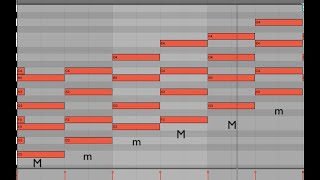
J. Anthony Allen shows how to add sevenths to the seven diatonic chords. The third determines the chord's basic quality, and the interval from the root to the seventh determines what kind of seventh to add. He walks through each scale degree to build chords like Imaj7, ii7, iii7, IVmaj7, V7, vi7, and viiø7.
Chapters
So let's go back to our diatonic chord progression here now, and let's just redraw it. And then we're going to add the seventh and see how everything shakes out. So here's my I chord, right? Here's my II chord. Here's my III chord. Here's my IV chord, five chord. Let's put it right there. Six chord, my seventh chord, the weird one. And then we're back to our I chord. Okay, let me just stretch all of these out. Okay, let's zoom out just a hair so we can can see that better. Okay, so here's our diatonic chord progression, again with thirds. Right? So now we remember our pattern, right? This is going to be a major chord. Minor chord. Minor chord. Major, Major, minor, diminished. And then we're back to the I chord from major. So let's see how that changes when we add our seventh now. Now, whether or not the chord is major or minor is not going to change, because remember, that's all in the third. And we're not changing the third. We're adding a note. So if we go up and add another note. Let me just go through and do it here. So this is going to be our seventh tone of each chord. Okay? So this first one has that nice, soothing kind of sound to it. Not the way I displayed it there, it sounded clunky, but. So this is a major seventh chord. Let me zoom out just a hair more here so I can get this all on the screen. That should work. So this is a major seventh chord. So I can tell because it's a major chord with a major seven. Now, to tell the quality of the seven, there's two ways I can do it. One is I can look at its distance from the fifth. And that in this case is a major third because it has five half steps in it. So that's going to be a major seventh chord. Another way, in a slightly more accurate way, would be to look at its distance from the root. So from here to here is a major seventh. And there's a quick way to tell if you're on a major seventh in that amount of distance, and that is to look at its distance from the next root up, right? So we know it's a major seventh if we're a half step away from the root. Again an octave higher. Right? So this is a quick way to tell if we're a major seven. So let's look at the next one. So this is our ii chord. So this is minor. But what is our seventh? Well, here's the root D. The next D is here, and it's a whole step away, so that means this is a minor seventh. We can also check the distance between the fifth and the seventh to tell us that's a minor seventh chord. Let's look at the next one. E, G, B. That's our minor three triad with a seventh on it. This one is a minor third away from the fifth. And our root, an octave higher would be right there, which there's a whole step there. So that means it must be a minor seventh chord as well. Moving on. Our F is a major chord. Because of our diatonic chord progression, we know that that's major.