6:49
J. Anthony Allen teaches two ways to build the Dorian mode: rotate a major scale to start on its second degree, or take a natural minor scale and raise the sixth. Dorian is the second mode, and it sounds like minor with a lifted sixth degree.
J. Anthony Allen teaches two ways to build the Dorian mode: rotate a major scale to start on its second degree, or take a natural minor scale and raise the sixth. Dorian is the second mode, and it sounds like minor with a lifted sixth degree.
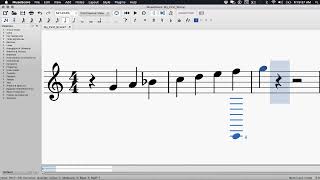
Okay, up next, let's look at the Dorian mode. Now remember, this is the second mode. So what that means is if we use that relative way of finding the modes, all we need to do is take a C major scale, rotate it by one note so that it starts on the second note, and that's going to give us a Dorian scale. So all we have to do is get rid of this note, add one more note on the top to compensate for what we just took away, and now we have D to D. And this is a Dorian mode. So let me explain that one more time. So if we were in C major, what we did here is we took a C major scale, but we're starting on this second scale degree because this is the second mode, right? This is where the order of them is important. So just by doing that, by taking C major and going from D to D, we have found a Dorian scale. This is a D Dorian scale. Okay, so that means if we wanted to find, let's say a G Dorian scale, okay, a G Dorian scale. What are we going to need to do? We, we're going to need to think of, okay, this is a bit of a head scratcher. So we're going to need to think of what is G the second note of so that we can find that scale and then we'll find our G Dorian scale. In other words, think of a scale in which G is the second scale degree. Right? That scale is going to be. So here's G. Right? So I need to find what this is the second scale degree of. So let's put a G there. And what's this one going to be? This one is going to be F. F natural. So now what we need to do is make an F major scale. So let's go up, not forgetting the key signature of F which has a B flat in it. Okay, so now I have an F major scale. Now getting back to that G Dorian, all I need to do is rotate this by one, keeping the same notes. Now I have a G Dorian scale. Because I took that scale, I rotated it by one, kept the same key signature, the same notes, and that got me the Dorian scale. Okay, let's go back to C. Let's go a D Dorian scale. Actually, I'm going to go back to a C major scale. Or Ionian, I suppose, since we're talking about modes. Okay, so here's a C major scale. We know that we can find a D Dorian scale using the relative method by just starting on the D. And that gets us a D Dorian Scale. Now let's do the parallel one because this actually tells us what's in the scale is using the parallel mode. So let's make a C Dorian scale. I'm going to convert this scale by nudging things up and down to the Dorian scale. So the first thing I need to do when I'm trying to find the parallel scale is find out if that mode is closer to a major scale or a minor scale. So and that's just something you have to remember. So in this case, a Dorian mode is closer to a minor scale. So let's first convert our C major to a C minor, right? And if we remember how to do that, we got to take our third down a half step, our sixth down a half step, and our seventh down a half step. Now we have a C minor scale. So, okay, so here's our minor scale. Okay, now let's make it into a Dorian scale. So the thing about the Dorian scale is that it is. You can define a Dorian scale this way. It is a minor scale with a raised sixth scale degree. So here we have a minor scale. We go to our sixth scale degree and we raise that one half step takes it back to a natural. Right? So now we have a C Dorian scale. So we have a raised six scale degree. Let's hear it. Okay, that is the Dorian scale. That's what it sounds like. Now, just to prove the relative way, let's go back and make our C major scale one more time. I'm going to go to major now. Okay, so now let's try the relative way one more time. I just want to show you how that lines up. So let's get rid of our C and let's add a note at the end. There we go. So now you using the relative method, I have a D Dorian scale. So let's see if it matches that definition that I just told you, which is a minor scale with a raised sixth. Okay, so for a minor scale, what we need is the pattern of a minor scale is whole step, half step. It's right so far. Whole steps, whole step, half step. That should be a half step, but it's a whole step. That means this one, which is the sixth is raised. So that's correct. And then that gives us a half step here because that's raised and then a whole step. So it works either way. Works this way produced a D Dorian scale. The other way produced a C Dorian scale. Because we started with a C minor scale and we altered it to get to the Dorian scale. So what do you need to actually remember two things. First, Dorian is the second. In the order of modes, Dorian is the second one. Second thing you need to remember is that a Dorian scale is a minor scale with a raised six. Okay, let's move on and talk about the Phrygian scale.










