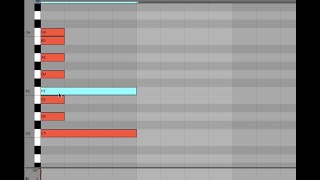
The fourth and sixth intervals don't build chords directly, but they appear when you invert chords. A fifth becomes a fourth when you move the top note down an octave, which is why the same C-E-G triad contains different intervals depending on which note sits on the bottom.
Chapters
All right, let's dive into part six of Music Theory for Electronic Musicians. In this section, we're going to talk about the 4th and the 6th, and we're going to kind of talk about those together because they're related. And then we're going to talk about the seventh and the second, which are also kind of related in a little bit of a different way. And then we're going to do a little example analysis in this chunk also. So let's dive in. Okay, so let's start Talking about the 4th by doing a quick little review. So remember when we started this class, we said that what we wanted to do was talk about the notes that sounded good together. That was our goal. And what we've done so far is talk about the octave, and we've talked about the interval of the fifth, and then the interval of the third, and building chords using the root, the third, the fifth, and eventually the seventh. And the seventh, like we just talked about, has kind of a special quality. So we don't want to use it all the time, but sometimes it's nice to put that seventh in there. Now, the fourth and the sixth, we skipped right over, didn't we? And I guess the second also. Hold on to the second for a minute. We'll talk about that later, in just a minute. But we skipped over the fourth and the sixth. So let's talk about the fourth. Well, neither the fourth or the sixth are incredibly useful to us for building chords, at least not directly. We don't build chords with the fourth. Right. Let me put my scale back up here. Okay. There's my major scale, C major scale. Right. So the fourth would be this fourth from C to F. All right? 1, 2, 3, 4. Now, what's weird about this is that they are actually. Both the fourth and the sixth are actually incredibly useful to us for building chords, just not directly. You have to do a little bit of maneuvering to get them to work the way we want. And here's the weird thing, though. The weird thing is you've already been doing it. You've already been using fourths and sixes in your chords, the chords that we've built so far, because when we talked about inversions, we talked. I kind of snuck in there, some fourths and some sixths, and you didn't even notice. So let me point that out now, how that works. So let's go back to the 5th for a minute. So remember, the 5th is going to be here. So this is the interval of a fifth. Right? Just humor me for a second, and let's count half steps. 1, 2, 3, 4, 5, 6, 7, 8. Eight half steps, including the bottom and top notes, okay? So when we do an inversion, we generate not only the inversion of the chord, but each interval. Every interval that we've talked about so far has an inversion. You can think of it kind of like its opposite. Like it's. What's the word? What's the. It's evil twin. Let's think of it as its evil twin. That's kind of a weird thing to think about, but that's okay. So every interval has an evil twin. It's inversion. So a fourth if we invert a fourth. So let's take the top note and put it an octave down, so still G to C. But let's count half steps. Now, 1, 2, 3, 4, 5, 6. Not eight. Six half steps is a fourth. So this now is a fourth. So the inversion of a fifth is a fourth. The evil twin of a fifth is a fourth. If we invert becomes a fourth. So this is a fifth. But if I put the G on the bottom, it becomes a fourth. So when we did our C major triad, or any major triad just like this, but I invert it like that, still a major triad, but there's a fourth in it now, right? We still would consider that to be the interval of a fifth when we're talking about the chord. Because the chord, the notes of the chord are C, E and G, but the interval by itself, technically is a fourth down there. So every interval has an inversion that makes up a different interval because our scale is not perfectly symmetrical.