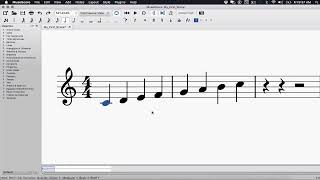
J. Anthony Allen explains the Lydian mode as a major scale with a raised fourth degree, which creates a brighter, more open sound. He demonstrates by rotating a C-major scale to start on F, then raising that F to F-sharp to show how the raised fourth imparts heightened brightness.
Chapters
All right, so Lydiaian is the fourth in the series of modes. If we're going in order, it is the fourth one. So what we're going to do is we're going to take our whatever major scale we're working with right now, it's C. We're going to go right up to the fourth note. So if I just rotate everything, this is going to produce an F Lydian scale. So let's do it. Let's get rid of our first three notes so that we start on our fourth note. Let's add three more notes to the end. And now we have F to F using all the notes of C which produces an F Lydian scale. Let's hear it. Interesting, right? So sounds nice and pretty. Take a guess. Does that sound like it's closer to a major scale or a minor scale? Because that's the next thing we got to do to figure out the parallel. We need to. We're going to convert this C major scale into that Lydian mode. And the first thing we need to do is figure out if it's closer to a major or a minor scale. So what do you think? Just from hearing it, did it sound like a major or did it sound like a minor? Good guess. I'm going to assume you said major because it is. I like to think of Lydian as like kind of like a super major scale because it has like a real brightness to it. It's a major scale with one thing altered that turns it into this kind of like whenever I hear a Lydian scale, I always imagine someone with their eyes like super wide open. It's just like it's brighter, I guess is what I'm trying to say. So what it is is it's a major scale, which is what we have here. So I don't need to convert it to a minor scale with one note altered. And that is the fourth is a half step higher. So it's a major scale with a raised fourth scale degree. So if we're converting C major to C major, Lydian, it's going to have an F sharp in it. So that's that four scale degree is gonna be one higher. Let's hear it. It's like when we play it like this and we get to this note, I feel it's just like, ah, it's like I just got pinched. It just makes it a little bit brighter sounding. Okay, so that's the Lydian scale. It's a major scale with a raised fourth scale degree. Okay, let's move on and talk about the Mixolydian scale.