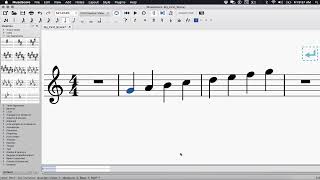
The Mixolydian mode is the fifth mode of the major scale, built on the fifth degree. It has a flat seventh that gives it a blues sound, which is why many blues songs use it implicitly. G Mixolydian uses the notes of C major but starts on G, keeping F natural instead of F sharp.
Chapters
Okay, here I am back on our good old C major scale and we're gonna talk about the Mixolydian here. Now I know we're just kind of running through all of these modes right now, but don't worry, in the next section I'm gonna talk about using these modes and we're gonna look at some songs that use different modes. This one has a very cool use in modern music and that is the blues. If you're playing the blues, you very well may be in the mixo Lydian mode. It's kind of what makes the blues sound like the blues. And there's a good reason for that, which we'll talk about later. But for now, let's just look at what are our notes in it. So it's the fifth. It's the fifth scale degree. Sorry, it's the fifth mode in the sequence. So we go up to our fifth note and that's a G. So if we're using all the notes of C major, we're going to make a G Mixo Lydian scale. Let's get rid of all of those notes and let's add four more to the top. And now we have G to G using all the notes of C major, which makes a Mixolydian a G Mixolydian scale. Here's what it sounds like. Okay, now I want to play that for you one more time. And I want you to think. I want you to think what sounds different about it. This takes. You might not hear anything because a lot of these, when you're just hearing the scale out of context of music, these are all very subtle. So don't feel bad if you're not like latching on to a certain thing. It's like, oh, that sounds really weird. It's a very subtle difference. But just listen to this one one more time and think about if there was one note that sticks out as like kind of sounding funny. What is it? See if you can narrow it down. Here we go. Anything stick out to you is sounding weird. Hold on to that for just a second. Let's think of one more thing. If we were in the key of G major, what would. What would our notes of G major be? We would have. What is. How do we read key signatures? Right? Like, let's go back to key signatures and let's think about G major. That's going to have one sharp in it, right? So it's going to be an F sharp. So the key of. Let's look at our key signatures here. This having one sharp this is the key of G major because remember, we have one sharp. We. We go up a half step and we call that G major. So that means G major has an F sharp in it. This one does not have an F sharp in has an F natural. So if when you heard it and you were trying to latch onto what is the note that sounds different, if you said the seventh, you would be right, because we ought to. If this was just a plain old major scale, this would be an F sharp. But it's not. So what is it? It is a major scale with a flat 7. So let's go back to our C major scale. Okay, here we are on C major. Now, if we wanted to convert this to a C Mixolydian, we already know how to do it. It's a major scale, so it's closest to A major, and it's gonna have a flat seven. So we're gonna go to our seventh scale degree and we're gonna lower it by one half step. Whenever I use the phrase flat this or flat that or raised this or raised that, it always means a half step. So if I say it's got a flat seven, it means it's flat by a half step. If it's flat by more than a half step, I would say, you know, we're gonna lower this note by a whole step or something like that. But if I ever just say a flat this or a flat that, it means lowered by a half step. And if I ever say just sharp this or sharp that, it means raised by a half step, just in case I haven't explained that yet. So there we have a C Mixolydian scale. It's a major scale with a lowered seventh scale degree. And there you have it. All right, two more in the sequence, and then we get to talk about using some of these things.