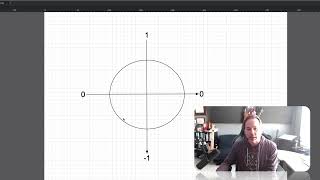
J. Anthony Allen explains the sine wave as the foundation of audio signals. A mathematically perfect sine wave oscillates between +1 and -1, the maximum allowable digital audio amplitude. Push it above 1 and you get clipping and distortion.
Chapters
Okay, let's Talk about this 01 and negative 1 issue again, but from a different perspective. So I have here what looks like a big block of sound, but if I zoom way in, you'll see that it's not a big block of sound. It is a perfect sine wave. Now, a sine wave is our most simple sound. It's our most basic sound. Sounds like this. Okay, Most basic sound. Now, it's perfectly going up and down, crosses over the zero line. Perfectly. Because this was mathematically created, I did not record this. So I want to show you how a sine relates to this. 0, 1, negative 1. If you remember back to math classes, a sin S I n, which is what this is based off, it's basically a circle. And this waveform is a circle. It doesn't look like a circle. But this is what happens to a circle when you have to distribute it out over time. Right. Circles in time don't line up very well. So what we have to do is kind of take it and kind of twist it like that. And this is how we do it. So let me just show it to you as a circle. Okay, so here's a circle. Let's say we call this line through its middle axis as zero. Okay? So we're going to put a zero on both sides. This line we're going to say is one, and this line we're going to say is negative one or the other end of the same line. So if I was going. If I had to distribute the circle out over time, what I would do is I would start at let's. I could start anywhere, but let's start here. Okay, so I'm going to say this point is zero. Then I'm going to go to one. Then I'm going to go to zero again. Then I'm going to goTo negative one, and then I'm going to go to zero Again. That's the path we take around the circle. So if I go look at my waveform, what I'm doing here is zero, negative one. I'm going backwards. In this case, let's go to right here. Okay, so zero to one. Now, this is a little short of one, but we'll come back to that later. Let's say this is 1 0, 1 0, negative 1 0. So it's the same thing through here. This would be called one phase of the sine wave, or one cycle of the sine wave goes from 0 to 1 to 0 to negative 1 to 0. So that makes a circle, and we call that a sine wave. Now circles and sine waves are good. They are pure sounds. They are clean. They are simple. Now there's another thing that this one and negative one represent here and that is our peak volume. We cannot go above one. One is our maximum volume. Okay? So when we talk about volume in audio programs, most of the time we're talking about one as our peak. So our volume is always going to be a decimal point. It's going to be 0.9 would be pretty, pretty loud, right? Because that's going to be near one if we hit one. Depending on the software that can be okay. But if we go past one, we get. We overload the system and we generally get distortion out of it. We'll talk more about that in just a minute. In fact, let's talk more about that right now. But let's go to a new video to do it.