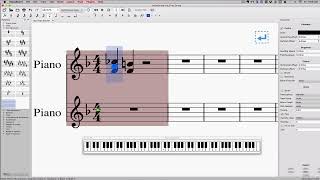
In this instructional video, J. Anthony Allen explains the tritone—a musical interval that can be spelled as a diminished fifth or an augmented fourth. He demonstrates how the interval is derived by lowering a perfect fifth a half step (e.g., C♭ to G) and shows the equivalent spelling of the same pitch (C♭ = B♮). Allen clarifies that the tritone is called such because it spans three whole steps, effectively dividing the octave in half. He describes its characteristic dissonance, provides an audio example, and points out its occurrence in diatonic contexts such as the F‑to‑B interval in C major and its prominence in the Locrian mode. Finally, he highlights the functional importance of the tritone in dominant seventh chords (e.g., G7 contains B and F), noting that while the interval sounds rough on its own, it contributes a useful tension when placed within appropriate harmonic contexts.
Chapters
Okay, we have one other kind of bizarre interval to look at actually, for now. And then in the next video I'm going to show you some other bizarre intervals. But this one actually is fairly common. And this is called a tritone. Here's what a tritone is. Here's my perfect fifth. Let's take that perfect fifth down one half step to a C flat in this case. Now here's another good example of a double flat and sharp. This is not a double flat, but this is a C flat. What? Why? I did I. I swear I told you C flats don't exist. If we look down here, C down a half step gets us to a B. There is no C flat. Well, there kind of is because we can put A flat on anything and it just means lower it by a half step. So a C flat is a B natural. And in this case, our key signature says B flat. So if I just wrote a B, it would be B flat, right? So C flat means B flat. And this is a diminished fifth. It is also called a tritone. Tritone is just a fancy name for a diminished fifth or augmented fourth. Here's a perfect fourth. Here is an augmented fourth. Same notes, C flat and B natural are the same sounding notes. But this one is a fifth. And the accidental tells us it's a diminished fifth. This one is a fourth, and it tells us it is a augmented fourth. So those are the basically have the same sound in this case. But in both these cases, we call this a tritone. The reason we call it a tritone is because it splits the oct. Well, is because it's three whole steps. So if we look down here, so F to B natural, F to G is a whole step, to A is a whole step, to B is a whole step. So tritone, three, three tones, three whole steps. But what this actually does is it splits the octave in half. This is halfway to here. So if we counted half steps, this one would be right in the middle. And it sounds bad. The tritone is not a pleasurable sound. It's a little rough on your ears. Let's just hear it. Okay? That's tritone. It's a diminished fifth. It's an augmented fourth, depending on how you spell it. Now, one of these does exist in a natural key. If. Let's go back to C major. Just to make this nice and simple, I'm going to go down here. Oops. The interval from this F to this B is the same as this, right? It exists in a diatonic key in a major scale, F to B exists. And so a tritone does come up from time to time. And in fact, when we looked at modes, one of the reasons that we didn't like the locridian mode, it sounds so harsh, is because there are tritones in it that really stick out. It's what makes it a difficult scale to listen to because the tritone is so prominent in it. But the tritone does exist, and what it is is a diminished fifth augment or an augmented fourth, depending on how you spell it. This is when we make the perfect fifth and perfect fourth imperfect. When we alter them to be imperfect, we end up with a tritone. But remember, a tritone only applies to this one specific interval of a diminished fifth or an augmented fourth. It doesn't apply to any other diminished or augmented intervals, just the fifth and the fourth. So watch out for the tritone. And it pops up in chords. You'll see it pop up in chords all the time. And given if you surround it with the right notes, it can be an okay sound. For example, a G7 chord has a B and an F in it, right? B natural. F natural. And that's an okay sounding chord. It's got a little bit of grit to it. But that grit comes probably from this, the tritone that's in it. Any dominant seventh chord is going to have a tritone in it. So be aware of the tritone.