J. Anthony Allen traces how Martin Luther's 1517 split from Rome reshaped European sacred music. Protestants demanded congregational singing in local languages instead of Latin, spawning chorales and psalm settings. Catholics kept Latin and Gregorian chant but made adjustments in response.
Chapters
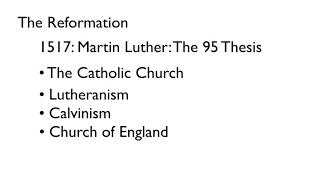
Okay, moving on to our next kind of big period in history, we're going to be talking about the Reformation. So without going into a huge dissertation on what the Reformation was, let's talk a little bit about the main principle behind the Reformation. So at the Beginning of the 16th century, nearly all religious people in Europe followed either the Church of Rome, which is what we would now call Catholic, or Roman Catholic, or were Jewish. But the dominant force in Europe was the Roman Catholic Church. It was centered in Rome. It was backed by political leaders. It was. It was the big dog of all big dogs when it comes to what people worshiped at the time. Then in 1517, Martin Luther comes along and Martin Luther publishes a document called the 95 Theses, in which he outlines problems with the church, things that need to change. And this ultimately creates division in the church that we call now the Reformation, or we sometimes call it the Protestant Reformation. Now, what this did was split the church into largely into four different factions. There was still the Catholic Church, which still for this time is still the big one where most people. What most people worship is the Roman Catholic Church. However, Protestantism comes along and we get Lutheranism as a first branch of what was created through the Reformation. So Lutheranism, which is primarily centered around northern Germany and Scandinavia. Another division is Calvinism, led by Calvin the Guy. And that starts off in Switzerland, the southern countries, moves up to France and into a little bit of Britain. And then the third is actually the fourth, because the first one is the Catholic Church is the Church of England, which originates from King Henry viii, which obviously is centered around England. So we have these four different factions now, but it's the three new ones that are really kind of driving the Reformation. So why do we care about this in music? There's a good reason. There's a couple things that were central to the idea of these three new religions that have very direct musical influence implications. Primarily, they wanted to involve people in worship more directly. So that means we. We start to see congregational singing things where the whole congregation is expected to sing along. That didn't really happen before in any of the Roman Catholic stuff, but we see it in these things, which does affect how people are writing music. We also see services presented in the common language. So if it's in France, they're going to do a service in French, not in Latin, where the Roman Catholic Church is still primarily doing all services and especially music in Latin. So remember, we're talking about sacred music now, not secular music. So secular music is the music of the people, the non Religious music that has been being done in the common language for a while, but still in the church. We're only getting Latin in services and in the music. But these new religions wanted to, again, involve the people more directly. So they wanted the common vernacular, the language of the people, to be the source of what they were singing. So that affects music quite a bit. Right, because most religious music, almost all religious music up till this point was written in Latin. If it was to be sung, which most of it was, it was in Latin. And now we're going to have music emerging in all the different languages where all of these religions are centered and where they're traveling to. So we start to get things like the chorale, we start to see more psalms. We also saw some changes in the Catholic Church during the Reformation. It wasn't unscathed. It responded to the Reformation in some ways. So music primarily still centered around Latin and still centered around Gregorian chant did undertake some changes as well, and we're going to talk about those in this section, too. And even Jewish music took on some outside influences as well. It primarily remained intact to its origins, but it did. It was affected by some of the things happening in the outside world, especially musically. Okay, so let's hone in a little bit more on each one of the different factions and kind of look at what they were doing uniquely in the musical world. So let's start with the Lutheran Church and look at what kind of music practices developed there.