Types of Contrapuntal Motion
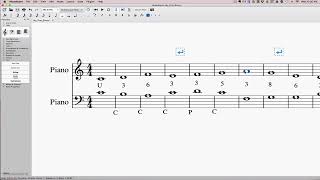
J. Anthony Allen explains the four types of contrapuntal motion: contrary, parallel, oblique, and similar. Parallel motion is forbidden between perfect intervals like fifths but allowed between thirds and sixths. Similar motion requires the upper voice to move by step when landing on a perfect fifth or octave.
Chapters
Okay, next we need to talk about motion. In particular, contrary motion. This is another very crucial step of counterpoint. So there are four kinds of motion. So here's what we're going to do. We're going to look at. Let's take this top line. We're going to assume that's the cantus firmness here, and the line we've written is the bottom line. Okay? So let's look at each of these intervals that we've added as the counterpoint to the cantus firmis and analyze them by the four kinds of motion. So this first one that happens here is the most common type of motion between notes. And that is just simply called contrary motion. We label that with a C in between the two notes. So this is in between the two, right on the bar. So let's just put it right there. Contrary motion means one voice moves up and the other voice moves down. That's all. Now, contrary motion is the most common and the most preferred. It is the best sounding one. It is the kind of motion that makes the whole thing sound the most unified. And this is something that I'd like to point out really quick that even though, yes, we're talking about counterpoint, we're talking about a very specific kind of music of, you know, this kind of homophonic, simple harmony kind of music. But if. Even if you're writing a pop song, contrary motion sounds good. So this is something that you can think about in any kind of music you're writing that if you have the opportunity to do contrary motion, it's going to sound pretty good. Now, knowing that the result of the contrary motion has to result in a chord or a harmony that we want. In this case, it adds a third. So that's okay. So we can do it. You can't always get away with contrary motion, which is why we have three other kinds of motion. But. But the preferred is contrary motion. So let's look at what our next one is. Our next one is also contrary motion. This one goes down, this one goes up. The contus firmness goes up by a skip because it's a third, and we go down by a second. But that's okay. Still contrary motion. So let's put a C in between those two to show that they are also contrary motion. Okay, let's go to the next note and look at this. We're also contrary motion. We've switched directions where here we're going down by a step. And here we're going up by a skip. But that's okay. This is still contrary motion. This one's going down, this one's going up. That's another example of contrary motion. Okay, now let's go on to the next one. Ooh, interesting. Here. Now, not contrary motion. This one's going up and this one's going up. So that brings us to another type of motion. This one is called parallel motion. Now, this has. This is allowed, but it has some additional rules behind it. Parallel motion means we are going in the same direction, both going up here by the same interval. So we're going up a second and up a second. This one's going up a minor second. This one's going up a major second. But I would still call that parallel motion. It's essentially a third going to another third. Right? So that is parallel motion. We label that with a P. And one additional rule about that one is that it is allowed only between imperfect consonances and not between perfect consonances. So we can do a parallel motion with thirds, because that's an imperfect consonance we can do. And by imperfect, I mean just not perfect. Right? We can do parallel motion with sixes. We cannot do parallel motion with fifths. Right. If these were both fifths, one fifth going to another fifth in the same direction, we've got problems. That is bad, bad, bad. So we can do parallel motion, but only between imperfect consonances, thirds and sixes. Right? Okay, let's look at our next one. Nice contrary motion there. Let's look at it again. We have another contrary motion example. So we're going up by a step, down by a leap. But that's okay. Slide over. So contrary motion gets us to here. Here we have more contrary motion. Okay, now we have something a little different. We kind of have no motion, right? Because this one stays the same, and this one goes down. So it's not contrary motion. Because this one would have to go up for it to be contrary motion. It stays still. We call this oblique motion. So this is another one. So this is allowed. So oblique motion means one part is not moving. It's either repeating the note or sustaining the note. And another part is moving by step, skip or leap. All three are okay in this case. Now, the one thing about oblique motion is that it's allowed, but it's not great. So it should be avoided. But it can be done. So we're going to call this okay, it's allowed, but it's kind of naughty. But that's okay. In other words, you should avoid oblique motion if you can, but if you can't, it's okay. It's still going to sound okay. What do we have next? Up and down, we have another contrary motion. And last, we're going up to a unison and down to a unison. So that's another contrary motion. Okay, so we've hit three of the four. In this little counterpoint, we've hit contrary motion, a lot of contrary motion. We've hit parallel motion, and we've hit oblique motion. The one we haven't found in this is called similar motion. And that's where things move. Let me just try to make one really quick here. So, Okay, here's a case of similar motion. We have the same direction of motion but at a different interval. So this one is up by a leap. This one is up by a skip. Okay, so this is up by a third. This one's up by a fifth. That's called similar motion. It's allowed as long as you don't land on a perfect fifth here. So we have B and G. So we didn't land on a fifth if we landed on a fifth. It's also allowed if it's just that they want you to approach it. That upper voice needs to be by step. So if it lands on a fifth, you need to be sure your upper voice is a step either up or down. And if it's down, this one would need to be down as well. Like something like that. So there are special rules regarding landing on perfect intervals. But that's similar motion. Basically, it's moving in the same direction but by different intervals. So of the four, contrary motion counts for most situations, because anytime you're moving in opposite directions, it's contrary motion. If you're moving in the same direction, it's either parallel motion, similar motion, or oblique motion. And just to review those really quick, parallel motion means you're moving in the same direction and going from the same interval to the same interval. Right? So from a third to a third, everything's moving up by a third. Similar motion means you're moving in the same direction but at different intervals. And oblique motion means that one voice is not moving and the other one is moving. Okay, so those are our four types of motion that we can have. And this is kind of how we label them like this. So you'll see that I put the type of motion label down here in between the two intervals. And obviously there's not one at the very beginning, because this is not motion. It's got to go between two notes for there to be motion. Okay, up next, let's talk a little bit more about this perfect interval of business and what results in landing on perfect intervals.










