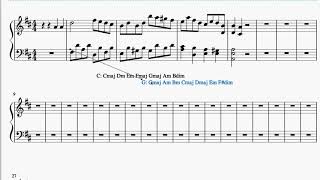
J. Anthony Allen shows how pivot chords let you modulate between keys. C major and G major share four chords: C major, E minor, G major, and A minor. Play an E-minor chord in C major, then continue in G major to smoothly shift keys.
Chapters
Okay, so when we're using pivot chords, the basic idea is we've got a key and we're gonna find a chord or maybe two chords or maybe three chords that work in both the key we're in and the key we're going to. Okay, so for example, let's just say. Let's just write some text here, staff text. We're going to look at this example that I have here in just a second. But let's say we're in the key of C, right? We have 1, 2, 3, 4, 5, 6, 7, and 1. Okay, now let's say. What's another key? Well, what I really should do here is let's do this. Let's write the names of the chords. C major, D minor, E minor, F major, G major, A minor, B, dim. Okay, Those are all our chords in C major. Okay, so let's pick another key. Say, let's do this. Let's say an obvious one would be like G. So we go to the five, right? So this is just one step over on the circle of fifths, right? This is a closely related key. That means on the circle of fifths, it's one step in either direction. So C is going to be one step to the right, and F is going to be one step to the left. Left. So that means there's probably going to be a few common chords between the two. So the chords in G are G major, A minor, B minor, D major. What am I doing? Not. D is not after B. C major, D major, E minor, F sharp, dim, and then G major again. Okay, so if I just scoot this over and line this up this way. Okay. G major is a common chord between the two. A minor is a common chord between the two. B is not, because in one it's diminished and the other it's minor. So that doesn't work. But let's go over here. Let's see. Let's do this. Okay, let's line up our C. Okay. C major is also a common chord. D is not a common chord because in C it's minor, and in D, G, it's major. Okay, so D doesn't work. E minor works because it is a common chord in both. F is not a common chord because it's F major in 1 and F sharp diminished in the other. So F is definitely not. So we could do, just to make this a little bit easier looking, Is. Let's do this. Let's just put this kind of out of order. Okay, so the key, the chords in G starting on C, just so that they're lined up here, C major, D minor, E minor, F. Just going to space things so that they line up. There we go. Okay? So C major is in common. D is not. E minor is in common. F is not. Or F sharp, G major is. A minor is. So we have 1, 2, 3, 4 chords in common between the two keys. Okay? That means we have four potential pivot chords. We have four chords that we could do something in C major, get to. For example, an E minor chord. And then after we do something using the E minor chord, we then continue on through a chord progression in G and we do a cadence to G major, right? That means E minor was our pivot chord. We went through a chord progression. We used E minor sort of in both keys when we did use E minor, and then we resolved to G major, therefore making E minor the pivot chord. Okay? Now, sometimes there's a few pivot chords where you might do something in E minor, or you might hit the E minor chord, then maybe do a G major, an A minor, and then resolve it down to G major or something like that. So you can find a few pivot chords and use them. That makes it even stronger. Okay? So that's basically how pivot chords work, and it's an easy way to do a modulation. Now, let's look at this little example we have up here and see if we can find a pivot chord happening just in this short little excerpt.