J. Anthony Allen breaks down seventh chords, which stack four notes on a triad by adding the seventh scale degree. The three main types are major-seventh, minor-seventh (the jazzy one), and dominant-seventh, each with a different interval between the triad and that added seventh.
Chapters
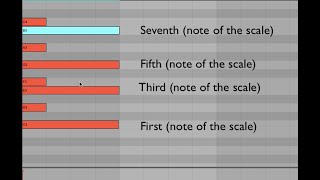
Okay, up next, we need to talk about seventh chords. Now, seventh chords are not chords with seven notes. That would be pretty extreme considering that so far we've only had notes or chords with three notes. Right. Seventh chords are chords with four notes. So how does that make any sense? Well, let's just dive in. So let's make a triad. Actually, before we make the triad, let's make the whole scale again. I know you're getting sick of this, but it's important, and it'll really help us to see why we call these seventh chords and not fourth chords. So I'm going to make a C major scale. Whole step, whole step, whole step, half step. There we go. Now, to make a triad, we use the first, and then we skip a note. Third and the fifth. Right? What if we kept going? What if we went one more step? So we skip a note and we add the seventh. That is what a seventh chord is. So we have four notes, but the notes we have are first, third, fifth, and seventh tone of the scale. Right. So that's why we call them seventh chords. Fairly easy, right? So what do they sound like? Well, let's get rid of these other things. Okay, so here is a seventh chord. It's what it sounds like. Let's drag it out a little bit. Right? It's a fairly pretty sound. Now, the dangerous thing here is that there are actually three different kinds of seventh chords. There are a major triad with what we call a major seventh on it. That's what we're looking at here. But then we can also have a minor triad with a minor seventh. It's a little bit more of a jazz sound. And we can also have a major triad with a minor seventh. That's what we call a dominant sound. That's called a dominant chord. We're going to talk more about that in just a minute. But those are our three different flavors of seventh chords that we encounter in the diatonic chord progression. So if we made the diatonic chord progression going all the way up, but we added seventh chords this time, we would have some major seventh chords. A major seventh chord is this first one a major triad with a major seventh. There's 1, 2, 3, 4, 5. That's going to be a major seventh. Sometimes we'll end up with a minor chord with a minor seventh that sounds like this, and that is a minor seventh with a minor triad underneath it. And sometimes we'll end up with a major triad with a minor seventh. And in a diatonic scale, that only happens once. There's only one chord that gets it. So we'll talk about that in just a minute. Now, you might say to yourself, hey, you skipped one. What if we had a minor chord with a major seventh that doesn't really occur anywhere in the scale, so we don't use that one very often. That one's pretty rare, and it's kind of a different kind of chord. We'll talk more about that, I think. Not in this class, but in the next class. So those are our three different kinds of seventh chords. Next, let's go into looking at how to use them.