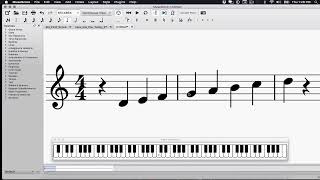
Modes are scales built from different starting points of the major scale, each with a unique whole-step and half-step pattern. Learn two ways to find them: alter specific notes in a major or minor scale, or rotate the tonic around the same seven pitches. Starting from C major, rotating the root gives you D Dorian, E Phrygian, F Lydian, G Mixolydian, A Aeolian, and B Locrian.
Chapters
Okay, so modes, like I just said, modes are scales. They're scales that we can build chords on. We're going to use our same diatonic chord progressions with these scales, but they're different than scales we've seen so far because the pattern of whole steps and half steps are different than the major and minor scales. Now, there's two ways that we can talk about modes. There's two ways that we can identify modes. There's what's called the relative identification and the parallel way of identifying them. And to kind of simplify that and to take that out of kind of fancy terms, the parallel identification would be to relate it to their nearest major or minor scale. So, for example, I could say here's a C major scale. And if I wanted to convert this to a C Lydian scale, what I would do is take a major scale because it's close, because the Lydian one is closest to a major scale, and I would alter it to fit the major scale. So I'm going to start with the major scale and then make it Lydian. I. I'm going to raise the fourth scale degree. Now, we're going to go over all of these separately. So you don't need to remember that, but just remember that what I'm doing here in this way of finding the notes in the Lydian scale is I'm taking its nearest major scale and I'm altering it in certain ways. So I'm giving it a raised fourth scale degree. That's what's going to make the Lydian scale. Right. So we can always say this one has a raised fourth, this one has a flat six. You know, it's a. It's a major scale with a flat six, or it's a minor scale with a flat six. So that's what we call the parallel identification. Taking its nearest major or minor scale and altering it to make the new mode. So that's one way. And for each of the modes, so there are seven modes, and for each of them I'm going to go through how to find both the, the parallel and the relative modes. Now, what I just said isn't quite right. Let me rephrase that. I'm going to go through finding all the notes of the scale using both the parallel method and the relative method. Both methods, if done right, will end up with the same notes of the scale. It's just two different ways of finding them. Now, the relative method is unique to modes. This is not the same as the relative major and minor scales that we've talked about recently, this is something that the modes do that is different than any other kind of scale we really encounter. What you can do with the modes is you can start with a single major scale and just kind of rotate it like looking at it through different angles almost and, and find all the modes. It's kind of how the modes were developed. For example, let me fix that and let's just get us an F without a symbol on it. Ok, so for example, now remember, this is going to be complicated, but I'm going to go through this in more detail in a minute. So here we have a C major scale. Nothing funny about it, right? Not a mode. Well, technically we'll talk about that in a minute. Just C major. If I, instead of thinking of this as from C to C, I thought about it as D to D. So let me add one note at the top, D. It's already there. So I just kind of reiterated this D. So ignore this C for a minute. In fact, let's just delete it. Okay, now we're looking at all the notes of C major. Okay, it's just C major, but I'm going to look at it as though D was the root. So I've just rotated the scale. Instead of it starting and ending on C, I'm going to start and end it on D still all the notes of C major. However, by doing that I've made what's called a D Dorian scale. That's a mode. So I just rotated C major so that I was looking at it from D to D. And now I've made a Dorian scale. That's a mode. If I rotate it again and go up to E, I've made the next mode. This is called an E Phrygian scale. All the notes of C major, but now it's called a Phrygian scale. And remember what I said earlier? Check this out. There's a half step in our first two notes. No other scale has that. That is what's called the Phrygian scale. Okay, let's rotate it again. I can keep going. And I'm going to end up finding all seven of my modes this way. If I go from F to F, I now have a Lydian scale. Now I talked about Lydians a second ago. That's the one that I raised, the fourth scale degree. Let's look at our pattern of whole steps and half steps. Whole step, whole step. What I should have here is a half step if it was a major scale. But I don't. I've ended up With a whole step. So that means this. If this was an F major scale, this should be B flat. If we were in F major. But it's not. It's B natural, which means it's a half step too high. That puts us in A mode. A Lydian mode is the name of it. More on that in a minute. Let's keep going. If I go from G to G, I end up in a mode called G. Mixolydian is the name of that one. If I go from A to A. Still using all the notes of C, I actually end up now on the relative minor. Right, but we have a fancy name for that and it's called the Aeolian mode and we'll talk about that in a minute and why that's the same. But let's keep going for a minute. B to B. This is the weird one. This is called the Locrian mode. A, B, Locrian mode. And if I go up one more, I end up back on a C major scale, which actually also has a fun name. If we're talking about modes, we would call that an Ionian scale. More on that in just a second. So that's what's called the relative identification of modes. It means that we're using a single major scale to find all the modes that work based around that scale. So it's like we take a major scale. In our case, we took C major and we just kind of started rotating what was the tonic of that scale. So if we lay out all the notes of C major and we think of it as from C to C, it's just a major scale, but with those same notes. If we think about it as D to D, it's a Dorian scale, and E to E, it's a Phrygian scale. More on this as we go through each mode. But those are the two ways we can identify what the modes are. Ok, so if you're scratching your head on that, don't worry, there's much more to come on modes, and hopefully as we go through them, you'll get it in more detail. But next, let's talk a little bit about the history of modes, because it's quite interesting.