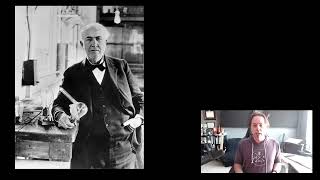
Thomas Edison's 1878 phonograph recording of "Mary Had a Little Lamb" is famous as the first, but a French typographer beat him by 21 years using a horn and pencil to etch sound waves onto paper. Modern computers have reconstructed those 1857 scribbles into audible sound.
Chapters
Okay. Do you know when the first audio recording was made? Before you answer that, let's think about this. Prior to this, we have no idea what humans sounded like. This would be the oldest recording of a human being, right, of the human voice. We have no way of knowing what people sounded like even prior to this. So what is the oldest record we have of the human voice? Of the humans? Of humans doing anything, actually. So take a guess. The correct answer is 1878. And that first recording we have is Thomas Edison. But there's a little asterisk next to it. Because recently. Well, because in the last decade or so, another recording has been found to predate Edison. So Edison, Thomas Edison invented the phonograph, which is the first way we had to record sound, but there was somebody else before him. So 1878, Edison invents the phonograph and records himself reciting the words to Mary Had a Little lamb. But in 1857, there was a French typographer who was working with graphite, like pencil, and found that he could do a cool trick where he could hook a big horn to a pencil, then he could yell in it. And he set up a contraption that would scribble, right? It would just like, scribble the waveform that he yelled into the big cone, right? So that was neat. It was. It could just scribble away for him. That's all it could do. But it was never designed to be recreated, right? Like, we would never. We couldn't hear it. It was just pencil on paper. But with computers we can. So some scientists have taken those scribbly waveforms and put them into a computer and interpreted those waveforms so that we could hear them. So this comes all the way from 1857. Now, remember, this is pencil on paper. This is not high quality audio. But it sounded like this. That's it. That's all we got. So that is supposedly this French typographer whose name I'm not gonna attempt to pronounce because it is a very French name, but that is a rendering of his pencil on. Or a graphite on paper. Recordings. But commonly we think of the first analog recordings being 1878, made by Thomas Edison. That is the first recordings where we can really hear somebody talking. And it happens to be Thomas Edison. It sounds like this. And that was it. So 1878, we get our first recording. Now, you may have seen floating around the Internet, this idea of this ancient Mayan pottery and audio recordings made from them. Similar idea to the French typographer, where the idea was, when you make pottery, you're spinning clay on a wheel and you take some kind of stick and while it's spinning, push it onto the wet clay and you pull it down in order to make a groove all the way down the pot. Right, that dries. And with computers, we could extract out of there the vibrations, the very, very, very subtle vibrations of the waveforms created embedded in the clay that would capture the sound in the room. You can find audio recordings of this around online. However, before you get all too excited, this turned out to be a hoax. This was just not possible. The. The minutiae of those waveforms is too delicate to be captured in wet clay. I suppose it's still possible that with. Conceivably that with computers we could pull out some waveforms from that could be hidden in something like that, but presently it has not been done successfully yet. So if you see something around online like that, or if you have a friend tell you, actually, you know, ancient Mayan audio exists. No, it doesn't. It's a hoax. So don't fall for that, because I totally did. When it came out, I was like, oh, my God, this is amazing. And then I read more about it and it was actually the audio file that's going around, and the story about it was actually released on April Fool's, and it's just totally not real. So I fell for it. Anyway, so our earliest known recordings.