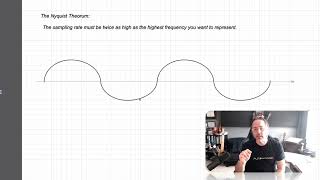
J. Anthony Allen explains the Nyquist theorem: your sampling rate must be at least twice the highest frequency you want to capture. When you sample too slowly, your brain hears the wrong pitch. He shows three examples, from adequate sampling to dangerously low rates that produce completely wrong frequencies.
Chapters
Okay, so we're going to talk here about the Nyquist theorem. Now, what this tells us is what the sampling rate is actually doing. Okay? So the Nyquist theorem states that the sampling rate must be twice as high as the highest frequency you want to represent. That's the Nyquist theorem. So if we want to represent a frequency, a specific sound, we need a sampling rate that's at least twice as high as that sound. Okay, here's why. The secret to this is in the fact that there are space in between the samples. There is space in between the samples, and your brain needs to fill in some of that missing information. Okay, so let's say this is our waveform. Okay? So we've got a waveform. Pretend it's a normal, smooth waveform, although it doesn't really matter for this example. Now, let's say my sampling rate is moving along. Let's say this fast. Zoom in just a little bit here. Okay, I'm taking samples at these points in it. Okay, that's all good. So in this case, everything's fine. So I took a sample here and then here. So that means remember that the speed of this waveform affects the pitch. Okay? So this waveform is moving along at just the right speed where our brain is going to have to fill in the gaps in between these samples. Okay? And it's going to do it like this. Let me get rid of that arrow. It's going to put together a waveform that looks something like this, you know, and it's going to be pretty accurate to what the waveform actually is. Right, because that missing information isn't very much. Okay, so let's step back a little bit here now. And let's say that waveform is now moving much faster. Okay? So our sampling rate is only going to get it here, here, here, here, here, and here and here. Let's say, okay, now we have much less information. So our brain's gonna put together the missing information and it's gonna be less good. Right? Because our brain's gonna do that. And this is what was actually happening. So we're a little bit inaccurate because we're going so fast. The waveform is so fast, but we're still more or less there. Okay, now let's say the waveform is moving even faster. And now we're getting data at, let's say, these points. Okay, now our brain is going to put together this. Oops, let me make a better line there. Okay, now we have an inaccurate pitch because our brain has basically made a different waveform. Moving at a different speed. That's wrong. We're going to hear the wrong frequency because we don't have enough samples happening because the waveform is moving too fast. And when a waveform is moving too fast, that means it's a high pitch because the speed of the waveform is what tells us the frequency. Okay, follow. So when a frequency is moving too fast, we don't get enough samples to fill in the gaps. So what we need is at least two samples per cycle of the waveform. This is the most minimal amount of samples that we can have and still accurately put together what's happening, Because if we fill in those blocks blanks, we're going to get this. Right, and that is still the correct pitch. Cool. Okay. So if. So to summarize, if the frequency is too high, we don't get enough samples to represent what it is. So what that means is that we need to figure out what is the highest pitch we can represent for a given sampling rate. That's what this tells us here. Okay. The sampling rate must be twice as high as the highest frequency we want to represent. So what frequencies do we want to represent? Let's go to a new video, and let's talk about the frequencies that we need to capture.