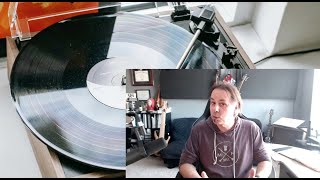
In this instructional monologue, J. Anthony Allen explains the fundamentals of analog sound. He begins by describing sound as pressure waves traveling through air, illustrating how these waves interact with the ear. He then broadens the discussion to show that waves of different sizes correspond to different sensory phenomena—tiny waves become light, medium‑sized waves become sound, and very long waves become weather patterns. Allen traces the origin of the word “analog” to the Greek roots ana (according to) and logos (relationship), emphasizing that analog audio captures a waveform in a form that directly mirrors the original acoustic waveform. Using a vinyl record as a concrete example, he shows how the physical grooves on the disc represent the waveform, which a needle and speaker can later reproduce. The talk sets up the contrast with modern digital recording, noting that analog was the only method available when sound recording first emerged.
Chapters
Okay, so let's start off talking about analog sound and how early recordings were made. And that'll kind of move us into digital sound, which is primarily where we're working now when we make music and when we record music now. But when technology to record sound first came into being, it was only analog sound that we were able to record. What is analog sound? Well, sound itself is just waves moving through the air, right? I talk, my throat makes sound, my lungs push air, and that generates a wave. And it's going like this. It's at the pitch that I'm speaking. These waves are probably about this long, roughly a foot or so long. And they're like real, you know, physical things going through the air. It's just pressure in the air. And those are going to. If you were standing here with me, they would be going to your ears, and that wave would hit your eardrum and push it in just the right ways that you would be able to hear the sound. So if we want to capture that, right, like, we want to take that wave and put it in a bottle. We want to capture it. How do we do it? It's actually kind of a phenomenal thing to think about. Like, you've got this wave flying through the air, and we need to, like, capture it somehow. And if you think about it, there are these waves going through the air. Are not the only kinds of waves going through the air, right? There are tons of different kinds of waves going through the air. The example I like to give is if those waves were, you know, the waves of my voice are probably about this long. But if they were smaller and smaller and smaller and smaller, and they got to be, like, in, you know, immeasurably small, like, incredibly small. Those waves we would interpret with our body as light, right? Teensy, teensy, teensy waves we interpret with our eyes. Waves this longish, we interpret with our ears. But there are even longer waves. There are waves that are miles and miles long. There are waves that can wrap themselves all the way around the earth. They're that long. We typically interpret those waves as weather. Same kind of waves, just much, much, much bigger. So it depends on how big those waves are, depending in order for us to interpret them. If they're the right size, we interpret them as sound. If they're a different size, they are light. If they're a much bigger size, they're weather or something in between. So the way that we first came up with, we meaning humans, not me, I wasn't involved in this. The way we were able to capture sounds was using a process or using something called analog sound. So analog, you know, it comes from, you know, two Greek words meaning ana, which meant according to, and logos, which meant a relationship. So analog sound means it's, you know, according to and a relationship with the sound. We have another word in English that is analogous meaning, like two things that are very similar to each other. And that's what analog sound is. In other words, analog sound has captured that waveform in a way that is the same as the actual waveform. So if we look at vinyl record and we zoom way, way, way in, what we would see is little waveforms, because a vinyl record is analog sound. So we would see these little waveforms on there. That's how analog sound works, is we capture those waveforms, we're able to chart out those waveforms, and then using a little needle on the record and a big speaker, we can recreate those same waveforms. So when we say a sound is analog, it means we've captured the waveforms in a way that you could. You can actually see the waveform, but it is the same waveform captured onto some kind of media, a disk or something like that.