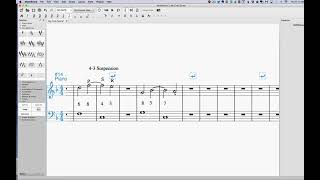
In this instructional video, J. Anthony Allen explains how to construct a 7‑6 suspension, contrasting it with the more common 4‑3 suspension. He begins by noting that the usual cantus firmus baseline used for a 4‑3 suspension cannot support a 7‑6 because the interval relationships differ. Allen selects a new baseline (G–C) and demonstrates building the suspension using an octave and a third as the initial consonant intervals, then ties the third over the bar line. When the cantus firmus changes, the tied note becomes a dissonant seventh, which resolves stepwise down to a sixth, completing the 7‑6 suspension. He highlights that the bass note must differ for this suspension to work, and that the 7‑6 has a weaker resolution tendency than the 4‑3. The video includes a brief audio playback of both suspensions to illustrate the contrasting sounds.
Chapters
Alright, let's move on and talk about a 7, 6 suspension. Now let's do that one here. Now what I'm going to have to do here is I need a different baseline. The same contus firmness isn't going to work because this interval is going to play a significant role in telling me or while in making this note turn from consonant or from dissonant to consonant. Right. So this interval of a fourth works for a four, three and there's probably a couple other intervals. It's not a hard rule that like the interval of a fourth in the contus firmis is going to make for a 4, 3 suspension. That is not true. There are other ways you can make a 4, 3 suspension, but I cannot make a 7, 6 suspension out of that. So let's go to a G. Oops. Let's go to interval of a fifth, a G and a C. Okay, now let's do. Let's start it off with a consonant interval, in this case an octave. Let's go to another consonant interval, a third. So we're going to do a diatonic skip here. And how you approach this is open. We don't have to approach it by diatonic skip. Remember that. Now I'm going to tie this one over the bar line and then I got to resolve it by a step. Okay, so let's put our tie in there. There we go. Okay, so now let's look at what our intervals are. Here we have an octave. Okay. Here we have a third, right? G to B here. Now that we've changed our Cantu's firmness note, we have a C to a B. Right. So that is a big old dissonance of a seventh, but it's going to resolve down by a step to a sixth. Right there. And that creates the 7, 6 suspension. There it is. So our bass note is different in order for the 7, 6 suspension to work. But in this case it does. We jumped up to a third, we held it over, it became a seventh when our conduit form has changed, and then we resolve it to a sixth. A consonant. Cool. Let's hear that real quick. Right. It has a little bit different sound than the 4 3. Right. Let's hear the 43 again. Right. Like this one wants to resolve in a certain way. And this one kind of. This one has less of a strong resolution that wants to happen. So a little less tendency, but it still has a resolution and it's different than this one. Pretty interesting how that works.