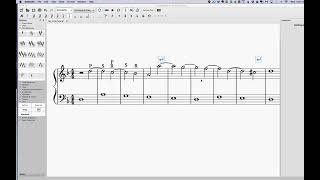
In this instructional segment, J. Anthony Allen explains why continuous chains of suspensions in four‑species counterpoint inevitably descend, leading to voice‑crossing, overly low ranges, or monotonous texture. He introduces the concept of “breaking” a suspension chain—replacing a suspension with two consecutive consonant intervals and a large melodic leap—to reset the line and avoid these problems. Allen outlines practical guidelines for where to insert such breaks, typically around the middle of a piece, and highlights natural break points that arise when a suspension cannot resolve to a consonant interval. The lesson emphasizes listening for these structural cues to maintain correct voice leading and musical interest.
Chapters
Okay. So as you probably noticed, if we're going to be doing this going down, we're eventually going to run into problems. So these suspensions always go down, right? They're going down and down and down and down and down. So eventually that could lead us to a voice crossing. It could lead us just down really low. And also, if we do nothing but suspensions like this, if we wouldn't have broke it right here, we would have just kept going down. It would have been boring. You need to break a chain. If you're doing a chain of suspensions, and you don't always have to do this in a chain, you can just do it one at a time. But if you're going to be doing chains of suspensions, you're going to be just going down and down and down and down in your counterpoint. And if it doesn't lead you to a voice crossing, it's going to be kind of boring. So we don't do that. Somewhere in the counterpoint, we do this thing called breaking. This is breaking the suspension chain. So that's what happened right here. So this was going down and nice. And I probably could have kept it going longer. But what we did here is we didn't suspend over this one. We did a consonant, two consonant intervals in a row and a big leap. And that leap makes it so that I can keep going down again, right, and keep doing these suspensions. So without that big leap right there, I would have just kept going down and down and down and I would have ended up in trouble. So often when you're doing four species counterpoint, you're going to want to break it somewhere, usually somewhere around the middle, just to keep it interesting. And you don't have to do it more than once. You should do it at least once in the counterpoint, but you don't have to do it more than once. And sometimes it's really obvious where to do it, because sometimes you can't make a suspension work, right, you're going to have a suspension into a dissonant interval. That's not possible. Like, you can't do that. Like, if this suspension here resulted in a dissonant interval after I did a step down, if that was a dissonant interval, this one would be no good. And then that would be a good place to break the suspension because I would have a spot where the resolution wasn't going to work out. Similarly, if this one, if this B suspended over. Suspended into a consonant interval, then that would also not be correct suspension. So it's a good spot to break it. So watch out for those spots where you have to break it so that you're not just always, like, rolling down downhill in this sequence of suspensions, just watch out for that.