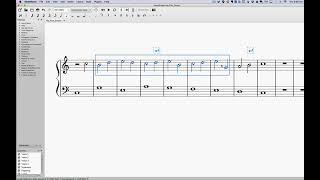
In this instructional video, J. Anthony Allen walks through the process of writing a second‑species counterpoint melody that not only obeys the strict voice‑leading rules but also sounds musically engaging. He first constructs a melody that strictly follows the rules, using consonant skips, passing tones, and neighbor tones, but notes that the result is monotonous because it over‑relies on the notes C, D, and E. He then revises the melody, deliberately varying note choices, shaping a clear melodic contour with a high point around the three‑quarter mark, and incorporating a permissible tritone on the second half of a measure. Throughout, Allen explains the treatment of dissonances (sevenths, fourths, augmented fourths), the use of contrary motion, and the importance of range (about an octave) and direction to avoid a flat, rule‑bound line. The video demonstrates both the theoretical rules and practical compositional decisions needed to create a compelling second‑species counterpoint line.
Chapters
Now, one of the tricky parts about second species counterpoint is that in the midst of dealing with all these rules, watching out for all the parallels, keeping in mind neighbor tones, passing tones and all the rule and everything else, we still have to make a nice sounding melody. And that can be rather tricky. So let's finish this one out. I'm gonna do it two ways. The first way I'm gonna do. Well, let me just do it and you'll see what I'm talking about. Okay, so let's go through here. So I have a C and a C and a G. What would go well with that? G. Ok. Okay. A G that goes up. Let's do contrary motion. I can go down to a B. That makes a third. It's rather nice. Let's do. We could do a consonant skip here and get us up to a D. That works well. Now we have in an E and we could go up to an E since we're kind of on our way there anyway. So that makes a nice melody line. This da da da da da kind of thing works well. Let's try doing a passing tone here. So I could go down to a D. That's going to make a seventh between E and D. So if that's a true passing tone, I've got to go to a C here. So hopefully that works. I have an A and a C. That makes a third. That's okay. Let's go now up, up to a D again here. And let's make that another passing tone. So that's a fourth. A to D. Right. And fourths are considered dissonant. So if I'm going to treat that as a passing tone, I go up to E. If I went down to C, it could be considered an upper neighbor tone. Let's have a look at that. That makes a G and a C, which is another fourth. So that's a dissonance. So that's not going to work there. So let's go up to an E and call it a passing tone. And that makes a G and an E, which is a six. That works. Okay, because that is a consonant. Next. So I've done two passing tones in a row. Let's just do like a consonant skip. Let's go down to B. G, E and B. That works because that makes a third between G and B. Now I have an F. Easiest way would be go back up to a C here. So F and C is going to be a fifth. Then I can go right up to a D, which is a sixth. So I'VE got two consonant intervals in a row. That's not a consonant, Skip. That's just two consonant intervals. And now here I have an E and an E. I can land right on an octave, which would be great. Let's do another consonant, skip. Let's do a big consonant leap down to G. So I can set up this A to work. Right. So I'm going to jump down to G here. That's a consonant. Leap E to G is a third. That works just fine. And then I can finish it out. Cool, right? I don't think I broke any rules. Let's hear it. So how'd we do? We obeyed all the rules, but our melody is pretty boring. And what makes it boring is I've kind of overused C, D and E. Nearly everything is C, D and E. Here's a B, here's a G, and here's an a. Other than 1, 2, 3 for 5 notes, it's all C, D and E. So it's really kind of contained in a very narrow range of notes. Just three notes that I'm using over and over and over, which tends to make not a great melody. So let's try that again. I'm going to keep my first and last two bars and let's take a different angle with it. Let's now think about obeying all the rules. But let's also now think about the melody and making sure our melody comes across as nice and lyrical. What we want is not to be repeating a bunch of notes. And we also tend to want like kind of a direction to it. Like a high point around the three quarter mark or some kind of point, some kind of moment in it so it climaxes somewhere. It reaches a high note. You can do it with a low note. Also something that shows a little more direction. Okay, so let's try it again. Here we go. So for this first note, let's go. Let's go down again because we do like that contrary motion. We have a third now. Right away. Let's just get out of this CD stuff. Let's go down. So now I've got a second. So I'm on a passing tone and I'm going to resolve it down to a G. E to G is a third. That works great. Let's go back up to that B and let's see if we can kind of do a sequence kind of thing here. Here. So we have a consonant skip. That's okay because I have a third here and a fifth here. So those are both consonants. Now let's go. So I have an A and a C. I haven't overused anything yet. I've got a nice little line. We go down, we go up. So so far, so good. Let's do. So A to C, A to A. How about another consonant? Skip. Kind of falling down again. So I have a G. What can I do to get down lower? I just kind of want to get away from these notes. Let's go to E. That makes a six. And then I can skip up another consonant, skip up to the G to make an octave. So another consonant, skip. Then let's step into an A. F to A is a third. That's okay. Now let's do something a little weirder. Let's go B. So that's a dissonance. So that's going to be a passing tone. And I'm going to hopefully step into C against an E. That works. That is a sixth. But check this out. This B, this is a new interval that we haven't used in one yet. Because F to B is a tritone, right? So that's actually an augmented fourth. But it's okay. Remember, augmented fourth, definite diminished fifth are in the allowable dissonant intervals. As long as they're on the second half of the measure, they're allowed in second species counterpoint. So that tritone is actually okay here because we stepped into it, we stepped out of it. It's on the second half of the measure and it's one of the intervals that are. Ok, So I land on a C with an E underneath it. So I'm on a sixth. Let's jump up to an E. So another consonant. Skip. And then I've got this big interval here and that kind of works. But I like this as being like my high point of the melody, this E. So maybe if we let that breathe a little bit. Let's change this. And let's see if we can just do a whole note on B. There we go. I think that's going to work a little bit better because we have this melody that's going up and up and up and up and up. And it hits its high point, which is not crazy high, but it's the high point. It's the highest note of the melody. So it's got a nice direction there. And then it's going to fall down to this B, which is a sixth against the D, and then it's going to open out to the octave. I think it's going to work. I think it's going to sound nice. Let's hear it. All right. It's better, right? It's much better than the first one, and I'm pretty happy with it. The melody has a much more interesting shape. So when you're writing these, this is just another thing we have to think about while we're working on counterpoint is does it sound interesting? Right? We can obey all the rules and write something really dumb. That's totally possible. So be keeping in mind the flow of the melody. You want it to have, you know, a range of about an octave. You know, that's not like, don't. That's not a rule. Don't, like, hold yourself to that really fiercely. But mine in this case does have a range of exactly an octave, actually meaning the lowest note. If I look for that, it's an E. The highest note is an E. So it's got a range of about an octave. It kind of meanders around inside of an octave, and that's nice. That makes for a nice melody. If you have too big of a range, it feels like you're just jumping around like crazy. And if you have too small of a range, it feels like you're just repeating notes over and over, like you saw in the first one that we did.