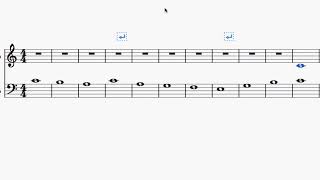
In this instructional video J. Anthony Allen explains how to approach the opening and closing measures when harmonizing a cantus firmus in first‑species counterpoint. He emphasizes starting the counterpoint on a unison and ending on a unison, using contrary motion for the penultimate interval, and choosing a penultimate note that creates a strong V→I harmonic resolution. Allen walks through the chord‑tone hierarchy for two‑part writing, noting that the third of the V chord is essential, the fifth is the most expendable, and the root may be omitted if needed. He demonstrates these concepts in C major, showing how to select the appropriate notes (B, D, or G) for the V chord and how to avoid awkward leaps. The video sets up the groundwork for a subsequent lesson that will develop the full counterpoint line.
Chapters
Okay, what we're gonna do now is we are going to harmonize, note by note, this contus firmis, and we're gonna break it up into two different kinds of things. In this first video, we're gonna talk about the beginning and the end, special rules that apply to the beginning and the end, particularly the end. And then the next video, we're gonna go all the way through it and develop a counterpoint for the rest of it. So sometimes when we look at a cantus firmness, what the easiest thing to do is to start with not the beginning and go all the way through, but to kind of find the target of the end and kind of know where you have to end. That way, as you write all the notes going through here, you'll be able to create nice voice leading, getting to the end, and you won't have to do a big weird jump to get to the end because you'll already know the notes that come at the end. So let's talk about the end really quick here. So in First Species counterpoint, we want to end on a unison. So that note has to be that, because these are in unison. Okay, I have a bass clef here. I made double sure of that this time. Now, the second to last note, we can kind of figure that out too. We sort of have some options here, but not a lot of options. So we can pretty much come to a pretty good solution for the second to last note as well. The second to last note, we definitely want to use contrary motion on between the last note and the second to last note. So we want these to have contrary motion. So our cantus firmness is going up. So we want this to go down. So my second to last note has to be higher than a C. So anything higher than a C. So that's one thing that we want. Another thing we want is it to have a nice resolution. Now, let's think about our harmony here. So if we call this a I chord, right, Which. Yes, you're right. It's kind of unfair to call it a I chord because it's just a single note. But what's going to be implied is tonic there. So what we want to do just before tonic is do something that leads very nicely into tonic. So we have to think about harmony a little bit. Again, so we haven't talked about harmony in a little while. But what is a chord that goes right before tonic to make it just really feel like tonic? What's our second to last chord? In a lot of cases, a five. Right. So we Want a five to go to one all the time. So if I can get a five here, it would be great. Now just looking at the Cantu's firmness line, we have a leading tone going up to tonic. That is great. We love that. So what can we do up here? Well, what are the notes of my V chord? Okay, so we're. If we're in the key of C, C major is our I chord. Our V chord is going to be A major and it's going to be a G major. Okay, so the notes in G major, let me just write them out just way over here somewhere. G, B, D, those are the notes. Let's not think about sevenths for now. Those are the notes. So I'm only going to have two of those notes here. So B is already one of them and it's in my V chord. So if I could add another note that helped reinforce this as a V chord, it would be good. So if I put a G, then I'm gonna have a leap down and that could be okay. That could work. That could be my leap. But I could also use a D. D is a nice step down while this is a step up. So D could work really well right there. So now I'm calling this kind of a G chord a V chord, right? And it's got no G in it. It's got a B and a D. And that sometimes happens when you're doing a two part counterpoint like this. Sometimes you're making chords that. Well, always you're making chords that don't have all three notes. But you have to decide which notes to leave out. You know, sometimes there's just kind of a hierarchy of what notes are okay to leave out. And typically if we're doing a triad and we have to leave out a note, the best note to leave out is the fifth. Now that's not what we've done here. We've used the fifth and we've left out the root. But I think it'll be okay if that doesn't work. We could try it as using the root. But sometimes the root is okay. The one you don't want to leave out is the third. Right, because the third tells us if it's a major or minor chord. So the third is important. The third is also a leading tone back into tonic. So we really want that third in there. So let's try to stick on this D for now and see if that works. Let's get rid of our V chord. So here we have a V. I kind of implied chord. Now, what needs to happen at the beginning? Well, we ought to start it on a unison, and that's it. So that gets us off and running. We've got three of our notes down, Right? So now we just have to fill in the other ones by using our rules of counterpoint. Okay, so let's jump to a new video and walk through creating a counterpoint for this.