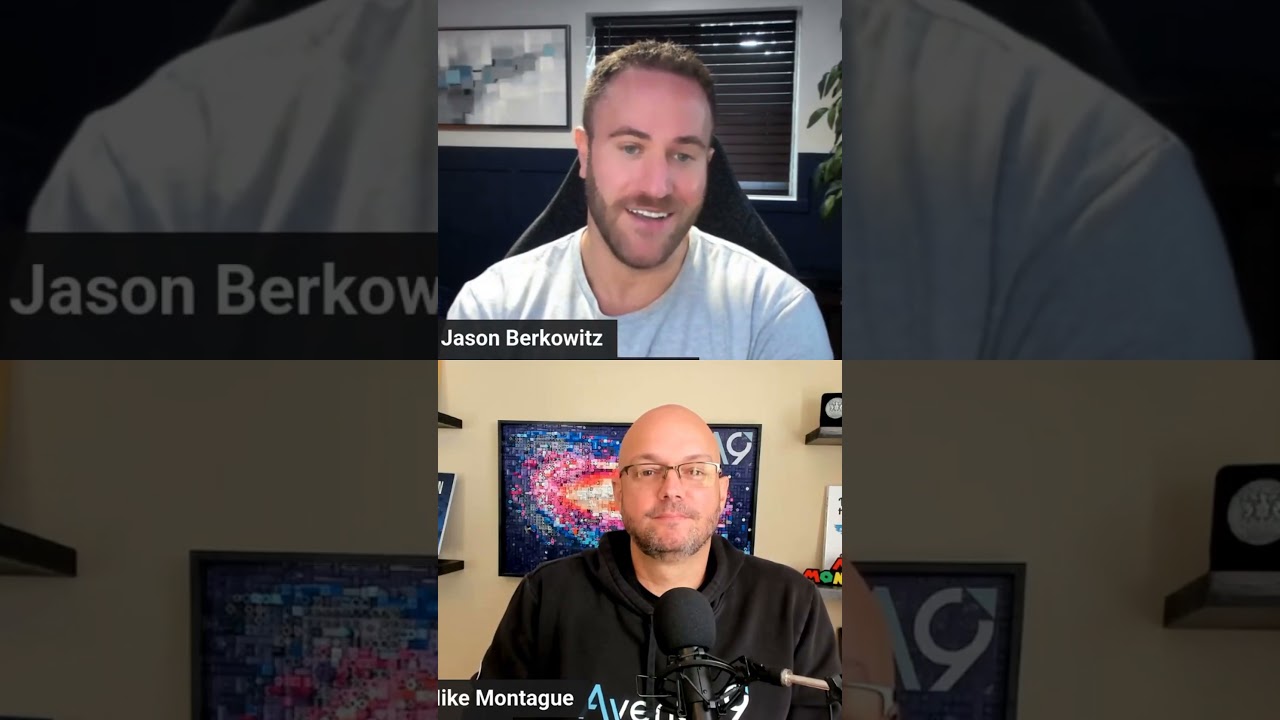
David Amerland explains that schema markup makes content machine-readable, not just for rich results. He debunks myths: plugins alone won't fix SEO, schema doesn't directly boost rankings, and social signals don't affect rankings, though social activity builds trust and brand awareness.
Chapters
Schema markup, semantic web, SEO, myth-busting— those are the topics of today's discussion. And joining us, we have SEO expert, human behavior expert, semantic web expert David Amerland. Let's dive right in. How about telling us a little bit more about you, kind of your background, what led you into this? Yeah, okay.
I've got a weird background. I'm a chemical engineer by training. I got my master's in quantum mechanics and laminar flow in micro— micro quantum processes. And from there, I jumped into journalism and then business journalism. And in the meantime, I was doing a lot of tech stuff in the background, usually writing for newspapers, translating complex technology breakthroughs, etc. So I was at— in 1995, I found myself at the right position, the right time to get into SEO because things were beginning to take off. I understood mathematics, I understood what the web was actually becoming as an opportunity. And in a nutshell, here I am.
That's of course way before Google. What was your favorite search engine way back when?
At the time, I absolutely loved Ask Jeeves because it was the first natural language processing we had and it was amazing. And you thought, this is really, really good. And you thought, oh, you can actually do a lot of this. And then it sort of vanished, right? 1998, Google came along and blew it out of the water.
Yeah, absolutely. So with this, everyone talks about schema markup, JSON-LD, structured data, primarily in the SEO community because of search result features and maybe rich results. At least I understood it from reading your book. There's actually a much bigger and probably more important reason as to why people should be marking up their website. In your eyes, what would that be?
Yeah. Okay. I mean, basically, the end goal of any kind of SEO activity really is to make what you're doing on the web clearly understood by search so that it surfaces at the right time for the right person. And if we achieve this, bingo, everybody wins. The thing is with content that it is not always structured in a way that is easily understood. Search engines themselves don't easily understand content when they come across it. They don't understand the context. They don't understand the importance. Sometimes they fail to grasp the originality and so on. So by using markup language, we are trying to bridge that gap. We're trying to make the content which we produce more machine-readable and more important than that, we're actually trying to make it Transferable outside our own website silo, across the web in different contexts and different touchpoints where it can actually surface when it's needed.
OK. And of course, semantic web. That's a much bigger discussion.
Yeah.
Entities and everything associated. If you can break down the semantic web, because again, the people aren't properly understanding maybe that the semantic web even exists. They just want to do what's new and sexy and shiny with their plugins and get some Schema markup up there. And like the dumbest dumbed-down version, what would you say maybe the semantic web is?
Semantic web is a place where whatever you do online is translated quickly and easily understood equally by people and machines. And you're absolutely right that we focus on the new shiny, whatever that might be. It might be a plugin. It might be a new sort of extension to schema markup. It might be a sort of new change that Google is implementing. And we chase that. Primarily because as human beings, we are geared, we are hardwired, if you like, to look for a shortcut which will give us the greatest results for the least amount of effort. And that's where we go wrong in marketing, SEO, and branding, and so on.
So of course, semantic web optimization goes beyond the website itself and beyond markup. What do you think are some other things that people can do outside of their website and markup to really enhance their I guess their entity in the semantic web?
Well, that's an interesting question really, because some of it is done piecemeal and some of it is not done at all, because people can't always see the results. The primary thing which you should be doing is essentially sharing your content across the social web, not in order to achieve a ranking signal, because that is a myth, but in order to actually get people to engage, appreciate the content, capture their attention and then basically repurpose it to their own needs as necessary. And if you achieve that, that actually becomes a signal of trustworthiness, which counts for something.
So what you're saying is social media doesn't help SEO rankings?
Surprising, right? I know, right? It seems almost counterintuitive, doesn't it? But every study we've carried out independently has shown that it does not affect rankings. How it does actually contribute to visibility and contributes to trustworthiness, it contributes to brand awareness. All those things taken together, they actually contribute to the brand's ability to surface in search. Yeah.
So it's indirectly helping the SEO efforts from that.
Yeah, exactly. Well, we've been talking about this for so long now, right? These things at the personal level, We instinctively know. I mean, we don't talk to strangers unless there's a particular context in which we feel safe. We wouldn't take advice from a stranger unless they said something which actually convinced us that we can give them our attention and they can gain our trust. And when it comes to working across the web, we tend to forget these things. We think, oh yeah, I've got a website, it's great, I've got all the content there, why don't people trust it? Well, you know, who knows about it? Have you seen this brand before? Has anybody talked independently about it? Have you got Google reviews? Have you got any kind of reviews whatsoever? And if the answer is no, then why would anybody do business with you?
Very, very well said. Okay. So in a nice, what I believe, a natural segue to that is myth-busting. I love busting myths, especially in the SEO industry where people are still reading articles from maybe 2007. My meta tags are awesome. You know, it's like super old things. So I wanna go through some myths that I've come across, myths that I've been asked, and things that I commonly hear and would love to get your take. If I say something and it's not a myth, you know, I wanna hear you point it out.
Okay. All right. Okay. That sounds good.
All right. So number 1, my SEO plugin or my SEO app on my website is all I need. to mark up my website?
Whoa, okay, that one. Yes, it's a myth because here's again, plugins are always middle of the road. They're calibrated on an average, which means that they're safe to use, but at the same time, they will not serve your website really as well as if you're doing SEO yourself on each particular page. I mean, that's logical, right?
Logical to us. Okay, number 2. Schema markup will help me rank better in search.
No. And actually, Google has come out a number of times through its spokespeople and said no, schema will not give you a ranking advantage. It's not really a ranking signal per se. But what it does do is it creates clarity in the content of your website. So when Google allocates a specific bandwidth to index your website, because it doesn't do the whole thing at one go in any one time, then it can basically better understand particular content, particular pages, especially if they're new. It knows how they fit in with everything else and it can serve it better if it merits it. Sweet.
Awesome. On the flip side of that, semantic search and semantic search optimization makes SEO redundant.
Oh, countless times I've heard that. I wish, in an ideal world, what would happen? Anybody would go on the web, create some content, that content would get indexed correctly, understood clearly, and served where necessary, and we'd all be happy. And it doesn't happen for many, many technical reasons, both on the sides of website technology, browser technology, and then search engine technology. And they don't quite mesh very well just yet. Our technology is not good. So essentially, yes, the semantic web and semantic search make things easier. Natural language processing is getting better and better by the day. But we still need to create proper SEO methodology if we want our online business to succeed. And search itself has fragmented to such an extent these days that if we don't do that, Then we will get lost in the noise.
Agreed. Agreed.
All right.
Number 5, there is no benefit to putting schema on my website if it's not going to create rich results or SERP features.
Well, again, that is not true patently. But discussing the benefit itself is always problematic. I mean, we know that if your content is great, if your website is really well organized, if everything's just 1 or 2 clicks away, if your writing is really, really good, and if you get a good social signal, good social presence, and people love what you write, well, implementing schema is an extra layer that you possibly don't need. Very few of us are there. So we all try to gain as much as possible. So yeah, implement it if you can. It doesn't hurt, and it can definitely help.
It helps especially for the smaller brands, brands that could use that extra advantage by feeding Google and semantic web that information.
Yes.
I got a little bit ahead of myself. That was actually number 4. Officially, number 5. If I put schema correctly on my website, I'm guaranteed to get those rich results.
No. And again, Google has said, you know, there are specific reasons why those come up. They are basically tables that are created through queries. And then those queries get pulled off websites that have ranking in terms of trustworthiness perhaps, or unique content, or very strong content that has a very high value proposition compared to its competitors. So if your website doesn't tick off those things to begin with, well, schema is not going to do anything for you. Okay. Awesome.
And last one. I can only mark up what is on the page.
Not always, because I mean, there's some things you can put in there, like perhaps your website's ontology structure. If you have that there, you can create specific categories which link to that, and they basically allow search engines to understand the context of your page better. These things are technical. If you can do them, if you can implement them, great. If you have a plugin that does them for you, amazing. If you don't, don't obsess over them. Focus on your writing and website organization.
Awesome. Awesome. I think we did some great, great myth-busting right there. I think these are things that also I tend to see in different communities in the SEO industry, people asking. And of course everyone's trying to get those SERP features and it's nice to see that there's a bit more beyond than just those rich results. So with that, I'm a guest quite like yourself on quite a lot of podcasts and I always get this question, so I feel it's obligatory that I ask you, what's the future of semantic web and maybe even SEO? What are things going to be like in a year from now, 2 years from now?
Well, it's hard to say. I mean, we know that things are becoming more and more intuitive. We know that there's more machine learning applied across search engines and across apps. And even certain specific CMSs are being machine-tooled these days with a machine learning algorithm in the background so that they can seamlessly, within inverted commas, talk to other apps or other devices or other search engines. So basically, the information flow is going to get denser, and we will see it get broader. So the context in which we access information is going to grow. These things are given. So really, the underlying question here, the subtext is, are we going to have better access to better information? And for that, still, we will need to do the hard work. We will need to basically do the heavy lifting, make sure that where we can, we are crossing all the T's and Dotting all the i's, those to help machines understand better what we do because although they're smarter, they're nowhere near as smart as they need to be.
Awesome. So, as we wrap up, what's new with you? Any books coming out soon? Yes.
What's going on in your brain these days? Absolutely.
Yeah.
There is a book coming out and I can't talk about it just yet because we're still finalizing the legal details. I can't get that exclusive? Oh, that would be awesome. Well, I will email you. I promise I will do. Within about 3 weeks, I will have everything wrapped up and I'll be able to send you an email.
Not bad.
But basically, the flow of my work has gone from writing purely about SEO and search to going into human behavior because these are linked now. Essentially, search and the way we use it relies on user intent and user behavior. Search engines understanding that and then managing to sort of match it up with website content. So essentially, we're getting to the stage where technology is good enough for our behavioral traits to make a difference. And that's where the focus on marketing, branding, search engine optimization, and selling and visibility on the web actually begin to sort of come together. And that's where my writing is heading in general terms.
I'm excited. I'm excited to get my hands on it. Me too, actually. Yeah. Awesome. So, where can people find you? Where are you mostly hanging out?
Platforms, websites? These days, I'm hanging out on Twitter @DavidAmerland. You can find me on LinkedIn, and I do put a lot of threads there and take part in the conversation. On my own website, davidamerland.com, and for specific writing that has to do with decision-making, On thesnipermind.com.
Awesome. Thank you so much, David. It was great having you here.
Likewise. Thank you very much for inviting me. I really enjoyed this.
More from Jason

Stop Doing Everything Yourself To Scale Your Business #agencylife #founder #entrepreneur
When Content Marketing Isn't The Right Strategy #contentmarketing #contentstrategy #seo #agencylife

The Only Place a Founder's Brain Actually Shuts Off #agencylife #seo #entrepreneurship



AI Is Making Your Marketing Team Worse #seo #ai #aimarketing #criticalthinking
The Two Things I'd Tell My 2010 Self About Running an Agency #seo #agencylife #podcast

The One Thing You Can't Systematize in SEO #seo #seostrategy #criticalthinking #agencylife #podcast