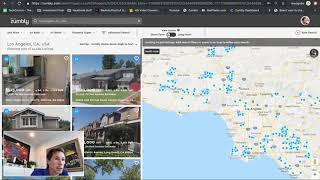
In this interview‑demo, Jason Hartman talks with Jeb Carty, co‑founder of Zumbly, a web‑based property‑search platform that ranks MLS listings by projected return on investment (ROI). Zumbly currently covers Los Angeles and Chicago and lets users search listings by both long‑term (traditional lease) and short‑term (Airbnb‑style) rental potential. The platform pulls rent estimates for 1‑4 unit properties from REIS (40‑year historical data) and short‑term rates from AirDNA, while property tax, HOA and insurance data come from the MLS feed. Each listing receives a “Zumbly Home Score” (0‑10) based on net income, which is calculated by subtracting mortgage, taxes, HOA and insurance from gross rent; the mortgage is included, so the figure differs from NOI. Users can adjust all inputs (down payment, interest rate, taxes, insurance) and instantly see the score update. The demo shows switching between short‑term and long‑term views, contacting the listing agent directly through the platform, and future features such as heat maps, motivated‑seller indicators (e.g., price reductions within 10 days), price‑per‑sq‑ft analysis, and rent‑vs‑buy comparisons. Carty explains that Zumbly is expanding from an investor‑only tool to a broader “home‑market” aimed at millennials and Gen Z who seek alternative income streams, emphasizing the new American dream of leveraging property for side‑income. Limitations discussed include potential inaccuracies in MLS tax data, the legality and seasonality of short‑term rentals (which Zumbly does not filter), and market cash‑flow challenges in high‑price areas like LA and Chicago.
Chapters
It's my pleasure to welcome Jeb Carty. He is the founder of, or the co founder, I guess, of Zumbly. And this is an Internet product that does investment property analysis currently in two markets, LA and Chicago. And it came out of his frustration for analyzing deals and looking at properties. Sounds familiar to me, as you know. So we're gonna dive in and, and see what Zumbly is all about today.
So I'm gonna give you brief overview of how it works. So Zembly, as you can see, looks like your typical consumer facing MLS from the very beginning. But we have a huge spin on it and that is that we let you search by returns at scale. And what that means is that we give you the ability to search by ROI based on a traditional one year lease, long term as well as short term in the sense of what the property could make on a site like Airbnb.
Okay, so the first question is, has to be how do you get the rental data? I mean, this is, this is a feed from the mls, I'm guessing, right? It's just an IDX feed, right?
Yes.
Okay, and so how do you get the rental data? Are you, what engine are you using for that? And then I guess Zumbly is just putting it, it's porting in its own rental data. And of course that's an estimate obviously, right?
Yes. So what we do is we've actually worked with a company in New York City called Reis and what they've done is they've collected the data on one to four unit apartment complexes all over the United States for the past 40 years. So they get the actual current going rates. We're not looking at past historical, we're looking at the actual rates. And then what we do is we take that, we have a few different data scientists that we work with. And you know, the good part is that just being in Los Angeles and Chicago, where we've enabled ourselves to, as they say, nail before you scale. So we've really had them go through and look and see what needs to be adjusted in different areas.
Okay, so what do you do? Someone comes here and they're at the website, what do they do? First? Take us through the steps.
First of all, I mean, as you would with any search platform, you would go by price, you know, you would enter what you're looking for, the beds, the baths, what property types. And then what we would do is, and you know, you can search obviously an area as well, and Zembly is going to take you wherever that map view is. It's going to show you the best ROI in descending order. And we do this by attaching what we call the Zumbly home score to each individual property. And that is based off of the net income. So in LA, there's about 25,000 active listings. We take those 25,000 net incomes and put them on a scale between 0 to 10. And that's when wherever you focus the map view, you will instantly get in descending order on the left side of the screen here, the best returning ones.
These are properties with that data already right here.
Yes, yes. And right now we are actually searching by short term returns. So we're not looking at long term right now.
Okay, so the short term rental data is even harder to get than the long term rental data. Would you agree?
Yes. There are, there are only a few sources out there. I mean, as, as tech progresses, these sources will become more open source. Right now we get these, we get the API from a company called Air DNA.
Yeah, we have them on the show. Yeah, we know Air DNA. Okay, so, so this first one, now the one problem I'd say is you're in two rental markets that just don't really cash flow very well at all because the properties are too expensive. If you were in Indianapolis or Memphis, these numbers would probably look fantastic. But you know, whatever. The point is the concept, right? So this is a $415,000 property and the net income is a monthly number.
Yes, that is a monthly number. We also give you the daily rate as well and we give you the ability to adjust everything. So I'm going to go ahead and click into this one right here.
And how do you determine net income? Explain that monthly net income number, what that really means.
Well, here it is right here. So if you look at this, here is your gross, then we take in your mortgage based upon a traditional, you know, 20% down payment. We had. We get, we have an API that brings in the rate every single day.
Okay.
And then we do. So we subtract your mortgage as well as your property tax hoa, if applicable, and your insurance. And that's what brings you to this number right here. Everything is changeable. Like, you know, if, you know, I thought the insurance would.
Right, sure. And you can change it. Okay, that's great. I mean, the property tax data, where is that coming from? Because that's notoriously wrong. Yeah. Where are you getting that from?
All of this comes directly from the mls.
Okay. So you're relying on the MLS agent to have put that in properly, and that's probably the old data, not the, not the reassessed data on the property taxes. So be careful. That one. So it's good that you can change it. Okay, that's great. So this one has a. Is, is net income the same as noi? Net operating income? No. You've got the mortgage in here, right?
Yes.
So this is a short term rental, yeah?
Yes.
Okay, let's look at long term.
Okay, so I'm going to switch this over to long term. And this is, as you can see, like you talked about in terms of, you know, not being a good value. As you can see, the other Property was a 10 with short term and with long term it's a 6. Meaning that, you know, this is the monthly return you can get. And the cool part is, like I said earlier, you can adjust everything. So if I start sliding this up, you're going to see that Zembly Home score going up. Because this is weighed against everything else. Of course you can reset it. And this is, you know, based upon the same thing, you know, your, your expenses and your mortgage as well. Yes.
Interesting, interesting. And how about contacting the listing agent? Is that data in here?
Yes. So as of right now, you can request info. We will eventually. We've talked about selling leads. As of right now, this is something that goes directly to the listing agent.
Okay, so. Oh, well, it's got, oh no, it's got your email address. So click on request info again, will you?
Yes. So this is, this is all my personal information right here.
Right.
Because I'm logged in to mine. So pre. Populate that.
But do you know who the listing agent is? I mean, agents are notoriously, they don't answer their email, you know, they don't return calls.
Okay, so this is the broker. That's their number as well as the agent right there.
Okay. All right, fantastic. What else do you want people to know about this?
Okay, so this is. We're on staging right now. So every website is built on a staging site. It then gets pushed live. So these features are almost complete. I can't show you them. But for instance, we have heat maps that will, you will be able to search for all these things. We're going to add in a whole bunch of other things. And of course, heat maps gives the user the ability to, if they don't know the market, to kind of understand it. Like price per square foot, you're going to see is really hot in Santa Monica and Beverly Hills compared to the rest of the areas. So this is for overall education. One of the cool parts that we're doing that nobody else has done is motivated seller. And so we have a couple of different rules baked in. And if so, one of them is if there's a price reduction within 10 days, and if we consider that person motivated, these property dots on the map are going to blink. They're going to pulse.
So price reduction, you mean like within 10 days ago?
Right, within 10 days of listing the property on the MLS.
Oh, you mean an immediate price reduction. So only one time. And it just calls them motivated. If they, if they, if they list the property, reduce the price in 10 days, the algorithm says they're motivated.
That. That's one of a bunch of them. Okay, that's. Yeah, that's one of, one of a few. But yes, if you do lower it within 10 days. Yes, that will consider that person motivated.
Okay, right, so go ahead. The other tools.
Okay, so this will show you the cheapest price per square foot per zip code. You know what's cool about these features that we're doing is this enables the greenest investor, the brand new person, to help you find the best deals as if you were, you know, you've been in this industry for four years just by the nature. And like, I'll show you like cheaper to buy than rent. So what you'll do is you would punch in your, you know, what you'd like to afford and we're gonna like what, what you would like your monthly payment to be. And we're not only gonna show you properties that you can afford to buy, but we're gonna show you the ones that if you were to rent those, the landlord will be making money off of you instead of, you know, like your, the rent would be higher than what your all in expenses would be to own it.
Yeah, just based on all in expenses. It's not that simple, of course, but yeah. Okay. Yeah. So it's for homeowners or renters too then, not just for investors.
Yes. Okay, that is. Okay. So the biggest thing that we discovered was we originally an only investor platform, then we dipped into the everything home market because we noticed that millennials and Gen Z, and this is probably the biggest thing that you can take away from me, from this, is that they are looking for a different way of buying, you know, between the housing crisis which they saw and how that devastated America with all the student loan debt that they're in, with all the different ways to make money these days that you couldn't before. Like for instance, wag, you can go and walk a stranger's dog and make money. You can view Uber. They're looking to see what their property can make for them. And so that's where the, you know, the whole short term investment property, or Airbnb investment properties are becoming more and more popular because this gives you a hybrid model, like, okay, I can live in my house, and if I find my home on Zumbly, I know that I could put on Airbnb and that'll pay for my vacation to Spain or, or can just help me build a bank account or whatever. You know, they want to be financially stable. That's. I mean, the new American dream. I mean, the old American dreams dead. The new American dream. Is your dream, what you want to do?
Yeah. Okay. On the short term rental component, does that take into account whether or not short term rentals are legal in that area and the occupancy rate? I see that you've got that on your screen, but when you pull the air DNA data, I see that you had a nightly rental rate, but of course, that can be very seasonal and occupancy varies greatly. So what about those complications?
Well, we do pull from air DNA quite frequently, so we get more and more updated data on the area that they're in. You know, obviously, Christmas time holidays, 4th of July is a big one. So it does change. But in terms of legally, we don't do that because we do not want to disclude any areas. I mean, in the city, you know, West Hollywood, you know, in Santa Monica, it is illegal. People do it anyway. So we want to give people that option, even though it is, it's technically, you know, they can't, you know, so.
So they got to be careful because they can't just look at this and think, oh, this would make a great short term rental. Because they might be. They might be fined or just totally shut down by the local authorities. Right. So, you know.
Exactly. I mean, that is something that we've talked about incorporating the future.