People Leaving California: How it Impacts Real Estate Investors
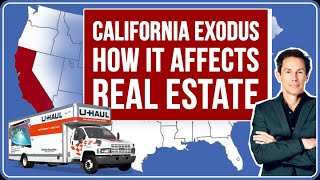
In this episode of the Jason Hartman podcast, host Jason Hartman introduces the topic of California out‑migration and its ripple effects on the U.S. real‑estate market and broader economy. He argues that California, despite being a cultural and economic powerhouse, is losing both working‑class and upper‑middle‑class residents, especially those with net‑worths between $500 k and $10 M, due to high costs and perceived mismanagement. Using his "water theory of investing," Hartman explains that money, like water, seeks the lowest point—so capital follows these migrants to cheaper states such as Florida, Texas, Tennessee, Georgia, and Indiana, where his firm recommends properties. He cites a Zillow survey indicating that roughly 2 million renters could become homeowners thanks to telecommuting, which will further boost demand in lower‑cost markets. Hartman also presents a novel migration barometer: one‑way U‑Haul truck pricing, showing a $1,300 price differential between moving from New York to Florida versus the reverse, signaling net out‑flow. He expands the discussion to airport revenue declines worldwide due to COVID‑19, warning that reduced passenger traffic threatens municipal bond defaults in major “trophy” cities (e.g., LAX, SFO, JFK, BOS). A personal anecdote about his dog Coco’s low platelet count serves as a metaphor for scarcity and utility as the basis of value. The episode culminates with the introduction of guest Leslie Appleton Young, chief economist for the California Association of Realtors, who will provide expert insight on these trends.
Chapters
Foreign. Welcome to episode 1551. 1551. You know, I can't wait until the day when I'm saying Welcome to episode 8362 or whatever the number is. We've been doing this a long time and we're going to keep bringing great value to you. And I just want to say thank you to everybody for all their kind words. You know, hardly a day goes by where I don't get a note or a message from somebody that talks about how much our podcast, our YouTube channel, our content in general, the blog, et cetera, or now the live streams have impacted your life in some way. And I want to just tell you what, I am honored and it's a pleasure to do it and really just glad that we can be of service on behalf of my entire team, really. So we'll keep the great content coming for you and keep you informed of the real world reality of what is going on out there in the economy, the real estate market, and every 10th show. Life in general. Sociology, you know, economics is a social science, right? Or a social art. Some would argue that it's not even a science because it's pretty hard to predict the economy. It sure is. But it does use some scientific method in it, and so sociology is definitely a big part of it as well. So anyway, we'll keep that coming for you. And today we have Leslie Appleton Young, someone I have been following for many, many years, probably 25 years. And she is the chief economist for the California association of Realtors. Now, I just want to explain something, and this is important, okay? You might be asking yourself, jason, why do you keep talking about California? I don't live in California. I don't go to California. I don't have a business in California. I don't own property in California. Why are you talking about California so much? I'll tell you why. Number one, there is an old concept that things start in the west and they go east, and to some extent, and for good and bad, better and worse. That is true. California does set a lot of trends for the country and the world. Think about it. California has Hollywood. Hollywood influences the entire planet in huge, huge ways. Also, it's a huge bastion for the music industry. Music influences the entire world in so many ways. I've been to 87 countries and I tell you, every country I go to, I'm hearing American music, okay? It's truly amazing. I'm seeing people dress like they do in American movies and, you know, American friends, they've just germinated all over the planet. Okay, California, if it were a country, it would be. Well, first of all, it's a really messed up country. They're messing it up badly. But it would be the fifth largest economy by GDP in the entire world. It's important. It's something significant to talk about. Now, California is a disaster. I call it the Socialist Republic of California. I left California nine years ago and I'm really glad that I did. But it's still worth talking about because what happens in California impacts a lot of things. Think about this for a moment. You know, you're thinking, hey, I invest in Florida. I'm investing where Jason's vesting and where Jason moved to two and a half years ago or a little less than two and a half years ago. And fine and dandy, that's great. I want you to think about this. California is losing its working class population and some of its wealthy population. Now. The real wealthy people, they, you know, they make so much money and they're so rich and they've got so many ways to avoid taxes that they don't, sometimes they don't care that much because they've got tax schemes and all kinds of stuff that we don't have access to. I'm talking about the mega wealthy, okay? The people worth, you know, hundreds of millions of dollars, okay? So that is not that significant to them, but to the typical people, middle, upper middle class people who are making $80,000 a year on up to several million dollars a year, right, in income, and maybe their net worth is anywhere between $500,000 and 10 or $20 million, right? Well, 10 or 20 million, they got all kinds of tax schemes, but if they're worth $5 million, they probably don't. And 5 million ain't what it used to be. If you think that's a lot of money with inflation, it ain't what it used to be, as the saying goes. It ain't what it used to be. I know that's improper grammar, but it's an expression. It's slang. Slang. So think about this for a moment, folks. Think what happens when 10,000 people who own $500,000 houses, which, give or take, is about the median in California, right? 10,000 people own $500,000 houses and they leave the state of California and they move to one of the other 49 states, or according to Obama, one of the other 56 states, because Obama thinks there's 57 states still. I had to tease him a little bit because that was so stupid, that comment. But then again, Trump makes All kinds of stupid comments, too. So I pick on him too. So I'm an equal opportunity critic. Anyway, think what happens when 10,000 people leave. Well, what happens when 100,000 people leave? Multiply that times $500,000 house. And then what happens when a million people leave? A million people in a state with almost 40 million. I could see that happening. Think of how significant it is when that money flows into other states and some into other countries. Right? You know, 16, 17 years ago, I was teaching something I call the water theory of investing. So here's a water bottle, okay? It's got the cap on it. But what if I. And by the way, if you're not watching this on video and you're listening to only audio, that's fine and dandy. You know, I'm going to just demonstrate this idea for you. So you take a water bottle and you pour the water out. Where does the water go? The water goes to the lowest point. That's a cliche. What is the cliche? Water seeks its own level. It goes to the lowest point. You know, money does the same thing. Money looks for the best value. Money seeks its own level. Money flows to the best deal. It flows to where it's treated best. Money goes where it's treated best. And it goes where it can get the most for its exchange value. So it's going to go to these other states that you can find, by the way, at jason hartman.com properties. That's where money is going. And as this money flows out of California, but not just California, New York, think how significant that is. There's a lot of money in these places, flowing out into other markets, into Tennessee, Florida, Georgia, Texas, Indiana, all of these places where we have properties and recommend properties, okay? So just think about how significant that is. When you're thinking, well, this California stuff doesn't relate to me, Jason, it does relate to you. It's really important. And interestingly, interestingly, the chief economist for the California association of Realtors, our guest today, in two parts, by the way, this episode moved to guess where. Sarasota, Florida. Yes. The chief economist for the California association of Realtors lives in Florida. Oh, the irony of that. Right now she's on her way to retirement. So that's all fine. A lot of people retire in Florida. But isn't it sad that California can't keep people there? That is a hugely significant thing. So we'll get into that in a few minutes, but before we do, let's take a look at this. So this is one of the Great benefits. The great benefits of the surveys of sickness. Covid 1984. And it is. This is Zillow survey for you watching on video. You see it on the screen. If not, I'll tell you about it if you're listening to audio only. Zillow says that nearly 2 million renters can now become homeowners thanks to telecommuting. Isn't that wonderful? That is wonderful news. And guess what that's going to do? That's going to push up the price of your properties that you're buying through our network and have purchased through our network. 2 million additional people moving out of expensive markets like New York and California or others. There's others, of course, Boston. They're leaving the cities, they're leaving these expensive environments and moving to affordable environments because what's the difference? All I need is an Internet connection and I can work from anywhere. Right? That's the, that's the digital lifestyle. It's a great thing. So all these people can buy. All these people that were renting in New York City or LA or downtown San Diego or San Francisco and they were paying $4,000 a month for a one bedroom or a studio apartment or studio condo. Now they can move to a nice suburban market, many of them you'll see@jason hartman.com properties and they can get a 1500 square foot house, maybe larger, with a two car attached garage in a nice neighborhood. They can live better in so many ways for a lot less money. So what happens with all that newly disposable income? Guess what? It stimulates investment and it stimulates the economy in terms of consumer spending. So there's a lot of good opportunities coming out of the COVID crisis. Okay, so let's go to the next thing. Just one moment. I need to make an adjustment on my screen here. Okay, there's the adjustment. Okay, so let's go to the next, next slide here. Oh, I want to thank all of you who reached out about my dog Coco, my dog who's many times used in advertising and always attends our conferences and you know, hundreds if not thousands of you have met her over the years and she was very sick. I rushed her to the emergency room last week and she stayed there for a night. But she's home recovering now, making platelets and platelets were very low and we're not exactly sure why yet, but hopefully she's recovering. And she checked into the emergency room with 3,000. Her platelet count was 3,000 and checked out after making 133,000 platelets. There for a count of 136,000 total upon release. And hopefully she's made a lot more since then. So I want you to think about this. We talk a lot on the show about currency. It's not money, it's currency. Money has real use, right? Money is something that has intrinsic value, but dollars are only currency. Yen, euros, Brazilian real pesos from many countries use a variation of a peso. They're all just currency. They have no intrinsic value. They're fiat currency. Right? But when you think about it, when I was really concerned about Coco, I was thinking the most valuable currency to me and obviously to her, if she's conscious of that, is certainly not dollars. At that time it was platelets that was a currency. With that in this dog's body was scarce and had very high utility. You know, you can compare this to economics. It's all about that, right? Because remember, for something to have value, as I've told you over the years, it's gotta have two primary value driving components, scarcity and utility. Scarcity and utility. If it has scarcity and utility, it has value. So this was a very high value platelets because they were scarce and they obviously have utility, right? So the little platelet factory dog has been busy making platelets. So thanks to all of you who reached out and expressed concern about cocoa. Okay, last thing and then we'll get to the guests because this relates to to the California migration. This one is about New York. Same idea, doesn't matter, same idea. Okay, so I went to u haul.com just a couple days ago. I shared this on the live stream. By the way, if you watch the livestream, this is a little bit of a repeat for you, but you can do this yourself. And it's pretty fascinating. You go to u haul.com the Moving Truck Rental company. And here I looked at a 26 foot truck and I said the first time, I said, okay, I want to leave where I live. I'm going to leave Palm Beach, Florida and drive that truck one way to New York City and I'm going to drop it off in New York City. If I want to do that, I can rent that truck, as you see on the screen, for $2,113 one way rental, Palm beach to New York City. Okay? What if I want to go the other direction? What if I'm doing what most people are doing right now? I'm leaving New York and I'm going to Florida. That's the big trend, right? It would be very unusual to go the other direction, right? So if I want to leave New York with that truck and I want to bring it to Palm beach, the rental gets much more expensive, $3,380, so almost $1,300 more to go the opposite direction. Same truck, same one way trip, just in the opposite direction. This tells you, listeners and viewers, this tells you what's going on. This is a barometer for what is going on in the real estate market and the economy in general. People are leaving these. Try it with California. Do it U haul truck from San Francisco to Phoenix or San Francisco to Las Vegas, or San Francisco to Dallas, or you know, Florida. Now that's pretty long move to do. It's a do it yourself move. You're going to drive that truck all across the country, but people certainly do it anyway. The point is do it in both directions and you will know. This is a capitalist barometer that is extremely accurate, that tells you what's going on. Try it with Portland or Seattle, okay? Because people are leaving those places too. Just like they're leaving California, Boston, you know, even Miami to a lesser degree. But you know, all of these high density, expensive places, they're leaving, places with civil unrest they're leaving and places that are not business friendly and not landlord friendly. These are the places people are abandoning. And guess what? I got one more slide here I need to show you, okay? And I'm going to skip a couple of these because this is what I want to show you. This slide talks about the COVID 19 impact on global airport revenue. Not many people are talking about this, but I am. And you probably heard it here first. So the dominoes that are about to cascade onto these big cities, these trophy cities, are absolutely staggering because remember, as they lose businesses and they lose population, they lose workers and people migrate out of these places. They also lose their tax base. And most of these places were already mismanaged because they're these leftist disasters, okay? They've been mismanaged for decades. They've been riding on a reputation that they earned decades ago and they've been mismanaged for so long, they've been spending money like it's going out of style and it's a disaster. But when you look around the world, airports have huge problems. And guess what the staple feature is of many of these cities? It's their airports. La, it's lax, San Francisco, it's sfo. Okay? In New York you got three major airports that serve New York City, right? So this is a big deal. Boston, you've got Logan Airport, right? Hugely significant These airports are one of the next dominoes to fall. They are. They are dying on the vine right now. And so will the cities in general, the municipalities. If you're investing, by the way, in municipal bonds, be extremely careful because a lot of these municipal bonds, my prediction, they will default. Okay? If they're in the cities that people and businesses are leaving and many are just not coming back. Okay? This is a massive sea change that's going on right now. So that's pretty interesting. And you look at, you know, the Original estimate for 2020 revenue by region of these airports before the pre. Covid 1984 and the post. Covid 1984. That's on purpose. The 1984 George Orwell. Okay, I'm being snarky if you think I'm missing it. I know it's COVID 19. Okay, I get it, okay? But look at this. Look at Europe. The projection was basically almost $60 billion in revenue. Now 20 billion cut by 2 thirds. Asia Pacific, essentially, same story. North America, same story. Middle East, Latin America, Africa, less significant because not as much tourism. Huge. And not as much business travel either. So this is huge. And as these airports go broke, they might become privatized. If there were bonds issued to build that airport or to sustain it, those bonds are going to default. That's going to have a cascading effect for many investors. So be careful. More on this later. All right, let's get to part one of Leslie Appleton Young. If you need us, reach out Jason hartman.com or 1-800-hartman and by the way, I want to just remind you, you can get your free mini book on Pandemic investing@pandemicinvesting.com Yes, I did get that domain name. I know a lot of people think that's a big score. I was able to get that one. PandemicInvesting.com for your free mini book on how to invest during the pandemic and during these crazy times we find ourselves in. And without further ado, let's go to Leslie Appleton Young, chief economist for the California association of Realtors.










