10 Things in Marketing that Change as You Scale with Kady Srinivasan, CMO of Lightspeed Commerce
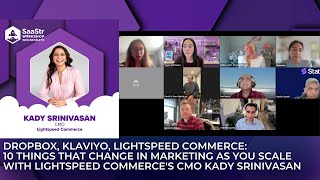
Kady Srinivasan, CMO of Lightspeed Commerce, breaks down how marketing strategy shifts as SaaS companies scale. She covers five strategic questions for go-to-market decisions, when to use product-led versus sales-led motions, and how to align marketing with product maturity. Her framework draws from roles at Dropbox, Owlet, Klaviyo, and Lightspeed.
Chapters
Welcome, welcome to this week's edition of Workshop Wednesday. We are thrilled to have you. And as you guys know, every Wednesday at 10:00 AM Pacific time, we are here week after week to share detailed, interactive, and hands-on workshops. We always have an amazing SaaS expert walk us through the content and then kick off with an interactive discussion. So today we are thrilled to have Kati Srivasan, CMO of Lightspeed Commerce with us. Kati is a SaaStr super fan, so we are thrilled to have her. She's appeared on the stages with with us quite a few times. We were talking about it just before we went live. I think Cady's first SaaS tour she was on stage was in 2017. We are so excited to have been able to follow her journey throughout the SaaS world these last few years and for her to always come back and share so many amazing insights with us. She has a very impressive marketing career spanning across B2C and B2B technologies with Dropbox, Owlet, Klaviyo, and now Lightspeed Commerce.
Thank you so much, Taylor. I really appreciate it and I'm so excited to be here. I've seen the whole lifecycle evolution of companies, so I'm more than happy to come here and share all of those, those learnings with the people.
Awesome. Catty, you have a great crowd already. We have folks from all over North America, Southern California, Vancouver, Boston. We have someone joining us from South Africa. So welcome everyone. Really thrilled to see so many folks from all over. So Catty, I'll pass it over to you to take it away.
Thank you so much, Taylor. Thank you so much for taking the time to to come to this presentation. I hope, I hope it's, it gives you the value you need. So let me just start by talking about my background for a second, because I think it's important to, to set the context for what I'm talking about. So I've had the, the great fortune to be associated with some really amazing companies. Some of them are really world renowned. Some of them are extremely mission oriented. And each of these, as you can see, in the last few years, Every one of them has had an opportunity to have an exit from the period of their growth. So I've seen literally every stage of company at this point from Series A all the way down to a public company. So I've seen the how companies evolve and how different kind of companies take different paths to where they want to get to. And it's been a fascinating experience. So when I joined Dropbox, it was a late-stage company. We went public in 2018. When I joined Owlet, we were a CDC company and we exited through SPAC in 2021. And then Klaviyo was the most recent one. When I joined, we were a pretty late-stage company and then we ended up— the company ended up going public in 2023. So all I'm trying to say here is really just an interesting experience in terms of tracking the growth of companies. And right now I'm with a company called Lightspeed Commerce. We are a POS and payments software provider. And we are a publicly traded company. We listed both in the Toronto Stock Exchange and NYSE, and we are close to a billion dollars in revenue. So you can imagine like the scale and the complexity of something like this is vastly different from a $10 million Series A type of a company. And the interesting thing is, as I've gone through my career, I've seen both of these two vectors, if you will, of— I've been in companies that have been exceedingly high growth, 300% growth. And I've been at companies where the scale has been massive. So it's been interesting to see the way companies either diverge in that respect or they bring it together as it happened in the case of Klaviyo, where you have scale and growth and move forward. So I wanna share some of those learnings, what happened in those companies that drove them to that success. How did they do it, particularly from a marketing lens, but you can also think of it as a kind of a broader go-to-market. How does it, how do I take this to inform my go-to-market strategy? So I wanna share that, those learnings, some of those learnings with you. I think Starting at the very basic principle, right? Marketing is never going to be a static function, although a lot of— I speak to a lot of founders and what I hear from them is, I categorize marketing into 3 buckets: performance marketing, product marketing, and brand marketing. Which of those levers do I need to activate at what point in my lifecycle of a company? It's not that simple, even though the basic principles are there. It's all about how do I find the right set of tactics, the right kind of strategy for the right stage of a company. In their growth stage. And all companies don't grow in the same way, remember? Every company has its own unique path. And so the metaphor I think about is how do I fit marketing into the right stage of company, right kind of growth of the company as the company evolves? And that's what I wanna share some of those things. So let's start with the first one. Every marketing strategy has to be extremely tightly aligned to what I call the product maturity curve. And what this means is When you are a single product company, you have a certain footprint in terms of products. But if you are a growth-oriented product company, you're obviously creating more and more products and you're creating a platform, right? And so marketing can never stay the same. The marketing strategy can never be, I'm just gonna keep selling this one little thing and then hope that we upsell all of these other pieces. Marketing strategy has to evolve as you think about the product maturity curve. And so where that means is— what that means is what is the best uncontested market space and what does it take to capture it? And so let me talk about what that means because this is an important point. When you start anything, right, when you start thinking about a product and how to take it to market, you're always thinking about what is my ICP? What is the set of customers that understand, that almost intuitively understand what I'm trying to give them, and how do I make sure that they just get to know that I exist, right? That's your first and biggest challenge is I have a bunch of diehard fans that I know that will love my product. I don't need to sell them too much. All I need to do is get my word out to them, and that's your uncontested market space at that point, right? But as you start to grow, what happens is then you need— you start reaching the limits of what that ICP represents. So you might have started with a very niche place, and then you start to think, oh wait, this adjacent audience is also likely going to be interested, but they might not fully understand the value of my product, or they might— the product might not be fully relevant to what they're thinking about. So I call this the ICP+. So these people are the ones that need to be educated on what the platform can give them. They're not thinking about you and making the connection between, wait, this feature means this benefit. They're not making that direct connection. You have to make that connection. But as you become a multi-product company, a multi— call it a multi, you know, services type of a company, you expand into different product areas, you expand into different revenue streams, you will tap that market out. And so the next one is thinking about what are the, what I would call the late majority customers. So if you think about ICP and ICP+, they're still your early adopters, late adopters, right? In the crossing the chasm type of a curve. And then you hit the point of late majority where these are people who are generally very adverse to switching. They don't want to take the risk of switching. They have way too many switching costs. They're comfortable where they are. They don't have a sense of FOMO about it. They're fine. And this is where you need to really think about, how do I create the sense of urgency? How do I create the sense of FOMO? How do I create the hook? And how do I even get in front of them and really sell them the value of this? And in some cases, you're just nurturing them to a point where it's— then they realize, oh shit, something has changed and now I have to switch. So the first focus area for marketing, in my opinion, in my experience, has always been this early and late adopters because you can really get a lot of value. You can get a lot of momentum out of this. And then once you reach momentum and you hit a certain tipping point in terms of market share, then it starts to go into— it starts to create a machine of its own, a viral machine. So if you start with that idea that you are really tied at the hip with how you're thinking about the product maturity curve and your customer base, then the second aspect of it becomes, okay, when you start to scale up, it's not as simple as thinking, only thinking about how you think about audiences. In the previous pro tip I talked, there was only one vector of complexity, which was the audiences, which is this one. The audiences and the product, the product becomes more relevant, the audiences increase, how do you create the growth? But the reality, to be honest, is that lots of things change as we grow. And there are multiple levels of growth, vectors of growth. You could go after different audiences. You could have different products. Either you buy different products or you create them, or you even integrate with certain ecosystem partners to expand your footprint. You go into different industries, all of these things. And then the personas is important, especially if you're an enterprise software. You have likely seen this already. There is no single persona in your buying journey. If you're a self-serve company that's appealing to SMBs, it's one thing because you're, you generally have the budget owner who is also the decision maker. So it's easy. But when you go into enterprise, you have a budget owner, you have an influencer, you have a decision maker, you have a potentially a finance person who needs to sign off. So you have multiple personas and all of a sudden now you are confronted with what does my marketing strategy need to look like for this enterprise audience who has this kind of a, who's in this sort of a risk stage, who's looking at this vertical, et cetera, et cetera. And then the last vector of growth that creates complexity is the go-to-market. How you create a go-to-market motion can make or break your growth cycle. If you get into a self-serve motion too early, but you're an enterprise-focused company, that match doesn't happen. If you are an enterprise-focused software, but you're trying to do everything through field motion, for instance, that motion doesn't work. So you've got to— you suddenly start to think about what is my go-to-market motion here? Where do I invest? And that creates complexity as well. And so the biggest problem that I see is in the quest for taking quick decisions and moving fast, which is the DNA of all good startups, people tend to simplify, oversimplify this complexity. And what I would suggest instead is asking these 5 questions. Instead of oversimplifying or looking at these 5 and saying, I'm just going to pick one of these and optimize the hell out of this, think about these 5 questions. What is the big insight that drives urgency? So if I'm appealing— if I'm a software that's appealing to a financial controller in a big enterprise, what's the one big thing that is driving urgency on their part? What is the problem statement that you are trying to be known to solve? What is basically the job to be done, right? The second thing I would love for everyone to think about is what is the new category you want to dominate? Why do customers care? Is it an existing category? Is it a subcategory? Is it something completely new that we haven't defined for the market yet that we want to go and create? So being very deliberate about the new category becomes important. And then the third one is the— this I cannot understate how important this third question is, which is where do I play versus not play? What are the, the the things that I will absolutely not do. I will not do self-serve because it is not relevant to me. Or I won't build a whole field motion— or sorry, outbound motion because I am going to be a self-serve-focused business. Where do I not want to play? And then how do I want to win? It could be that I want to win primarily through a partner ecosystem, a really robust ecosystem of integrations. That could be your clear how to win. Or in some of these companies who have gone to amazing successes have said, I'm just going to focus on inbound marketing as my big lever. So how do you want to win? And then what are the current growth levers that can scale? This is another super important thing. Every growth lever is going to hit a point of diminishing returns, right? And in the beginning, you can get growth but not profitability, and it looks very attractive. But what are the things that can continue to scale? So don't oversimplify complexity. Think about these 5 questions, and then once you really put some effort behind these, the answer starts to get clearer about which of these levers of complexity you want to try to optimize for. So the next one is like leading into one of those bubbles that you saw in the previous slide. I'm calling it know your motion, but I— what people don't fully realize is there are multiple ways to go to market, right? So, uh, PLG is a very well-known thing— bottoms-up, self-serve, product-led growth. And for those who are not familiar with this, this is basically the idea that your product is so intuitive and so user-friendly that people sign in, they self-serve their way into signing up for a premium experience, and/or they continue to sign up to add-ons and features, and they basically use the product on their own. A very minimal human intervention. And of course, if you look at some of the biggest successes in the world in SaaS, like Slack and Dropbox and Klaviyo, most of them were— made it so easy for customers to, to get onto the platform and use the platform that it became truly self-serve. So we call it product-led growth. Product-led growth also has a bunch of different other elements, such as how do you create that experience, growth hacking, all kinds of different things. So the thing that is important here to know is this requires a real, real focus on product and analytics and growth-minded either marketers or product-focused people who can take this, have a vision, and make it happen. Then there's on the other side of the spectrum, you have sales-led growth, which is basically the idea that you are having a bunch of touchpoints, human touchpoints. And I think that's also fairly obvious. Now, the interesting part is that you can create hybrid motions, the PLG and SLG motion. One example we had at Dropbox was this thing called self-serve sales assist, which was basically people would self-serve, but their needs were a bit more complex. So at that point, we would offer them a way to chat with, with a human and/or get in touch with a human, request a demo, and then that human would convert the sale. All of this is saying at different parts in your company's life cycle, different motions become relevant. And so the most important thing is to make sure that you are really focused on understanding what is relevant to your audience. At what point, and where do you think you can scale and focusing on that. I won't touch on this. I think we can skip because I've walked through this, but the knowledge of how you can play around with each of these is going to be important as well. But also keep in mind too, some of these are much larger investments, particularly on the, let's say the sales-led go-to-market motion. You're talking about hiring people, commission planning, all that kind of stuff. So there's a cost to each of these. And the important thing is to recognize where do you want to scale— sorry, where do you want to grow? What do you want to be known for? Where is the growth going to come from and how much is it going to cost? And is that balance going to work? The next one is— so this, it's an interesting one because last couple of weeks ago I spoke to a couple of founders, amazing business, and they're— but they're sub-$500,000 in, in ARR. And they said, we want to start building out the brand right away. What do we need to do? Should we invest more in brand? So my answer to that was no. And here's why. I think about brand building in two elements. One is there is a top-down brand building approach, which is basically you're saying, I don't care what the market— sorry, I don't really want to know. I don't really want to segment the market. I just want to go and raise broad awareness in a specific area. Let's call it a geographic— San Francisco Bay Area. I'm going to increase the awareness in that San Francisco Bay Area. And I know based on some historicals or whatever, there's only a small percentage of people who will actually come through the funnel and become my closed ones. But I am okay with that because what I want to do is lift the baseline aided and unaided recall in that market very quickly and over with a bunch of investment. This works for some people. Again, it works for companies who are looking to establish themselves in a market very quickly. And very— with a lot— with mass impact, and who also want a halo effect coming out of that kind of investment in a market. Because once you get a spike, you, you have a halo that sort of keeps going on for a little bit. Where it doesn't work is companies that are scrappy, small marketing budgets, and who are looking to establish a foothold in a very niche area to begin with. And these are— this is where the bottom-up approach to building a brand comes in, which is basically saying, I'm going to go figure out what— who are— who's my audience? This set of, let's call it, accounting professionals. I don't know why I'm calling— thinking about accounting today, but let's say accounting professionals that I really just want to go and increase my awareness in. So I go to trade shows, I go to associations and whatnot, get in front of them. It's a very targeted approach to building a brand that requires more, more investment in understanding the ICP, more in really selling the value proposition of the product. And also it, it means that you get much more deliberate about your product. So my, the advice I gave to my founders there was focus on things like designing the brand in the way you want it. Think about the brand identity, the visual identity, the verbal identity, the aesthetic, and how you want to come off. But when it comes to building the brand, then take the approach of doing it market by market, audience by audience. Versus the top-down, because that is the most sustainable way to build the brand. So as you go through this journey, keep in mind there's the top-down and the bottom-up, and super important to know which life cycle you're in. Okay, the other consideration here is we are seeing a lot more M&A right now, and we probably will continue to see this. And for companies that are thinking about how to acquire and integrate, there is a— in my opinion, the— there is a most— the most optimal way to go from being a house of brands, which is basically saying I'm I've acquired this and I'm this. Going from a house of brands to a branded house, which is one specific umbrella, is this idea of an endorsed brand and then converting that to a sub-brand and then finally talking about a branded house. I know we're running short on time, so I'm going to skip this and I'll have more of what this means from a positioning and category creation on my LinkedIn at some point. If you're interested, follow me there. The next one is one of the growth tips that is frequently underleveraged, in my opinion, is the ecosystem. The idea of an ecosystem is you have you have the right partnerships and you have the right set of people who are creating new value for you and for your customers. But it's the experience I've had is if you don't do this right, it becomes a runaway train. You are, you have a bunch of us who are talking about you in potentially the wrong ways. You're starting to become price competitive, and that's not, never a good place to be. And so what I have here is a quick framework, super simple framework to think about How do you maximize the idea of building an ecosystem? Obviously, like you have to reach new audiences in terms of partnerships. For me, the, it's a very clear distinction between how do you go acquire new partners or do you enable the ones that you have? And there's some elements of how you create the right connections, have the right stories, have the right branding, have the right communications to do all that stuff. So I'm going to skip through this and get to a little bit more of the soft skill part of how marketing evolves as you think about a company. If you are a marketing leader, then you know that your job is actually not just in marketing. You are actually trying to bring a lot of different people in the company together. So you are— people have used the idea of a quarterback. I— people have used the idea of this connector. And so that, that's the fairly obvious part about this. But I think what's important is how do you do it becomes important. It's not just the force of your personality that needs to bring these groups together. It's what I call red threads. What is a red thread? A red thread is the set of unifying principles, attributes, or whatever you want to call it that gets teams aligned behind the work that you're doing, behind the messaging. So it could be that your couple of your red threads are, we are a business that serves complexity, we are a business that serves, that is a market leader in X. Create the red threads that resonate across all these departments and use that to drive the agenda forward for the company in terms of what you want to be known for. Because what you want to be known for is not just a marketing objective, it's a company objective. Product has to show up in the right way. Finance has to show up in the right way. Sales has to say the things that you believe the company stands for. Customer success has to have the same voice in how you interact with people. So this idea of red threads, which I've used in the past, becomes very important to get people aligned. This one is a bit more practical. Every single company that I have been at, the, the first job I've had to do is, has been to figure out how to reduce the marketing budget and increase efficiency. There's a lot of detail behind this in terms of the ongoing experimentation that you need. In my opinion, some of our partners like Google and Meta have been really good partners in terms of helping understand the ways to create more, more optimization, et cetera, et cetera. But I just want to focus on 3 things that I've seen over and over that don't generally happen within companies. And these are things that we can control. One is the, with all of the latest generative AI stuff, there is so much we can do with AI to drive, to drive optimization. Campaign optimization. So please leverage this as much as possible. Lean on your partners, especially if you're spending money with Google and Meta and LinkedIn, because there's a shit ton of things that we can, that can be done here. The second thing that I've seen that doesn't happen, which is very surprising, is if you're a sales-led organization, these handoff meetings, handoffs need to happen very crisply, cleanly, and regularly between sales and marketing. And generally this is like a once in a month people get together and talk about the pipeline. But no, actually, you know what, the daily or even twice a day type of a cadence works wonders when you're trying to cut costs and become more efficient. And then constant creative testing. The number of times I've seen content and design not working well with the performance growth team is unbelievable. This always needs to be top of mind for any marketing leader who's coming in fresh. This is the— probably one of the most important kind of slides in this presentation is marketing has to continuously evolve how we position the company and the product. This is a framework that I— this is not mine. I adopted it a while ago. The idea is that there are only 3 types of companies in the world. There's product-focused companies, customer-focused companies, and what's— what is called concept-focused companies. So if you think about customer, the example that frequently people give is Intuit. Intuit is a very customer-focused company in that they really look at audiences and designed for audiences. A concept company is like a Tesla or an Apple where the founder has a vision and an idea and a concept and it gets built. And then there's a whole bunch of product-focused companies. So you go through the assessment and the diagnostic of what kind of company are you, and based on that, we start to create the positioning around what do we want to be, what do we want to be known for. My company is this type of a company, I'm a product-focused company, We are in the category which we— where we provide this kind of a solution to these kind of people, and these are the benefits we offer, and they care about it because of this reason, the cultural context. I would actually also add this idea that when we talk about the value proposition, we also need to always think about the reasons to believe. So we always want to be saying, this is why you should believe in me. I've shown 30% growth in, in efficiency for your competitors. So this is why I can do it for you. Always keeping an eye on these 5 things and making sure your positioning is always updated is a very good idea, because as if the company is innovating rapidly, the positioning needs to stay in pace with the innovation or else it goes out of whack. All right, the last couple of bits. One thing I talk about quite often is as you grow the marketing team, and I've seen— I've done this mistake in the past is either hiring too many generalists, people who can do a lot, or hiring too many specialists but putting them in silos where they don't come together and work together. So the important takeaway here is depending on where you are in the evolution of the marketing team, think about the capabilities you want to, you want to have in the team, what kind of headcount, and then the what is the unifying framework, say what kind of goals roles and responsibilities and culture. Even going beyond— I know we are talking about marketing as the, as a thing here, but even going beyond marketing, what I've done with sales and other go-to-market groups is also exactly this, which is what is the balance of specialists and generalists? And if you bring in generalists, how do you get them to become I-shaped? And if you bring in specialists, how do you get them to become T-shaped, right? That's, that, that's the, the way to think about this. And the last one This is actually a favorite of mine, is the— this idea that, are you a map maker or a market creator? A map maker, in my opinion, and there's no right or wrong, by the way, but both of these lead to success. But as a company, and this is not just marketing, as a company, are we charting? We know what the map is, we know we have a certain amount of share, we want to increase the share, we know where we're going, and we just have to go get that share, or are we in a completely uncontested new category, new space? We don't even know how to define what we have. Customers don't know how to define our solution. And in that case, it's about becoming a market creator, right? If anyone is a gamer here, if you remember back to the Zynga days, they created a market, right? But if you contrast that with Electronic Arts, where I worked, we had a very clear path to market leadership and we followed it. So there's no right or wrong. It really depends on where you're in the stage of your company growth. So are you a mapmaker or a market creator? And becoming extremely clear, particularly with your founders and your, the executive team at a company, with the board on what are the, what's your persona and what are the moves you want to make? And that basically brings me to the final, which is when you think about when you are going in front of a customer, keep in mind that there are basically only two things, right? There's people who are aware of a problem and they're motivated to solve it, which is your ready access. And then there are the people who are aware of your brand or your product, which is the informed access. Your ready and informed bucket is generally what shows up in your funnel. But then you have the opportunity here of, are you going after the people who know your problem, who know their problem and are motivated to solve it, but don't know your product, which is all about branding? Or are you going after the people who know your product but don't know that you can solve it, which is all about positioning? And that'll guide your decision on where you want to focus your efforts as a company. And that's it. And 3 things to remember: product maturity curve determines your marketing strategy, know your brand, make sure it shows up in all touchpoints, your motion, go-to-market motion is super important. That forms the basis of your growth expansion. And with that, I think I believe I'm done. If I do share a lot of these, these tips on my LinkedIn. So if anyone's interested. Please follow me and I'll try to take this and start to give more context behind each of these tips as well.
Thank you so much, Kati, for a great presentation and for all your insights. Thanks to everyone for joining. We did get quite a few questions for the slides. So as always, slides are going to be available right after the session, probably later today on slideshare.net/saster, and the recording will also be available on YouTube immediately after we wrap. Make sure that you're subscribed to both those channels to check everything out. Katy, thanks so much for joining us. And then we are back next week for another edition of Workshop Wednesday.
Thank you so much, Taylor. Thanks everyone for joining in.
Thanks. See everyone next week.
More from Jason

Why Your Next Hire Should Report to an AI, Tragedy Apps, and Too Many AI SDRs? | The Agents #004

Our Agents Drove Our Salesforce Bill Up 80%, Marketo Hates Agents, and We Stealth-Churned Off Notion




Managing 20+ AI Agents: Lazy Agents, Our $500K AI Bill, Stealth Churn & the Death of 60% Solutions




