10 Tips for Startups to Create Powerful Partnerships with Big Companies with SAP
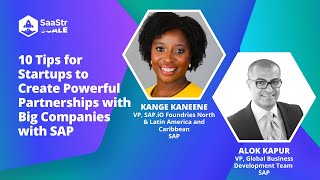
Kangé Koneini and Alok from SAP explain how startups should approach partnerships with large software companies. They warn against exclusive deals without guaranteed revenue, stress the need for a demo-ready product, and note that partnership cycles typically take 6 to 18 months.
Chapters
Hi everyone, so excited to have the opportunity to speak to you today. You are in for a big treat. We're talking about how growth companies can partner with large software companies. Alok and I, my co-presenter, have very specific points of views but have the same recommendations for you. So my name is Kangé Koneini. I'm based in New York. I lead SAP's external startup accelerator, so looking at companies from seed to Series C, been at SAP for about— or been enterprise software for about 15 years in different roles, corporate strategy, corporate development, business development. Really excited to talk to you today. Alok?
Yeah, thank you, Kange. Hello, everyone. As Kange said, name's Alok. We have a bit of a different perspective, but think of it as two sides of a coin, which is how we scale and drive ecosystems at SAP. My team and I are responsible for large software partnerships for the company. So these tend to be companies that are unicorn, decacorns, or publicly traded entities. Great.
Let's jump in.
All right, perfect. So just to give all of you a little bit of sense of when we think about ecosystems, largely from a market perspective. So this is SAP agnostic. It applies to SAP, other entities, that Kang and I have worked on, worked at, we sort of look at the outside-in and the inside-out when we're evaluating partnerships. From an outside-in perspective, it makes the most sense with the revenue as a primary scale, but also then looking at, is it additive to product strategy? Is it driving feature completion? Is it feature and functionality adjacency? Or is it helping create something new that is really relevant for customers? And that's where you need to partner with a certain company because time to market, time to revenue can be a lot quicker. So you think about the outside-in assessment, how does it really work, right? With Congate's focus working with emerging entities, we look at growth private equity firms, investment banks, venture capitalists, have discussions with them, looking at which companies make the most sense. Are they accretive to the company's strategy? So for any of you running an emerging company, that's probably a good filter to apply as you're working with a large software company, right? You start looking at, well, how can we add to their product portfolio? Can we really help their customers drive better outcomes? Some of that translates into corporate processes. This is the portfolio product evaluation and so forth, looking at product gaps. And then of course, they tend to be for large global companies, real geographical needs due to certain markets and customer segments. So that's how the process actually works. And then of course, when you consummate a partnership, it's looking at, do you have the right business model, right? Is it something speculative, opportunistic? Is it something that currently exists? Is there something new that you might want to incubate, especially in a cloud-native world? That is a very relevant pivot to focus on. So with that, over to you please, Congi.
Great. So today we're going to be very specific and talk about 3 main questions. A company should ask when they're considering partnership. So one is, is my organization ready to create an ecosystem? Which organizations should be evaluated for partnership? And which partnership models are most opportunistic? So we're going to go through all those questions and provide more detail. So first, um, for all the recommendations we're going to mention, I think it's important to understand that you should really have a data-driven approach. So we less feel. I know it's maybe tempting to go through who you have the best relationships with in your network, but making sure that data is the root of your decision-making process, I think, will be most effective. So, for the first one, when we're thinking about what's the market opportunity, if you have data to support that there's a market that you can go after, but then you think about what it takes to get there, you might come to the conclusion that you don't have enough resources, either human or financial, and that a partnership will help you get to that market better. So that would be one rationale. The second is, and this actually happens a lot at SAP, especially for me, for the startup accelerator that I run, is a lot of times companies are not even thinking about partnership, but what makes them get to that decision is because their customers are asking about a partnership that they wish could take place. So for example, with SAP, it might say, a customer might say, I have all SAPs technologies, and I'm considering you as an emerging company, if these two technologies don't talk to each other from a data perspective, then that's stressful for us as an organization. So sometimes it's your customers that might drive why you would want a partnership. And the third is, and this is something that is sad but very true, as big companies, we take a really long time to make decisions and, and to execute. And so I think on average, it might take maybe 6 to 18 months to execute a partnership from end to end. And so, as an organization, you have to think about, do you— can you afford to wait that long for a partnership? If not, I've seen small companies kind of get bled from all the resources that they're putting into a partnership. And then on the other side, big company can afford to let that bleeding happen, right? So, I just wouldn't want you to suffer because you were trying to be strategic. Over to you, Alok.
Yeah, so thank you, Kangi. And just to build on that last comment a little bit, it's not that large companies are being difficult. It's just that, as Kangi rightly said and what I'd mentioned earlier, identifying the right opportunity, the right product-market fit can be a little bit of an involved process, right? Because you're trying to deal with organic development. You're trying to talk to a company and they have their own potential roadmap. Maybe they're talking to other companies. That play in that particular space, right? So you just need to be a little patient and understand if you can afford to take that loss. So now, as you think about, you know, the evaluation of companies for partnerships and the process around which companies should be evaluated, you know, the potential partner has to hit all of these different areas you can see on the slide, right? Largely around an aspirational market. Is there relevance around a particular customer segment? Around a particular industry, right? Is there a compatible model? Like I said earlier, can you fit into an existing programmatic commercial construct or is it something the company has to work with you to build, right? Nothing wrong with the second bit, but it just takes a little bit longer, right? Have you worked with similar organizations to build and scale at a similar stage of growth? These things are really, really important when it happens. The fourth point, getting a sponsor, somebody who's willing to really shepherd your cause and make onward introductions to concerned stakeholders, is super critical. That is something I suggest to startups that I mentor and work with that everybody should focus on. Focusing on a singular stakeholder or sponsor can unfortunately at times not work out if the person moves to another group, they move to another company. So use them to expand the footprint and go meet other organization stakeholders. Who might be relevant in product and marketing and so forth, right? Um, and then again, from a partnership perspective, you start looking at the exit strategy, right? A lot of times when we work with companies, they do come into the acquisition set, right? We understand that the strategic opportunity in partnering with companies is a lot more if we work more closely with them as part of the family rather than just partner opportunistically, and there is a competitive takeover. Right? So then you start looking at these particular business models and to the right-hand side, this is very relevant in a cloud-native world. Consumption user-based pricing is something that our customers ask for, all large customers are looking for. Tuning your business in a way that makes it compatible to customer needs is super, super critical. Right? A lot of times, a company might not sign a deal as we did in the past where you're going to get a sustainable, predictable revenue cash flow from a partnership, it's going to be through revenue share with customers, right? So that becomes an equally important pivot to focus on, right? Hopefully that's helpful. Back to you, Kange.
Yeah, thank you. I just want to mention one thing that I've seen across several companies that I work for, which is when you see some of these business models on the slide, ensuring that your business model can work with another business model, right? It's not often that a company will change how they make money to partner with you. And so if it's so different, even if they have aspirational industries or customers that they work with, if the way they make money isn't something that you can digest, there's a part of this. And then the last question is, which partnership is most opportunistic? So there are some organizations that will try to push you into an exclusive agreement, meaning you cannot partner with anybody else. In my opinion, that's very rarely something that is a good idea because you don't know what the next chapter will be. If you are venture-backed, your investors might not want you to do that because of exit opportunities. As an organization, that might help— that might deter you from other customer acquisition. And so If you are a startup or a company that has a lot of value, then that means your value should not be restricted to just one relationship. So think carefully about what that means to be exclusive, especially if you're with a company that is a lot larger than yours. The second is we talked earlier about sometimes partnerships take a long time to materialize. You should think also after that materialization, so after that 6 to 18 months, After that point, how long will it take for you to actually see the money? Because of course that also matters when you think about the business plan. So very clearly understand how the money will come in and what's the effort to make that accelerated. The second one is, or the third is, typically you might have one initial conversation about a partnership model, and as things change, maybe you're, you're earning a lot of revenue for the company, you're getting a lot of traction, Does that mean you can re-talk, renegotiate how the partnership is set up? That's important because then you can grow as the partnership grows. So if you can try to establish some milestones that there are natural ways to check in with your stakeholders, then that could be opportunistic. And finally, and I think we said this before, but that the company that you're working with supports the kind of growth that you're expecting to see. So, Alok, please.
Yeah, I, I think, um, so when you start looking at these key takeaways, right, it's important to understand as an organization for you, are you ready to take that step? Are you ready to create an ecosystem, right? Uh, we think about that a lot as well. Even though we're a large software publishing company, uh, we end up looking at what's the material value of an ecosystem. For you as different software companies, think about that, right? Are you ready to take that step, create an ecosystem, be part of an instrumented ecosystem with a large entity, right? Think about which organizations carefully you need to evaluate for partnerships. One thing that can happen, as Kangi said so eloquently, is you can get spread really, really thin, and there could be a massive resource crunch on your business if you're trying to partner with several large companies. It's very involved and time-consuming. As I said earlier, it's not that companies are being difficult, they just have a need for information to find the right fit. And then lastly, think about the business models, right? These commercial models are really, really important. If you come in with something that's totally orthogonal, either you're partnering with a company or you're looking for partners, that kind of lack of fit can put a lot of tax on your business. So these are just some important things to keep in mind. Anything to add, please, Kangi, from your side?
No, perfect. Very well said. I want to make sure that we provide some time to ask questions. I think Alok and I are very candid, so we're ready.
Amazing. Well, thank you guys for that content. So the first question we have from an audience member is, if they want to connect a partner with SAP, what is the best route to that connection?
Good question. So SAP has an open ecosystem, so everyone has the opportunity to approach SAP through our website. I think the best way is the partnership program is called PartnerEdge with an E. There's a standard application that you— that of course there's some qualifications needed. There's also different types of partnerships. You can look at that website to understand which type of partnership makes sense for you. And way to start.
Amazing, that's super helpful. Um, so we still have about 5 more minutes, we're gonna answer some other questions. Um, let's see, how— okay, let's see, how do you break in with a partner when there clearly is a favorite in a category?
Hello, can I take that?
Yeah, um, favorite in a category, um, I don't think, you know, when we are assessing companies or generally looking to partner with companies, they're really these superlatives, right? Around a favorite. I think it really comes down to product-market fit, right? It's your ability to clearly understand and state your unique selling or value proposition and reciprocally understand if you're looking to partner with a company, what's their real USP. Obviously when we make decisions and in my past experience in the software industry, generally there isn't a singular pivot that drives a decision and process, right? So if you think about some of the things we talked about, It's the product market fit. Is it the right commercial model? So I think to the extent you can solidify your pitch and make these things abundantly clear, help a company you're looking to partner with, what's in it for them and their customers, um, it can maybe help you be the favorite. So that's a super little tip for you.
Amazing. Um, next is, how early do you think you should hire a VP of Business Development?
Uh, question. Um, I think fundamentally, every type of entrepreneur you are, whether it's software or other, your number one job is to sell. So you might be thinking you're hiring a VP of sales, but as a founder or CEO, that's actually your fundamental job from the beginning. So I think what happens is when you get to a point as a leader of organization where your full-time job You, like, if selling is your full-time job and you can't do anything else, then that's when you need to hire somebody. Alok, do you agree?
Yeah, I totally agree with you, Congi. And I'd also like to add, for companies, if you scale up a little bit, right, when you get to that point where you've got a decent amount of subscriptions, sustainable revenue, also understand the difference between sales and business development, right? Even for emerging high-growth companies, The way we think about it, business development is on a bit of a longer time horizon. When you're working on customer sales or sales opportunities, it's all about getting to that monthly, quarterly revenue on that singular customer deal. You have to get it across the finish line. With business development, it's somebody who understands complex partnerships, somebody who understands you're looking for these scale-type relationships where it could be around near-term revenue but long-term What does the partnership really mean for you? So thinking about a business development, I think Kangye put it really well, where you are in your maturity curve, but also then thinking about, are you looking for somebody who's going to drive sales or somebody who's going to drive long-term partnerships and drive business development? Because there tends to be a difference in the skill set.
Yeah, good distinction.
Yeah, really, really good insight. So the last question is, is there a risk in partner— partnering with a large firm like an SAP type of company? That may alienate other large competitors of that company?
Yeah.
Kandi, do you want me— Go ahead. Why did you stop?
I think there's probably some perceived risk, but as long as you don't have something contractual, like I mentioned earlier, exclusive contract, then it's your responsibility as the person that's shepherding the partnership to talk about why this should not necessarily be a threat. So I've seen companies do that very effectively and have basically partnerships across all the competitive landscape.
Yeah, I think Congi said it really well. I would not personally agree to an exclusive arrangement with any large company till there is a guarantee of revenue and/or they're making a commitment on certain customer opportunities. A strategic area that's a carve-out. In cloud-native, honestly, and digital-first, we actually— honestly, when we evaluate partnerships, the presumption always is everybody's working with everybody else, right? Even lots of their companies that have traditionally competed with each other partner today to drive better outcomes for their customers. So I think, to be perfectly honest, that isn't really an issue unless you have papered inside something which Congi and I strongly, strongly recommend. If you are going to do, do it very thoughtfully in consultation with your board of directors, consult with other senior folks in the company and see if it makes sense. Otherwise, don't do it.
Great. And actually we have one— oh, do you have something to add, Congi?
Yeah, just anecdotally, like I think people will be surprised to know that some of the biggest software companies also partner with their competitors. As SAP, we partner with Oracle, IBM, Microsoft, and these are like our, our big-time competitors that you would think you would never talk to, and we give each other revenue. So even we understand that to be successful, we have to partner with our enemies.
Amazing. I love that. And then the final question is, how early in a product development lifecycle should they engage with a partner like SAP?
Um, I think one of the reasons to partner is to help to scale. And so if you think about what your aspiration is for working with a company that can help you scale, then you have to understand, can you consume that much business right now? So if SAP said, okay, you're going to work with us and we're going to give you all of Latin America, you have to think, if I only have 2 people in my team, that's not going to be a good look for you or the customer. So think about the aspirational skill you want to get to in the partnership and if your current infrastructure is set up to consume that. Alok, anything else?
And I— yeah, I think you said it really well, Kangay. The other thing I always recommend to companies that engage with us, please, for God's sakes, have ready product. The challenge you will have in working with the large companies, if you come with slideware Or you come with something that's on a napkin. Nothing wrong with that. The challenge is a large company doesn't know how to consume that. You have to have ready product. And I don't mean instrumented integration with SAP or competing systems, but be ready to demo and show something where you can show the product's ability to scale up and scale out. It is enterprise ready to an extent. If it's not, how can SAP help you get there? But you have to have bits and bytes working. And please don't show up with slides or content without product to back it up. That would be my strong suggestion.
Yes, I second that.
Amazing, amazing advice. Love that. Okay, well, that wraps up the Q&A portion of the session. So thank you again to Congay and Alok from SAP for this amazing insight. And to all of our attendees, we thank you and hope you enjoy the rest of SaaS2Scale 2022. Thank you, everyone.
Bye.
Thank you.
More from Jason

Why Your Next Hire Should Report to an AI, Tragedy Apps, and Too Many AI SDRs? | The Agents #004

Our Agents Drove Our Salesforce Bill Up 80%, Marketo Hates Agents, and We Stealth-Churned Off Notion




Managing 20+ AI Agents: Lazy Agents, Our $500K AI Bill, Stealth Churn & the Death of 60% Solutions




