10 Tough Lessons We Learned Building a Unicorn Outside of Silicon Valley from Pendo CEO Todd Olson
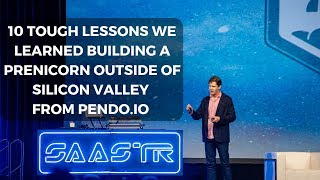
Pendo CEO Todd Olson built a $100M SaaS company in Raleigh, North Carolina by embracing regional identity, traveling constantly to win deals, and hiring remote talent. He argues that Silicon Valley perks are replicable anywhere, but Southern hospitality became a real differentiator, and that founders should focus on core metrics like net retention over valuation multiples.
Chapters
Good afternoon. Welcome. It's great to be here with all of you. And so Pendo, my company, is headquartered in Raleigh, North Carolina. Thank you. Thank you. Guys, can I see a show of hands for those of you that have headquarters outside of the Bay Area, maybe a secondary market? OK. No surprise. Not all of you. Well, look, starting companies is really, really hard. Starting companies outside the Bay Area is even harder. So, one, I love the fact that everyone's trying. So that's really, really positive. But, you know, look, access to capital, access to talent, there's simply less of it outside the Bay Area. You can read blog posts, tweets about why you shouldn't try to create a company outside the Bay Area. A number of VCs, prominent people, smart people, will tell you not to even try, to kind of give up and just join what's going on out here. But it doesn't— it's not impossible. And there's plenty of success stories. And my goal today is to share a few lessons that we've learned and how we've gotten to this point headquartered in Raleigh, North Carolina. So when we started the company, when we were just 5 people in a coworking space, we actually put an address in San Francisco, thinking, look, we want to be taken seriously. Let's put a San Francisco address on it. Um, we had this on our web server for 6 months, and invariably, every once in a while, someone would email me and say, hey, I'll be in SoMa, uh, tomorrow. Can we meet? Now, mind you, that's about a 6-hour flight. Um, I have no reason otherwise to go to San Francisco to meet this person, and, um, I honestly never went to the space. So it was a friend of a friend's address. And it was interesting that early on we felt we wouldn't be taken seriously unless we actually put a San Francisco address on our website. After about 6 months of this, I got really frustrated and angry. And it's like, look, we are not being authentic. We are not embracing who we are. So as part of a rebrand and a relaunch of our website, we actually started to finally embrace the fact that we were made in North Carolina. We actually— have a North Carolina map on our website. We have a little heart in it. And ever since that point, we've really embraced who we are. And we've tried to now think of it as, how do we take what's unique and differentiating about our region and make it a positive? So one of the aspects of our area is southern hospitality, treating customers really, really well, going above and beyond, being thoughtful. And we try to say, how do we— infuse Southern hospitality into our brand and make that a differentiator rather than being stressed about the fact that, you know, there are some negatives to being where we are. So again, it— we felt that there was much greater value in being authentic than trying to be someone that, that we weren't and try to find positives. So, so wherever you live, wherever you're from, there's something really unique about that area. I encourage you to think about what's unique. Think about what's differentiated, and use that as a positive. Also part of that is being intentional about who you want to be as a company. When we started this company, and I think this is one of the great things about being in SaaS, and all of you are at a SaaS conference, is that you can address the entire world. The world's your market, right? So when we benchmark ourselves, when we started this company, we didn't say we wanted to be the biggest company in Raleigh. We didn't say we wanted to be the biggest company in North Carolina. We want to create a category leader. We want to be one of the biggest companies in the world, and we've always held ourselves to the bar of what are the top 1% of the companies in the world doing? How fast are they growing? How are they behaving? And we've always thought of ourselves as that's our comparative set, not our local region. So that's helped us make sure that we don't get too caught up in the fact of how we're doing in relation to other folks in our community. It was always make sure we kept a really, really high bar. So I'd encourage you to think and be intentional of What kind of company do you want to create? Who do you want to be? Who do you want to compare yourself to? Look out 4 or 5 years. What company do you want to be? And the good news is you're at a conference where there are a lot of amazing examples, amazing companies. And we first went to SaaStr 3 years ago, and we picked a few examples of companies that we wanted to model ourselves after. And that became the bar. That became the goal. The second thing, which is fairly obvious— and look, you guys, pass this test, right? Be willing to travel. I'll never forget, we about a quarter into selling customers for this first time, we had this deal that was just stalled. It was in Utah, it wasn't moving. I kept trying to schedule a phone call, trying to schedule a phone call, and it was getting really, really frustrating. Finally, I gave up and said, "Look, I'm gonna be in Salt Lake City tomorrow. Can you meet in person?" The person said, "Sure, I can carve out half an hour of time." So I immediately left the office, went home, packed a bag, went to the airport, booked flight, showed up there at midnight, met with the individual. We ended up signing that contract in the Uber back to the airport on the way off, on the way home. It was our largest contract to date, kind of helped seal the quarter. It was the last day of the quarter as well. So if I was not willing to just put myself out there and get on a plane, we would have never closed that deal. I think I do this time and time again. I spend a lot of time going to events. Part of one of the great benefits of some of the investors that we've raised from is that we get invited to a lot of great networking events here. It's a positive thing. I've always gotten a lot of value out of hearing tips and advice and stories from other founders that have been successful that are a few years ahead of us. You know, I make time for it, and that even means getting up, taking an early morning flight, and heading home on a red-eye to do a day trip to the Bay Area. I'll do it. I think it's that willingness to travel that continues keeping us ahead of the curve, continues teaching us how to continue building a great business. So Our Series A, when we actually closed that, a lot of people hadn't heard of us. We're again, this small company in North Carolina. We ended up getting introduced to Battery Ventures via a customer. So we weren't raising money. We weren't trying to raise any money. I had no— honestly, we were just focused on taking care of customers, building a great product, taking care of customers. And through the process of taking care of customers, customers introduced us to investors. As someone interesting, someone to look at. Um, had that meeting, did not have a deck, had really honestly no sophisticated pitch. Uh, I don't think I was even that coherent in the description of the company, but I talked about customers, and I talked about what we were doing for customers, and the results those customers were seeing, and Battery followed up. They talked to all the customers. They did reference calls, and turns out they said really, really good things about us, And lo and behold, it led to our Series A. So I think a lot of people talk about, oh, I'm fundraising right now. I got to get the right pitch. And I got to build my list of folks. Sometimes you just need to focus on getting really amazing customers saying great things about you. And there's no replacement for what customers can do for your business. It's never a waste of time to find a great customer and take care of them, and that's led to, frankly, a lot of our success to date. So 2 years ago at SaaStr, I was huddled up in a room trying to close on a chief product officer. I had met an individual, he actually bought our product, we really hit it off. He was a VP of product at a Series D startup startup, so a little bit ahead of us, and we just had a real connection, real connection, but there was a catch. The catch was he had just moved his family, 4 kids, to New York City. Now we have no New York City presence. Our entire company's in Raleigh. Our entire development team's in Raleigh. Our entire product management team's there. I'm there. This was a problem, and you know, I had my CTO, and I would be like, "You can't do this." This is never going to work. But I knew he was the right person. I had a good sense. I mean, we had an alignment of vision. We had just— we really gelled together, and I wanted to work with him. So we decided to be flexible. And through that, we actually opened a New York office. We hired him. And my thesis always was, if you find the right person, be flexible, and the right person will make it work. And sure enough, I mean, he's traveled when he's had to travel. He's been there. And lo and behold, fast forward to today, he recently is under contract of a house in Raleigh. He actually is moving. So it ended up working out very, very well for everyone in the long run. But I think if I wasn't flexible, I wouldn't be here today having that. And that goes for other talent as well. Our chief revenue officer, another Jason M. Lemkin, one of our senior leadership, lives in Scottsdale, Arizona. Still to this day, I've not been to Scottsdale, Arizona, and it has not been an impact on the business at all. Honestly, for folks that work at our company, I doubt most people actually know where he lives. That's okay. He makes it work. A lot of us as entrepreneurs, certainly early-stage entrepreneurs, we get this idea this person must be here. I'd encourage you to, like, if the person's right, just figure out a way to get it done. You know, a lot of what you see on TV about a Silicon Valley culture, and I do mean the good things, not the bad things, can easily be replicated. You can buy a sit-stand desk. You can have an open PTO policy. You can have kombucha in your office. They make it all over the country. You can have beer. You can have a transparent culture. All these things are actually pretty easy to replicate. So, um, you know, it's a pretty common practice for someone from the Bay Area to walk into our office and say, "Oh, it feels like we're in Silicon Valley," like we somehow did something magical by buying similar furniture and having similar perks. But the good news is, is in our geography, we actually are pretty unique. It actually is differentiated, what we do. It's actually a positive for us. It's not just, what everyone else does all around you. So there's a lot of goodness to some of the, I guess, less traditional things about a Silicon Valley culture, and we've embraced it, and we constantly look at our perks and our benefits and make sure that we stay competitive with best-in-class companies doing out here. I mean, ultimately, having best-in-class benefits attracts best-in-class people, and our business is a people business. You want the best people at your company. So this is something that's very easy to replicate that is honestly a no-brainer. I would just do it. You know, it works for a reason. So this is something very easy to bring into your culture. Look, we're a Diamond sponsor here, if you didn't notice, right? So you see a lot of pink around. So you have to take every advantage to build awareness. Given that we don't live here, there is no word of mouth. We do now have an office here, but that's very, very recent. So we have to go above and beyond to build awareness, above and beyond to build brand. We actually did an out-of-home campaign, which is a billboard campaign, bus terminals. If you had told me 3 years ago that we'd have billboards out here, I would have thought you're crazy. As you all know, it's very difficult to measure ROI. The reality is we have to think differently. We don't have the benefit of being here. In order to be present on people's minds and be seen as a leader, we have to build our presence, and part of building a presence is spending money to build our brand image. The Diamond sponsorship here, out-of-home campaigns, like I said, traveling and being willing to attend events. I was just talking to someone that knows me in the community that says, "Wow, you go to a lot of events." Well, yeah, I go to a lot of events. One, I learn. I can't walk down the street and talk to a unicorn CEO that just happens to be walking around downtown Raleigh and grabbing coffee. If I want to meet these people, I have to go to them. I have to come here. So we take every advantage of any opportunity for us to get in front of people, to share the Pendo story, to build a relationship, build a connection. So this is a really, really important part part of being outside the area. It's kind of like a tax in living outside the area. But you have to be creative. You have to be bold. And we've done a lot of interesting things. But the other thing that I think we've done very successfully is not just focusing on the Bay Area as a geography. Believe it or not, people live all over the world and country. So we've actually done a lot of local events in— Vancouver and St. Louis and of course Austin and Boston. And we actually have a really good brand presence and reputation and customer sets in all these cities. So I think we have an advantage of being outside the area that we've built, you know, we've taken advantage of this and built quite a bit of awareness and all over the United States. You know, we've raised, just for context, about $100 million, and I think by most measures they've been, you know, good valuations, competitive deals. You know, I'm certainly not, you know, I thought we did a good job, but, you know, last week I'm in the Bay Area, I'm sharing a ride with one of our investors, and he starts sharing with me this number that had, you know, 100x multiple, and You know, it's pretty easy to feel like a failure once in a while. You walk around here and people talking about multiples and post-moneys and all these things. And I have to remind myself that one, every business is different. Every market's a little bit different. Every deal's a little bit different. And honestly, the multiple and the post-money and a lot of the metrics they talk around out here aren't necessarily the metrics that matter. You have to constantly remind yourself revenue, revenue growth, retention, net promoter score, eNPS, employee net promoter score. These are the numbers that really matter. If you have happy customers, if you're growing, if you have good net retention where your core revenue base is organically growing, if you have NPS, which is good word of mouth and references, if you have really happy employees that, that love coming to work and take care of customers. There's the numbers that ultimately matter. That's what you should be focusing on, focusing on your, your post. Look, I mean, yes, there are financial consequences to these numbers, but, but they're not really what matters. And honestly, if you focus on the, the other metrics, you'll get the multiples, you'll get the funding, you'll get— honestly, you'll, you'll get what you want in terms of hitting those next milestones. So I think it's always, always critical to focus on what's core forward to your business. Look, building a business is a team sport, and part of a team sport is your investors, is your board syndicate. And I would encourage you to get the best possible investors. And when I say investors, I mean people. I mean humans. You know, we've had two rounds, our Series A and Series C, where we had a single term sheet. So we did not shop it. We did not get competitive offers. And that frankly is not the advice you'll hear from a lot of entrepreneurs. If you're going to a talk on fundraising, they'll say talk to as many people, make it competitive. The more competitive the deal, the better deal you're going to— that's conventional wisdom and that's what you'll hear. But I would argue that you should place a bias on getting the best possible people involved in your company because people are ultimately what's going to affect your day-to-day. Trust me, there are, there are some situations that can cause serious pain for you in terms of how often they call you and what questions they ask. And this, this really, really matters. So, um, I would encourage you to think about the person, even if it means you take a slightly worse deal, to get the right people around the table. So again, our Series A, um, battery, it was We like the people. We did the deal. Our Series C, Maritech, I'd known Rob Ward for 5+ years. You know, I mean, there's a lot of value in that relationship. So we brought him on board for that reason. And honestly, in all of our other rounds, we did an extensive number of personal references on the individual. In our Series D, we We did about 15 references all in all on evaluating our investor syndicate to make sure not just the firm, but the individuals of the firm are the people we want to partner up with. I got good advice early on that raising money is a lot like getting married. It's just a lot harder to get divorced. In many cases, nearly impossible. This is a really long-term commitment, and I would encourage you to understand the people, understand what, what you're getting involved with. You know, I think Reid Hoffman's book The Alliance, he talks a lot about getting, getting intelligence and building a network through your employee base of how you understand what's going on in the market. This is really, really critical. It's especially critical if you're not in the Bay Area. By not being here, you just don't have access to insider information, things that are going on. For example, I referenced us hiring a Chief Revenue Officer, Bill. Honestly, I had no idea he was looking for a job, no idea that he was on the market, but it was through meeting with a network, again, investors, other folks in the industry, we kind of found out about it and got connected. I would encourage you just to, when you're traveling, when you're meeting with people, invest in getting, coffee, getting intelligence, everything from whether your competitors are raising capital, whether folks are looking at an acquisition. We've been really fortunate by building relationships out here that we get a lot of early warnings when these things happen. The early warnings are useful because while you probably can't change the outcome, and you probably won't change the outcome, you can better prepare for it. You can prepare communication. You can prepare what your potential response is gonna be. Honestly, I'd rather know something's gonna happen, good or bad, in advance so I can at least prepare for it. By knowing, it's put us in a very strong position for being thoughtful about our business and not being reactionary. This is something that's not that hard to do, but encourage all of your employees when they're traveling or they're meeting with folks or meeting with folks, just ask them what they're hearing in the grapevine. What's going on? What do you hear about us? What are our customers doing? And use that network to build a kind of an intelligence network and share it across your company. You have a channel in Slack or whatever tool you use to share this sort of information. It's incredibly valuable to keeping your fingers on the pulse of what's going on. And again, because you're not here, you have to overinvest in these sorts of systems. Well, the good news is it gets easier the bigger you get. And, um, you know, the interesting thing now is when I talk to a number of CEOs, uh, even headquartered out here, they're asking me about, hey, we're looking at setting up a second office outside the Bay Area. You know, can I talk to you about Raleigh? Uh, or I hear, you know, people looking at, um, Arizona or Austin or Nashville. Um, but now as people start getting— you start getting to the Series C, the Series D range, start starting to think a little more, more efficiencies. And then frankly, you start looking at your company and thinking, if I'm really going to scale this, so I'm going to hire lots of people, you know, competing against the Googles and the Facebooks, just one, it's very, very expensive, but two, it's very, very difficult to access the best possible talent. So you eventually get to a certain stage where the fact that you're outside the barrier is seen as an advantage. And I've talked to several late-stage and growth investors that actually like investing outside the Bay Area more so than inside. So I think we are seeing a little bit of a sea change in terms of trends here, but I think it absolutely, from my perspective, feels very, very different today than it did before. And honestly, once you get to a certain size, people are willing to travel to see you. When you're small, no, you're probably gonna have to go to see them, but when you get bigger, people get on a plane for a company that, that's of a certain scale. So, and We're finally kind of in that position where people are willing to get on planes to visit us. And, and so there is hope if you're in a place where it feels like there isn't. You know, soon you hit a certain scale, gets a whole heck of a lot easier. So I kind of close on, you know, kind of an 11th point that, that I have, and that is if you are in a small market and you start seeing success, one thing you need to think about is What sort of impact do you want to have on your community? And one of the things about being in a smaller market is as you achieve success, you start becoming a big fish in a small pond. I know that's often seen as a negative comment, being a big fish in a small pond, but it's the reality of the situation. And when you're a big fish in a small pond, there's no one else around you, behind you, helping you grow the pond. If you aren't growing it, no one's growing it. I personally devote about probably 10%, maybe 15% of my time to mentoring young entrepreneurs, volunteering my time in coworking spaces, spending time with local universities. We host a lot of meetups in the community. Not just me, it's our entire leadership team and executive team is invest in your community because ultimately, your success could be constrained by the overall success in your community, your community's ability to recruit people, your community's ability to create, honestly, a quality of life. So if you don't invest in it, there isn't anyone else doing it for you. There's no one else to draft off of. So when you think about building your business, you're also not just building a company, but for some of us that are in smaller regions, you're building a community. And it's something to be cognizant of, and something that's become more aware to us as we have gotten to our scale. But thanks for being here. Appreciate seeing everyone, and enjoy the rest of the show. Thanks.
More from Jason

Why Your Next Hire Should Report to an AI, Tragedy Apps, and Too Many AI SDRs? | The Agents #004

Our Agents Drove Our Salesforce Bill Up 80%, Marketo Hates Agents, and We Stealth-Churned Off Notion




Managing 20+ AI Agents: Lazy Agents, Our $500K AI Bill, Stealth Churn & the Death of 60% Solutions




