“5 Secrets to Maintaining Product Velocity as You Scale” with Drata’s VP and Director Product
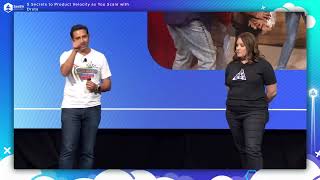
Drata's VP and Director of Product explain how they shipped 350 features and 100+ integrations in two and a half years. Their five secrets: ship at 60% completeness and iterate, obsess over customers not competitors, say no ruthlessly, balance vision with quick wins, and hire only hell-yes people.
Chapters
To the stage, Brian Elmy, VP of Product at Drata, and Dana Mauger, Director of Product Management at Drata. Hi everyone.
Good afternoon.
How are you?
Good. Awesome, thank you. So I am Brian Elmi, VP of Product at Droda.
Hi, I'm Dana Mauger, Director of Product Management at Droda.
And we're going to take a few minutes to talk to you about 5 secrets of product velocity as you scale. And spoiler alert, these aren't really secrets. This is probably things that you already know. But it is much harder to do in action than in theory. So we want to kind of go through them and give you examples of how we're using these every day at Drata as we have scaled the product organization over the past couple of years. So, but first, let me give you a quick primer on if you're not familiar with Drata. We are a compliance automation platform. What that means is that we connect to our customers' tech stacks, right, from their infrastructure like AWS all the way to their ticketing systems like Jira. And we automate, continuously monitor their controls and collect evidence for their security and compliance controls in place. So what this means for our customers is that we can, we can identify any gaps in their security and compliance posture in real time and alert them to actions they can take to remediate, remediate those. And we can— we're collecting evidence as proof that these controls are effectively implemented. So when it comes audit time, when you turn the keys over to their auditors, they are very confident that they are in a really good state. Make sense? So, uh, we have been in business for about 2 and a half years. So we are a very relatively young company and have had massive growth over the past couple of couple of years in our product and in our business overall. So we started with just automating SOC 2 compliance and have really quickly automated over 14+ different frameworks. We have introduced our Trust Center capability. We have introduced our Enterprise Risk Management capability, Work Center capabilities, our audit collaboration capabilities, over 100+ integrations. And all of this in just 2.5 years. We've listed about 350 different features and 100+ integrations. So hopefully that gives you a lot of context on what we're here to talk to you about. So the first thing that we want to cover is this idea of shipping fast and iterating even faster, right? So we have a principle at Droda that our team uses that is all about 60% of use cases shipping really quickly because the opportunity cost from getting to— from that 60% to 90% sure is enormous. You're going— what you're going to do, you're going to spend a ton of time researching. You're going to make a lot of assumptions that may or may not pan out to be correct. Right. And you might end up shipping the wrong product and you've taken just a long time to ship that. So what we say is Let's ship this at 60%. Let's put it in the hand of users. Use real data, real users to measure the success of this and how the features are being used. And then we have a feedback loop from our customers and our partners that tells us, hey, are we on the right track or are we not on the right track? And we are real-time modifying the priority of the following iterations that we're going to go after. So this idea of shipping fast at 60% It's been key for us.
Number 2, be competitor aware but customer focused. So at Drata, one of our core values is customer obsession. We basically take it to like just one step before stocking. So yes, of course, we need to be aware of what's happening in the marketplace, what our competitors are up to. But the bottom line is your customers are the ones using your product. Not your competitors. The problems that you're solving are your customers' problems. Hopefully you're your competitors' problem, right? So we could spend energy and time reading competitor press releases and articles and blog posts and billboards and yes, we gotta know what's going on there, but the more energy that's spent there means more time and energy and focus taken away from our customers. We at Drata have teams that are totally focused on building product and new functionality and really shipping big things. We also have teams that are totally devoted to customer obsession. We actually call them our customer obsession teams. That's an opportunity for us to try and get smaller enhancements and delighters, things that maybe didn't make the roadmap, but little things that we can continue to say, we're listening to you. We're taking your feedback. We're putting things out there and we can move quickly with those teams. Keeps the other teams that are focused on maybe delivering larger feature sets or products. It keeps them moving quickly and it allows us to still focus on what it is that customers need and to deliver it. They also are responsible for handling really high priority customer support issues as well. It's really the ethos of, you know, focusing on the customer, identifying their problems— long-term, short-term, immediate— and solving for those. But don't take my word for it. Someone once said it better. Yeah, I'm sure a lot of applications will be written for the business world. Do you think that RIM should be worried, and what is the message for them?
Well, You should go ask them. I have no idea what they—
message that you're sending them.
We're not sending them a message. We're sending customers a message and developers a message that we're going to try to serve their needs. I mean, we went around and asked a lot of enterprise customers what they wanted, and that's where we got our list from. We didn't make it up ourselves.
Exactly right. This is about addressing what customers want and making the best product ever for enterprise customers because we listen to them and we move quickly to make a killer product. That's what we're doing.
Yeah, remember the iPhone has been out for less than a year. This stuff is going to be shipping, you know, right around the 1-year anniversary of the iPhone. To every iPhone user is a free software update. So we've been moving pretty fast. Scott and his organization have been busy.
Good, good. We have been very busy. Exactly.
Number 3 on our list is embrace ruthless prioritization. So I always say that as product managers, we are people pleasers who have to say no. Or we have to say not yet. Or we have to say not now. And sometimes you gotta do that, especially in the early days, especially early on when you've got so many things coming at you and so many places you wanna go and goals you wanna achieve. But, but you do have to say no sometimes, right? Again, early days, maybe there's a logo you really want to get, but the things that are maybe on their list don't necessarily align with where you're going or, or the steps that you need to take right now. A great example, in the early days of Drata, we had— SOC 2 was the only framework in the platform at the time. It was very, very early days. And a conversation with a customer, They were giving us their feedback, pain points around risk management. Are you going to build a risk management tool? Are you going to have that? Is that in your wheelhouse? And at that time, we said no. It wasn't even a not yet at that point because it was such early days. It was a no. But we got that feedback. We talked to other customers. We talked to prospects. We knew where we wanted to go. And while we couldn't say yes then so we could focus on adding more frameworks to the application or more integrations or building out other capabilities. Within 24 months, we now do have a risk management capability in the application. So it was a no, not yet back then. So we could get to where we are now to say, yes, we've got it and we're going to iterate on it.
It's, it's really hard to say no. And I think in that, in that theme of focus, which is kind of what we embrace day in, day out, I wanted to kind of talk about sort of this is balance between vision and execution, right? So as product people, you need to— actually, you must have a vision for where your product is going to be a year from now, 2 years from now, 3 years, 5 years from now. But if you are spending too much time dwelling on that vision and what that ideal state going to look like, then you're going to lose sight of what's really important today because your customers aren't going to pay you for what your product, what your vision is 5 years from now. They have real problems today that your solution could solve for them, and that's what they're paying for today. That is the value that you're delivering to your customers. So, so you want to of course have a vision, but you want to be very focused on building step by step towards that and delivering value to your customers that they'll pay for along the way. A great example of this is our enterprise risk management offering. So we have a very clear picture of where we want it to go, including our sort of third-party risk management about 3, 2 to 3 years from now. But we're not waiting for that perfect ideal state to ship the product because our customers have a need today and we can solve, you know, we can ship an MVP on our way to building and achieving that vision, right? So the real problem is get us out of spreadsheets, right? But great, we're going to have an MVP. That's going to help you with that, right? There is value that we're delivering along the way, but you got these pieces of the puzzle that you're putting on your way to achieving that vision. So don't think about perfecting that vision because that is going to change as soon as your customers put their hands on it. As soon as they start clicking through your product, things will change, right? So you want to be very careful about not spending too much time on that. And then number 5 is that it's more than just product. So when you're thinking about scaling your organization, your product organization, it's 3 pillars that we look at. It's your people, your process, and then your product, right? So you want to focus on— we focused on hiring the right people. Trust is one of our core values, and we are using it not just our organization with our customers, but we're using as a principle with as part of our hiring process, right? So we go through our hiring process, we have multiple people that are involved, and we just say, "Hey, if this person is not a hell yes across the board, they are a no for us." And that is really key because we want to hire the right people in place. The second, it's processes. So honing in your processes and that feedback loop that I talked about early on, It's, it's very important to build that from the ground up before you scale. Right. So we have data points that we use from all the way from our prospects. Our sales team use that to tell us exactly what features or what, what, what, what capabilities some of our prospects are interested in. That data feed goes all the way to our customer success team. Right. To figure out what our customers are saying, how they're using the features. And capabilities, and that comes back to our product team, and just around it goes. And we have honed in that cycle and that process, so we're getting real-time feedback from prospects all the way to when they become customers, all the way to when they use the product, and back and forth. And that has helped us to really understand the product and our customers, and then build quickly around that. And of course, the last pillar is you want to have a— you want to have a product that solves the right problems. And we've kind of already talked about that. So those three pillars, it kind of talks about it's just, it's more than product. It's that entire people, processes, and your product combination that's going to help you to scale.
So to recap our takeaways, product velocity is anchored by your commitment to your customers, right? Trying to solve customer problems. You're in business for your customers and getting the entire organization around that is really what will help you grow and scale quickly. It's what's worked for us. Number 2, striving for perfection will probably lead to regression. It's true in product development. It's true in life. Progress, not perfection. You've got to start taking those brushstrokes to get your masterpiece and really making sure that you're intentional about what you're delivering now so that the broader picture does get painted, but that you're not so overly focused on that that it's slowing you down. And then number 3, success requires alignment across the organization. It takes a village, right? So as Brian was saying, it's not just, or in addition to our sales feedback on prospects and our customer success team on our customers, this is aligned all through the organization, leadership, marketing. Engineering, we are all moving in the same direction so that we can move forward quickly. And hopefully you're finding that to be the same. And as Brian said, these might not be secrets, but these are some tips and some things that have worked for us and love to connect and find out what's working for you all.
Yeah. So hopefully that was a little bit insightful in terms of how our product organization across the board works. Obviously, there is a lot more lessons that I'm happy to to share— that we're happy to share with you all. So find us afterwards. I'm happy to connect and learn from you too.
Thanks all.
Thank you.
More from Jason

Why Your Next Hire Should Report to an AI, Tragedy Apps, and Too Many AI SDRs? | The Agents #004

Our Agents Drove Our Salesforce Bill Up 80%, Marketo Hates Agents, and We Stealth-Churned Off Notion




Managing 20+ AI Agents: Lazy Agents, Our $500K AI Bill, Stealth Churn & the Death of 60% Solutions




