"5 Steps to Launching a Product" Cloudflare Head of Products Jen Taylor
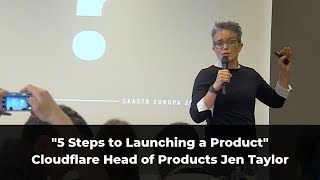
Jen Taylor, Cloudflare's Head of Product, outlines five steps for launching SaaS products: drive awareness with a clear value proposition, enable activation through simple onboarding, support customers to hit promised benefits fast, deepen relationships over time, and measure what works. Start planning launches the moment a concept is approved.
Chapters
I'm Jen Taylor, Head of Product at Cloudflare, and I thought I'd go ahead and get us kicked off and talking frankly about one of my all-time favorite topics. So I spend the better part of my day working with engineering, marketing, and design to build products, but the thing I'm truly passionate about is launching them. Because especially in a SaaS business, leveraging the launch moment to grow and drive adoption and engagement is critical. If you step back and think about it, in a SaaS business, what you're really trying to do is drive awareness, drive adoption, and drive recurring engagement to keep and grow that revenue stream. And so using the launch moment and using that as a way to really facilitate that adoption is critical. And that's a big part of what I'm gonna focus on today. So first things first, where I see teams go astray. It's about when you start thinking about your launch. So teams tend to go astray if they wait until the very bitter end. This is a software development process for those of you who may not be familiar with it. Where teams really go astray is they sort of like, "Great, we finished coding it. We're ready to develop it. Okay, I'm ready to push it live tomorrow. Let's engage and write some marketing message and push it to the website." Not gonna work. If you really wanna leverage your launch moment to drive adoption in your business, the best time to start planning your launch is actually when you have decided you're gonna build the thing and you're in the process of working on your requirements. Because you'll be amazed as I go through how many of those requirements are gonna tie intimately into how you think about, develop, and deliver that product. Okay, so next question you need to ask yourself. Okay, I know what I'm gonna build and I know what I wanna deliver to my market. Now what kind of a launch is it? Is it like a big bang, like big sizzle, juicy 1.0, like headline-making moment for me? Or is this a more incremental moment? Is it a beta release? Is it additive capabilities and functionality that I'm adding to my product? And again, in a subscription business, you're gonna have both. Both of them for the sake of your sanity, your team's sanity, and frankly also your customer's sanity. You need a healthy combination of both over time. You're gonna wear everybody out if it's constantly like everything's a headline, headline, headline. And also you wanna make sure you take advantage of the opportunity to have some of those more quieter moments and to really expand and deepen the relationship. The next thing to think about is when do you wanna land? Do you wanna basically, make a moment out of it, or do you want to build upon and leverage on a moment that is already there? Now in terms of making a moment, the classic make-a-moment opportunity is like, I'm gonna put on my black turtleneck, and I'm gonna stand up with my iPhone, and I'm gonna launch it to the world. But those moments are actually few and far between. Those events tend to be expensive and difficult, and often more difficult for startups to create at scale 'cause they tend to be expensive and you may not actually have the audience that you can pull into a room directly. But you can think about making a moment in other ways. So one of the ways we do this at Cloudflare is— we actually just did this a few weeks ago— we bundle a bunch of our launches into what we call like a week. We did Speed Week recently, and we took a bunch of our smaller launches and bundled them up into a moment around a central topic, and then we did a lot of community outreach to effectively create a moment and create visibility and awareness. The other way to do it is to actually leverage a moment that already exists. And this is great especially for younger companies where you may not yet have awareness or attachment with your audience. You might want to look to a moment where there are things happening in the ecosystem that will pull your audience towards them. So for example, if you are working with a developer audience, like do you want to do something at JS Conference, right? Are you trying to reach those developers? That would be a really good time to do an announcement and have a moment. And again, sort of think about what is the balance, how do you want to invest, and how are you going to be able to reach and engage your audience. OK. So now I get to my 5 steps. Those are my cheat steps I had. OK, so really if you think about what you're trying to do here as you launch your product is you really want to help take your customers on that journey. You want to go from the moment of being able to drive awareness all the way through to the ability to retain and grow that customer. I tried to get my design team to make this a circle, but it didn't happen, right? So this is a circular experience, and I'll talk about more of that towards the end of the presentation, but imagine a circle. So the first step is driving awareness, and when we think about launching a product, this is typically the classic moment that everybody's like, "Okay, I need to write some messaging. I need to create a website. I need to get out there, and this is what I need to think of when I launch." Yes, you need to create this, but a couple things to consider. Make sure you step back and think about like, who's my customer? What's the problem I'm trying to solve? How do I articulate that value proposition and that solution in the language of the customer? One of the things I've noticed specifically we struggle with at Cloudflare is like we're a bunch of nerds with social skills, right? And we'll go way deep down into the technology and oftentimes it'll go whoosh right over the head of the customer. So be very thoughtful about the tone, the approach, and the way you're talking about actually solving that problem for that customer. And the second is, whenever possible, leverage the community to help you tell that message for you. The example I like to use here is if I tell you I went fishing last weekend and I caught a fish and it was that big, you guys are like, "Oh, that's kind of interesting." But if somebody here in the front row said, "No, no, no, for reals, I saw her fishing last weekend. She's a madwoman. She caught like a mako shark. It was huge. It was amazing," my story starts to create more weight and more credibility. And so to the extent that you can find people who will help you articulate the benefit that you're delivering to your customers, leverage that. Never shipped anything before, brand new company, think about how do you leverage your beta customers? How do you leverage your early testers? How do you get those testimonials and those value propositions? Don't have customers you can talk to yet? Think about what are some of the statistics and value propositions you can ascertain from what you've been able to tell. For example, We anticipate you'll have a 20% performance gain as a result of this. Again, that value proposition really compelling. You want to hook them and get them in. Okay, but the next thing is once you've actually hooked them in, and this is what— part of the reason why you start the process so early is you want to make sure that when you create that awareness, when you make that investment, whether you're putting money on the table to buy ads or an event or you're spending your own time and energy, you want to make sure that as you're taking those moments to drive awareness, you can enable your customers to take action on the information directly. And this is often one of those times where, again, that hook into your product organization and your product development process is critical. 'Cause you wanna make sure if you're like, "Brand new service, please come sign up now," the signup flow is up and it's working. You wanna make sure that they have an opportunity to jump right in and seize the moment. This actually is one of the most critical successes for SaaS launches and one of the ones that I often notice that people really struggle to remember. It's like your design team is going to convince you that they are better artists than Picasso and that they have built the easiest, most intuitive product ever known to man. And that may be true, but don't risk it. What you want to make sure is that once that person takes action in your application, in your experience, whatever, they have an opportunity to get started and be successful available immediately. And this is that tipping point where you're really converting that, like, I've acquired the user and now I'm trying to think about how I get some modicum of adoption to kind of engage them and lock them in. So some things to think about here specifically as you're thinking about your development process is, how do I have simple, easy, guided flows? How do I help users get started? How do I onboard them easily? What sort of product documentation and tutorials can I make available? How can I make it easy and intuitive? How can I help them achieve their top 3 value propositions, the things I was telling them I'm gonna do for them? How do I help them achieve all of those things in less than 15 minutes? My main suggestion on this one is test it because this is the other thing I've noticed specifically for us at Cloudflare when we're moving fast and we're trying to launch something. Sometimes we get so caught up in our own ether, we write documentation for ourselves and we skip Skip steps. So this is a great activity, like, to enlist everybody's, like, parents and grandparents and stuff like that to actually test the onboarding flow, test the documentation, test the getting started. This is also another critical one and one that I think is— also requires a great deal of forethought and training up front, which is make sure you have resources to help your customers get successful. Because again, if you're thinking about what you're trying to achieve with these customers and with these launches, You're trying to drive awareness, adoption, engagement, and retention, and support is often a critical component for retention. So again, think about how do I provide different types of support for the different types of customer experiences? What types of customer supports am I at scale to provide, right? Fairly easy, provide some documentation, some scalable one-to-many resources like knowledge base articles, but also make sure that if you decide you're like, you know what, we're gonna put a Slack channel up and if customers have questions, They can just post to the Slack channel. Make sure you staff the Slack channel and make sure you have that SLA and you follow through because again, this is part of the engagement and the experience that customers are having with you and with your company. Other critical thing is to remember many of us are small. We may not have support organizations. That's okay. Just make sure you have a team or a staff or somebody who can actually pay attention to the questions that's coming in and can route them. Also make sure that the people who are paying attention and routing these products— uh, projects and questions understand and know the products as well as they need to. Again, because these are gonna be the representatives and this is gonna be the glue between you and your customers. Okay, so congratulations. You've launched your project. You've gotten it out into market. People are using it. Now is the time to think about how do you continue to deepen that relationship? And if you're lucky and successful, you're gonna continue to ship incremental things as you go. But the way I like to think about my customers is they're like my friends who live at a distance, right? My friends from university like to keep in touch with me over Facebook. My friends of mine from elementary school like to get my Christmas cards. You know, and other people actually like me to call them every once in a while. And it's important to understand a little bit about your customers and how they like to engage and to have a variety of different mechanisms and channels and to experiment with them. [FOREIGN LANGUAGE] Okay. Expect the unexpected. Launches are intense and exciting and emotional times, but it is for this very reason that I think it's critical for everybody at the outset of a launch process to clearly define the criteria for what we're trying to achieve, what we're trying to achieve from a product perspective and a market perspective, and to have consistent check-ins on how we're proceeding to that goal. Other thing I recommend is have a decider. Decide who the decider is because in the moment that you actually have to make a hard call about like, do we slip the launch? Do we go with this without this feature? Is the bug count okay? Is the marketing okay if it's not local? You need somebody who can help you crisply and cleanly make those decisions. I also recommend highly having a plan B because more often than not, there are gonna be aspects of that plan B that you're gonna have to pull in. And that's okay. I mean, again, the most important thing is you have— one, that you have launch, and two, that it's successful. But most importantly, that the team knows how to do it. The other one that I didn't include on the slide that I was thinking about this morning as I was brushing my teeth is— this is super tactical but really valuable and something I've learned the hard way time and time again. Create a little bit of buffer from the day that the engineering team says they're gonna be done with it and the day that you wanna push it out to your customers. Just saying, sometimes things slip. Just give yourself a little time and space. OK. OK. How do you know if your launch has been successful? Well, ideally you've set out at the beginning with some goals and objectives about what you hope to achieve in terms of the blast, the radius, the attention, and the market you're going to be able to drive. You probably have set some goals for yourself in terms of how many— what the conversion rate is going to be and how many people are going to sign stuff up. Instrument all of the things. We live in an era and a world where so much of what we do we're able to actually literally calculate. And we're actually literally able to measure against. Those. And people are like, "Well, can't you put down what your conversion funnel is and show them?" It's different, frankly, for us for each of our different products. We have different goals and objectives. Some of the projects that we launch, we launch as a result of trying to frankly build a better internet and launch new protocols at scale. And it doesn't necessarily convert to revenue. But we definitely have other projects where it's like, "Actually, we're looking to this one to drive some cash, so let's see how it goes." And so the funnel and the metrics that you define are gonna be unique to your goals and your business and the importance of of the product to you. The important thing though to remember in this moment of the quantified life that we all live in is don't forget the opportunity to do a retro with the entire team. I think of launches as basically learning experiences again and again from the team. And I think it's often really important and powerful to bring together those cross-functional teams to debrief and talk about what went well and what could go differently. I've been amazed at how much insight and innovation we've seen in our launch process from people who aren't necessarily in the core of it, but have been seeing it on the edges, been a part of our community, and have been able to help us hone and drive it. If you're successful, this is hopefully what your life looks like going forward, right? You start, you launch one product. Nice job, get your first one out. Then you'll have an incremental release, another incremental release, and maybe you'll launch a second product. And part of the reason and the purpose, the point I'm trying to make here is thinking about how do you start building a launch machine within your organization and using this, using every launch as an opportunity to experiment. Try different things, big bangs, little bangs, incremental, making those moments. But again, there's this pattern and there's this ongoing rolling cadence that is critical to the long-term success of your business. But don't forget, again, every time you take your customers on a journey, you want to take them through that moment of driving that awareness, to driving that— the adoption and growth and deepening of the relationship you have with customers. Launching products is a very exciting but often emotional time, and so partner closely across your organization to really make it a success for your customers.
More from Jason

Why Your Next Hire Should Report to an AI, Tragedy Apps, and Too Many AI SDRs? | The Agents #004

Our Agents Drove Our Salesforce Bill Up 80%, Marketo Hates Agents, and We Stealth-Churned Off Notion




Managing 20+ AI Agents: Lazy Agents, Our $500K AI Bill, Stealth Churn & the Death of 60% Solutions




