5 Things I Wished I Asked Before Switching from Employee to Founder
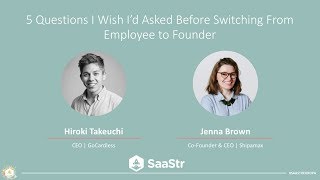
Hiroki Takeuchi, CEO of GoCardless, and Jenna, a former employee turned founder at ShipperMax, discuss what they wish they'd known before starting. Early founders often over-hire talented people who don't fit the stage, and values need to come from the founder, not consensus. Transparency gets harder as you grow, and you should focus on a few customer innovations instead of building everything in-house.
Chapters
Thank you everyone for coming. So I'm Hiroki. I'm one of the co-founders and CEO of a company called GoCardless. What we do is we make it really easy for businesses to accept recurring payments, and we're based in the UK, working with about 35,000 businesses, collecting £6 billion a year, growing about 100% year over year at the moment. And I'm joined today by Jenna, who I'll let Jenna introduce herself in a second, but actually used to be an employee at GoCardless. So I think one of the things that we wanted to talk about today was, you know, that transition from being an employee to starting your own business and what are the questions that, you know, come up as you go through that journey. So Jenna, why don't you introduce yourself and then we can get into the questions.
Yeah, so let me kick off. Um, so I'm Jenna, I'm the CEO of a company called ShipperMax. We help companies in the bulk shipping space, which most people don't know exists— ships that carry grain, coal, iron ore. And yeah, as Hiroki mentioned, we're, we're kind of very early stage. Um, now very curious looking at everything GoCardless is doing because I think since I left it's made quite a big transition into A lot of people. So kind of let's kick off. We last spoke quite some months ago when I was having some employee problems.
Yep, sounds familiar.
And we'd kind of made that traditional mistake of hiring, let's say, someone who was quite exceptional but was taking up a lot of my time personally managing them, and they're probably having a net negative impact on that team. So I guess the question is, how do you handle it when you've made that mistake?
Yeah. So I think that it's one of those mistakes that seems to be unavoidable. We've definitely made that mistake many times before. And I think that what I've found is that there's kind of two patterns of when you have people that are exceptional in many ways becoming actually a sort of a net negative impact on the team. So the first is when the team member effectively creates dysfunction. So I think that, you know, the example that I think we were talking about in your case, and I've seen a bunch of times before, is where you have an employee that kind of can't commit to decisions that are made and is so hell-bent on being right, and often is right, but, you know, can't go along with the decision decisions that you make, and that kind of dysfunction can really create a lot of tension and issues. And then the second is, as the company scales, people that were great at one stage not necessarily being the right fit for the next stage. And that can also create issues as well. So yeah. So those are the two types I've seen. But I think that one of the things I've definitely noticed is that it always seems like it's going to be worse than it is. To actually make the change and either get someone to leave or make them really change their behavior.
Yeah, so I guess kind of picking up on that, have you got— you've hired someone, it's not worked out, you need to let them go. How do you kind of handle that without demotivating the rest of that team?
Yeah, well, I think the thing I've always been surprised about is that when you kind of make those changes, you think it's going to be really negative and a really horrible experience. But typically, the team are a lot more in tune with these things than you are. So I've generally found that when that kind of thing happens, the team are already aware. And they're happy that it's happening, because it means that you can focus on the thing that matters, which is building the next stage of your business.
That makes sense. And going back— Any tips on how you can actually avoid making those hires in the first place?
I'm not sure your mic's working.
My mic's gone. Hello? Oh, no, it's back. So yeah, how do we avoid that happening in the first place?
Yeah, so this is something that I think for us we've definitely found that over time we've had to really think about what makes a great hire in a bit more of a structured way. So I think early on you can go with your own gut a lot more. Especially as you're hiring everyone yourself. You may not have a super structured or formalized way of assessing people, but you kind of get a good sense of what good looks like. But I think that as the team grows and, you know, you're no longer involved in every hiring decision, you need that structure. So for us, I think that there's— There's 5 things that we look at to assess whether a hire is going to be good or not. So the first is, you know, do they have the right experience for the stage that you're at and the task at hand? And, you know, you don't necessarily need to have that experience in every case, but if you don't, you need to be explicit about not having it and, you know, making sure that you're supporting the person around not having that experience. The second is, and in many ways I think this is the most important one, is attitude, right? Is like, you know, how do you think they're going to actually operate and, you know, how much they care about what they're doing. The third one is what sort of trajectory that you think this person is going to be on. So, you know, how quickly are they going to get from where they are today to where you need them to be, to be successful in the role. And oftentimes, that trajectory can be very fast. So you might want to hire someone with less experience, but with a really strong trajectory. The fourth is the values fit. So I think that it's really important to have those values as a company. And when someone doesn't fit with those values, that's when The culture really gets impacted. And then the final one is how driven are they? Do you think that this is someone that's going to really push and give it their all to make things successful? Which in an early-stage company is super important. You've got really little resources, very few people, a lot to get done. So that's a super important one as well.
So let's dig into that. Kind of core values piece. We actually about maybe even last week started thinking about what are those 3 top things we want to work harder than anyone else as an organization to be great at. When you started defining your values, how did you practically define those for you?
Yeah, we've been through a few iterations of values, I think. So the first thing I'd say is that I really wish that I'd done it earlier on. So when we first started the company, and I think it's really easy to fall into this sort of trap of thinking, okay, well, this isn't the most important thing. And I think it probably isn't in many ways, but it's also something that is much easier to do when you're at an earlier stage and have fewer people in the company. So we did our first set of values probably when we were about 30 people. And I think that was around when you were at the company, right? And the problem we had was that we took a really collaborative and sort of— a really collaborative approach to it and did it by consensus. And I think one of the things that I reflect on about the values that we ended up with then was that we ended up with a fairly muddled set of values that no one sort of disagreed with. At the same time, no one was really passionate about. And in particular, I wasn't super passionate about them, if I'm being honest. So I felt like it was really hard to champion those values and shout about them from the rooftops when you didn't really have that strong sense of ownership around them. So we definitely got that wrong the first time.
And who was it? Was that you and the other founders? Was it management team? The whole company?
I mean, it was kind of a little bit like the whole company. I can't remember. Were you at the company when we did this? I think I was. We might have done it just before you joined. We did it just before you joined, and we literally got the whole company involved. And we thought that would be a really good idea because we wanted to get a true reflection of everyone in the team. But I think in hindsight, that was probably a mistake.
Okay. So as you kind of started to do that second time round, what did you do differently?
Yeah. So one of the things that I've definitely personally struggled with a lot in building a company is that transition from being a sort of a merry band of fellow peers that are kind of working towards a mission together and it being really like side by side to, you know, the team being more structured, having to have more leadership in place, having to take more of a leadership role myself. And I think that one of the things that is really important when you go through that is You have to get comfortable with the idea that you're going to set an example, or you're going to make it something that you decide rather than something that you're deciding together. And so one of the things that we changed when we did the next set of values, which is the ones that we have today, was that I kind of embraced that idea of, OK, well, look, these need to be values that I personally really believe in. And using that as a starting point. And obviously getting feedback from other people and stuff, but really being much truer to myself. And then being able to embed that into the company has been a lot easier as a result.
And what was the kind of— I think you mentioned you got a kind of consultant to help pull out some of the—
Well, it was a coach, actually. I was working with a coach, this guy called Ren, who— He was fantastic. He coached the founders of Airbnb and a bunch of companies in Silicon Valley. He was super strong on that idea of the founder narrative, which I felt was really cringy and American. But I kind of figured, you know, he talked me around to embracing that. And I think that it's definitely been something that I still don't think I feel fully comfortable with it. I'm trying to embrace it a bit more, and that definitely helped me to take that more selfish approach, I guess, to saying those values. But I think we came out with a set of values that were more authentic as a result, and definitely easier for me to sell because I really believe in them.
So I guess just to take a couple of practical pointers from that, what were the one or two questions that stuck in your mind that Ren asked you? That helped you dig down to what those values would be for you?
So what I actually did was he encouraged me to basically write my sort of personal journey.
Did that feel weird?
Yeah, it was really difficult. It was really awkward. I sent it to very few people. But what I did was I kind of thought about what are the things that I care about through the lens of what I've learned through my life. And, you know, he was super fascinated by my Japanese side and the fact that I have Japanese heritage. So he kind of encouraged me to dig into that and things like that. And then I sent that to a few people I really trusted in the company and got them to sort of try and turn that into a set of values that reflected both my personal point of view, but also what we felt was true to the company as well. And then we kind of used that as a starting point.
And that group of people, was it management or people you thought really reflected those things the best?
Yeah, no, I purposefully made it no one on the management team. And it was all just people that I felt really reflected the values that I believe in in the company. So yeah, all across the company. That was really important. Having representation from not just one area but across the company overall.
Okay. So kind of, I guess, spinning back to early days and GoCardless, when I joined, certainly it was full of young, kind of smart but relatively inexperienced people. And I think at that time, you know, I personally assumed you could just exponentially figure stuff out as you go along. But we definitely hit quite a few breaking points. What were the kind of problem signs for you, like some examples of when you realized we actually need to come and hire some experience?
Yeah, I mean, there's plenty. We've made a lot of mistakes. I think that there's two types that I've seen. The first is when we've tried to reinvent functional experience. So how does sales work? How does marketing work? And trying to figure that out from first principles. And when we try to do that, what we typically find is that we throw a lot of energy and effort into it and get very little output in return. And then I think the second type is— more the kind of scaling experience. And we definitely have had teams where we had the kind of relatively inexperienced leadership in place, and as a result, you kind of cap out at a certain stage. So for example, for a while, product development, we couldn't hire more than like 25 people, it seemed. Like every time we got to 30, we'd lose a few, and then we'd get back down to 20, and then we'd kind of bandy around about then. And that was super frustrating because There's all these things that we wanted to do as we were scaling the company. And we were only really able to do one thing at once. And so I think that that's the other type of experience that we've started to bring in now, especially is more experience of having gone through that scaling journey. Yeah. Yeah.
And what was kind of missing, or what have you seen since you've made those hires that you've seen kind of really step up? What have been the core things that you look for?
Yeah, so that's something I've been thinking about recently. I think the thing that I really noticed the difference between is two things. So one is their ability to team build. So, you know, we hired a guy at the beginning of last year to lead our product development team. And, you know, within a year, he'd built that team from like 25 people to about 100. And, you know, that— so we hired, like, more engineers in a year than we had in basically the whole history of the company. And so I think that, you know, that kind of team-building element is really key. And then the other is being able to take really ambiguous problems and create a huge amount of structure to deliver solutions around them. That's the other thing that I think I've really noticed amongst those more experienced experienced operators is that they're really good at that.
If you would kind of go back again, and when is it that you think for each of those kind of core hires would you have looked to kind of slot them in the company? Are there other rules you should follow?
I'm not sure I've like noticed, um, hard and fast rules for that. Like, I think that, um, I think broadly it probably falls into into two kind of categories. One is when you've hit product market fit and you're trying to accelerate functionally. That's probably when you need to start getting in that kind of more functional experience. So hiring in marketers that have done that before or salespeople that have sold before. And then the other is when you're really trying to scale the team and build the team quickly. I think that the important point is to get that balance between still having young, hungry, somewhat naive, but in a good way, people, and matching them up with people with a lot of experience. If you have too much of one or too much of the other, I think that's where the problems come. I think it's about finding the balance at every stage rather than necessarily being like, hard and fast rules.
And would you want to kind of mimic that balance as well in your management team, having a bit of a mix of both or kind of experience only? What's been the best kind of mix for you?
Yeah, I mean, I think that's something that evolves over time and hard to say because you don't get to A/B test it much. But I think that in the leadership team, you generally probably need to skew more towards experience, though, especially as you get in— some— once the team crosses about maybe 100 people, then it becomes more and more important, I think, because some of those scaling challenges become quite common across every function.
Interesting. And I guess actually an interesting point, um, kind of, who is it— I guess you're kind of first-time founder, even though it probably doesn't feel like it now— who do you lean on for that kind of support on how to tell you how to do your job?
Yeah, I talk a lot to my co-founders. They're no longer in the business, but I still talk to them a lot. So I think that there's an element of peer kind of— and actually the other thing I'd say is one of the good things about hiring people who have gone through that scaling journey is that they have a lot more experience than you. So actually I feel like I learn more from from the people I'm meant to manage now than they probably learn from me, right? So I think that that's the other area that I get a lot of support from is the exec team that I've hired. [Speaker] Yep.
So kind of moving a bit on to kind of transparency, and it kind of ties in a bit with the kind of culture and values you were talking about. A lot of people say they would like to have fully transparent organizations, but as a startup, you're going through a kind of a big and a bumpy journey. And where do you kind of draw the line on how much you're sharing, and, and how does that change as you're growing the company?
Yeah, I think it has to change quite a bit, right? Because like, when you're 5 people, 10 people, you're all kind of sat around the same table, then it's really easy to be very transparent. And actually, in many ways, it's hard to not be transparent, right? Because you're talking to each other every day. Everyone knows what everyone else is working on. Everyone kind of dips into everything. So there's a lot more fluid. That's something that we struggle with, though, is that you want to try and maintain that transparency as much as possible, but then what I started noticing is that as the team grows, that transparency becomes increasingly expensive. And from the perspective of taking people on the emotional journey that you go on with a lot of things, right? So take something like fundraising. You go out and say to your team, OK, we're kicking off fundraising. When you're 20 people, it's kind of impossible not to notice. So everyone knows anyway. But then when it's a bigger team, and you're going to have shit meetings. You're going to have meetings where you feel like it's gone really badly. You wonder whether you're going to be able to raise it all. And taking people through that, you know, I'm not sure how helpful it is, right? And especially, I think that as the team grows, the nuance gets lost very quickly when you're trying to communicate at a large scale. And so you can very easily end up communicating actually the wrong thing, right? Even when you're trying to be transparent. I think what we try and figure out is, and I'm not sure we've got this right yet, but how do you maintain that sort of aim of transparency but do it in a way that is actually helpful and productive to the team, right? So making sure that you don't communicate stuff until you've actually kind of formed the decision, or you have a clear process to forming a decision. Being clear about the level of clarity that you need about the decision that you're making. You can't just iterate on that like you do when you're 8, 10 people.
Actually, I guess let's take an example of that. So we talked a bit about fundraising. Everyone knows in the media, if you raise a seed, you're most likely to go on and want to raise an A. Not always true. And your team's going to be wondering when you're doing those things. So kind of comparing the two situations, early stage when you're 10, 20 people, like when would you make that announcement? And then how would that change now you're kind of 250+?
Yeah, I mean, I think one of the things I've noticed is that actually, like, as the team grows, the team becomes less sort of influenced and focused on fundraising. So I felt like when we were in the early days, almost all that anyone cared about was when the next fundraiser would be. Which is not— I don't get that vibe as much anymore. So that helps, right? So for example, now, I don't think we really need to talk as a whole company about when the next kind of fundraise is, because I think there's a certain level of assumption that you're managing the business to make sure there's enough cash to actually do the next thing. I think that probably the changing point is around, like, 50, 60 people. Up until that point, I felt like it was much smaller and a lot easier to kind of explain the nuance behind how you're thinking about fundraising. And actually can be quite helpful, right? Because I think that, to answer your question about the Series A, right? It's like, well, what do you need to deliver to actually justify the next raise? And setting that as the target that the team aligns around can be really something that everyone, you know, motivates everyone, right? So there's ways to use it in a positive light as well.
And I guess kind of another point on transparency, and this might be related to fundraising, it might be kind of any other thing. When you're wanting to, I guess, deliver kind of bad news to the team, how do you do that in a way that doesn't— maybe you have to pivot, maybe the fundraising didn't go well, whatever it is, how do you kind of keep people going?
Yeah, I mean, that's always a tough one, right? I mean, I think what I found is that actually the team always really appreciates it when you're honest, right? So trying to sugarcoat over the things that aren't working well, I don't think actually ever works, right? People know when things aren't working, right? And if you haven't closed any deals in a few months, then people will notice. So I think that actually it's better to be really open and honest and transparent about those sorts of things. It's more about being clear on what you're going to do about it, right? And what you've learned from the experience that's important, right? So I think that especially as you grow, you can't do it in steps. You can't say this isn't working and I'm going to tell you what I'm going to do about it in 3 months. X months or X weeks or X days, like you need to sort of deliver the message together. So I think it's more about the form that the communication takes rather than what you're actually communicating that necessarily needs to change. But I think that generally speaking, if you have that level of honesty and transparency around the things that aren't working well, that can help you to sort of embed your values depending on what they are. And also, I don't think it's really telling the team anything they don't know already anyway. So it can actually be something that makes people feel more comfortable.
Yeah, makes sense. OK, so turning to the last one, this is really all about focus. So I think when you get started out on a new company, it's very exciting. You have a kind of blank slate. You see how many things were maybe done not as you would have liked before. But there's a kind of opportunity cost of redesigning those. So how many things can you really focus on designing, redesigning from scratch?
Yeah. That's one of those things that's actually really interesting. Because you'd think that the answer would be like the bigger you get, the more you can focus on. But I'm not sure that's true. And I think we definitely made a lot of mistakes early on on this, right? So when we were first starting, we thought we could reinvent everything. We thought that everything that everyone else had done before us was stupid. And it turned out actually we were stupid. And so we rebuilt our own expense management system. We built our own phone system. And these were all things that were like, you know, really great in the sense that it was just like born out of passion and people just wanting to do as much as they could to make the company successful. So, you know, on the one hand, it's kind of tricky because you don't want to— you want to celebrate that. But I think that what we found was that over time, you know, there's a reason why expense management is a whole company. There's a reason why building a phone system is a whole company. And, um, we— I think we kind of underestimated the underestimated the cost of doing those things in the first place. Yeah. And sort of overestimated the cost of getting them in from externia. But also I think that what we didn't realize at all was like the maintenance cost, right? That's the issue. And so I think that initially we basically had this mindset of we are literally going to reinvent everything. And over time I think what I've at least come to the conclusion of is like Actually, you need to be very, very choosy about the things that you're going to reinvent from scratch. And they generally should be things that are going to benefit your customers, right? So how are you going to reinvent the product or the operations in such a way that you can deliver something to the customer that they can't get anywhere else? And that's actually very few things that you need to do there to be successful, right? If you can just reinvent 1 or 2, maybe 3 things, then you can create a huge amount of value for your customers. And I think that that's really the key thing early on is identifying what those 1, 2, 3 things are gonna be and then focusing all of your efforts on those.
And any, I guess, framework or digging deeper into how you actually figure out what are those core things?
I think it has to start with the customer. You have to figure out, well, what is the problem that I'm solving for the customer? What's the value that I'm providing them? And then what are the things that are going to really be key to delivering that value? So is it that you're going to be 10x cheaper than something else or 10x faster than something else or whatever it is? And then you work backwards from there. And I think that's really where it has to start.
And I guess coming back to the practical side of things, it's very nice to say, let's focus on this, but then managing people, and they might come up and say, "Hey, I spent my weekend on this. Isn't it great?" And how do you kind of not debone them but push that energy back into—
Yeah, I mean, I'm not sure I've got the answer to that one, to be honest. It's challenging. I think it's probably more about energizing around the directions. That you care about rather than discouraging people from going in directions that you don't care about, right? So going and saying, like, why did you waste your time on this? It's not that motivating. What's better is to kind of focus on, well, these are the 3 things that really are going to make a difference and trying to get people to focus on those instead. Cool.
Perfect. Well, I wish we had this chat 2 years ago. But hopefully, it set us in the right direction. OK. And we'll wrap up there.
Thank you. Thanks very much, guys.
More from Jason

Why Your Next Hire Should Report to an AI, Tragedy Apps, and Too Many AI SDRs? | The Agents #004

Our Agents Drove Our Salesforce Bill Up 80%, Marketo Hates Agents, and We Stealth-Churned Off Notion




Managing 20+ AI Agents: Lazy Agents, Our $500K AI Bill, Stealth Churn & the Death of 60% Solutions




