5 Ways AI Has Already Changed B2B Sales Forever with Perplexity's CBO Dmitry Shevelenko
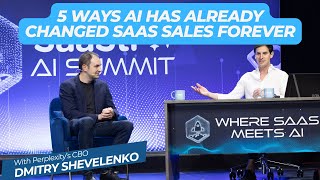
Perplexity's CBO Dmitry Shevelenko explains how AI is reshaping B2B sales. Speed is now the main advantage: salespeople can instantly research accounts, prep meetings, and generate discovery questions. Mature teams are using AI to score leads, analyze contracts, and review pipelines with better forecast accuracy.
Chapters
Speed is the new moat, right? So the one— if there's one takeaway, you have no excuse to not be moving faster, right? And really, you now have these superpowers at your fingertips. And, you know, I think something I like to tell folks is every question that you would ask in a meeting with some, you know, third party and an external party, you can be asking those questions of Perplexity, of different AIs in advance, right? So the— there's no excuse to not be informed. You should not actually be doing the discovery. Like, you shouldn't be learning the discovery questions in real time. But I think the imperative is to move faster because your competitors are moving faster.
Hey, are you tired of listening to hours and hours of sales calls? Recording is yesterday's game, folks. Yesterday's game. Attention.com unleashes an army of AI sales agents that auto-update your CRM, build custom sales decks, spot cross-sell signals, and score calls even before the coffee's cold. Even before the coffee's cold. Teams like Bamboo HR and Scale AI already automate their sales and RevOps using customer conversations. Step into the future at attention.com/saasster.
Excited to be here. Another incredible SaaStr annual. Big shout out to Jason M. Lemkin and Amelia and the whole SaaStr team. Every year bigger and better than the last somehow. Thrilled to be here. My name is Sam Blonde. I have a series through SaaStr called CRO Confidential. I'm also the founder of a startup that's in stealth, that's an end-to-end revenue platform. Enough about me. We have one of the coolest guests from one of the hottest tech companies in the world right now. Dmitry Shevalenko is Chief Business Officer at Perplexity. I won't talk much about you or the business because I won't do it justice. Before we jump in, maybe just tell us a little bit about your background and tell us what Perplexity is. And then we're going to talk a lot about how folks should be leveraging AI in sales and more.
Awesome. Well, thanks everybody for coming. Thanks, Sam, for doing this. Hopefully we have some fun. So I'm Dmitry, CBO at Perplexity. For those that haven't tried Perplexity, it's an answer machine. You bring your hard questions and we do our best to answer them for you, grounding it in the high-quality sources from the internet, from inside your organization, from high-quality external sources. And it's been a real privilege to, to be part of the Perplexity journey. I started my career at Facebook, was at LinkedIn, was at Uber, had tastes of hypergrowth and got addicted to that feeling and excited to be creating it once again with Perplexity.
Awesome. Well, thank you for doing this. So let's see, coming into the show, I often do some research on the guests, listen to some podcasts, those sorts of things. For this one, I started with just asking Perplexity. I gave it a prompt around, this is who I am, this is a little bit about the show, this is my guest today, Demetri, and his role. What are the most important topics that we could include in the list of things to discuss today? And Perplexity basically just built the show for us. And so, you know, they talk about like AI coming for your job. This is one that I think is pretty quickly being disrupted. With that in mind, there are two really exceptional topics that I think you'll have maybe the most sophisticated view on than anyone in the world. The first is like, you know, you're at this cutting-edge AI company. You're also a former founder. And so one of the things that I want to do is talk about where we are today and how companies, specifically tech companies, should be leveraging AI within their go-to-market organizations. So that's topic one. We'll move on to the sort of intersection of product-led growth and sales-assisted customer acquisition. I think Perplexity has a lot of revenue with a mix of sort of product-led or folks coming directly to the website and signing up. Also sales-assisted. I think that's true across like, you know, many if not most companies that are formed around AI and in B2B. So let's start with the former of the topics. If you are a startup founder today, you're starting a new business. You've been a startup founder before. Most of what there is to know about AI's capabilities today, the products that exist in the market and more. What are the things that you are leveraging AI for as part of demand gen and customer acquisition? And then maybe what are some of the things that we aren't yet there?
Yeah, I think we were talking about this backstage. Speed is the new moat, right? So the, the one— if there's one takeaway you have no excuse to not be moving faster, right? And really, you now have these superpowers at your fingertips. And, you know, I think something I like to tell folks is every question that you would ask in a meeting with some, you know, third party and an external party, you can be asking those questions of Perplexity, of different AIs in advance, right? So there's no excuse to not be informed. You should not actually be doing the discovery, like you shouldn't be learning the discovery questions like in real time. Now we'll get into a tactic that I like to use that I think is the best of both worlds, but I think the imperative is to move faster because your competitors are moving faster. I get asked, you know, why is it that Perplexity is in the position that we're in, and part of it is timing and part of it is execution speed. If we had, you know, we got lucky with timing. If we had founded the company 6 months before we did, GPT-3 would not have been good enough, the equivalent of it at that point in time, and we wouldn't have been able to create that initial magical experience of combining AI with the internet. If we had started 6 months later, there'd be somebody else on stage right now that would've like seized that moment. And so that's really kind of where I like to give advice for founders.
Okay, that's awesome. So I think it's sort of the version of what I did with Perplexity coming into this show. It's like you're a founder or you're a sales rep. You have a meeting coming up. Just prompt AI or Perplexity with who you are, what your company does, who you're meeting with, what their role is, and ask them like, how should we structure this call? What are the things that I should know going into the call? And so this is the sort of like meeting prep that used to be very manual that you can probably do in just a matter of seconds. And again, sort of like relating to preparing for this show, I saved probably 90 minutes to 2 hours on just sort of like prep for what are the things that we should talk about? Tell me about Dmitry just by prompting Perplexity versus doing the listening to podcasts, a bunch of my own research. You're applying that same thing to meeting preparation.
Yeah, and I think it's about just being with the time you saved, you actually then ask more questions, right? And going deeper. So what are Perplexity's biggest challenges? Like, how have they tried to solve them? You know, once you're armed with the initial information, it should spark that curiosity. One of the most popular features in the product are the related questions that we show below the answer, because the thing, you know, there's no end stop to knowledge and learning. The, you know, a good answer just begs more questions and you actually want to, when you're then like going from meeting prep to the actual meeting, you want to carry that spirit with you. So what I like to do is I'll just share my screen and I will in real time start asking questions about the company that, that I'm talking to or the person, right? So it's like, hey, What are the, the biggest challenges Company X is facing? How have they tried to solve them? So you kind of show your work in real time. And obviously it's easy for us to do it because it's showing our own product. But in some ways it's even more powerful for you all to do this because if you can prompt the right way and all of a sudden your solution, your product, your approach comes up in the AI-generated answer or it points to that, Man, that is authentic. That's powerful. It's transparent. And I've just seen that work really well. And I think that's a tactic of just in this new era, transparency is everything. And if a smart AI is pointing to a certain direction, that's going to help whoever you're meeting with gain conviction in that direction too. Okay.
So I would, I would categorize these things as combination of like meeting prep and meeting assistance that historically would take 10 to 20 times the amount of effort as it does today. Anything else that comes to mind before we sort of progress?
Yeah, I mean, I think in general, at the earliest stages of startup development, and this isn't just using Perplexity, but the rate at which you're prototyping and coming up with new concepts, getting feedback on them, that can all be accelerated dramatically. Right. And so when you are then ready to, you know, put the pedal on the gas, you should have a lot more conviction and you've tried a lot more concepts. And so, you know, using tools like Cursor, you know, we're going to have the ability to build many apps in Perplexity soon or something's going to get announced called Projects. You know, it's not meant to be a coding replacement, But to quickly visualize different concepts and get feedback on them, that should no longer take a week, a month. That's like an hour. And you should be constantly running through your head, you know, how can I do in 1 hour what used to take a day, in 1 day what used to take a week, in 1 week what used to take a month? And that's the right mental model here.
Awesome. I'll add a little bit of my own color before we get into more mature businesses and how a company like Perplexity is leveraging the advancement of this technology. You know, as an early-stage founder myself, there, there are a few things within go-to-market that I am leveraging today. The first is lead scoring. You know, historically this used to be something that was pretty complicated that you would need maybe RevOps assistance with. And it was like very manual and very trial and error. Models are quite good at this today. So as you are building out your addressable market, the scoring of that addressable market models are very good at. I think the second thing that I am taking advantage of, and again, like you're sort of behind if you aren't doing these things, is intent signals. So once you have a set of your database, it is scored based off of, you know, different tiers from a graphic information. You want to overlay intent signals on top of your scored database. So these are things like Where do I have connections that exist within buyers at these companies? Are they hiring for different roles? Whatever your individual intent signals are that you want to overlay on top of your addressable market models are very good at that today. I mean, there are several products that do this today. And then lastly, on the demand gen side, we are very good today at deciding the type of outreach to take advantage of given the account score and the intent signals. So if we want to prescribe Reach out to this account with this message through these channels because of, you know, these reasons, you know, these 3 different steps here. Score my database for me, overlay intent signals on top of my scored database, and then tell me what I should do to break into these accounts based off of the information that exists in these scores and intent signals. Models are very good at that today. And so these are things that I think like if you today aren't leveraging in go-to-market acquiring customers, you're, you're a little bit behind. And then you described the meeting prep, I think, very well. Once you do have meetings on calendars, I think that the models are quite good at preparing you for that stuff. Okay, let's talk about as we get a little bit larger and introduce more complexity in the organization, potentially, you know, management structure and those sorts of things. How is a company like Perplexity taking it to the next level in terms of leveraging either your own technology or AI in general to do things that weren't possible even 12 months ago.
Yeah, I think one mental model is to assume that using a tool like Perplexity and other AIs, you can get to 80% of an expert level in a lot of fields that, you know, are not your profession, right? So a good example is when I receive a contract, instead of immediately kicking over to the lawyer, I run it through Perplexity and I prompt and I ask, hey, what are the likely issues here and what should I actually discuss with my consults. And that way, when I am actually engaged with— I'm not just like pretending to be a lawyer and then going off of what the AI says. Like, I don't think that's where the technology is. I know some founders do operate that way, but we're talking about more mature organizations. And in, in, in for them, it's, it's really about making that lawyer's time more efficient so that when a business counterpart comes to them with an ask, it's focused, they've already done their homework, and you're not wasting time on the broad review and you're zeroing, zeroing in on the most pertinent issues. And so then take that same approach and think about engaging with a colleague in marketing, a colleague in design. You're able to, whatever your zone of responsibility is and you need to interface with others, you're able to anticipate a lot of what they may help you with. And so then when you do approach them, you're saving both both sides a lot of time. Right. And that's where we see incredible efficiencies. I think there's also when you have templates, right? So say you need to generate a proposal and you have, you know, 3 or 4 really good examples. People love uploading those into Perplexity Spaces and then prompting, hey, can you generate an example, a proposal in the same style, but for this other company? And where Perplexity really excels is we're able to pull in all the real-time information about that company, what's specific to them, and preserve the style of your templates, but update it and personalize it for that company, right? And you should never then just take that output and immediately hit send. That's not— I think that's— it's not about replacing human judgment and oversight. It's about saving you that time to get to the 80% quality first draft. And then making sure you're applying your judgment, your intuition on that last mile.
Awesome. I'll add a little bit of color as well. I think, you know, as companies mature a little bit, you get more data and I think you can train a model about historical engagements that you've had with different companies and data on sort of like how to position your product One of the things that Jason brings up a lot is how— Jason from Zaster brings up a lot is how effective their AI is at sort of like selling for Zaster. You know, they have on their website, come talk to the like chatbot. And I think like I'll, I'll go a little bit further on that specific example, but I think generally speaking, transactional sort of commodity-like sales will be disrupted in ways that support has been disrupted, where more and more revenue will be generated from just pure models converting website visitors to revenue without the sales touch. And I think that will continue to become increasingly true. You know, as I said, Jason was raving about how Saastr is leveraging their AI, and I wanted to like play with it, see what all the hype is about. Let's see, beginning of last week I went to Saastr and it was just like, hey, it feels like I'm pretty late, but is there still any spots? Sponsorships that I could take advantage of for next week's annual. And interestingly, what the model did is something that I think a sales rep would never do. And it sort of like down-sold me. And what I mean by that was, you know, it sort of outlined here are the types of sponsorships that you can still move forward with that are available. Like I actually would, I being the model, would recommend that you move forward with like either a gold booth, a silver sponsorship, or one of these brand type sponsorships. Because one of the more advanced sponsorships, I don't know if it was the platinum or what it was exactly. It was like, you know, it's going to be pretty tough for you to take advantage of all that, that, that sponsorship level has to offer, given that we're 8 days away from the event. And like, you know, that just built a lot of trust with the AI that I was speaking to. It's the type of experience that I just can't imagine That is what a sales rep would be recommending because of course they like want to maximize the amount of revenue that the company generates and ultimately their commission. So I think like that is maybe some proof of models and AI replacing salespeople, especially at the sort of like transactional or almost commodity-style sales. You know, other end of the spectrum, you have the, I don't know, Endurals of the world that are selling weapons to the government. Probably need a human for that for the foreseeable future. And then everything in between.
Just building on that, I think the, the most essential quality for AI products and AI-first products as you project out is what you were referring to, which I call trust. Right. And, you know, you really have to trust a salesperson to, you know, have confidence they're not selling you something you don't need. But the trust threshold for an AI is even greater. And, you know, that, that informs everything we do at Perplexity. How do we create and preserve trust with our users? And trust will be the scarce asset of the agentic internet, and a lot of the products that are built on top of it. So it's easy to create AIs that manipulate people, but that's a very short-term strategy. And for folks that want to build for the long term, you have to build trust in at the foundational level of your product and how you prompt these different AIs.
Yeah, I think that's smart. And then the second thing that comes to mind as companies mature a little bit, it's in the category of converting demand or opportunities to revenue. So closing revenue and, you know, you might be a founder that manages some salespeople, you might be a sales leader that manages a team of salespeople. And, you know, this typically manifests in what I would what I would describe as pipeline reviews, where this can either be ad hoc or casual, where it's sort of like, you know, how's the opportunity with Perplexity going? And you get an update from the sales rep. Over time, it becomes a little bit more formalized where, you know, my experience, and this was true even up to something like 12 months ago, you have this incredibly sophisticated RevOps-influenced process around, you have a 30-minute meeting with each of your sales reps. And in that meeting, there is within your CRM, all of the deals that have the sales rep notes that are like ready in different categories for you to talk about, you know, each of the sort of risks and, you know, highest probabilities with the different deals. And then through that, you kind of get to a forecast and, you know, everything is like so perfect about this process. And RevOps has set up this like beautiful spreadsheet in CRM. The only problem is it's entirely wrong. And, you know, you have like a sales rep that is adding their own like subjective experience about the account. Like they may want to influence the sales manager to think that the deal is going to close, or they may be forgetting about what actually happened on the call. And, you know, back to your point around trust, today you should have a model that is reading all communication with the buyer, the opportunity, the customer, and that's over generally email. You also should have an AI that is joining all of your calls. And the AI should be the one that is preparing for that meeting. And so when you come in, it's not actually the sort of like sales rep subjective information about the opportunity. This is like very matter of fact. You have a prompt. Given all of the data that you have in the model, what are the risks about this deal? What do you think the probability of this deal closing is? What are the suggestions that you have for the sales rep? And so as if you are not doing this today, with a model, this like pipeline review, sort of pipeline hygiene type application, you are a bit behind in something that wasn't totally possible 12 months ago. Yeah.
The one thing that you can rely on in terms of the direction of AI progress is the context windows will expand, right? You'll be able to feed more into the prompt and get a useful output. Right now, yeah, they claim million tokens, 10 million tokens. When you start going up to that size of input, the quality deteriorates on the output, but that's not, you know, you have to assume it will get better. And yeah, you'll be able to just feed in, not necessarily train a new model, but just in the prompt, pass in every conversation you've had with a potential client and get that, you know, honest readout and benchmark it against the other prospects.
Okay. We're all— we're moving just so fast with the progression of the technology and in the way that people are coming up with applying it. And, you know, we talked about a lot of these things that even 12 months ago, they were either less good than they are today, certainly less trustworthy or not possible. And in your seat, being at truly the cutting edge of you, probably having even access to things that aren't available publicly today, You know, if we're sitting here this time next year, I think it's really hard to project out beyond 12 months. What are the types of things that you're excited about that we can expect over the course of the rest of this year?
Yeah, I like to answer that by saying what won't change, because in some ways that's a harder challenge. And I think the, you know, going back to where we started, coming up with the right questions to ask will become the critical skill, right? And you can say that's a form of like prompting, but preserving the spark of curiosity and knowing where to take the next question, that's— because the answers will keep getting smarter, the products of Perplexity will be better at incorporating many different sources, but it won't it won't solve the cold start challenge, right? And so the cold start spark, that's the thing to focus in on. That's the thing that you can project will remain an evergreen problem. I think where we want to take the technology is to become a lot more proactive rather than being reactive, right? So instead of you having to always ask for the update of what's happening with this account, we're able to detect those changes that are meaningful and surface that to you. Right. And whether that be your personal life, your professional life transcending there, having these technologies become more personalized, become more proactive, I think that's, that's what I would expect 12 months from now.
Awesome. I'll try and layer in a couple of tactical things that I think will change with the way that companies, how companies leverage technology. You know, I talked about the different piecemeal things that today models are very good at: scoring accounts, overlaying intent signals, determining what the best outreach strategy to, to ultimately generate a meeting and close revenue is. You know, today these things sort of manifest in like a very piecemeal approach where you have maybe one product or service or one approach to doing the account scoring, and then you have to sort of like check the work and see if it's correct. And then you have like a different model, different company, different product that is doing the intent signals. Then you have a different model or product, however you want to think about, that's doing the outreach strategy. I think there will be a sort of like unified platform that comes together that takes all of these sort of disparate piecemeal processes and, and basically combines them. So can effectively say like, this is my TAM, I want meetings. And the output can be— these things are still happening behind the scenes, but they're all happening in one sort of unified end-to-end platform. And I think because of that, what will start to happen for technology companies, for technology founders, so much more of the success of the business will be predicated on finding product-market fit. Like delivering customer value rather than being exceptional at developing and scaling go-to-market. Because I think that the models are going to start to become really good at that. And so for technical folks, I think that's hopefully music to your ears where it's like, you know, you can really focus on solving customer problems, building the product, finding product-market fit, and gosh, like the risk around hiring the right SDR leaders and teams is far more abstracted away because the technology can get so much better at this stuff.
Yeah, I mean, I think we're a good example of how this may play out. We have around over 5,000 enterprise clients for Perplexity Enterprise Pro, and we have 5 sellers. And so that, I mean, that also speaks to like the PLG motion of having a consumer-facing version of Perplexity that's very popular, and that effectively reaches every enterprise that could potentially become an enterprise customer. But I think that's— there's a version of that that's true for many businesses. How do you have— use AI to bridge that, that kind of enterprise version of what you want to sell with the easy to get, the 80/20 of the value consumer accessible version that may distribute itself. And that's, you know, and AI may help in crafting that, but that feels like a strategy to unlock.
Yeah, I think it's really smart. Sort of piggybacking off of your comment around something like, yeah, I think I don't want to butcher this. Was it 5,000 customers from 5 sales reps? Yeah, exactly. So like, you know, incredibly efficient go-to-market model that you have in place. I think, you know, I'm, I'm now leading, you know, the product that I describe as what I'm hopefully and we are hopefully building. But I now have a startup and I've gone through sales cycles buying products for the company that I lead. And there have been several instances where it was sort of like a commodity transactional sale. And I was just like, the sales rep adds unnecessary negative friction and like, I have to wait on them to respond and get back to my email and they want to take a call and it's like, gosh, like, I just want to buy the thing. And maybe I have some questions, but these are the types of questions that the Jason M. Lemkin SaaS model that I described earlier, they're going to have better answers than the, you know, low-paid sales rep that's selling this transactional commodity. And so I think like one thing that maybe slightly more mature businesses and certainly businesses that have been around for a long time should start to think through is like, is the way that we are leveraging sales reps, salespeople, is this the future? Or like, are we actually adding negative value? Value by paying sales reps to try and serve and convert these customers. And like, you know, maybe start trying to disrupt yourselves a little bit. And what that will, what that will do is it will enable the salespeople to focus on the opportunities where somebody is truly need, like, I really want to talk to a sales rep versus the buyer like me on the other end saying like, I don't want to talk to a salesperson, but you're forcing me to. And I do think that we're collectively probably a little bit behind given the capabilities of models today.
Yeah. Where sellers end up being still very essential is things like security and compliance review, where you're actually— it goes back to trust, where it's somewhat arbitrary process. You know, hopefully one day those become more automated too. But that's where, you know, you need the human glue. To fill the gap. And Sam, I hope you won't get upset me sharing this, but, you know, in your self-startup, one of the things you're using is actually Perplexity's Sonar APIs, which I think is, you know, for folks here kind of at the earliest stages of building new products, being able to pull in real-time information, which is kind of our bread and butter, but synthesize and reason with AI and LLMs, that's what we're unlocking with our APIs. It's growing really fast. We have 75,000 developers using them and very much in the space where Sam is building, we're seeing a lot of traction. So was really happy to hear that you guys are finding value there.
We are happy customers. For the record, Perplexity was not one of the companies that forced us to talk to a sales rep that I was really disappointed with. It was incredibly easy to onboard. You know, unfortunately, I think one of the things we wanted to talk about was product-led growth, the intersection of product-led growth and sales-assisted growth. Growth. And I think we don't have time, but, you know, your business is one that does an incredible job with that. I think we're going to start getting the, like, music to kick us off the stage. Dmitry, you are awesome. Huge round of applause for Dmitry. Thank you. Thank you for attending.
More from Jason

Why Your Next Hire Should Report to an AI, Tragedy Apps, and Too Many AI SDRs? | The Agents #004

Our Agents Drove Our Salesforce Bill Up 80%, Marketo Hates Agents, and We Stealth-Churned Off Notion




Managing 20+ AI Agents: Lazy Agents, Our $500K AI Bill, Stealth Churn & the Death of 60% Solutions




