A Deep Dive on AI And The Next Generation ofAutomation with ZoomInfo CEO Henry Schuck
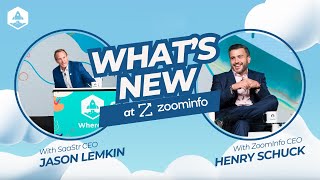
ZoomInfo CEO Henry Schuck discusses the company's "barbell" strategy: high-touch sales for Fortune 500 companies and self-serve for SMBs. He explains how AI tools like the upcoming "Signal to Action" copilot will help sales teams prioritize accounts and draft emails, shifting reps from manual work to strategy.
Chapters
Hey everybody, it's Saster. We have one of our very favorite founder CEOs, Henry Shuck, here from ZoomInfo. I think all of us have used at least some of the ZoomInfo portfolio of tools. We've certainly all used it, uh, in our, in our sales teams. We've used marketing tools. The portfolio has grown, which we'll chat about. But as part of our What New series, I couldn't think of somebody who more has the pulse of what's going on in the markets. And at a personal level, I want to hear what's going on at the product level, especially AI and data and more things. I wanted to get an honest, no stone No baloney feedback. So, Henry, thank you so much for coming back and joining us again.
Of course. Thanks for having me, Jason. Hello to everybody.
Yeah. Thank you. And I want to get to what's new at ZoomInfo. But before we get there, I, I noticed something that I thought, uh, from a GTM perspective was super interesting recently is that you said, and I, and folks, other folks have said this, you're going more PLG, right? Probably to be more efficient, but also more enterprise at the same time, right? More and more focused on those 6 and 7 figure deals. How do you do both? Do you have two teams? Are, are people at each other's throats? Like, they're all— they, they're obviously not completely in opposition to each other, but at some level they are, right? Product, marketing, sales. How do you do both?
Yeah, so great question. And it is very much like these two things do tend to be at odds with each other.
Yeah.
In our business, if you think about the barbell approach, basically I've got at the enterprise business where we do business with You know, today almost 2,000 companies who spend, uh, $100,000 or more with us, dozens of companies who spend over $1 million a year with us. We see our biggest opportunity really in the enterprise segment of our business. And so lifetime value is higher. They grow more with us. They have a lot of room to expand. And so we don't wanna ever neglect that opportunity. And so you've gotta staff properly, particularly in the account base for that. And so making sure that we have the right account loads for our largest, most potential-to-grow clients and making sure we've built a repeatable process that says, hey, if we land a, you know, a Fortune 50 company at $100,000 a year contract, that we have a blueprint to grow that to $1 million, $2 million, $3 million annual customer. Yep. And so we're investing meaningfully behind that. We brought in the right managers, we've set up the right account loads, we've brought in the right people. We think that's an ongoing great opportunity for the business. At the same time, there are only 1,000 Fortune 1,000 companies, and then there are hundreds of thousands of downmarket businesses that can get value out of ZoomInfo. And so what we've been rolling out this year is the ability for, you know, an SMB customer that maybe does, you know, payroll in Philadelphia to become a customer of ZoomInfo without having to talk to an account executive, without ever going through the demo process. But with the ability to sign up for a free trial and then grow into a paid customer of ZoomInfo. The place where that creates friction obviously is that we also have a pretty large new business sales team of account executives. Yeah. Who would theoretically capture that as a lead, do a demo, follow up, try to evangelize the platform and get to a, a, a sale of ZoomInfo. And so you have to step into this. It requires tremendous alignment between pro— the product lead on PLG and the new business sales head and the chief revenue officer. The way you step into it, or at least the way that we've stepped into it, is, okay, let's take the cohort of leads we're not talking to anyways. They don't meet the score threshold. They're too small of a business or whatever the reasons are.
Yeah.
Let's push those through the PLG motion, see how they behave. Make sure that we can continue to maintain the new business sales motion while we're doing that and see if we can get to a place where it's additive. At some point you're going to start bumping into each other. You're going to create channel conflict. Hey, you sold that as a 1-seat deal. I would have sold it as a 5-seat deal.
Yeah, there can be some truth to it, right?
Yeah, absolutely. There's truth to that. Yeah. And so really aligning between the PLG head and the new business head so that when that channel conflict clearly rears its head or obviously rears its head, that we also have conviction around the volume that we're generating and a pathway to move a PLG customer after a certain amount of usage from a 1-seat customer to a 3-seat customer to a 5-seat customer. There has to be that pathway for new business to get in and grow those accounts. And so we've built that connective tissue back in, but then we're also driving in the enterprise where we think there's the biggest opportunity. Those two things growing in the enterprise and growing PLG, they don't create the same, that same kind of conflict. The conflict is around messaging, really marketing and messaging, because the way that you market and message to a startup or an SMB or a PLG customer is very different than the way you want to talk to your enterprise customers. And so that's where the battle really happens is how do I have messaging that resonates to my upmarket customers while at the same time not neglecting my SMB customers? That's a magic trick because enterprises want to be, You know, all of the messaging to an enterprise is really different. I'll give you a real, just a fun example. We talk a lot about like how we show up on social today. And social is where a lot of our SMB and our startup customers are getting the messaging about us.
Yeah.
Primarily like LinkedIn. While at the same time we're like, okay, well how do we get in front of our enterprise customers? They're not really getting that messaging on social and LinkedIn. Instead we're going, hey, Hey, content team, for our enterprise customers, we should be out there positioning articles with CIO.com or with Forbes or Fortune where we bring one of our enterprise customers in and we go, here's what we did for them. Here's how we work together to modernize how they go to market. Let's go pitch that as a story.
Yeah.
To CIO, to Forbes, to Fortune, to the Wall Street Journal about how You know, Fortune 50 Company A, B, and C are modernizing the way that they go to market. That also doesn't resonate with our SMB customers a little bit, but they don't really care what, you know, Walmart and Google and Microsoft are doing. They wanna know what other SMBs and startups that look like them are doing. So there is a bifurcation of the marketing effort for sure.
Yeah, it's interesting. I thought you were gonna talk about just a more basic thing, how even at the website level, the domain, it's tough to, to hit them all. But that marketing thing, You know, it's also very hard to find a marketer that's good at both. I think it's impossible.
Yeah. That's—
you gotta pick one. You wanna do all of 'em, but they're only gonna be great at either getting you in, in with CIOs or managing a funnel from a million folks hitting ZoomInfo.com. Right? They can't be great at both.
Yeah. Totally. I think the way that we think about that is like, at the highest level, I want my chief marketing officer to know how to talk to CIOs, chief revenue officers at really large businesses. And then I want somebody in content or someone in the marketing organization to really own like community buildings, community building, social, how we, how we talk to our customers in the communities and social media places that we operate. Yeah. And how do I get someone who's really great at that while making sure at the highest level we're communicating with our enterprise customers on the website?
Hey, just one more question on this, cuz I, I super curious to learn from you. A lot of folks are trying to go more PLG. Salesforce just said they're, they're going back, they're trying again with self-serve and PLG. But I think the reason Salesforce is doing it is cuz on paper they think it's cheaper.
Do you—
this is the age of efficiency. Do you think it's really cheaper or just better in that ZoomInfo, for example, the core products, anyone can use it. Right? Is it cheaper or just better to expand the base?
Um, so I think it's both. If you look at scale, PLG is cheaper, right? You're— if you figured out an organic way to drive traffic to your website, there's obviously some investment there. How do I get people and traffic to ZoomInfo's website that I can then convert into a paying customer? If I can do that without a person, that's definitely more efficient and cheaper than driving demand through an outbound motion where there's an SDR there's a sales ops layer that's feeding that SDR. Then that SDR is making calls and sending emails, generating demand that way, that then goes to an account executive who has to do a demo and take them through a funnel. That's a heavier—
but you guys are good at that. You have 40% margins.
We are good at that.
We're really, really— you're— are you sure PLG is cheaper than 40% margins from a sales-driven process? I'm not saying it's not a good idea, but is it cheaper?
Yeah, well, it's cheaper in that instead of that process Yeah, you're replacing that process with the right group of companies with a process that brings them in in a no-touch, self-service way. Yeah. If you do that versus the sales-led way, that is by definition cheaper. I don't think— we're not doing it to get efficiencies.
That's the real question I'm asking. Yeah.
Yeah. We're not doing it from an efficiency reason. We're doing it for a whole group of people who should be ZoomInfo customers that we're never going to get in front of with the sales-led motion anyways.
Yeah.
And so here's this whole group of SMBs, you know, we, we, we mapped our market as 700,000 businesses and there's a whole group of them that we're never going to— we're never going to put a sales rep in front of. We just don't have the, the sales reps to be in front of every customer who has a passing interest in ZoomInfo. But can I take a group of those and make them customers, paying customers without a sales rep being in front of them? Yes, absolutely. And so then it should just be additive. The second place where I think And maybe this is what Salesforce is talking about, is we're also, you know, Google is a customer and, you know, AWS is a customer, but not across every sales rep that should be a customer at AWS or Google, across some subsegment of them. I want to give free access to ZoomInfo to as many of the sellers, as many of the account executives, account managers, SDRs, BDRs, marketing people, at our big clients for free. And then I want the opportunity to take that cohort of users, go up to the chief revenue officer and say, listen, you've got 200 sellers, 300 sellers who are using ZoomInfo every day. I'm not charging them right now, but at renewal time, let's start planning for them to be— I'm going to have to sell you the license. Yep. That's the classic playbook. Yes. Yeah. Yeah.
Super interesting. Let's talk a little bit to help other folks. What are you seeing at a macro level? I want to learn from ZoomInfo because, and we were chatting about this a little bit before we started, ZoomInfo is probably in a bigger category in this, but when I talk about sales and marketing tools, I think it's probably the most heavily impacted by whatever we're in. I'm not even sure it's a downturn when you look at it, but it's a something turn. It's like, it's like a truck hit a wall or something. But the impacts are not even, are they? They're not even across the industry. So what are you seeing? And have we hit a bottom in terms of some of these contractions, or do we just not know? Yeah.
So look, I think that the thing— if from where you said, Jason, you see like hitting a wall.
Yeah.
Then— and, you know, we see that too. We see it primarily in our software vertical. So our software and technology customers. And the best way that I can articulate what we're seeing there is just about every VC and every private equity firm is showing up, has shown up to their portfolio companies, and they've said, hey, listen, I know— I was just talking to a company today that got an investment a year ago, brought two companies together, and their private equity team is showing up and saying, listen, I know that when we bought the company, we told you that we wanted to grow, that growth was the most important thing for the business. We have changed perspective on that. And while we were planning on you growing 40 to 50% year over year, yeah, what we would prefer— and burning dollars to do that, dollars that we invested for that purpose— what we would prefer now is that you grow 10% and you do it with 30% margins. And you've got a quarter to figure that out. And so when that happens, that is the, that is the event in a business where the handbrake gets pulled on the freeway and everything stops. And so you end up making what are less than rational decisions to get to that point as fast as possible. You're laying off, you're cutting tool spend, you're looking around everywhere and seeing how, you know, what can I cut and how quickly. Now, for companies like ours, that manifests in two ways. One, our tech cohort of customers, we're our fastest growing cohort of customers. For the last two decades running. They were the customers that grew the most with us. They were the most loyal with us. And all of a sudden, these are customers who are downselling and then some are churning. You know, some are actually churning outright. The downsell is what we're seeing the most, particularly in mid-market. And it's a combination of, hey, I just don't have the seats anymore. You know, like as part of that get to 30% margin, I'm actually laying off sales reps and SDRs and BDRs and account managers. I don't have a need for those seats anymore. So we have to get rid of that. And then, and then I'm just actually going to cut spend other places too. Instead of every account executive having this, I'm going to give it to half of them. Instead of every SDR having it, I'm going to give it only to this portion of the SDRs. And so there's this, you know, double punch that's happening where you're downselling because of the seats and you're downselling because of this VC PE pressure. And if you're a company that sells primarily to other technology companies, other software companies, you're feeling that in the worst way. And I think that a lot of startup world and VC and PE-backed firms, a big portion of their customer base is technology and software companies. The bigger portion it becomes, the more it's mid-market and a bigger portion, the more you're feeling that effect. Now, Dave, this has been happening now for like a year. I think Q1 of— I think as you pass Q1 of '24, you will be left with a customer base that has transitioned over the last year with you that's already been through a renewal cycle since they've learned of these cuts. Has already been through a renewal cycle since they've laid employees off, since they've operated in this new model. And so there should be more, a more normalized customer base from a retention perspective as you transition past Q1 of '24. And you should be seeing a better retention rate, a better renewal rate, because the customers who are there with you are customers who've already gone through that storm, by and large.
Yeah, I mean, we don't know for sure, but once we get through that period, it should be better, right? It may not be great.
Yep.
But it should be better if we're through this, this almost one-off contraction time, right? It should be better, we hope, right?
Should be better. And you should not be surprised, right?
Like, it should be more predictable, right?
A lot more predictable. Because, you know, one of the things that we saw in our business people talk a lot about additional scrutiny and then they don't really talk about like what that actually means in your business. But, you know, one of the things that we saw is like historical levels of usage and utilization that correlated to a renewal and retention rate changed on us. And so if you were utilizing, call it 80+% of your licenses on a regular basis, yeah, that was an account that you would see grow with you at renewal time. Like that was an upsellable account.
I see. Interesting. Yeah. And now that might be a downsell. That might be a contraction.
Downsell. It's a contraction. I definitely don't need those 20% of same utilization though. Same utilization rates are now connected to a different net retention and net renewal rate. I think the biggest learning for me is if you came to me 2 years ago and I was meeting with the new Chief Customer Officer or Senior VP of Customer Success, and I was like, hey, how do you want me to judge you? If they told me, hey, you should judge me on health of accounts, utilization of the accounts, you know, overall usage and engagement with the product, I'd be like, no, I'm gonna judge you on net renewal rate and net retention rate because those are the, the metrics in the business that actually matter for what you do. And so I don't care if you tell me every account is super healthy, but that correlates to a very low retention or renewal rate. You know, I don't care for that. So I'm going to tell you net retention, net renewal rate. The problem with that is that between 2020 and 2022, those metrics, they just ticked up and it didn't actually matter how healthy every account was.
It didn't. It disguised a lot of things, right?
Disguised a lot of things. And so when I thought I was being more true to the bottom line of the business, net retention and net renewal rate mattered the most. Yeah, it hid a whole bunch of like health-related things that you should have been focused on. And so today I think the most important metric in our business, in any software business, is utilization and engagement. Am I using all of my seats? How deeply am I engaging across those seats? Those are the metrics that matter the most for whether you're gonna be healthy at renewal time or not.
Yeah, it's a good insight there. The high NRR, just, it, it was a generation of, of, of disguising issues from product to sales, all, all up and down the stack, right?
100%. And you would pat yourself on the back.
You'd go like, yeah, we're geniuses. We're, we're the best customer success deployment.
Every— I'm glad I made all those investments in customer success because look at this net renewal rate, net retention rate ticking up.
This small question, but curious, this to, to go in and say, listen, I'm gonna, I'm gonna, I'm gonna have Zoom info for Bob, but not Elena and Jim, but not Jane to save money. That does take energy.
Yeah.
It takes a lot of energy, like, and, and you could do it once because there's a crisis or my boss yells at me, but you can't do this every month. Has this gotta end in a way? There's only so much time with software management.
Yeah. Look, I think this is the, the, the worst emotion for software sales is uncertainty. And we are, we, we have been in this very uncertain time. And I think that what we're coming, you know, what we should be coming out of in '24 is that uncertainty. Now I know where my operating levels are. I know how to operate in this environment. A lot of companies have shifted around their executive teams, brought in new people. Yeah, these people know how to operate in the environment that they are in. And so there shouldn't be another handbrake moment. Yeah, we should be understanding where we're operating and how to operate under this construct.
Good.
All right.
Before we run outta time, I wanna make enough time for what's new, what's new at ZoomInfo. And, but the first part, just tell me, cuz we're all curi— or everyone that's in B2B is curious what's real and what isn't in AI. What's demo ware? What's moving the needle? What are you hearing from your, and what do your customers want that may be real or fake or not right there in general and across your portfolio? What's real?
Yeah. So I think what's real first, I think there's a lot of stuff that's real, but maybe not that valuable. And then there's stuff that's just real. So I'll talk about the real things in our business. We see prioritization and personalization are real. Okay. So when you come into ZoomInfo today, if I want to personalize that experience for you, I want to show you the right accounts. I want to show you, you know, which, what technologies that a company's using matter to you, what intent topics are important, what scoop topics are important. I gotta ask you a whole litany of questions, right? Yeah. And I have to ask you of them by product, cuz maybe your company has 3 product SKUs and the buyer for one is different than the buyer for the other. The scoop that you're looking for is different for one product versus the other product. It's like this nightmare from an administrative per perspective. What size companies, where are they? You know, how big are they? What technologies do they use? Who's in your buying committee? It's impossible to really get someone to sit down for an hour and onboard with you to ask all of these questions. And then get to like a really solid result that allows me to personalize the interface for you.
Yes.
AI does this incredibly well and can be tuned so that whenever user comes into the platform, I have preconfigured the platform exactly to which companies, which people, what scoops, what intent, what signal is important to you. I can just deliver that to you. And then I can also deliver for you contextually what your communications to those companies should be based on your website. All that understanding that I have about you, your case studies, all that information should allow me to craft in any circumstance a really contextual communication for you. The second is prioritization. And today, triangulation is how people prioritize who they're gonna reach out to. They go, okay, here's my list of accounts. In those accounts, what's happening in them? Are any of them on my website? Have any of them hired a new CTO? Have any of them had a good quarter? Have any of them posted a job for blah, blah, blah, blah, blah. That's like a very painful exercise to try to triangulate. And AI does a really great job of gathering all of this signal and being able to deliver you prioritization on the accounts. Prioritization on the people, prioritization on the timing of when and how to engage. Because you also don't always engage via email or phone. Maybe you're gonna engage on ads. You're gonna, you know, they're at a stage where you're gonna put ads in front of them on Facebook or LinkedIn or Twitter or wherever. And so personalized experience, prioritize who I should be engaging with, give me the context to engage with them, and then help me pick where I should be engaging with them. That's all real in the AI stack. Absolutely real.
What do you think on, and if we go to post-sales support, if we look at Intercom, Zendesk, Gorgeous, their, their goal all there is to eliminate 50% of the humans from the loop, automate 50% of interactions. Does any of this automating SDRs and AEs, this stuff gonna work in our, in our work lifetimes? Or are we just gonna make them better or less lazy?
No, I do think we'll automate out a lot of the function. Uh, yes, not all of it, but I do think there are lots of places, you know, look, there are companies where the SDR is just sending emails. Like, what do you, what do you need? They like just to press a button. Like, it does not necessary in those situations. SDRs are gonna have to move up the value chain and figure out like, for sure, where do they add value? Where You know, what you're really gonna get to and want to get to is where is the SDR riding alongside the AI and driving incremental value along that chain. It is the Copilot model for SDRs and account executives. Is it, how do I leverage the AI to be more productive, to add value to the AI while I'm moving myself up that value chain? That is where they're gonna plug in. Cool.
I hope so. I was asked this week by SDRs, one, would I like to buy Salesforce? I've been a customer since 2005. I was also asked if I'd like to join the G2 Reach Digital event with Henry and Jason speaking.
Yeah, those are triangulation. Those are pretty bad ones. Those are bad ones. They're also triangulation problems, right?
They're triangulation problems.
I have to, you know, I gotta go look and see. You know, who's going to this? Who's my customer? And if I don't have to triangulate because the AI will triangulate for me, I do get rid of a lot of those issues.
Yeah. Yeah. No, I do love how it makes SDRs email better. If nothing else, I'm just waiting to see what's real and what isn't. Okay. Last one on this. And maybe it's related to AI or maybe it isn't. What's, what's your favorite feature or functionality that you've either rolled out recently or are going to roll out in the next 12 months? What are you most excited about?
So we are rolling out, uh, a, a product that is a copilot product for our account executives, SDRs, and account managers. Internally we call it Signal to Action. Okay. And so you come in, we do all of that personalization for you. So we know who your company is. We know the, the scoops and intent spikes that are important to you. We know what companies are visiting your website, who's on your pricing page. We know what your buying committee looks like, who are the buyers at those companies. We know who's coming in and out of that buying committee. And then we built a decisioning engine in the middle that looks at all of that signal and decides which companies you should be engaging with today and how you should be engaging with them. And so we're bringing account executives, SDRs into this universe that tells them these are the accounts, these are the reasons, these are the people, these people should be communicated with this email. Look at the email, hit it to go. These people should get an ad. Click this button. So Marketing OS launches an ad. These people should be in just marketing automation. These are people who should just be on your radar. And so the ability to use AI to synthesize a whole bunch of noise and pull signal out of that to deliver at the exact right time with the context you need to, uh, engage with the buyer, we're super excited about that.
When's that coming?
It's, it's already in beta. It'll be in GA in Q1.
And how does it work? Do I log in and get a series of action items that then I go through, or what's the flow like?
Yeah, that is the flow. So you log in and you see what's going on at accounts that you're currently engaged with, and then with action items associated with them, and then greenfield or white space accounts. What's go— which are the accounts I should be engaging with, with the one-click action? I guess.
Got it. Well, that's the vi— that's what we talked about. That should be the vision, right? That should— that, that's what we all need and want, right?
Yep. The question becomes if over time you can automate that whole thing where I'm not actually saying like, go, go, go, go, go on these. Instead, it's just being automated in the background. We're not there today, but yeah.
Yeah. Hopefully as we do this, and maybe we could wrap on this point, if all, as, if this all, I mean, this will work for ZoomInfo, as this works, the AEs and SDRs and others, they do need to be better. They do need to be better product savants. They do need to be ambassadors. Their job is not to write the exact same email. I, I hope as an industry we can get there.
Yeah.
I hope as an industry we can get there. Maybe we need slightly different people.
Yeah. Or we need slightly different enablement and implementation. And look, I, it's hard to imagine that the new cohort of employees here at ZoomInfo are less tech savvy than the people I started the company with. Like the— yes, my chief revenue officer, the day he sat down in the seat, he asked me— I told him to open Outlook and he said, what is Outlook? I don't know what that is.
I hear it.
Today's cohort of new first-in-seat employees are way more tech savvy. Yeah. So they just need to be pointed at a different set of software to come up to speed.
I think they are. I worry that for the current generation, That we've been doing stuff the same way so long that it's hard to change. You know, I move from another SaaS leader to ZoomInfo. I write the same info email. I do the same playbook and we've gotten so used to these. I hope so. I almost think like AI, I'm hoping it ignites like a radical change in the industry.
That's one of the questions that I've been asking my SDR team is, listen, I think, you know, we have 400 SDRs. We have this really efficient, effective motion for generating new business. And what I've been asking them lately is, hey, I want to know where the innovation is. Like, innovation cannot just come from you scaled this thing we did 5 years ago from 10 SDRs to 400 SDRs. That is innovation, I'll give you that, but it's not the real innovation I'm looking for. Tell me the things that we're doing that are new, innovative, cutting edge, different. I want to know what we're doing there. And so, you know, we have to just keep asking those questions. Otherwise, we are just going to run the same playbook that we ran since 2009.
Yeah, it can't work better. I mean, it worked one time, the second time works better, the, the eighth time I think it works worse.
Yeah, I think that's right. That's right.
All right, Henry, this was amazing. Did we hit everything we wanted to hit? Anything we missed?
No, I think that's it.
All right, man, you are the best. We look forward to keeping the conversation going. And again, thank you so much for the— these pretty deep insights. I think they'll be helpful to everybody. Thanks, my friend.
Thank you, Jason. Thanks, everybody.
More from Jason

Why Your Next Hire Should Report to an AI, Tragedy Apps, and Too Many AI SDRs? | The Agents #004

Our Agents Drove Our Salesforce Bill Up 80%, Marketo Hates Agents, and We Stealth-Churned Off Notion




Managing 20+ AI Agents: Lazy Agents, Our $500K AI Bill, Stealth Churn & the Death of 60% Solutions




