Adding Outbound Sales & Marketing to a Product-Led Growth Engine Freshworks, Twilio, 1Password, Coda
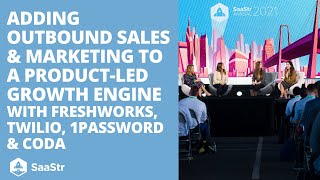
CMOs from Twilio, Freshworks, and 1Password discuss layering outbound sales onto product-led growth. They share how companies like Atlassian and Twilio use self-serve models, why PLG demands 35% R&D spend versus 15% on sales and marketing, and how to identify product-qualified leads for enterprise deals without cannibalizing self-serve growth.
Chapters
Hi, everyone, and welcome to our session. I just want to thank Jason M. Lemkin sincerely and all of the organizers at SaaStr. We are so excited to be live and in person. How wonderful is it, ladies?
It's awesome.
Yay!
Great to see everyone.
I'm also so thankful to be here with you guys because we have a very hot topic that we're going to talk about. So let's just do a quick round of introductions. So why don't we start with you, Sarah? Go ahead.
Yeah, sure. Hi, everyone. I'm Sarah Varney. I'm the CMO at Twilio. For those of you who aren't familiar with Twilio, we're a customer engagement platform delivering a series of APIs for a massive community of developers covering everything from voice to SMS, email, video, you name it.
If you haven't heard of Twilio, you might not be in the right room. Hi, I'm Stacey Epstein. I'm the CMO at Freshworks. We make tools that make it really easy for companies to delight their customers and employees. CRM, ITSM, HR. You might have heard of us from our IPO, which was last week.
Woo-hoo!
My name is Carrie Lou Dietrich. I'm a former CMO, most notably the head of marketing that took Atlassian public. These days I'm an advisor to companies including 1Password, Segment, Miro, and other hypergrowth companies.
Hi, everybody.
I'm Bibiana Vega, and I'm soon to be a general partner at Felicis. And I'm a 3-time CMO with 20 years of experience as well. So thank you.
All right.
So let's get to it. We're here today to discuss a very hot topic that every CEO and C-suite leader is talking about today. Product-led growth. The beauty of it and some of the common pitfalls that we would like to help you avoid when you're working with sales. So what is PLG? It's funny. I went online this weekend to look up the technical definition. So I'll read it to you so we're all on the same page. It's a growth and customer acquisition model that relies on the product and its viral hooks to drive customer acquisition, retention, and expansion. And what we were just chatting about earlier today was that it's actually been around for about 10 years or so. And so we're really excited to go through what we've learned in the last 10 years as it's been deployed across all the companies that we've been fortunate enough to work for. So ladies, tell us a little bit about PLG at each of your companies. Who wants to start?
We decided I was going to start because Atlassian's one of the most pure models. And product-led growth is really just using a product that sells itself and giving people access to use it right away without ever talking to the salesperson. And at Atlassian, that took place because the two guys who started the company were in Australia, and they didn't want to sell directly themselves, and they didn't want to hire people to sell. And they were selling to developers who were super excited to never have to talk to a salesperson. And so putting the product online and making a product that is so is so wonderful it sells itself, Atlassian set up a business model that spent a ton on R&D and very little on sales and marketing to help propel and make this viral product-led growth. And now has tried, you know, has some sales that comes through upsell, cross-sell, and mostly kind of customer support sales. And we'll talk a little bit more about that. But the whole motion is the product sells itself. The consumerization of enterprise software.
In the hope that you don't really need a person to have to sell.
You don't. The product does not need a person for you to be able to use it, buy it, and continue on happily.
Until you do. Sarah, so tell us a little bit about Twilio and their model.
Yeah, absolutely. So our joke at Twilio is that we're a 14-year-old company with a 3-year-old sales organization. And up until very recently, we were almost 100% a self-service and product-led growth motion. Similar to Atlassian, we sell to developers. You're not going to go throw inside sales reps at them to call them and ask what their budget is and timeframe. It's probably not going to go down too well. And at Twilio, we really focus on how at every step of the journey we can unblock developers and get them to what they need to do. So we invest a lot in documentation. We invest a lot in code samples and snippets to get people going and thinking about what they can do with Twilio. And it's really just all about making our developer community successful.
Yeah, at Freshworks, it's a little different for us. We don't sell to developers. We sell to technical support teams, sales teams, marketing teams, IT teams that do internal ITSM. I say we layered on sales a little bit earlier in our history than some of the companies. We're also not like a Zoom or a Slack where it's very viral. I think there are a lot of people think of PLG and virality as synonymous, but they're not. I think you can still have a purebred PLG model where it sells itself because the buyer can get right into the product, and they can actually even use it in a trial or in a free version and really experience it, and that's what leads them to buy. But it— you may not have the viral component of like, you know, Zoom. Well, I need another person to be on a Zoom call with me, so now suddenly Carrie Lou and Viv are in Zoom too. That's not true with a customer service department. It is actually a buying process. And so even though they may go all the way through the product, through the trial, and decide they want to buy it, you still might need some of that sales to come on and actually help with, you know, getting buy-in from a higher buyer in the organization, etc. So I, I think, you know, it is when you're selling to a different constituent and you don't necessarily have the benefit of that virality, you might have to think about layering in an outbound motion a little bit earlier in the process.
Definitely. Before we dive into how to layer in that outbound motion, one of the things that we were also discussing that was really interesting was just the level of investment required when you're working within a PLG model. So, Kari, talk to us a little bit about that.
Well, I was gonna add on to what Stacy was saying because I think she's underselling Freshworks, which has a viral word-of-mouth business, right? The, the core aspect of product-led growth and the reason it's so attractive is because it can be way less expensive than salespeople. There are a whole bunch of things you might try to sell that don't warrant a very expensive enterprise salesperson to pick up the phone. That's why marketing and marketing automation and automated user journeys are so important. In a product-led growth environment, there can be a lot of sales that are happening when someone's in the product. We used to call them wow moments, and we had these amazingly smart growth analysts that would figure out how to make those show up faster or engage people through email and in-product. But, you know, one of the business model things that's required is to invest a ton in a fantastic product. For product-led growth to work, the product has to be fantastic. People have to be talking about it word of mouth. And a salesperson can follow up and sell that. But if you have a dud product, you can't have product-led growth. So at Atlassian, the whole business is set up around this and we invest more. And this is from a recent blog from the CRO Cameron Deitch on his LinkedIn that 35% of future revenue is invested in R&D and only 15% is in sales and marketing because there is no sales team of significant size. And so this type of business strategy underlies it. It's not just something the marketing team slaps on the front of the website.
Great.
Great.
So here is the million-dollar question. And go for it.
Well, yeah, I was— before we get to sales, the why is it so hot, and I know you'll add to it too. I also think, and you touched on this, I was having a conversation earlier about empathetic marketing and empathetic, just that approach to business and building products. And it really, you have to get into the mind of your buyer and your user and what they want because you don't have a chance to do a pitch deck, or to be a really dynamic salesperson who just sells you by how great they talk about the product. They are literally experiencing the product that they're going to buy. And if the product doesn't meet their needs when they're experiencing it, they're not going to turn into a paying customer. So it, it, it is much more efficient, and it's also— it makes your team really focus on building that great product, all those features. All the value that they're going to get. You have to be an empathetic product company in order to be successful with PLG. And I think that's— it's been a good trend for us in SaaS to get more of that focus on that great feature.
Yeah, and I'd just add on exactly to that. I think when you're thinking about the investment you need to make in PLG, you want to think about, all right, where does the ownership live? And it can't just be one person who has to wake up and think about acquisition. I think it's super critical for PLG motions to work, to have a shared metric across both your product and your growth team, if that growth team sits in marketing or wherever it sits. But it can't be just the marketer keeping up at night sweating about hitting that metric. It also has to come from the product because they're going to be— they're going to have the leverage to make the tweaks within that onboarding experience or flow or whatever it is to help move those numbers the right direction.
Yeah, and every team, right? The customer support team needs to think that way. And the engineering team has to prioritize features that might be in the first 5 seconds of starting it, and the email team needs to be thinking about how you get people back into the product if they've fallen off for the last day or two. So I think it changes a lot of the fundamental metrics and teams.
Yeah, I think it's— there's a journey that we talk about, website to trial. Like, if you're doing pure PLG, they may be coming in through your product, they may be coming in through the website, but your whole goal is, okay, if I'm PLG and they've come to my website, how quickly do I get them to the trial? And what does that journey look like? Okay. Now they're in the trial. What features am I exposing at what point? I don't want to overwhelm them, but I want to show them value. Am I giving them cues along the way? Like, how am I literally leading them through the process to become that paying customer? Which is really pretty different than the old world of, okay, we're going to do a requirements gathering session, and then we're going to come and pitch to you, and then we're going to do a custom demo, and, you know, 4 months later, you're going to tell me if you want to buy. This is like you got to get your journey from traffic to trial to conversion down. It's so important with PLG.
And I think we can learn a lot just from looking from our consumer lives, right? PLG is the consumerization of the enterprise. People want to research themselves. They want to comparison shop themselves. They want to try it out and see if they like it without any pressure. I like shopping at DSW, the shoe store where no salesperson ever talks and they don't have the most stylish shoes. I just don't want to talk to salespeople. I'm a great target for PLG. And I think we see across a number of things that there's some specific audiences. Most developers hate marketers and hate sales. So for selling developer tools, where Atlassian started, PLG was a great fit. And up to 70% or 80%, even of normal enterprise sales these days, people research themselves. They're not looking for someone else to educate them in person.
Viv, I think we might want to move to your next question.
I know.
So everyone that's a salesperson in the room doesn't feel bad.
I feel really bad for every salesperson in this room. I'm so sorry. We actually do love you, and you do play a very important role, but you play a very important role later on in the process, and we'll talk a bit about that. But I think you touched on this, Sarah. One thing that we'll talk a bit about is the org chart and how different it is. This idea that there's now a growth team, which at Yammer, it was an independent team that was comprised of marketing, sales, customer service and support. Product played a big role. Analytics as well. You kind of need— one thing that you should think about building as you're building out your PLG motion is to build this independent growth team.
Mm-hmm.
Oh, now I think we could debate that. So I advise like 6 or 7 teams and the companies and the CEOs are always like, where should we put growth? Should growth sit under the CMO? Should it sit in product? Should we split it up? And it's a really tough question because really it's both, right? The website team needs to think with the testing mindset that's the same as what's happening in product. And there's so many different intersection points that I do think we'll see org charts evolve.
It depends on the company. Everybody does it differently. I liked it how it worked independently, but I've certainly seen it roll into product and I've seen it roll into marketing. It just depends.
Yeah, I mean, for us right now, it does roll up to our marketing ops function. But I was talking to another CMO the other day and they were talking about different models they've seen. Eventbrite, actually, where they've got like a growth kind of SWAT team that goes in and attacks certain parts of the funnel depending on what's happening in the company right now. They kind of embed themselves in that team if it's onboarding or if it's customer lifecycle and nurturers or whatever happens to be the issue. And I thought that that was a really interesting approach because you're really, you know, you're not just saying, oh, I'm just coming out from a marketing angle or I'm just coming out from a product angle. It's really what the company needs most overall based on what you're seeing.
I love that. That's what we did at Yammer. I was independent. It was, it would attack specific issues, and we'd go on from there. So let's talk about sales.
Our favorite—
folks, I think I went one slide too early. So if we can go back, that would be wonderful. All right. So where does sales add the most value? Who would like to start? Stacey?
Yeah, I mean, we definitely have outbound sales. I think certainly as you're moving up in the enterprise, you're going to— the bigger customers, the bigger companies are going to expect to have that relationship and that higher touch. They just— it's part of how they're used to doing business. And especially if they're spending hundreds of thousands of dollars or millions of dollars, they want— they want to really meet the people and have that relationship. So that's certainly— as you get higher up in the enterprise, certainly companies are successful there with purebred PLG models. Twilio is a great example. But that's, I think, one area where salespeople are sales might be necessary. I also think, you know, there's inbound and there's outbound. You talk about the growth team. Are you just trying to capture all the interest that exists for your market by capturing inbound, or are you also trying to create new pipeline and new opportunities? And we do a mix of both inbound and outbound because we want more people to know that we exist, that we're an answer. We're in very crowded markets. CRM, ITSM, HR. And we want people to know that there's an alternative way of doing business. So we're doing outbound campaigns and programs. And that's, you know, sales is working both of those leads in that pipeline. And they're going to events like this. So I think, you know, again, we don't sell to developers who mostly just want to buy online without talking to somebody. We sell to department heads. From CIOs, and sometimes just sales is the best way to meet those needs.
We were debating backstage about which way is easier, to have a product-led growth company that adds on sales, or a sales-led company that tries to get into product-led growth. And we voted that it was easier to start with product-led growth and layer on sales than to go the other way. And one of the reasons is, you know, let's take 1Password for Instance, 1Password is a very successful consumer password security management company that is now in business for both passwords and securities management. And so the model is actually very well established for product-led growth because it's been a consumer company that's been successful for many years. Leads come in, they can buy themselves, they can install, things work well. And now there's a sales org to help with larger, more complex deals and primarily to help people who are already using a lot of the products go wall-to-wall. And I think really sales is absolutely helpful in upselling, cross-selling, accelerating deals. It just has to be at a company and a scale of revenue that makes it worth paying those salespeople. And that really has to be the tradeoff. And so the inverse, a company— another company I advise is trying to add PLG on to a very large enterprise sale to get some, like, cheap, fast leads. But it's totally disrupted their revenue. They slapped it on the front page, and they took off all the get a demo leads from their sales reps. They messed up their SEO. The whole mechanism isn't necessarily working because it's not just something you can slap on. It requires so much different product development, experience, engagement, and you can't just steal leads from sales reps and expect people to self-serve in the same format.
Yeah. I mean, I would just say that at Twilio, we really think about applying our salespeople, again, where we can help get people unstuck. And, yeah, sure, 9 times out of 10, the developer doesn't want to be called, but there are signals you can see where they are stuck and they do want help. And I think it's just a matter of making sure that you're applying the right resources, one, from a cost perspective. You want your salespeople on your highest value deals, but second from an experience. If someone is stuck and legitimately raising their hand, you should be helping them.
And tell us more about the relationships that you guys had some massive clients before you had salespeople and you found that you really needed the—
Yeah, I mean, I think when you don't have a relationship and it's all self-service, you're not going to know. You're not going to have an ear to the ground on what's actually happening in that account, what challenges are happening. Maybe they're having an issue with pricing, whatever it is. And without having that relationship in place, it's, you know, those customers can disappear as quickly as they came to your website and converted. And so I think you've got to just, you know, I think that that, as you're moving up into bigger and bigger deals and bigger accounts, and again, echoing what both of you guys said in terms of how are they using their products, you know, understanding that at the account and being able to promote the next product or the next best thing or the best way to implement what they're doing is only going to lead to a healthier account long term.
I think it's also, you gotta stay true to who you are. If you look at like the Slack versus Teams sort of fight that went on, and obviously Slack was pretty pure PLG. They would publicly say they didn't have salespeople. They eventually did. But you know, you would have never thought that Teams stood a chance with such a great product and so much viral usage of Slack. But Microsoft had the relationships with the CIOs. And people were— companies were wall-to-wall Microsoft, that their product didn't even have to be as good as Slack. They could still go win so many customers. And they didn't say, oh wow, there's this new PLG thing, let's go try to have Teams be PLG. They stayed true to an enterprise outbound, we've got salespeople, we have relationships. And I mean, they certainly gave Slack a run for their money. Then you look at Zoom versus like WebEx and some of the earlier, they just came in with pure PLG and said, we're just going to build it so it's so easy and so great. Obviously benefited by COVID. But I think that we talked about it, that like, I am going to build it so exactly what my customer wants that it's just going to take off. And maybe they were a benefit of— they benefited from later technology that WebEx and some of the earlier ones hadn't caught up to. But they just— purebred PLG, they just hit it out of the park.
Yeah, I think you touched on something that's really interesting. When you think of Zoom, the product is better.
Yeah.
Right?
And I think when you talk about Teams and Slack, those deep entrenched relationships really mattered, right? So that's a perfect example of where you needed sales to come in. One thing to think about at Yammer that we did to help the relationship with sales, and I wonder how you guys run this, is we built this system called Mission Control. And what Mission Control did, it was really an early warning system. Like, hey, there's this very specific lead that is very hot that could be very big, and we want sales to call them right now. And they fell into a very specific bucket. Did you guys have a system like that as well? So the sales knew, hey, I need to jump in on this one, but I shouldn't touch these other ones that maybe should be— you should go directly to self-serve.
I mean, I think there's a lot to segmenting your audience in any marketing and sales strategy. And so lead scoring scoring is very popular and account-based marketing and enterprise targeting, I think, makes a lot of sense. One of the things I was going to add on that's kind of interrelated to those two questions is I think that the product-led growth methodology that I grew up in at Atlassian requires a testing mindset that's very different than the sales methodology mindset. That in a sales model— and I started my career as an enterprise salesperson in accounts where I had to sell internet infrastructure to more for more than $1 million per client or something. So I was doing like large account management. There has to be a methodology and consistency and a sales territory, and you have structure and predictability. Whereas in the product-led growth, you might add things in and out of the product all the time and change journeys and switch things around. And I think that those different mindsets can be tricky. And so I don't think you can just like throw things out of the product-led growth into the sales org and expect expect them to go as well as thinking kind of like at quarter or a half year. Whatever their sales quota is in, you can't change things faster than that, right? Yep.
Yep.
And one thing I want to touch on when I say, talked about mission control, really wasn't lead scoring. It was that integration of product where we could see if a specific network—
Like a product-qualified lead.
Yes.
Well, you could know how healthy was that network. Were people using the product, right? So then that was a clear indicator as to whether or not the propensity to sell. So that was really important. Awesome. I have so many more questions, ladies. So talk to me a little bit about what are some of the challenges between sales and marketing that you guys have faced and how have you overcome them?
Yeah.
I mean, I think that you've got— you have to have kind of an honor code between the two teams to not— like if you started like Twilio as a product-led growth function and company and then you're graduating to sales, you want to make sure that you're, again, not running like an enterprise playbook on, you know, developer base like that, because that could erode the the trust and brand that you've built, you know, however long before that. And so we really try to make sure that we are training our sales organization, partnering with them to first, like, identify, hey, are there new signals that we should be more aware of? And trying to systematize across the whole sales organization. And then, you know, just— and making sure that we're connecting our salespeople with our developers that are on the ground so that they understand what a good experience and what a bad experience might be. I mean, in some ways it's all going to work out in the wash. If a sales rep is not able to convert these people and, and use what's in front of them to, to close business, they're probably not going to be at your company for the long haul anyway. But I do think to the extent that you can recognize repeatable signals in your base and enable your entire sales organization to address them in a consistent way, you're going to protect that brand while still being able to to get more out of your customer base and upsell and cross-sell.
Do you find that there's a good balance between sales reps not trying to steal too many leads from the product-led growth funnel?
Look, I'm always like— I was at Salesforce prior to Twilio, and at Salesforce and Twilio, we kind of have this horseman model of contributors to pipeline. And I never like to get too wound up around, one horse, but collectively, what are they all doing together? And if at the end of the day, that, you know, by mining our self-service funnel in a smart and effective way that doesn't degrade the customer experience, I'm all for it. I will do it all day long. And, you know, I work with a lot of our sales leaders and sales development team to make that happen.
Yeah, I'm the same way. I feel like we could do a whole session on like, don't try to attribute this something to marketing and something different to sales. It is a group effort all the time. Everything that I'm doing in marketing is helping the salespeople win, and everything that's happening in sales is leveraging— you know, we're leveraging each other. We're helping each other. We're all working on the same stuff. I think where a big collaboration happens, again, I talked about this before, is that journey. For us, the trial is owned by product because it's product, right? They're going through the actual product. So features get added to the trial by our product team. But we're heavily involved in helping with what should that trial flow look like. Again, what are we exposing along the way? And because we study the pipeline and we, we spend so much time looking at our conversions, we can help product with how to build the trial so that it better converts. And so it's not just a collaboration between sales and marketing. It's also with PLG. It's all very much a collaboration with the product team.
I see a lot of problems. As an advisor, I get to see into lots of businesses, which is awesome, 'cause I get to compare them to each other. But I see a lot of problems where in a pure PLG, you don't have that much control over the sales pipeline. You only get as many leads and sales as people who kind of come into you. But in a sales model, if you add philosophically, for every salesperson you add, you can add $100,000, $200,000, $500,000 of revenue for each salesperson. So companies start adding salespeople really quickly, faster than the PLG model can feed them. And then they're, they're doing outbound and you're trying to feed them with these inbound organic product leads. But you end up in this stealing process where, where the product qualified leads don't actually get to go down the low-cost path to self-completion. They just become leads for a salesperson to call as soon as possible. And that could be okay. It could be a great, super highly qualified lead, right? I mean, if it's a Fortune 500 high-ranking person that's doing the product qualified, then salesperson should call them. But I see a lot of problems of this, you know, especially in the power dynamic between marketing and sales. If sales is kind of the savior of the company because you're going to hire more salespeople and make more money and it's just sucking all the leads, you can't have a product-led success at the same time.
Yeah, and I think that's why you always have to be monitoring what is that threshold that kicks it over to sales or when it's going to hit their dashboard. And is that at the right level? Should it be lower? Should it be higher? So that, you know, you're not leading a really expensive product-led growth motion and defeating the purpose entirely.
And there is, there is an argument to be had to say the ones that are actually really hot and growing fast are the ones that you should not be putting your expensive people on. Let those go and convert.
Right?
Right? Put your money and your resources on the ones that maybe need a little more nudging and a little, you know, it sort of feels risky, but if you're looking for efficiency, maybe you should be focusing on the other ones.
The harder ones.
Nurture those more with product or, you know, a little bit more.
Nurture through it.
Yeah. One thing I've certainly seen, and for everybody to consider here, is that, and you touched on this, Sometimes companies will get so excited because they see some early signs of success with PLG, and then they add too many salespeople. And that can actually kill the culture in many respects because it's never good when salespeople are not hitting their quotas. Right. So be very thoughtful around when you hire and who you hire so you don't hire too quickly.
And I think that was why we were saying it's easier to have PLG and add some salespeople. So Atlassian has an upsell cross-sell enterprise sales organization that's not hunters. It's all farmers. And Sarah was talking about that. The Twilio sales group is farmers. It's harder when you have hunters and then you're trying to add leads that you're not gonna work. 'Cause hunters want leads. And that's how they operate, right?
And I know we only have a few minutes left. So I wanted to actually ask you guys a question that I'd love to leave with the audience a couple key takeaways. So if there was one one or two major lessons learned that you've experienced while building out PLG within your company? Tell us a little bit about that. Why don't you go ahead and start, Stacey?
I knew you were going to ask me first.
I know.
I mean, I feel like I talked a lot about them. I go back to the— I think the collaboration is really important. If you're spending your time arguing over the fact that, well, my SDR called this company 10 times and that's That's why they got a trial. So why is marketing taking credit for this trial? Because it was really sales. And I just, you know, I look at my CRO and we just look at each other like, we're not gonna fight over this. We have a great prospect that's in a trial and that means pipeline. So we're all, we're doing it right. So let's just keep doing more of it. So I think that's, if you're gonna have both PLG and an outbound sales, SDR kind of motion, you just don't get in the fight of who generated. We're all one team, right? You might be making the pass. You might be scoring the shot. It doesn't matter as long as you score the goal. That's what matters for the team. So that collaboration, extending it to product, to me is, I think, a big takeaway for me.
You got a great product-led growth CRO too. She is the last— at Atlassian. Yeah, yeah, he's great. Sarah, what do you think? And we have a slide about this.
We do.
We get there last.
Takeaways. But I wanted to just kind of hear quickly if there was one.
Yeah, I mean, I think when you're thinking about marrying product-led growth with a sales organization, there's a bunch of surrounding programs that we haven't even touched on that have nothing to do with digital too, right? And how can you think about joining both a bottoms-up motion and a tops-down selling process? And so, you know, things we've thought about at Twilio, like we have what we call enterprise hackathons now. And so we will bring developers along with the line of business owners at an account together. We'll have them hack on real problems that they're having in their company. And at the end of the day, they'll do like an American Idol-style demo competition on what they built. Very cool.
I love that.
It's awesome because these developers in a company get trained up on Twilio in a day. The, you know, business owners also get to see, you know, proof of concept very quickly. And, you know, our sales organization loves it as well because it obviously shortens the fuse between that bottoms-up and tops-down motion. So there's a whole world of surrounding programs that I think you need to think about when you're taking this path to add on that sales organization. Just to bring those two groups together. Awesome.
Awesome. Carrie Lou, anything you want to add?
My dad likes to invest personally. And I have spent the last, what, 15 or 20 years being like, Dad, tell me how it works. If I do it just right, how will I pick the company that makes a good investment? And he's like, well, sometimes it's high. High growth and low, you know, this. And sometimes it's high this and high that. And what's so frustrating is that there's no right answer. And I think there is no right answer. If you go home and you're like, we have to do PLG, it's so hot, and you're selling to large enterprise customers who are like, I don't know, this would be misqualification, but in HR and don't want self-service or some non-self-service, it won't work for your company. Like, you have to look really closely at who are you selling to, how do they want to buy, and how are you going to set up the right profit-loss business to serve them most effectively. And sales and product-led growth are two tools in your tool belt that you might use. But I don't think you can just over-rotate on the most recent hot thing, or you will fail. The company has to be set up to be successful in that mechanism. In a really serious long-term way.
It's pretty hard if you're selling to the Fortune 50 to like PLG probably isn't your thing. You need to build relationships. You need to think about things a little bit differently. So here's just a couple of the key takeaways that I think we've talked ad nauseam about on this session. This has been so much fun. But the first one was product must have product market fit.
And must be fantastic. People must love to use it and tell all their friends.
Absolutely. And they have to invest in product.
Absolutely.
Absolutely. The network effects are a critical, critical driver. Talk to me a little bit about the technical teams. The small team buyers tend to like PLG. We talked a little bit about that.
Yeah.
And I think with, like, the examples we've used, Twilio, Slack, Zoom, Atlassian, these are all companies that sell to buyers who are really comfortable buying that way. Small teams, technical teams.
They don't want to get on the phone.
You can roll them up later, right?
Yep.
That sounds good. So building systems to rapidly identify these hot leads. Leads, however you define them. Beware of the cannibalization. So sales and PLG will fight over leads, but let's stop the battles and realize that although people get comped, you know, it's funny, we had talked about this once. Whenever I would present to the board, I would always present with our CRO. Because I wanted this to be really one team. So try not to allow that divide between sales and marketing. So sales adds value in complex enterprise deals and build a self-serve model for non-enterprise deals. It's something to really think about. And it's hard to build both at the same time. So try to pick one, do that really well, and then move on to the other. All right. And that's it. And I think we're right at the hour.
Well, I have one other thing. Because we still have 6 minutes, don't we? Oh, we do. We still have 6 minutes.
That's 6 extra minutes.
So I have a trick. Because last week I was speaking at a CMO event on product-led growth. And this one woman who worked at a very illustrious product-led growth company said, we just faked it. And I said, you faked it? How did that work? And she said, we just— Well, we didn't really have them in the product because it wasn't a cloud product at that time. So we had this really intricate demo where they went into a web form and could click around and do all the key things we were telling them. Things would pop up and tell them to go places. And they felt like they were getting the experience of the product. And then we'd kick them over to a salesperson, and we could do a custom demo or whatever they needed. And it was fascinating because I think there is a lot you can take from product-led growth. To say, how do I just help serve, self-serve my customers better? How do they want to experience a demo and a deep feeling for what the product can do for them? And you don't have to change your company to be product-led growth to have amazing online demos. And maybe it's premium or—
I think it's getting prospects to see the value of your product as quickly as possible. And that might be through a real product, or it could be through like an interactive demo or whatever you're talking about. I think if they can't get to that, that's where you are going to have to get a salesperson to sell that vision or a sales engineering team.
And that's a whole other session, right? That's really growth hacking. That's a totally other, like, let's find different ways to think through our user, live y breathe them, and how do we in effect hack their brain so they buy our product, which is a whole other talk.
I think that's the part that energizes me about product-led growth, right? Like 20-some years ago, I was an enterprise salesperson. But all the new technologies around growth hacking and all the smart people you guys must have on your analytics teams too, like pulling it apart, I think that speaks a lot to where things are going and how much better they're getting.
Yeah.
I think one of the things we haven't really touched on today is that for product-led growth to work, you do need a somewhat similar set of best practices and needs by your customer. So for example, my last company, Stripe, ServiceMax. Like, you know, you look at Slack, you look at Zoom, Twilio, like most companies, most buyers are going to use it in a somewhat similar way. So they can go through one of several journeys and it works. But like everybody does field service different. And if they go through a standard journey, you really risk them saying it's not going to work for me. Because I— the way I dispatch my technicians is very different. And then they have to do a debrief. And so that's one of the reasons why PLG won't work is if you can't walk people through a somewhat similar journey in your product. Really, if it needs customization for it to meet the needs of the buyer, you're probably going to need a sales team to come set up a custom demo and show it to them. And it's not product market fit. It's more about the, like, you know, customer service is done You know, I get the problem. I try to solve the problem. I tell my customer I've solved their problem. It's like not that different across industries.
Great. Well, anything else you guys want to add to our session? This has been a lot of fun.
Great.
Thanks for having us.
Good luck.
Good luck out of product-led growth.
Thank you guys so much.
More from Jason

Why Your Next Hire Should Report to an AI, Tragedy Apps, and Too Many AI SDRs? | The Agents #004

Our Agents Drove Our Salesforce Bill Up 80%, Marketo Hates Agents, and We Stealth-Churned Off Notion




Managing 20+ AI Agents: Lazy Agents, Our $500K AI Bill, Stealth Churn & the Death of 60% Solutions




