AI and The Future of Sales, Marketing & CS with HubSpot CEO Yamini Rangan
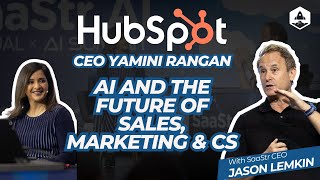
In a candid SaaStr interview, HubSpot CEO Yamini Rangan and investor Jason Lemkin discuss how generative AI is reshaping HubSpot’s go‑to‑market (GTM) engine. Rangan explains the company’s rapid 2023 pivot to an AI‑first product platform, embedding AI (Copilots and agents) across all six core HubSpot products rather than offering a separate SKU. She details concrete productivity gains – 95% of engineers use AI daily, and support automation now resolves 45‑80% of tickets via the Customer Agent, with knowledge‑base creation automated by a second agent. The conversation covers the shift from volume‑driven outreach to hyper‑personal, context‑rich communication, the blurring of functional boundaries (sales, support, marketing) as agents become unified customer‑facing interfaces, and the emergence of generalists empowered by AI. Rangan also highlights HubSpot’s partner ecosystem (7,000 partners contributing ~40% of ARR) as a strategic moat, and stresses cultural leadership: CEOs must model curiosity, growth mindset, and AI fluency to drive adoption. Throughout, both speakers stress the need for unified data, seamless human‑AI handoffs, and a new conversational paradigm that replaces search‑click‑consume with ask‑answer interactions.
Chapters
I think if you're in the tech industry and I've been in this industry for 25 years, of course this is an unprecedented level of change, but change has been the constant and you just have to thrive in it. I'm like a kid in the candy store right now, looking at all of the new ways in which we can help customers. And so you have to embrace it. And when people around you see that you're excited about it and you are learning, you are answering questions.
For us, for the tech It's really interesting you said kid in the candy store.
Yeah.
Actually, for me, that's the bar. Like, sometimes people get mad when I say this, especially when I talk to product teams or engineering teams. If they're not saying this is the kid in the candy store age, you have the wrong team.
Yes.
They should be excited. They should be excited. They should be going home at night and screwing around and coming up with— they should be doing internal hackathons even though you haven't had one in 5 years. They should be like, finally some cool stuff they can do. If you're not seeing that, it's brutal, but you got the wrong team.
The last 5 years were boring. Boring. We were doing the same playbook and we were trying to push It's just the same thing. Exactly.
So if you don't feel that, it was interesting even Yomini said it, like, that's a sign. Hey everybody, this episode is brought to you by Adio, the AI native CRM. Just connect your email and Adio instantly builds a powerful CRM with every company contact and interaction you've ever had. Get 15% off your first year. That's 15% off your first year at attio.com/saasster. That's adio.com/saasster.
Taster.
Yamini, thanks for coming back to Taster.
So good to be back here.
Great. Absolutely. So I couldn't think of anyone actually better to tie to that opener in terms of everything that's changing. I mean, there are— if we look at the public SaaS companies that are like classic-ish B2B, no one's doing much better than HubSpot. But so much change, right?
So much change.
So much change. So I want to get into that. First of all, Who in the audience is a HubSpot customer?
Thank you. Thank you so much.
Most of us. All right. So if you have any— if we have time, we'll save a little bit of time for questions because we have so many customers. So if a couple folks want questions, we will save some time. So think about some questions.
First off, I have been to SaaStr for the last decade. I came in person when I was at Dropbox. I did the video one with you. This is incredible. Congratulations. And the insights that you add to go-to-market leaders, it's just incredible. Congratulations.
Thank you. Thanks for being part of it. It's good. It's a lot of change. I feel like now, like there's different eras. There is the pre-2020 era where it was smaller, but like we're all doing the same thing, right?
Yes.
And then, then there was this weird era from 2020 to 2023. Like, first of all, we were all geniuses. Like we talked about before, we were all geniuses in 2020, 2020, weren't we? Yeah.
Yes, I completely agree. I was listening backstage and we thought that we were good, but we were going with the same playbook and getting the excesses of that playbook. That is gone.
Gone. Gone. Yeah. And then last year, it's good you weren't here last year. Last year was great, like in terms of quality, but it was a low point in terms of this transition vibe. Like people were still feeling bad for themselves. The people were still talk— there's no, listen, it is not easy at HubSpot today, is it? It's not easy.
Totally not.
But there's no downturn, is there?
No, but we are working harder—
Harder, right?
—to get to the same kind of output. I was just agreeing with what you're saying. It is a new playbook. And for a company like HubSpot, we absolutely want to keep all of you existing customers happy. And we are reimagining what go-to-market looks like in the world of AI. So, it's a lot of "ands." And that means there's also higher anxiety. Anxiety. Yeah.
And how, since you do, how will you— I see it in what you write. I certainly see in what Dharmesh has done, right? But how are you helping create urgency at the company? Because I would say of all the public companies, HubSpot seems to be executing the quickest. I'm sure it's not as fast as you want.
It is not fast enough.
We'll talk about it, but it's fairly fast. So how have you actually created— because that's a tough question. How did, how have you helped create the urgency?
It is not fast enough, and my team will hear this from me every single day. Look, I think November 2022 is such a pivotal moment. AI was there before. Generative AI was there before. But November 2022 showed us that you can now interact in a very different way with technology and get more done. And so for us, coming into 2023, we just finished the annual planning process. We had the roadmap. We knew exactly what we were doing. We came into January 2023, and we said, pivot. That entire roadmap that we just planned for the last 3 to 4 months is not going to be what we are building in 2023. And so we pivoted our entire company in the beginning of January 2023. We started building a whole set of new features. The first set of features that Dharmesh helped us launch that are teams launched was March 2023. We launched our first chat spot, now called Copilot, in March 2023. Then we launched a number of content features in March 2023. So it was like immediately pivoting. But Jason, I don't think it has been easy. There was just a lot of question. I think you mentioned this, 2023 and '24, lot more skeptical voices, a lot more, yeah, this is going to be like every other big tech fad that was out there. This is just going to go away. But I think internally we felt like this is the first time that some immovable metrics in go-to-market can be moved. I've been in go-to-market and I've been in tech for the last 25 years. There are things in sales where— what is the percentage of time that your sales team spends in front of customers? I want you to think about this number because this number has been 25% to 35% for more than a couple of decades. We've not been able to move the time we spend in front of customers because we are trying to do all these administrative tasks. We've not been able to expand the account coverage that every single salesperson has. You give your salespeople 100 accounts, guess what they cover actually? Maybe 40. They cover 40 out of 100. 40% of the accounts get better coverage. So there have been these key metrics in go-to-market that we've not been able to move, that AI is now going to help us move. And so for us, it has been just pivoting towards that. And I would say that it comes from the top. One of the reasons, like, I do a 5-minute video for our entire company. We call it a weekly wrap, and I send it out every Friday, and I'm demoing what— how I'm using AI. And I'm demoing how our teams are using AI. We're talking about where we are getting benefit, where we are seeing real customer value. And so it has to come from the top. So those of you who are leading organizations, go-to-market teams, your founders, you have to lead from the front and you have to believe that there is value for your customers and you have to be able to showcase that value for customers.
Yeah. Let me, I've got a few things I wanna dig in on it, but we were chatting before. When we were catching up. Yeah, I don't want— I might have misquoted you, so reframe it. But you said something to me that I've seen, but I still thought it was fairly stunning, which was that on product development side, on coding. Yes. Because of you using tools like Cursor and others, whatever the suite is, it almost doesn't matter. You now almost have a— you almost have too much product to ship into production, right? Is it that different than a year ago? I might be slightly misquoting you, but it was dramatically higher output of product.
So I completely agree with what you said just a little bit earlier, which is Coding and support. These two use cases have found product market fit with AI. No question. We're not going back. If you're not doing it, you're already behind. I think coding and support are done, right? Like, we know that there is product market fit. What I was mentioning is that we started with the first generation of Copilots with coding, and it had some level of productivity. There was some value in it. Now we're on to the second generation with things like Cursor, with Claude Code, and obviously MCP. And the combination of all of that is certainly driving the productivity within our engineering organization. We track what percentage of our teams use AI every single day. Within engineering, it is 95% using one form of agentic code generation every single day. And that means we have to be even more careful about what we ship. It's not just the velocity of shipping something as new features. It is what is the value. Everything in this age, and we'll talk about this, but the business model is changing. It's not like what product you shipped and how much you can get for that product. It is where is there value and how much work is getting done because of AI. And we are becoming even more focused on usage and value that we generate through all of those development efforts. Yeah.
And let's, let's just talk about support for a minute because you've had it, but not everyone really understands why it's working. Yeah. But people don't understand how good it is now with AI. Typically what I've— tell me what metrics you've seen, but typically what I've seen is you— a good AI in support that's— it does have to be trained. Like you usually do have to train it, but you're usually going to be out of the box 10% in CSAT. Yeah. And for depending on how you— and maybe deflect 40 to 50% of the issues and maybe resolve another 20 to 30% of routine questions. You still need humans in those cases, right? You do. But the— and for an average question, a great, well-trained AI is better than a human, isn't it?
Here's what we have seen. Yeah. And maybe why is support a great use case? I think because there's a lot more documentation. And anywhere there is documentation, anywhere there is data, anywhere there is history, and anywhere there is a known amount of finite work, AI is a great way to solve that. And if you take the tiers of support, tier 1 support tickets, you should not be using humans at all because you have documentation, you have a support history of how you have solved it. and you can get all of this. And so I think internally we started using AI for our tier 1 support tickets, but we had a counterbalancing measure, which is CSAT. So you can't solve tickets with AI without knowing that you're maintaining or improving your customer satisfaction. So those two metrics go hand in hand for us, and internally we've gotten it close to 45% solved. With AI. Now, last year at Inbound, which is HubSpot's conference, we launched Customer Agent, and the use case is support tickets. And we have over 2,500 customers now on Customer Agent, 52% average resolution rate with AI. And we have customers that have between 70 and 80% of their tickets getting resolved with AI. And we are like watching the patterns of these customers really closely. What is the difference between someone who is solving 40% with AI and 80% with AI? It comes down to knowledge and knowledge-based articles. And now we launched a second agent which actually identifies that knowledge gap and says, from your unstructured data, from your emails, conversations you're having on how you're solving that, We can write a knowledge article and AI writes that knowledge-based article and gives it back to the team to look at, approve. And that is way to improve that overall rate. But 70% to 80% resolution is happening right now. And so it's incredible. In a, in 15 to 18 months, we have seen such a huge movement.
And what is— I probably should know this, but what if I'm— what, how much training, how much time does it take me to get there in HubSpot? Like how Is it an hour, 2 hours? Is it doing an extra hour a week? Like how— it's not zero, is it? For you?
It is. It's— look, it's not zero. And it really starts with having well-documented knowledge bases and history. The easiest that has taken is get your knowledge base into the agent. Get all of your support tickets and history into that agent. Sync up all of your website data. You can read now hundreds of web pages in a matter of seconds. So sync up your pricing data, all of the website information, sync up your community answers, all of that stuff. Now, if you have that readily available, it is a matter of few hours to get that in. Few hours. Then it is a question of reinforcing. Are you happy with it? But it's also another point, which is where do you want handoff to humans? Because this is where you started earlier. It's not all AI. AI is augmenting your support teams to drive a higher level of productivity. So where do you hand off? And how do you make sure that handoff between agents and humans, and sometimes back to agents, is really smooth? That's where we are working most of the time on.
Yeah. And where that, this handoff, the, do you think that ratio will keep going up? Do you think it will, can go up to 80%, 90% automated as we get better over the next, because the rate of change is so fast.
The rate of change is fast. I think that there will still be a portion which is going to be for humans to solve. I don't think— there's a lot of hype and there's a lot of, you'll get to zero headcount. I don't believe that to be the case. I think there's tremendous value in working with agents, reinforcing the learning, but also having humans really read the particular case and be involved. So I think there will still be humans augmenting the work that AI is doing and vice versa. So handoffs are going to be really important, and that's in general, not just in support. I think AI working with humans and handoffs being seamless is going to be important for every function within go-to-market that is customer-facing.
What do you— and I want to dig into some HubSpot AI stuff. I have some slides next, but let me ask you, since you're running the leading company that does all of this, I don't know if you heard the story I gave backstage of a leading B2B company where the SDR asked me if I wanted to meet at SaaStr next week. This morning. I got an email this morning. Okay. Hey, Jason, I saw you're going to be at SaaStr next week. Next week. Okay. This morning. We want to meet next week. This is a leading company. When you hear that in the age of AI, is that going to be gone next year? Is there a role for that human? Because can't AI do better than that human? Do we even need that type of pretty low-performing knowledge professor? Like, how do you react Managing an organization that in general and with like, how does that— how do you react to that? That's someone that's got a sales background.
That is egregious. I hope it's not from HubSpot.
Not. I could, but I could tell you 3 other stories because people ask me, Jason, why does this always happen to you? You know, people ask, but you could do it too. It's just because I know. Yes. I just look, I just enjoy, I don't enjoy it. But when I get that email, I don't, I like, I have a little fun with it. I make it a case study. I'm not going to put the vendor. Absolutely. But it happens every week. I get an email like this. So how's it going to change with AI?
Look, the biggest change that's happening is that you have to do more to get your customers and prospects to pay attention to you. There's just an explosion of content. There's an explosion of emails. There's an explosion of outreach. And how are you going to cut through that noise? Not by— first of all, if you have like egregiously wrong information, like, oh, your conference is next week, then you're out. Like, you don't even get 10 seconds in that email and you become a case study for what not to do. But then it becomes a, what does it actually take for a CEO like you to open that email and to engage? It better be exceptionally targeted. It better be personal, not personalized. We've been talking about personalization for a very long time, which is you segment your customers, you take your customers and you personalize your data and send it to everybody in that segment. That doesn't cut it anymore. It needs to be personal. It needs to be, Jason, here are the 4 posts that you did. Here is why I can help you with this single problem that you have, and let me get 10 minutes with you. I sometimes get, and I was telling our sales team yesterday that in the last 2 weeks I've gotten 2 videos and they were personal videos and they were, I don't know if it was AI generated or not, and it actually didn't matter. But they actually said something very specific about what I talked in the earnings 2 weeks ago and how they can specifically help. That caught my attention. So I think junk and irrelevant content and both humans and agents not doing their job— Yes. —is not going to cut through. But humans and agents doing their job, understanding your very specific context, and sending you a personal message is what will cut through, and we are going through that massive transition. Yeah. It's not volume of content. It is really how personal it is that is going to drive conversion. It's almost like we have to readjust all of our scorecards. It's not— we've gotten used to in the old playbook, increase the volume of leads, increase the amount of pipeline, increase everything, and it's been this focus on volume. It really needs to be focused on conversion. Because the volume is exploding. Now it is all about how do you convert and how can you be very relevant, very personal so that you can make that connection. That is what AI is gonna help you do.
Yeah, it has to be personal. A minor thing, I'm curious your thought. I've seen this, so sometimes we still get these terrible, like SaaS for next week, right? There's another thing I'm cur— and I'm curious where you think it'll go, or actually what I'm seeing now is great first email, terrible second one. Yeah. The first one's AI. Yeah. I saw on the earnings call, you're— Subsets doing this, but I saw you have this one issue around personalization of this. We've got a backend solution with our AI and it's great and it's perfect. And then you're like, great, tell me, can I do this? And then I get the worst email after that because all the steps have to be S-tier now to get the attention, don't they?
I think the question becomes, how is there a handoff? Is the second email written by a human? Probably. So I think there's a, throughout the journey, you now have the ability to know what your prospect wants, what your customer needs, what the last conversation was. If you got that first email answered, what was the very specific point that they were interested in? How can you go deeper? I started in the industry in sales more than 20 years ago at this company called Siebel. This was the original CRM company. And before every conversation with the customer, my preparation was like 2 hours. I would read 10Ks, I would read 10Qs, I would look at transcripts, I would look at anything that was publicly available about that company, their challenges, their strategy, and I would ask very pointed questions. And asking questions was the biggest thing that I learned early in sales, and I think that has become even more important in the age of AI. How can you ask the most relevant questions on what your customer is facing right now so that you can get the next answer and the next answer? It's like every email, what you're working for, is getting the response. Every meeting, what you're working for is getting the next meeting. That's all you have to focus on. You have to be just brilliant at it.
Yeah. I worry that as our AIs get better, for a while, the handoff for human might get worse. It might get worse because it's a crutch. Yeah. I'll tell you the email I got. It was basically an email like this. It was like, Jason, I saw that you just did this interview with Yamini Adzaster. It was terrific. I really liked the points she made about agent-to-agent conversations. I have a way to create your entire podcast automation for you. I can create the clip, I can redo it, I can do everything your team's doing. I can automate it for you. Here are the 3 folks that have done it for you. I can do it. I could even do it for free for you this week. That's a problem I have. That's great. That is fantastic. So I responded, I'm like, SaaStr Annual's coming up in a week. I have no time, but if you can do this for real, I'll pay for it right now. This is my response. You won the deal. I get the human response back. Oh, what is your podcast and how many do you do? Oh, go to Apple, go to our blog, go to Spotify. We've done 801. Yes. What is your podcast and what do you do? Yeah, that was— you asked the question, that was the human responding to the AI. Yes, the AI was so good. Yeah. And I actually said, I'm so busy, take my money. Yeah, just, just, I just— that's a good— that was a good AI. But not a great handoff. Not a great handoff. So I've got a slide here. I know there's a lot here to see, so we don't have to literally go through it, but I wanted to break out two things. Give— tell me what you're— what you think HubSpot will do with AI in whatever timeframe. 12 months, 9 months, end of the year. Yeah, you can talk a little bit about today, but what are you really excited— what are you going to be— we're going to be able to automate in HubSpot, like in the next 12 months that you're already working on?
Yeah. And maybe a step back, took you back to the journey of January 2023. Yeah. I think couple of important decisions that we needed to make back then was there's going to be one product, which is an AI-first customer platform. And that is an important decision to make because there were a lot of folks building an AI SKU with an AI price and like a separate thing that you would do. And I think for us it is, did anybody buy black and white TV after color TV came out? The answer is no. So you, when after AI there is no product that should not have AI in it. And so I think that was the fundamental way in which we approached our product roadmap. And to simplify this very complex and comprehensive slide, we embed AI in everything that we do. So every product that we have has AI features in it. And we have a Copilot, which is a digital assistant, which means any go-to-market employee should be able to ask questions of the Copilot to be able to get answers. And then we have agents that do work for you. Now, in the industry, there's just a lot of confusion about what is a Copilot? What is an agent? Do you need both? And there's a fight over you don't need Copilots, you only need agents. And the simplified version is you actually need both. Copilots help you do work, and agents do work for you. And there's a fundamental difference in what is happening with technology because forever software and technology and specifically B2B, we've built it so that, and we've driven innovation and we've poured billions into R&D across all the application companies so that we can help someone sitting in their seat to be able to do more with their time. And that has been the last generation of technology and software. I think what is happening now is that you are not constrained, and technology is getting more work done for you when you may not be there. If you have a customer agent and that's answering questions, that website question or the question that comes into you might happen at the middle of the night when nobody is working, and that's still answering questions for you. And so there's a fundamental shift that's happening, which is how is work getting done? And I give that context because we believe that you need both Copilots and agents. And if you look at what, you know, we're trying to do is that we launched 4 agents last year. We added 1 more agent this year. We're here to prove product market fit. We just wanna make sure that every customer that's actually leveraging an agent is getting clear, consistent, repeated value from those agents. So if you're using a customer agent, it should, like, clockwork be able to solve your Tier 1 and maybe even Tier 2 tickets. If you're using a prospecting agent, it should look at your entire customer base and be able to tell you what are the best prospects to go after and even help you set up meetings with those prospects. Content agents should look at the distribution of the content that you have and be able to say, here is the best channel to put this content in. Here's how I would cut it for Instagram. Here's what I would do for YouTube. It should be able to help you do that work. And that's what we are trying to prove. And what is interesting is that in the world of applications before, it was somewhat predictable. You go in, you point, you click, and you can see what the customers are doing. I think in AI, it's very new usage patterns. And so all of us in the industry have to be very curious about what those usage patterns are, because we just can't go back to what we saw within technology and usage in the last 10 years. It's a new playbook. So we are so obsessed about what are they clicking, which ones have daily repeat usage versus weekly repeat usage versus novelty use. Because what's happening in the industry is there are novel, neat AI things. We've all used it in our personal life. You— we've used it once and it has this beautiful image that it creates, and then we never go back to it. That's just neat. But AI has to be necessary. It has to go from just being neat to being necessary to being in the flow of everyday work in order to have the promised transformative benefits that we all think there is. And so that's what we are obsessed about.
Is— just a couple questions I had when you said that. So HubSpot's got, I think, 6 core products right now, right? Yep. 6. As they all have an AI, And as you said, AI is core to HubSpot. It's not an upsell. It's not a, it's not an addition. It's not a $60 a month extra feature. Are those products blending more into one? With, because AI can stretch, it's stretch across them. The difference between sales, support, marketing, service. If it's one AI I'm communicating with, the products aren't always, they're getting less distinct, aren't they?
Tell me why you're asking this. This is, I'm very excited that you're getting there, but tell me you're asking this.
There's two reasons. One, it might be on the next slide, but I'll tell you the real reason. I'll go back. Oh yeah. In what I've seen in, I think the bleeding edge here and B2B has been in e-commerce. Yes. E-commerce is because it's super high volume, super transactional. And in e-commerce, the lines between sales and support were always blurry. Yeah. In B2B, I buy the product often with a human and then support handles the headaches. And customer success smooths over the bumps. In e-commerce, when I go to buy some cool shoes or this neat bracelet online, I might want to buy it. I might have a question. Is this in my size? Is this— do you have it in gold? Or I might need a return, or I might— there's a myriad of things, or I might come to the site for the bracelet, but I've got to get to Saster. Yeah, I might need a coupon, so I go back later. So that's marketing, sales support. And what is What I've seen from the companies I'm close to in e-commerce, they're already blended. Klaviyo, Gorgeous, all these folks in the Shopify ecosystem, they're already merging into one AI. And it's almost, it's incredible the pace that it's happening. Classic B2B is behind, but HubSpot is in this unique position where you have all the apps. So I just think this idea that I talked to this SDR that thinks SaaS is next week. And then I have to talk to an AE and then I have to talk to a CSM that doesn't know who I am. And then the marketer's got to get the data and learn, like, the customer wants— and I'll tell you one less— the customer wants one experience. And the interesting thing in e-commerce, this just literally changed a couple months back. My secret gaming chairs. I'm not a gamer. No, but all the gamers— anyone have a secret chair? No, not enough gamers. All the gamers you watch on YouTube, they all have these secret chairs. Oh yeah. It's the— if you're going to sit in your If you're going to stream all day, I always wanted one of those.
Yeah, we'll get you a seat.
We'll get you a seat. And you can brand them HubSpot. You can brand them. They're pretty cool. So I go to buy one with my son where I'm at his college. He's a freshman and we're tired and we like bought the wrong chair or something. Yeah. So I had to switch it and there's 5 links. There's chat, our new ChatGPT. Yeah. There's support. There's sales. There's questions. And there's like literally 5 chats on this site. I go back, there's one. Yeah, there's one. So I asked that question. This little quote from John Dick teased at this. Totally. But not that many in B2B have all the whole stack, right?
I'm so excited that you're like going here because I think two things are happening. One is that the usage patterns are creating a blur of lines between the different functions in B2B. Yeah. Just like it created in B2C and like other places. And this is exactly right. Like we launched our customer agent and we were Specifically thinking about the support use case, and we're obsessively watching like how are customers using this agent and what is the daily usage patterns. And what is interesting is that they're not only, you know, when someone is using a customer support agent, they're also asking about pricing questions. They're also asking about the next event that is getting thrown, the next webinar that you can attend. And so For them, it's not, oh, this is a service product, and I now can only ask questions about a ticket. It is, I'm your customer and I have questions. That's it. It is not, I'm your question— I'm your customer and I have a service question, a marketing question, a sales question. So you literally cannot do that when you put an agent out there. And this is one of the realizations that we had. The lines are blurring. And at the end of the day, you serve your customer. Your customer does not need to know which org they're dealing with. And we've been saying this for a while in our industry. It is now possible to do. I do think the lines are blurring. And in order to do that, the level of documentation, the level of history, the full context of the customer journey needs to be there. And we do think that's one of the reasons why platforms will continue to win. Point agents will not win in this whole race that we are in. That's one part of it. There's another subtle thing that is happening, which is we have in B2B software always focused on providing technology for specialists. BDR has a tool, a pre-sales person has a tool, a solution consultant has tool, a salesperson has a tool, a content manager has a tool, a video editor has a tool, like, There is— we've really provided tools for specialists, and what AI is going to help us do is to enable generalists. In marketing, you might not be the translation expert, but you can now translate. You might not be the video editing expert, but you can edit your videos right now. You might not be specified, like, social channel media expert, but AI is going to help you do that. So I think it's also going to lead to more generalists that can then leverage technology to be able to do more. So that's fascinating as well.
Yeah, maybe just two thoughts, one about HubSpot and then more about John's insight here, your insight, Phil. I also think if I'm thinking like 2024, 2023, everyone here is a HubSpot customer, but maybe some is for their old school, they're just marketing, maybe a lot are just CRM because HubSpot owns CRM for this community, but maybe in 2024 I might use 2 vendors or 3 vendors. I feel like in 2026, I might be like, if I just have one AI, I really don't want my hubs, my AI leaving my platform and going to a different AI. I want this whole thing to be transparent to the customer. So I think I want an ideal world. I want one app that does it all.
And I think I want HubSpot to do all of it. Tons of agents. So we're not going to take it lightly. We're just not going to assume that we have the ability to provide that platform, we're gonna fight for it. Because while the premise is that point agents cannot solve more than point questions, and you as a customer, you'll need to be able to answer all the questions for your customers, that is given. If you peel back the onion, think about what does an agent need? An agent needs to be onboarded just like your employee needs to be onboarded. When your employee joins your company, what do you do in the first week for that employee? You provide your products, your ideal customer profile, your brand voice, your tone, your competitive differentiation, your value proposition. You're actually training your employee with all of that context so that the employee can contribute meaningfully to your organization. That's the same thing that's happening with agents. When you onboard an agent, you provide the same thing. Your brand, your tone, your knowledge base articles, your history, your ideal customer profiles. And when you do that with the most exhaustive and unified set of data, then your agents can actually perform better. And so you really have to start thinking about what is required to leverage AI. It is more unified data. It is data across your entire customer journey, and it's context about you, your company. I prompt like crazy. And I'm spending time on Claude, I'm spending time on ChatGPT, and I probably do tens of prompts, but I have a generic one, which is, this is my role, this is what I do for HubSpot, this is our company, this is our customers. Now I have a question for you. Like, that first part of the prompt, I'm just going to assume anytime I prompt, that's there as part of my prompt. And then I write the second part of the prompt, which is a more specific question, and your applications need to do the same thing. You shouldn't have to give that context every time you use an agent. It should just be available for you. And that is the difference. Yeah.
And just for folks that maybe are behind here, this point that I highlighted, Yamini already brought it up, but this, the team started using it beyond service is pretty profound. Yep. Our own little AI, 140,000 chats. Yeah. It was just, I thought people would ask about what Yamini said when she was at Dropbox. They've reviewed hundreds of VC pitches, hundreds of board sections. They've written SDR pitches. There've been a lot of therapy sessions with digital Jason about their business slowing down. There've been a lot of conversations about whether they should fire a CRO or a CMO. And our AI, which I didn't know, our AI closed one sponsor here.
That's amazing.
But I wouldn't have, I wouldn't have— it was an experiment. And so the fact that HubSpot at their scale can see it already do more than service. If you're not in production with your customers, letting them drive you, you're not— in one of the old SaaS posts, which I know you would agree with, is everyone needs to do customer support or you don't learn, right? So pre-AI, you do customer support, you listen to, oh my God, I can't believe we're saying that, or, oh my God, I can't believe our product has that. You learn these, you learn like things that you knew but were a little different. With AI, customers take you places you did not expect it to go.
Right? That's the power. Yeah. You have to be obsessed about usage patterns. What are they clicking? What are they returning to? And then we are constantly sifting between neat and necessary. Yeah. Daily usage and one-time use. And that's the pattern that you have to like really follow. This whole thing of every company needs a website, every company now needs an agent. Here's the thing. What was happening in the previous generation is you search and then You click and then you consume information. That is the pattern that as an industry that we are using, that we've used for the last couple of decades. Search is gone. Like, we're not just searching to get the information anymore. AI overviews are actually providing answers. So waiting for search to lead traffic to your website is gone. And that is one thing. The other pattern that is emerging is that it is not search, click, and consume. It is have a conversation. That is the new pattern. And so it— we're now in this mode of a completely different pattern, which is all about ask a question and get an answer. You're not pointing, clicking, searching, consuming. You're just asking a question in your natural language and getting an answer. And that's a huge paradigm shift. And that means a lot of things in go-to-market has to change based on that.
It is a huge— now, I was actually trying— the reason I put the slide up is with the bottom part, but now I get the bottom— the top part much better, right? Which is the whole idea of a website is somewhat dated, right? Website now is a carrier, a vehicle to interact with. We can call it an agent. The terms agent have one— I like to just call it an AI. Yeah, it is a carrier so that I can talk to an AI. In a variety of angles, prospect, customer, user, and have it do things. I don't know everything that you're getting here, but if your website is a static website with a data chat for research, you're falling rapidly behind. Everyone wants to talk to their documents, to their vendors. Like they just want to talk to these things. Exactly. That's the shift. Yeah, it's a big shift. I think the interesting thing is you, the other thing I learned from our AI Not to get on a tangent, because I do want to at least talk about partners before we run out of time, even though it's not AI, is why does our AI work so well? It's Aster. And I guess this is an obvious point, and some people make fun of it because it's conceit, but when they're talking to me, if you have, I don't know if you have a Yamini AI like Brian does, but if you put one on the HubSpot website, right? Not everyone knows who the CEO of HubSpot is. Honestly, you have 260,000 customers and a lot of them know they will talk to you. Yeah. And because they'll talk to you or me, the prompts are inherently different. They're specific because they've been reading SaaS for 12 years. Jason, I know you did this thing at SaaS Arena with Yamini last week and you talked about how we have to motivate the team. I've got a CRO who's angry and yelling at me that she doesn't want— like that inherently creates the right prompt. I just, I don't even know. I don't even know if we should be prompt experts in here.
Should we? I still think there is benefit in that. I don't think like everything is going to be like so obvious and easy that the conversation that you and I have is going to replicate itself. I do think that you have to be decent at writing the context for the prompt and being good at prompting. I don't think it's going away.
It's asking a lot for a customer though, isn't it? Yeah, it is. To become more— it is.
Yeah. All right. We hit the prompt.
Fascinating. Yep. All right. I want to— we come back to AI with the questions, but I know AI is really exciting. But this one, in just in terms of helping folks learn, I find so many founders do not understand partners and indirect sales. So many partners. I was literally catching up with an up-and-coming VP of sales I know who just washed out at a company at $30 million. And I said to him, what happened? I know you, I would recommend you in a heartbeat. He went into an environment that was 60% indirect, 40% direct. He only ran outbound, talk to the customers myself, was pretty good at it. What happens when it's 40% of your revenue? Revenue declined. Exactly. Even though that 40%, I bet he tilted the curve, right? Yeah.
Look, I think that as an industry, we got fascinated with product-led growth. Yeah. To the point where we solve everything with product-led growth, and that is not the case in go-to-market. There is a sales team and how you actually bring them to the most productive use. There is a whole partner ecosystem. And then of course there's product-led growth. And for HubSpot, 40% of our ARR has been influenced by partners. That is either they are bringing us leads or they are co-selling with our sales team and helping them close. Those two are what we call as influenced. And if there are HubSpot partners here, thank you because we love having you in the ecosystem and it's been a great journey to One, we've had that 40% for, from the time that we were like $100 million to now we're close to $3 billion in ARR. We've had partners be part of that. It's stayed 40%. Yeah. So they've scaled.
And we are, and in the old days, a lot of these were agencies or smaller shops. That ratio's probably changed. Yes. Who they are, right?
Yes, absolutely. So the couple of big transformations that have happened within our partner ecosystem, Most of our partners, we have about 7,000 partners, and most of them started as agencies, marketing agencies, building websites, and it was great. Then as we started expanding from marketing to sales to service to content and building an entire platform, we went to our ecosystem and we said, look, this is the journey that we are on. We're going from an app to a suite to a platform, and now to an AI-powered platform. So come on this journey, and we've spent a lot of time talking to them about the journey, and many of them— it's just one of the most fulfilling things for me to see— many of them have transformed what their organizations were to now become CRM implementers and AI-powered CRM implementers. That's one part of the journey. The other part of the journey was when we got started, we were really focused on SMB, and most of our customers were 100, 200-person companies. Now we've gone north of that. We are serving customers with 1,000, 2,000, sometimes 3,000 employees, and our partners have gone on that upmarket journey with us, and they've done a wonderful job. And it requires a lot of focus. It requires creating vibrant ecosystem where there's support, and it is, it's been just this wonderful journey, and that's why you see these numbers out here.
Yeah, I think what folks might not realize is that we talked in the opener about moats versus momentum. Yeah, maybe it's changing today, but at least in the past, most HubSpot partners only work on HubSpot.
Yeah, it still is.
If the customer goes to the partner or the agency, they're not going to look at 3 vendors because, listen, I need help with my CRM. I need help with my marketing. We'll help you. We deploy HubSpot. So it is. If you— not only if you ignore partners, do you maybe lose 40 to 50% of your revenue. Yep. But it's super hard to compete when they're HubSpot— like web buyers can, if they have the energy, they can evaluate 100 vendors. Yeah. Really? It's 2 or 3. Yeah. But, but with partners, it's just one, isn't it?
Yeah. How many of them sell 11, 11, 11 other competitors? Not 70% of our partners are focused very specifically on HubSpot. Yeah. And Yeah, it's a huge moat. There are moats and there is momentum and a lot of them are getting disrupted, but I do think having a great partner ecosystem is a very good moat.
Yeah, whatever you do as founders, at least this direct thing, even if you don't know anything about sales, direct is intuitive. Okay, I gotta, I gotta email somebody, get on the— study your ecosystem. If your ecosystem is in any way partner-driven, and you'll see if you go super, if you go like into security or enterprise, sometimes it's 100% partner-driven. Wiz is all partners. You want to compete with Wiz and you want to sell direct and be like, you're just going to lose. But at least study, at least calmly study your market and don't make this mistake. This VP of sales, CRO said, who obviously didn't study the market. They see it like, if you don't adapt to these ratios, you're just going to lose. You're just, we're not all direct buyers, but all right, thanks. I got more questions, but do you guys have questions?
In the last session, Jason M. Lemkin said that 20 to 40% of the workforce might not make the cut. I'm—
Now this is a tough one for Yamini, but keep going. Yeah, I did say that. Yeah.
I was interested in knowing who makes the cut at HubSpot. What skill sets or traits or strengths are you prioritizing for the future for those that remain? Yeah. Curiosity and growth mindset. That's what will make the cut. And I think that I agree with, with Jason, if you're trying to slow roll AI, if you think that this is going to go away, if you're not investing in yourself and developing a level of AI fluency, then you've pretty much lost the game. And so I think that is what we are focused on within HubSpot. Thank you so much. First of all, thanks for the great session. It's awesome and it's insightful. My question is that you, in the beginning, you mentioned about the after ChatGPT release, you changed the business roadmap and product roadmap. So what would be the good attitude that CEO would need to have to cope with change? Because things are changing dramatically. Yes. And I would like to understand how you cope with change and what kind of do you prepare for it? Yeah, you just embrace it. I think if you're in the tech industry, and I've been in this industry for 25 years, of course, this is an unprecedented level of change, but change has been the constant. and you just have to thrive in it. I'm like a kid in the candy store right now looking at all of the new ways in which we can help customers. And so you have to embrace it. And when people around you see that you're excited about it and you are learning, you are answering questions, and a lot of times this is a time to say, "I don't know." I say this within the company a lot. If there's a question I don't know, I'm like, "I don't know. This is like 2-year-old phenomena, so how would we know?" And so I think being able to role model how you are thriving with change will encourage others to do the same thing with change. Thank you.
For once, I really want to take another question, but it's really interesting you said kid in a candy store. Yeah. Actually, to me, that's the bar. Like, sometimes people get mad when I say this, but when I, especially when I talk to product teams or engineering teams, if they're not saying this is the kid in the candy store age, you have the wrong team. Yes. They should be excited. They should be excited. They should be going home at night and screwing around and coming up with, they should be doing internal hackathons, even though you haven't had one in 5 years, they should be like, finally some cool stuff I can do. If you're not seeing that, it's brutal, but you got the wrong team. The last 5 years were boring.
Boring. We were doing the same playbook and we were trying to push the same things. Another SOC.
What? Another compliance I gotta build, Yamini. Now I can do stuff that's fun. Exactly. So if you don't feel that, it was interesting even Yamini said it, like, that's a sign. Thank you, Yamini, for being here. I do have a question, but the first question is, hopefully Brian Halligan's doing well. I know he's doing great. The founders had an accident. I don't know if he's still involved in HubSpot or not, but my question is involving scaling. So does HubSpot have a direct competitor? I used to describe HubSpot as the easy-to-use Salesforce. Yeah. And I know you mentioned that you guys can handle companies now with 2,000 to 3,000 agents. Can you go enterprise?
Yeah. So on the first part, thank you for asking about Brian. He's doing great. He's fully recovered. He continues to be involved. He's on our board and he's doing fantastic. And I particularly enjoy having conversations with him and learning from him. So I think that's good. On how we think about the segments that we serve, we really care about ease of use and time to value. And we think that the segment, which is 2,000 employee segment, which most of us can call it as like a mid-market segment. They've been underserved. They've been underserved because there's like very complex enterprise tools that try to fit into that market, or there's like point solutions that you have to cobble together, and it has been underserved. We focus on that particular segment and we wanna serve it really, and we wanna be the market leader within that segment. HubSpot runs on HubSpot. We're an 8,500-person company, but that doesn't mean that we want to take our product all the way up to the enterprise. We really want to focus on serving scaling companies really well. Thank you.
Just one follow-up. I have, when I, my epiphany, we did, we did this in 2021, all outdoors out here. Pretty funny. Yeah. And that was the first time ever when I asked this question, this type of question, nobody in 2021 now was migrating off HubSpot. Yep. What I meant in the old school, people, everyone loved HubSpot, but when HubSpot CRM was early, folks would use it and then graduate to Salesforce. Yeah. Then in 2020, '21, I'm like, no one's really doing this now. 3,000. I mean, but the folks that are now at that next level, you wanna stay with them forever, don't you? We can. Yeah.
And like I said, HubSpot went on to HubSpot and we've grown and scaled over the last 5 years. We've gone from 4,000 employees to 8,500 and we've continued to scale on HubSpot, so it's It's not necessarily product scalability, but which focus market do you really want to serve?
And that's where it comes down to. I just literally haven't been, I can't, I haven't, it's been years since I've been in some sort of meeting where someone said we've gotten too big. I just don't hear it. It's just an interesting observation. Yeah. I just don't hear it. Good. All right. The next time you come to SaaS, we'll talk about pricing, Fran, and it'll be totally different. Thanks everybody. Let's give y'all money if they can.
More from Jason

Why Your Next Hire Should Report to an AI, Tragedy Apps, and Too Many AI SDRs? | The Agents #004

Our Agents Drove Our Salesforce Bill Up 80%, Marketo Hates Agents, and We Stealth-Churned Off Notion




Managing 20+ AI Agents: Lazy Agents, Our $500K AI Bill, Stealth Churn & the Death of 60% Solutions




