Best Practices in Customer Success: Maximizing Revenue, NPS and Happiness
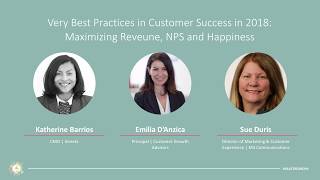
Catherine Berrios and Amelia Danzica discuss how SaaS companies build customer success teams that drive revenue and retention. Key points: $1.6 trillion is lost annually to poor customer experience, 90% of revenue lives in CS, and CS leaders must align with sales, product, and marketing from the start using shared frameworks like Salesforce's V2MOM.
Chapters
Hello everybody, how's everybody doing? So if you're in the right place, this is Very Best Practices in Customer Success in 2018: How to Maximize Revenue, NPS, and and happiness. My name is Sue Duras. I'm founder and director of customer experience and marketing for M4 Communications. We're a customer experience consulting organization out of Palo Alto, California, and we work specifically with coaching SaaS companies on how to be customer-centric. So let me take time now and introduce our panelists. So on my immediate right is Catherine Berrios, who is Chief Marketing Officer at Zeneta, where she leads the marketing and customer success teams. She has close to 20 years of experience in B2B software product space with core expertise in demand generation, enterprise sales, product marketing, product management, and media analyst relations. Katherine is a true believer that the entire organization must align along the customer journey with marketing and customer success teams working in lockstep at the core. Berrios is a native of New Jersey in the US and has been living and working in Oslo, Norway since 2001. Next, we have Amelia Danzica, who is a strategic management advisor and principal of Customer Growth Advisors. After nearly 20 years in the tech industry and helping companies like Jobvite, BrightEdge, and WalkMe scale, she has a deep understanding of best practices in building highly successful customer-focused success operations, and marketing teams. She now specializes in working with executives globally to build customer programs from onboarding to customer advocacy. I want to throw a number out to you: $1.6 trillion. That is the latest number in 2018 of money that organizations are losing because their customers are switching to, to their competitors because of poor customer experience. Customer experience, I'm sure you've read a lot, has become the key brand differentiator for businesses. So it makes it very important to really focus on customer relationship building. And we know through research and things of that nature that most growth is happening in the post-purchase phase of the customer journey. It was Jason M. Lemkin who actually said customer success is where 90% of revenue is. So there— There are the important stages. There's the onboarding stage that it's very, very key. Matter of fact, if you have an effective onboarding program, you can reduce at least 25% of your churn rate. And you're constantly nurturing so that when time comes for renewals and expansions, you're going to have those customers in drive, in my opinion, the, the most important customer metric, and that's customer lifetime value. So let's start out with the first question I'm going to pose to Amelia. So customer success is more than just a customer relationship-based consultative process. Now it needs to include how do we help our customers reach their desired outcomes. So how do we locate the gaps and what are the opportunities and strategies that we can put in place to help them?
So I would say for especially startups, starting early and investing in your customer success Customer success programs. Often companies end up hiring their first VP of customer success too late, and then suddenly that person is not acting in a strategic way. They're not putting process in place, but rather they're just putting out fires. So they have to clean everything up first before they can actually become proactive. And I think that's the first thing I would say is hire someone sooner rather than later that actually has seen the playbook successfully in customer success. You also want to hire someone who understands your technology, not just the customer success journey. So especially in SaaS, it's critical. What is unique about your platform? What's the unique differentiator that will lead customers not only, or prospects, to buy your platform, but also to keep renewing. Why would they go to a competitor if they're able to really understand the platform and what the benefits are?
Yeah, I agree 100%. I think we could say from our side that we were a bit late in hiring our first customer success person. So if you want to see something where we didn't do it too great, we would be an example of that. So we did go into some firefighting mode initially. Now we're on a good path. But in addition, I would like to add that the alignment between the commercial teams, meaning sales, marketing, and customer success, is critical to happen earlier than later in particularly your acquisition strategy. And how does that play through into your retention strategy? And how do you have a full circle of acquisition and retention and then going back to new business? So having those teams aligned on the same strategy is very important. And having that again happen earlier than later is what's really going to make a difference with all teams being accountable for revenue in, in shape or form.
And that's a really good segue into our second question. And we can't do customer success in a silo. We can't do anything really in a, in a, in a silo to be effective. So making sure that there's alignment between customer success, marketing, sales, product operations is not only is it a full-time job to do so, but it's very, very critical. So what strategies can employ that we can accelerate that alignment and sustain it? And maybe a part 2 to that, and I know it's kind of a million-dollar question in customer success circles, is who handles the renewals and the upsells? Is it customer success? Is it account management? Is it someone else?
Yeah, so in our organization, our customer success team handles the renewals. So they run the lifecycle of the customer and they handle the renewals. The upsell is sent back to the account team. Whether that's the right way to do it, we need to see. It's, um, we are advisors, so customer success are in an advisor role. And if all things go in play, meaning the alignment between sales and marketing, and we all align as to why did our customer buy, are we delivering on that promise, are we delivering the value that they want, in essence, if all those take yes and we have programs in place to do that, the renewal process should be a smooth one where it would be normal for the— in our business, for the CSM to take and carry the customer through through the renewal process instead of handing it back to the sales. So there's a balance between being an advisor, a trusted advisor, and being able also to bring in that revenue and identify upsells.
I'll take a more tactical approach to your first question. I believe that it starts with communication across all executives, the leaders. So if you just are asking your leaders to provide a couple slides for the board, they're not talking to one another, they're not aligning on their vision and their values. So what I've seen as very effective is using something like the V2MOM, the Marc Benioff Salesforce way of alignment, where every team is responsible once a quarter and once a year to provide their vision for their team, what values do they adhere to, how will they measure their success, What obstacles do they usually— do they currently have? And what methods are they going to use? And if every team can answer those questions and it's in a shared place where all the employees have access to it, I believe that the communication can make everything run smoother. And that leads into the second question of the renewals. I think it depends on your company. What do you provide as a service? And also, who do you have on those teams? I've worked— one of the companies I recently worked with, during the span of my tenure there, they changed who owned the renewal 4 times. Because it's not— there's no set answer to it. It's how do you work with the customers? And so, What I believe is if you start the customer journey once it's closed, the customer understands that they have a trusted advisor leading them, their customer success manager, and there's someone doing the financials, and they're introduced early. It's not a choppy customer experience. They know that if they want to up— they want to purchase more of the platform or the renewal's coming up, they know that this this person will come back to be part of the journey. And they're always there, for example, to vent. I don't feel I'm getting value out of the product, or the customer success manager isn't a good fit for my needs. I think it's always good to give the customer a lot of support, and that means it's okay to have a customer success manager that gives them the trusted advisor relationship, and have someone else be doing the financials.
What another great segue into our third question. So building the customer success team, whether it's your first customer success manager that you've ever had or you're adding, adding to the team, getting the right traits and skill sets so that that organization, that customer success organization can be effective with customers is so critical. So Amelia, what are those key traits and skill sets that a customer success manager or customer success team as a whole should have?
So I'll ask this to the audience. Think of one word when you think of a customer success manager. What's their one trait? And when I do this with customer success teams and we, you know, write down our words and then we go in a circle, one of the recent sessions I did, not one person wrote down leader. Customer success managers are leaders. Once the opportunity is closed, that customer is depending on the customer experience the customer success manager to lead them through best practices in that journey. So that's the number one trait I believe a customer success manager should have, is being a confident leader. I know the product, I know the journey you're about to embark on, and I'm going to become your trusted advisor. And along with that comes good communication. So being really clear and direct with what the customer can experience through this journey. I would say those are the two most important ones.
Yeah, in addition, I would probably say an empathetic person, being able to look outside of your own two feet and not be in your own bubble, whether it's, you know, only talking about your product and all the buttons and all of that and how great it is. Woo, you really need to try this. I think it's really looking at What does the customer really need? Answering their, their questions. What value are we bringing to their business, to their bottom line? And then in addition, being able to look forward to anticipate what their questions can be, what their needs can be like and will be like, and proactive in that and not waiting for the customer to come and ask the questions, but really be involved as much as possible into the business of that portfolio of all the companies as much as possible and know what kind of information they can be needing and how to drive that relationship further. But in addition, I think the customer success manager must also be able to be a good colleague in terms of being empathetic and looking at on their own two feet within an organization. So how does sales— how can sales and customer success work together? Marketing work together with customer success? Product work together with customer success? So understand the needs of all the different departments and again be empathetic towards the needs and the goals of every single department because essentially we want everybody to work together. I think that's the hardest part is that most teams really live in their own bubble. And again, not being empathetic for each other's needs creates chaos and misalignment, and that ultimately, you know, stalls many processes when you get to the renewal part, when you get into upselling and all the other things that you can do. Yeah, so that's what I think about that.
So a panel discussion would not be complete without one question on metrics. So I need to ask by a show of hands, how many of you use some form of NPS, Net Promoter Score, in your metrics? That's pretty good. So NPS, has been a key way for SaaS companies to basically monitor where their customer satisfaction is, judge what the key satisfaction is. And so that said, I'll pose this to both of you. What are the pros and cons of using NPS to determine satisfaction and not only to determine satisfaction but using the insights to improve processes? And are there other metrics that we should maybe consider?
Sure, Sarah. Yeah. We use MPS. We don't particularly look at just the number on the MPS, but we look at really the scale of how things are moving up and down. So, from promoter, passive, and a detractor. And we're running them quarterly. So, if they're running— if they're moving from passive to detractor, we obviously have a challenge. How many of those are moving up and down? Who are those? And what we do then is we actually reach out to particularly the passives because those are the most dangerous ones. That aren't saying anything and risk them moving to detractors. But we're measuring how they move on that scale. So the number itself, there's a lot of margin of errors there depending on when things are sent, who actually answered them, what kind of email address, was it a user or not a user. There's so many things that can go wrong on an actual number and also like what do you benchmark towards. But in terms of it moving up and down with the promoter, passive, and detractors, that's where we really draw value. That allows us to see— to try to predict, obviously, what's going to happen and who we should be focusing more on. And we couple that also with who are our high-value accounts. If we have high-value accounts, then at passives, our team is going to focus a lot on those. And depending on when their subscription is over, In addition of what we see is, you know, other metrics is not only the NPS, but also, you know, engagement overall with our platform and engagement overall with our content that we push out. Everything we measure engagement with our content, are they attending our webinars? We have very customer-specific things working with our customer advocacy manager and how much they use our platform. How much are they signing in or not signing in? And all of this sort of makes up a score for us in terms of letting us know if it's something that we can anticipate to easily renew or if there's more work that we need to be doing.
Yeah, I would say NPS is dependent on, one, what do you do with information? And two, is your entire company part of the NPS scoring? And what that means is, once you send those NPS to relevant people, so like you said, not to everyone, but the decision maker, the day-to-day champion, those, those two users are probably the most important ones you want to send an NPS to. What do you do with that information? So one of the, the things I've found as very effective is making each head of each department not only review you review the data with them, but also they're responsible for calling 10 of the people who answered. And they're not the 10 happy ones. That we'll give to marketing, let's write a case study. But all the passive and the detractors, let's get the head of product on the phone with them and really understand the frustration they have. It will help push your product forward. And I do believe using, you know, if you're using Salesforce, and you can push your data in there so your CSMs can see that data on a regular basis in terms of usage is really important. Uh, the other, the other survey I really like to send is, uh, right after they go live, the customer success manager marks the customer live with your platform. What does that really mean? So if you send that survey a week or 2 weeks after they're marked live, you can really get a good deep understanding of did they feel they were live. I've been through an onboarding where suddenly I was— went from being with my onboarding manager to suddenly being with my customer success manager, and I thought, wow, I didn't even know I went live. I don't feel live. So I think it's really good to send these surveys from someone like the vice president or another third party, for example, so that that customer will give you honest feedback on that experience, because I think we can all agree, during onboarding is one of the most critical times when a customer is, can churn. I mean, they will be calling saying, "I want out of the contract," and I work with clients all the time saying, hearing these kind of challenges. The customer has buyer's remorse. So it's a great time to send surveys then as well.
To the audience, do you guys use other tools like— are you doing customer satisfaction? Show of hands on you're looking at customer satisfaction or customer effort score. One thing about NPS that we don't want to do is turn it into a transaction type of metric. So if you have a service issue, you don't want to put that out every time— you don't want to ask the NPS question every time you have an issue. An issue. You want to do something more like customer effort type of a score, because customers who see that every interaction that they have are going to get sick of it. It's time and place, and I think you were talking about quarterly. It's quarterly or biannual. Those are the appropriate times. So our fifth and final question is— Since we are now in the mid part of 2018, what trends for the rest of 2018 and in the future do you see in the wonderful world of customer success?
Do you want to start? Do you want me to?
Okay.
Well, I see that with so many different generations right now using platforms for different needs is One, incorporating emotional intelligence in how you build a customer success team, especially one, one of the clients I work with, a lot of the owners of that purchase the platform are 60+, very successful, they own their own companies, and then the people who actually end up using the platform are in their early 20s, let's say, and those people who are fresh out of university, they totally get tech, they want self-service, they want it in the platform, they want to figure it out on their own. But the— perhaps the people that are used to more handholding, or they don't want to even use the technology, how do you, how do you service both of them? So really thinking about emotional intelligence across generations, I think that's really important and often missed. That also means if you're a global company, you have to think about the different cultures and how to communicate with different cultures. So I've been working with Israeli companies for a long time now, and I remember getting an email in all caps, and I felt like I was being yelled at. And so I told the person, I said, why are you writing to me in all caps, I feel like almost threatened. So really understanding that different cultures have different communication styles, I think, is really important. And then just really from the user perspective, making your product as self-service as possible. Customer success, I don't think, is going away just because you have in-platform support that's contextual and real-time. I think it's just becoming the norm. You have to have a way for your product to be consumed without having so much handholding.
Yeah, from my perspective, I think more from an organizational side, um, I mentioned I am a true believer of having teams aligned. So again, and going back to the sales, marketing, customer success, and I believe that, and particularly marketing and customer success will be even more aligned as we move forward. And our teams currently work together and the reason for it is that customer success needs to be a strategic player in the organization. And that's important. And if you're able to see, you know, how all the different acts of a customer success manager plays a role into revenue contribution as to sales and marketing, That is golden. But in order to do that, we need to first align everyone from the very beginning. And in our case, we're bringing even our CSM into deals before they're closed. We sell to enterprises and we're— customer success is kind of going everywhere in the organization. So it's not just within the customer success bubble, but bringing them in into the sales cycle already early Working together with marketing in terms of getting all the feedback and making sure that that feedback and understanding what makes a successful customer, what content caused that to happen. All the learnings is bringing that back to the top of the funnel and creating content that is really making people love what we do and ultimately become a customer. And working with product. I think that is the way that CSM also— needs to go be a strategic player within an organization and not only be within the retention side. It needs to really go through entire organization. So I see that happening more and more. And for us, it's working really well. It's taking— it has taken a while to get the teams to, again, look beyond their own two feet. Like customer success, look beyond only onboarding and that part. And for marketing only to be doing you know, marketing, but now we really see, and especially sales, let me get me started on the sales side. I could talk forever about sales alignment, but that's critical to make sure that everybody sees the purpose of every team and that they're aligned strategically.
Well, great. We've come to the end of our session. I hope you learned some things. The three of us are going to be around approach us on customer success, customer experience. I can't see a scenario where a SaaS organization can be effective and grow without having a customer success team. It's very, very vital. So we'll leave you with that, and thank you very much for your time.
More from Jason

Why Your Next Hire Should Report to an AI, Tragedy Apps, and Too Many AI SDRs? | The Agents #004

Our Agents Drove Our Salesforce Bill Up 80%, Marketo Hates Agents, and We Stealth-Churned Off Notion




Managing 20+ AI Agents: Lazy Agents, Our $500K AI Bill, Stealth Churn & the Death of 60% Solutions




