Blazing Trails, Building Opportunities with Procore, King River Capital and Black Angels Miami
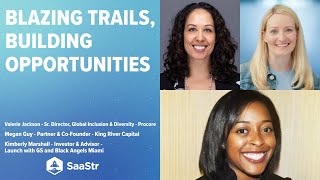
Kimberly and Megan, leaders in venture capital and angel investing, discuss building capital access for underrepresented founders. King River Capital has backed companies where 60% have female founders or CEOs. They share how being first in tech and finance pushed them to create Black Angels Miami's syndicate and Goldman Sachs' $500M Launch with GS program.
Chapters
Ain't never seen Harvard like this.
Do I click? I don't click start webinar, right?
No. Nope. I'll handle it all, Kimberly. You don't have to do anything.
Don't worry. I was paying attention.
I'm not worried.
OK, we're live streaming now.
And then I'm going to hit broadcast right now, Valerie, and go on mute. So as soon as I hit broadcast, you will count off. OK, good luck.
Hello everyone. Welcome, welcome, welcome to Wednesday, first of all, and to Blazing Trails: Building Opportunities. I'm excited to see the number of participants go up and to be with two phenomenal women today, both of whom have done amazing things by forging unique paths for themselves and for others. Throughout the session, we'll be sharing our learnings through stories. So I've asked Kimberly and Megan to introduce themselves because let's face it, no one can tell your personal story better than you. But before passing it over to them, I'll kick it off by introducing myself. I'm Valerie Jackson, and I'm the Global Head of Inclusion and Diversity at Procore Technologies. I'm a recovering finance lawyer, and after leaving legal practice 13 years ago— yes, I said that, yes, 13 years ago— I began focusing full-time on building global talent inclusion and diversity initiatives in corporate environments, often from the ground up. Often creating my own roles and building teams along the way, which is why I was immediately drawn to Megan and Kimberly's stories about making their own ways and making a difference. So let's hear from them. Kimberly.
Thank you, Valerie. I'm really looking forward to this discussion with you and Megan, and thanks to all of you for coming. I invest under a few different hats with a focus on minority entrepreneurs and investors. I'm a personal investor in companies and funds. I'm a founding board member of Black Angels Miami, and I advise Goldman Sachs on their Black and Latinx investing strategy under Launch with GS. I spent my career in investing in tech at Tech Investing at the Bill and Melinda Gates Foundation. I helped build Uber from 19 markets to over 400, Macquarie Capital, Morgan Stanley, and a few other projects and funds. Um, and I'm passionate about increasing access to capital for minority entrepreneurs and investors, job creation, and wealth creation. My guiding life principle is, to whom much is given, much is required. And I feel tremendous responsibility to be a good steward of the many opportunities I've had throughout my life. So when I think of our session, Blazing Trails and Building Opportunities, it is very much guided by that.
Awesome. Thank you. Megan.
Hi, everybody. It is wonderful to be here. And I am beyond delighted to be here with Valerie and Kimberly, who are two of my favorite people and— certainly folks I look to as I think about what it means to be blazing a trail or an opportunity builder. So I'm also, like Kimberly, an investor. I'm the co-founder and a GP at a fund called King River Capital. We raised our first fund last year. We're headquartered in Sydney and California, focused on the software space. And I lead our US presence. Before that, I really worked kind of at the intersection of finance, environment, energy. For many years I was a venture capitalist at a fund called Angelino Group that's energy sector focused in Los Angeles. For many years I spent some time with The Nature Conservancy where I actually led kind of our carbon finance and corporate conservation investing efforts. And then I started my career a long time back at Goldman Sachs. So I guess I'm a recovering banker to go along with Val's recovering lawyer. Um, and so part of what I think is so exciting to me about being on this panel with you guys, um, is that I think we've all had really varied journeys even though we've ended in the same place, uh, working in tech. And, you know, for all three of us, I think that spans the private sector, the public sector, like many flavors in between. And for me, that's actually been really fundamental to how I've thought about my path. Um, and I'm not sure Honestly, I would really be trailblazing without that and having had the benefit of all those different perspectives throughout my career. So excited to get into that more with all of you.
As are we. As are we. So thank you both for introducing yourselves and giving us a flavor— giving our attendees more of a flavor of who you are and what we can learn from you as we dive into our first topic. Which is, surprise, surprise, Blazing Your Own Trail. So I know both of you have been a first multiple times throughout both your careers. Was that intentional? Did you seek out certain opportunities because you knew you'd be first or for another reason? Megan, why don't we start with you?
Yeah, I kind of love this question because I think the answer for me is both yes and no. I would say at the beginning of my career, I certainly wasn't looking necessarily to be the first one to do anything. I had studied environmental science and public policy in college and kind of thought I would have a career, you know, at EPA or doing something that was really focused on helping preserve and enhance our natural world. And so I ended up naturally at Goldman Sachs. Which actually I was really drawn to because I loved solving really interdisciplinary problems and working with people that thought about those problems in very different ways. And for me, that was a great opportunity. I worked with energy companies for the most part to really learn about how they thought about deploying capital, how they thought about growth and markets. And I didn't have any of that coming in. And so I thought I'd do a 2-year analyst stint and then leave. I ended up having the opportunity to go to Australia with them and then come back and start a new group actually internally within the firm that was focused on environmental markets and really identifying opportunities where there was a business win and also some kind of environment story behind that. And that became, you know, really about making that bigger than the sum of its parts across all the different business lines of the firm. And I think was kind of indicative because I started seeing new opportunities that weren't immediately obvious, I think, as a result of that. I mean, I never in a million years would have thought I could do environment work at a big investment bank. But the fact is I could. And so as I started to see those different opportunities, I got deeper into the investing piece of that business. I started to see opportunities in VC to do things very differently. And we can talk more, I hope, about what that means. But in a nutshell, like, I just really want to work with teams and back companies that are making all of us and our systems, our communities, our world better and stronger. And so I'm, you know, the first woman at my firm, but I'm one of a small and really quickly growing group of us. I think I'm repping my AllRaise shirt here today. So hopefully there are some more who will be inspired, maybe watching. Um, and I'm really, really excited about being a first in that respect. Um, and, and, you know, really did that because I saw a need that wasn't being filled in the market elsewhere. Um, and mostly I think because being first means that there will be a second and a third and a fourth, and, you know, we kind of continue to grow. Kimberly, how about you?
Yeah, I agree. I say there always has to be a first. And I'm very much standing on the shoulders of giants that were, many of whom were first before me. You know, at the beginning of my career in finance, there were people reaching back to pull others behind them. You know, there were paths that had been kind of charted out and you could get on them and hopefully follow them pretty well. But tech was, a completely different story. Um, I was the first Black person in Uber headquarters. You know, we had great folks running different markets and launching cities, but I was the first one in HQ and I didn't even realize it until I got there. But I don't mind being the first and I appreciate the responsibility that it entails. So many have paved the way for me. And most critically, there has to be a first for there to be a second and a third and a fourth. Um, and being in that seat, seat, I think both allows others to see that, hey, it's possible, like to see here's a Black person, a woman, a Black woman, whatever it is, doing, doing that role. Really importantly, especially in the tech space, it gives an opportunity for my colleagues. For many of them, it's a first for them as well. Like you could very well have landed at Uber and I would be the first Black person you'd ever worked with. And most importantly, you know, it enables me to create opportunities for others to follow.
I love that both of you talked about how being a first means that at least in theory there'll be a second, a third, a fourth, but what if, what if it's a hot minute or two before there's a second, third, or fourth? What about being an only? I know at times y'all have been that too, or at least Megan, you have.
Yeah, I think that's such, such an important distinction, and that's, that's really the crux of it. You know, there was a time, I think, probably at the beginning of my career when I thought you got some sort of badge of honor and it was like a point of pride to be the only one, you know, that was doing something and that you had succeeded where other people hadn't been able to before, and that meant you were special for some reason. And I look back again now and I just think it's so totally wrong. And I think the person who actually really described it best for me was on the Black VC Video cast, they had a day of action event a couple of months ago, back in June. And a woman, an investor at GV, Terry Burns, talked a lot about her success as a Black woman in venture being a system failure, was the phrase she used. She said our system today is not designed for people like her to succeed and to deliver good outcomes for them. And I really think, like, for me, that is the heart of what being an only means. It means you've succeeded despite terrible, terrible odds. And to me, like, the fact that those odds exist in the first place, that we aren't having opportunity to thrive and build our careers equally across an organization, is not something we should be celebrating someone enduring, but something we should frankly be indicting and calling out when we see it. And so Being a first, I think, means there's a commitment to change, and it's really important at the start of something, I think, to, to understand which of those environments you're walking into.
For sure. So let's talk about not being system failures, but instead being system builders, right? Both of you have built brand new endeavors. So again, one of my favorite questions: why? Kimberly, let's start with you.
Sure. You know, as I mentioned, I'm passionate about increasing access to capital for underrepresented entrepreneurs and investors. I do my own investing, which I quite enjoy. I started an angel investing group to increase access to deals for investors and capital for entrepreneurs. Really think all that's fantastic. However, Goldman Sachs has way more money than I do. So when presented with an opportunity to build their Black and Latinx investing strategy and inform their engagement in that space and how they might be involved, you know, it's something that I'm super passionate about, that was huge. So many of you are entrepreneurs, you've identified a market need, you know, you've created a solution, and it's that same necessity of creating something that doesn't exist, you know, in this case, access to capital for underrepresented minority founders, that drove me to build both, you know, the Black Latinx strategy at Launch with GS as well as The Black Angels Miami and all the other pursuits that I follow to have impact in that space.
Yeah, I mean, I think on my end, I would say there's a real difference between building something new within an organization and building something new from scratch. And, you know, at Goldman Sachs, at The Nature Conservancy, that was very much about building capacity across the organization, getting people aligned and really being the internal expert on something to drive a new idea. Forward. At King River, you know, it's about seeing flaws in the existing system and trying to invent something new that you think hopefully does it better. And it's, it's never perfect. You learn along the way. But it is really, I think, about having kind of that vision. And so for us, just as an example, you know, there were really 4 places I would say where we felt like we could do something different and fill a need in the market that others weren't necessarily hitting. One of those was around fund size. So we kind of, by design— yes, we're a first-time fund, but by the time we're a fifth or sixth or tenth-time fund, we still hope to be actually a pretty small fund. We like the flexibility that that gives us in terms of the size of check and the stage of a company that we can come into. And we think it lets us move a lot faster and have really close relationships with our LPs that also help strengthen those companies. A lot of those folks were entrepreneurs themselves or have industry contacts and potential customers, executives, right, recruiting. That's been a really, really valuable and unique piece, I think, for us. We also wanted to really think about inclusion differently, and both in terms of the companies we fund, but also in terms of our own investors and our firm, right? So we have a long way to go still on all of those fronts, but it's been a really conscious effort from the outset that, you know, we know kind of what we want to build towards, and we've sought to have an LP base that's diverse, you know, a set of companies that is, and a team as well. And then I think the last one was— is impact. You know, I spent my career before King River really focused exclusively kind of on energy, environment, and those challenges. Here, we aren't explicitly an impact fund. We aren't sector-focused, but we very much look for impact in all that we do. And we really want to be— life is short. We want to be spending time with companies that are helping make us healthier, make our communities healthier and more resilient, that are solving problems that are really important. And so that's been a real cornerstone for us, I think, kind of putting people and relationships and doing something that matters first, even though we aren't necessarily quantifying it or raising money with impact as a key thesis. It's definitely been what's attracted us to the entrepreneurs we've worked with and vice versa. And then, you know, there's a company that for me that's been great because it's expanded my notion of what impact is. Kind of one of the companies I point to as an example there is a business called Centropy. They develop— they've developed machine learning tools that help to identify and are context-aware to find hate, harassment, and abuse in online platforms. And then they have tooling for moderators and kind of really a trust and safety solution. You know, that's a business that I think is going to have immense and really important, powerful impact on the world and the way that we engage online. You know, today more important than ever. But if I'd been thinking kind of in a traditional impact mindset of like, education, energy, right, like these much narrower health verticals, this, this wouldn't be a company that was on my radar. So I think being able to be a little bit more expansive and kind of always learning and being a little bit open to new things has really helped us there.
So it sounds like you're, you're not just building something new, you're doing new things, you're leaning into what's new or what's next. Wherever we find ourselves in the building process, and Kimberly pointed out, we have a sense we have a lot of builders watching right now. Who did y'all, and yes, I'm from Georgia, we say y'all, who did y'all turn to for resources and wisdom as you're building?
Yeah, it's a great question. I mean, I think, For me, I was really lucky in that I have two wonderful partners who have been through this before, who both raised funds before. And so I learned an immense amount from them about that process, building relationships with LPs. But we also all brought our own backgrounds and experience and perspectives to that, right? And I tried also to bring into that, I had a lot of friends, either like women, people of color in my life, entrepreneurs I'd worked with, that had not had a great experience working with VC before, or, you know, had worked in other elements of that ecosystem, be it policy or something else. And so I tried to also kind of learn from those stories and bring those into our partnership discussions. And as I said, like, they're not easy, and, you know, we're still learning. And I think— I hope we continue to, right, over time. But having those different sounding boards was was really helpful. And then, you know, today I think there's kind of a group of folks that I still kind of come to when I have questions about things I want to bounce ideas off of, or, you know, roleplay a hard conversation in some cases. And having kind of that sounding board, and I think you've called it before sort of a board of advisors, personal board of advisors, is really valuable. And those are not all necessarily people who are older than I am or more senior than I am. A lot of those are actually people you know, who are 10 and 15 years younger than I am even. Um, and I find it really valuable to hear how they're thinking about some of the same problems, uh, and what they're noticing.
You know, similar to Megan, I would say also just fantastic network and ecosystem that continues to be so generous with sharing their learnings and experience. Um, I found it particularly important moving into tech as it's just worlds away from finance in so many ways. Funny story, I joined Uber right after business school and I was so excited to be at this cool company in this new industry. This was 2012. I was going to find a mentor to show me the ropes. When I arrived, I realized that I was one of the oldest people there. So instead of finding a mentor, people were asking me to be their mentor. But then moving back to investing from tech, I'm again, just so appreciative for the people in that tech ecosystem who were really helpful to me and continue to be so, you know, even today as I explore different investing career opportunities. Some of them, like, I've brought on formally as part of Goldman Sachs' Advisory Council. There's just been so many individuals that have really been backing throughout my career. I think it's been guidance from others that have done what I'm doing before that's been so critical and just made a big difference.
So before we leave off this topic, I did notice that we got a very defined question: Where can I find mentors and advisors? And I know sometimes it's magic, sometimes it's arranged, sometimes it's some combination of the two. How did you find even just one of those, either of you?
I think like for me, one of the really big things is just always in every element of life kind of being open for that, right? I think it's really hard, in some cases probably harder to find mentors at your firm or in your industry because you can end up in kind of uncomfortable, either competitive dynamics or like there's just, there's internal politics, right, that can complicate those relationships sometimes. And so if you're able to have that, that's of course hugely valuable and really important, but I wouldn't think that that is the only place you can go. And so for me, I've kind of just tried to keep an eye out for amazing people I've met in the world that were doing incredible things, some of which are completely unrelated to what I'm focused on, but, but who I feel like are having the kind of change and impact that I aspire to. So I'd look in some of those places. And then, you know, the other thing, as I said, I'm wearing the shirt and repping AllRaise here. There are, particularly in tech, I think a lot of fantastic organizations that are being founded, you know, that their profiles are being elevated. They're full of people who are really eager to help each other. And, you know, I'm in a cohort now of emerging managers. That I got connected to through ARIES. I never would have known these women otherwise. I wouldn't have people, you know, to talk through some of these same issues with in a really safe space. And so I would encourage, you know, anyone who's looking for those sorts of relationships, I think you'll be really pleasantly surprised by how willing many people are to pay it forward and share what they've learned.
Yeah.
Awesome. Thank you for that. And you brought up something that is near and dear to my own heart when thinking about a mentoring relationship. You talked about competition. And I remember having to learn the hard way, at least for my relationships, the recipe for a successful mentoring relationship was mutual trust, mutual respect, and an absence of competition. So whether it's because we're in the same workplace or just in the same swim lane in life, I don't know, but I found that when you compete with someone or they view you as competition, how are they going to have your best interests at heart and vice versa? Anyway, that's just been one of many experiences. So going from building to— thank you for that paying it forward sentiment— talking about paying it forward, growing the pie. We've all heard about growth mentalities. Get you one. So Both of you have talked about how you have end goals that are focused on helping others. Why is growing the pie so important and impactful for you? Kimberly, let's start with you.
Sure.
I think I take a yes and approach. Like, yes, that's a brilliant idea, and that idea is brilliant too, especially in the realm of investing in underrepresented founders. You know, when you look at the data that less than 1% of venture funding goes to Black and Latinx founders, the data that the data that diverse teams outperform, the data around entrepreneurship being one of the biggest drivers of wealth and job creation in the US, and also the data that median wealth for Blacks will fall to zero by 2053. Then you think of the, you know, the economic consequences of that and how those pieces are all related. And that it's not only far from a zero-sum game, but that everyone gets more pie. When more people are able to participate in the economy. And I really like pie. So I think, you know, the data really drives the importance of growing the pie for me. You know, beyond the data I mentioned earlier, the deep responsibility I feel to leverage the opportunities that I have had to create more opportunities or build larger pies for others. And so I would probably say it's a combination of those things.
Awesome. Megan, what about you?
I think that's super well said. And the only thing I would add, I guess, is for me, one of those phrases that just makes me cringe and tense up is hearing, like, that's market as an excuse not to do things, right? That's the norm. It's the way things are done. If we do it somehow otherwise, it's like an aberration. It's going to stick out, and that's a problem. And I think market as a concept works great for the people that have power. For the people, you know, kind of wrote the rules and have set up this system, but it leaves out a huge number of others, or it makes for a pretty lousy experience for them. And so for me, growing the pie is also about moving what that market norm is. I can't change market by myself and move the market. I need a group of others to help me do that. And so that's for me why growing the pie is like critically important.
I love that. Don't just accept a paradigm, shift it. Don't just live in a box, build it. I mean, build it or blow it up, whatever your flavor is. Okay, but so going back to pie and flavors, and I'm really hungry now, oh, what sort of impact have you seen with the pies that you're building? How have you been able to really lean into and in a way benefit from personally, right? The impact that you're seeing out there.
Yeah. I think—
Let's start with you, Megan.
Yeah, for me, the, like, statistic, I guess, or data I'm most proud of so far with KingRiver is 60% of the companies we've backed in the US have at least one female founder and CEO. And, you know, not only are those incredible companies, they're growing really quickly, and that whole economic story, like, the data is going to very much support that these were fantastic investments regardless of gender identification of the founder. You know, we're also really focused on and doing more work around building out a pipeline, not just of female leaders and entrepreneurs, but people of color, people from either communities that don't typically see a lot of venture investment or tech attention, and helping our companies also bring folks into their organizations in that way. And I think we're going to see really good improvement in the coming years, because that's just been a big focus. And not just for us, I want to acknowledge there are a lot of other firms, I think, that are also doing quite a lot there. And Goldman's initiative is a big one that Kimberly, I'm sure, will tell you more about. And I think the other place I've seen my impact is just like hearing from founders when I do a first meeting with them that, you know, maybe they're just sucking up to me, but many people have said, it's really powerful to me that, you know, your firm has a female GP, that you've got, you know, a third of your partnership that's female, that doesn't just kind of look like the norm across Silicon Valley. And so So that tells me this matters to them as well. I think it's very much, you know, getting back to that impact and mission alignment, something that resonates with some of the portfolio companies we work with. And then I guess the last piece on the mentoring we talked about before is the other place I see impact is seeing some of those people I've had an opportunity to work with formally, informally, go on to get fantastic roles and do amazing things and build wherever they are, because that encourages me that this is having impact, it's going to continue getting greater. And again, as I said, like that market norm will start to shift.
Yeah, I would say where I see my impact most visibly is in the funding and visibility opportunities that I'm able to create, whether it's highlighting phenomenal entrepreneurs and funds at Black Angels Miami pitch nights to building Goldman Sachs' advisory council of some of the nation's top entrepreneurs, investors, and executives and elevating the profiles of some of those to even just sharing my personal investments with relevant friends where we're now co-investing in deals that will both change the world and have tremendous returns. Now, I ultimately hope to see my impact in moving the dollars allocated to diverse founders and investors. That's where I— it will show up. And obviously the returns to match it. But that's where I tend to see most of mine.
I feel like that should be a t-shirt. Change the world and have tremendous returns.
Follow.
That's my investing thesis right there.
Yeah.
There you go. So although that may have been— that was one for me just to hear. But what were your proudest moments as you think over either the past or the present? Megan, let's start with you.
Oh, good question. I think I'll give you two. The first one was getting my first personal friend that came in and wrote an LP check. It was a woman who's a longtime friend of mine. She's actually a founder. She's built and now exited a super successful business. And the first time she was able to actually take a little bit of money out, I think they raised around and she got a little bit of a secondary. Literally the dollars hit her account and she turned around and gave them to me. And that was like just so powerful that someone would believe in me that much and, you know, and trust me with this thing that was not just because of dollars, but I think the symbolism of it, it was really special. And it kind of affirmed that, you know, we were on the right path and there were people out there that wanted to help, right? You're never doing this alone. No one does this alone. And then the second thing I guess I'd say was like one of the first deals that we ended up getting involved in and leading actually when I was at King River. We met with this company, we got introduced through one of our LPs. He had been very vague about what the company even did. Like he was like, "I just know it's a big deal." I don't have a lot of background on it, but I can probably get you at least a first meeting. And we left the meeting and I was visibly excited. It was me and my partner. And as we were walking out, he clearly was trying to just let me down easily a little bit. He was like, just, you know, we're probably never going to win this deal, right? This is going to be a very hot company. It's a big space. They were found— or they were— their seed round was led by a top-tier firm, really well known. And, you know, he's like, we're great, we're doing big things, but like half our team's in Australia, you know, we don't have the kind of pool of capital and the brand behind us, obviously, that others do. And I really kind of took that as a challenge. And so for the next several months, like, I flew out to meet the company probably once a month. I'd have lunch with some of the founding team. We just bounced ideas off of each other. I like spent hours and hours scrolling through my like LinkedIn contacts trying to figure out anyone I knew that might be able to help them with some of their early customer attraction or, you know, that they might be able to hire into some of the open roles they had. And when they did actually go out and raise a round, they ended up working with us even though, you know, it was a competitive process. They had multiple term sheets and that was was so affirming that we were being chosen because of who we were and how we showed up. And I think it doesn't get a lot of credit and it doesn't get talked about as much as it should. We tend to sort of often paint VC with this big bad brush and tech for that matter. But there are so many people out there and not just women and underrepresented groups. There are plenty of white guys too who hate the system the way it works today. And you don't feel like it meets their needs or aligns with their values. And so that was another really, really powerful moment for me that just said, like, we're on to something here. And, you know, there's a bigger pie than I even thought, I think, out here waiting for people to come, you know, help build and grow.
Megan, I love those. And it's always great to be able to reflect on some of your proudest moments. Opportunities, you know, I, I feel like there, there's just so many, and I'm really lucky to have had many opportunities throughout my career to do well while doing good and leverage my resources to create opportunities for others. Um, I could share two as well. I think one would be very recently building a Black Angels Miami syndicate to invest in Mac Venture Capital. Um, so we created access for individuals who could not have made the individual investor minimum on their own. To invest in a top quartile fund. We actually partnered with another angel group in Miami, Miami Angels, to be able to hit the, the amount required. And it was just tremendous to be able to create access to, you know, a very successful, very high-performing, great track record investor for, for people here in South Florida that would never have had opportunity or access to it otherwise. And I also believe investing in diverse fund managers is key to increasing capital to diverse entrepreneurs. So just really proud of that. You know, it wasn't a big amount, but it was, it was something. So I think that's great. I would say the other thing, just building Goldman's Launch with GS Black and Latinx Entrepreneurial Award, you know, is something I began working on over a year ago. Applications opened in February, an 8-week cohort experience started in June, and it was insane to build something for the first time. There was a lot of building and flying it, building it while flying, I guess, is what they say. But, you know, the companies and the founding teams were great. I was blown away by the resources that Goldman was able to bring to bear for these companies and the impact impact that we had, not just on those companies' trajectories, but subsequently, you know, that will pay so many dividends for the venture ecosystem, for those founders' broader communities, for the nation and the world. It was, you know, it was definitely an exhausting summer, but one of the things that I'm most proud of that I've done in my career.
I love that.
I just want to say on that, so that cohort, I attended the day where the companies all presented and That was hands down, I think, the most impressive cohort that I've seen in the last couple of years. It was just a phenomenal group, awesome set of problems, such smart people. I mean, gosh, I was intimidated by the backgrounds and experience that so many brought to what they were trying to build and solve. And the other thing I think that's really powerful about what you guys have done there was some of those companies I've spoken with since, one entrepreneur in particular, I remember just saying the most powerful thing about Launch With Jia, the least impactful thing was actually the investor day. He was like, that was kind of this nice ice cream on top, but the experience of going through that cohort and the resources and folks like you can really— he just raved about. So kudos to you guys. I hope we see many more programs like that and get a lot more attention on those kinds of entrepreneurs and the businesses they're building.
Amen.
Hear, hear. Me three. So before we go to questions, and we have some great questions that have come through, so I'm very excited to get to them. Before we do get to those questions, I want to make sure that our attendees remember some of the key points that y'all made that shine throughout your stories. You know, I think it's been clear throughout both your stories is that knowing for why, when embarking on an endeavor, whether you're doing something new for the first time or for the 50th, is crucial. And, you know, it can be both a North Star and something that puts the gas in your tank when you're running on fumes. Not that any of us know anything about that, right? But we also heard how much more we can do and accomplish with more. We can always do more with more. Yeah, yeah, yeah, more funding, obviously. With more people, more ideas, more perspectives, all the things that help us to scale and drive impact. And as many of you have heard today, as I know I heard, impact, at least for some of us, comes from paying it forward, which we believe yields great dividends. And of course, speaking of impact, remember that a transaction is just a moment in time. It may be a huge moment in time, right? And it might involve a lot of work to get there, but it's still a singular event, right? It's not ongoing. Relationships, however, often are ongoing and can last a lifetime. And a single relationship can yield multiple transactions. So remember that when you're investing money, time, effort, all of it, are you chasing a transaction or are you investing in people? And relationships. So before I turn to our questions, Kimberly, Megan, anything y'all like to add?
I think that was a great, um, that was a great summary, Valerie. And it was, it's fantastic to discuss this with you all. I'm excited to get to the audience questions. It's the only thing I would add is just find and have intrinsic impact in everything you do. Impact, not in a nonprofit sense, but in a change the world with whatever you're doing. You can do more with more kind of sense. There's just always, there's always good work to be done. And you just have to look in the right places and see how your, your product is impacting the world.
For sure.
Very well said. I think the one thing I would want to leave people with is just this notion of I'm a big runner. One of my favorite runners is Des Linden. She actually lives in my parents' hometown. For folks that don't know, she was the American woman that won the Boston Marathon a couple of years back when it was like crazy hail and driving wind and 35 degrees or something awful like that. And her motto, which she's kept coming back to, is when people ask, how did you do that? She says, I just keep showing up. You have a day that is bad and you don't feel like you're up to it or you can perform at your best, but you show up, you are true to who you are, you kind of move forward with integrity and commit, and good things start to happen. And for me, that's, I think, such a powerful kind of North Star to keep orienting myself to, that even when things seem like they're going in the wrong direction— and certainly this year a lot more has felt like it's going in the wrong direction than right— I think if we kind of keep showing up and being true to who we are and know that North Star, like Kimberly said, like know your why, that's how we start to see things really change.
Awesome. So, okay, we've got some amazing questions come through. And I am going to try to group them really because some of them have similar themes. So we had a couple couple come through that talk about both how can I, as a founder, sort of break the ice in early stage of company building, especially when I'm new in a place or I'm the first of my kind or some other kind of trailblazer. How can I navigate the challenges of being that trailblazer while also doing what I got to do in that early stage to to really connect with people, show up as my confident self, meeting all the big bad founders. Who may—
who—
let's be real, sometimes they're intimidating. Maybe sometimes, maybe often.
Yeah.
Except, you know, y'all. Investors, I bet investors can be intimidating. Except y'all.
No, I mean, for sure, it's always intimidating, I think, when you're asking someone for something. Something, right? No matter that relationship, that can be hard to do. It doesn't necessarily come naturally. And I think my advice would be, you know, try not to let that distract you. Don't overthink it, right? Be true to who you are. Ask questions. I think one of the things I really love, and it's helped me get to sort of really know companies and figure out if there's a fit, is when they have as many questions for me and how I think about a space as I do for them. And so I think there are a lot of, you know, ways to kind of start building that relationship in, you know, not feeling like this very formal pitch mode. You can, I was gonna say, you can come to events, right? A lot of like these ask me anythings, grab a bag lunches, they're all virtual now, right? But that in some respects, COVID makes it easier because we're not having to navigate travel schedules anymore. But I think use that process and use a little bit of that discomfort also to help you really figure out who, who's a fit with what you want to build and whose vision is aligned. If someone makes you feel intimidated after you've spent half an hour with them, that's, you know, probably not the right, right fit. If they're actively, you know, doing and saying things that are making you feel like you're not able to show up at your best, and believe in what you're putting forward.
And then I guess I would only add— I agree with all of that— on actually getting to the investors, depending on your, your industry, but LinkedIn is very useful for that. And this whole publishing articles and showing yourself as an expert in that space, I've seen people do really well, and that's great for both investors and for clients. Especially if it's on the enterprise side. And then Megan mentioned the events. I think that's been really critical for a lot of founders. And now those are all virtual, which does, you know, does make them more accessible, especially if you're new to a place and, you know, could be intimidating just going to a room with people you don't know. Now it's a little bit easier, which is nice. Yeah, I would agree with all those things.
And I think when you do make those intros or reach out, you know, try to forge some sort of connection, right? Like a lot more firms I think now are taking and are really open to cold emails. Like we very much are. Like, uh, and I think like someone who writes to me and says, you know, hey, I saw you at this fantastic Saster panel, um, and I'd love to share a little bit more about the word fantastic. Uh, I, you know, would be delighted to take that meeting. Um, so feel free to email me, megan@kingriver.co. Reach out on Twitter. I'm a terrible VC Twitter person. That's not really my world, but I do have a handle. And yeah, I think take advantage of that and do a little homework first, but that also really helps break the ice, I find.
I love that. Would you give the same advice to folks who are considering both accredited and non-accredited options, like, say, equity crowdfunding or just those who are just starting out, who are aspiring investors?
So, for the investor question around how investors might just get going, I do think there's so much information that's available online. People ask me all the time how to get, like, engaged with angel investing. I think it's great how much information is available online, especially with, like, things like the Angel Capital Association. If you're— if there's like a local angel investing group in your market, especially like you're university affiliated or something like that, I think that's great. And then one of the things I always tell investors is to really focus on things that you know well and/or can add value in. So if you've built a career in, you know, marketing clean energy products or something, then you might happen to know the clean energy space. Really well and have a competitive advantage to be able to evaluate what would be really good deals to pursue in that space.
I love that. When you talk about leaning into your strengths, your experience, etc., would you also apply that advice to someone who's wrestling with imposter syndrome?
Not—
let— not assuming you've all dealt with it, but assuming we've all dealt with it.
Yeah, no, that's a great question about—
I find investors intimidating too. Yeah, absolutely. I think that's where really the importance and the value of relationships comes in for me, because it means the world to me to have people I can go to and say, you know, gosh, I feel like everything's going wrong with this, or it's not turning out the way I thought, right? We aren't having the impact we wanted, or And it's so awesome to just have people that remind you to see the bigger picture and that you're accomplishing so much. And yeah, I mean, I, I feel like everyone I know has dealt with imposter syndrome, deals with it regularly. Sure, there are some folks out there that don't, and must be great to be them. But having that sounding board of people that bring you back, you know, to reality and can help you focus on positive and the short-term wins is super important.
Yeah, I do think imposter syndrome, it's pretty— tends to be pretty common, especially as you become more senior in your career. And then once you start moving places, especially if you're jumping ship for a promotion or that sort of thing, and just like knowing that you're exactly where you're, you're meant to be. And also if you just remind yourself that you are the smartest person in the world and the absolute best to be doing that role. And even if you aren't, there's a reason that you're in it. You know, it doesn't matter how you get a seat at the table, it matters what you do once you get there. So kill it.
Doesn't matter how you got there, just matters how you use it. Kill it. Have impact. Paraphrasing. So we got a question again for your email, Megan.
Oh yeah. Can I put that in the chat? I don't know how to do that.
I don't know that we can chat out.
Oh yes. Yes.
I'll type it. It's Megan, M-E-G-A-N, @KingRiver.co.
Boom. The wonders of the internet. Awesome.
Okay.
So we have a few more minutes. So we had one question about VC in particular. On a scale of 1 to 10, in terms of providing equal opportunities to founders and others, where were we in, you know, 5 years ago, say? Compared to now?
Oh, that's a hard question. I think it's so— I mean, as an industry, we're still doing pretty dismally, right? Particularly when we look beyond women to underrepresented communities, people of color. I would say there's a lot more awareness, and I think real honest engagement. The conversations that I'm hearing now give me great encouragement that things are starting to shift. And I'd say I also am super excited about some of the new funds that people have started, where they've looked out and said, you know, the bright path for me isn't going up through kind of the traditional VC ecosystem to a big brand name firm. I actually want to do it differently. I want to compensate, you know, my partners differently, our employees differently. I want to think about aligning with founders in a different way. I think some of those businesses, like, they've hired amazing people, They're thinking about the world, I think, in a way that's going to be really powerful and aligned with where we're headed. So I'm optimistic that there will be more change, but there's still so, so much to do. So I don't know, I'd give us maybe a 2 or a 3 today, and we're probably at a 1 in 2015. Because the fact is, when you look still across the web pages of most venture firms, myself included, you see a lot of white people and a lot of men still.
Yeah, I would second all of that. And the data still points to 1% of funding goes to Black and Latinx, 3% to women. And that's been pretty— like, that hasn't moved that much. And so I would say it's still pretty— as far as equal opportunities, that's still not there. But one of the bright spots is there is an increasing number of VCs. They're still small funds, but more people with more diverse backgrounds, and they tend to write— they tend to fund more diverse entrepreneurs. So that's definitely a bright spot.
So with 60 seconds to go, any top-of-mind D&I capital initiatives that we can look forward to, either from Goldman Sachs or King River, that you want to let people know about? And also, Do you know where people can go to find information about these opportunities or other resources for entrepreneurs?
So I would say Launch with GS is pretty spectacular. It's, um, Goldman's $500 million investment strategy grounded in the data that diverse teams drive returns. And it focuses on entrepreneurs, fund managers, and ecosystem building. Black, Latinx, women, and other diverse entrepreneurs. And it has a pretty robust set of resources built out, both like just on the Launch with GS webpage, but then different webinars and chats and all sorts of things. I think it's been a fantastic resource for entrepreneurs.
Yeah, I second that. I'd say on our end, you know, we're a very small firm, we're 3 partners, and so we don't have like big formal initiatives we've been able to launch at this point, but I would say we are very, very actively looking to increase the diversity of our pipeline. We're going to be hiring more people, particularly in the US, and I would be delighted to have folks that have a really different perspective from me and from my partners coming to the table there. And so, you know, less formal, but very much, I think, the same thesis that there are great returns to be made in enhancing diversity, and it's way more fun as an employee too. Here, here.
And not just because that's what I do for a living. So we're at time. I went ahead and shared again our title slide, which has everyone's Twitter handles in case folks want to reach out. I'm just saying that you may have been really popular in the Q&A chat. People want to connect with you both. And thank you both for volunteering to be open to connecting, because it's a demonstration of everything you've said. And you're definitely paying it forward in doing so. So with that, I am so thrilled. I'm going to stop sharing because I want to see your lovely faces. I'm thrilled that you all did this with me, with us. Thank you so much to Megan and Kimberly. Thank you to the SASRA events team, the CRED events team. This was a fantastic experience. And I'm so proud of all of you, not just because you're my fellow Harvard sisters, but because you are amazing humans. And this world, if nothing else, could use more amazing humans. So thank you both. And to our attendees, thank you for attending. Enjoy the rest of your SASR conference. Go out. And what's the tagline? Do well by doing good, right?
Here, here.
Thank you.
Pleasure to see you all.
Thank you guys so much.
Thank you.
Bye.
More from Jason

Why Your Next Hire Should Report to an AI, Tragedy Apps, and Too Many AI SDRs? | The Agents #004

Our Agents Drove Our Salesforce Bill Up 80%, Marketo Hates Agents, and We Stealth-Churned Off Notion




Managing 20+ AI Agents: Lazy Agents, Our $500K AI Bill, Stealth Churn & the Death of 60% Solutions




