Disrupting the Desk Phone: How and Why We Made a $50M Acquisition with Dialpad
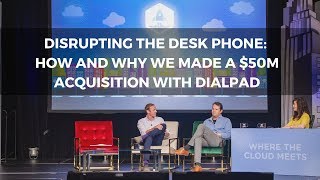
Dialpad CEO Craig Walker and TalkIQ's Dan O'Connell discuss their $50M acquisition. TalkIQ's real-time speech-to-text and AI recommendations beat competitors' post-call analytics. The deal started as a licensing partnership, and Marc Andreessen suggested buying instead.
Chapters
Please welcome Jessica Lin, Workbench co-founder and general partner, Craig Walker, Dialpad founder and CEO, and Dan O'Connell, Dialpad chief strategy officer.
All right, thanks so much everyone for joining us for our fireside chat today, uh, Disrupting the Desk Phone: How and Why We Made a $50 Million Acquisition. My name is Jessica Lin, I'm a co-founder and general partner at Workbench. We are an enterprise-focused VC fund in New York, and we invest in enterprise startups throughout the country. And it's both a privilege and a blast to be here with one of our Workbench portfolio companies, Dialpad, with Craig Walker, founder and CEO, and Dan O'Connell, chief strategy officer and former CEO of TalkIQ. So one of the things I love most about being a VC is I'm always learning, and of course last year as one of your investors, when we learned of your plans to acquire TalkIQ, we were thrilled to hear that. But even just this past week, I learned so much more of the inside scoop of this acquisition, and that's why we're really excited to share more today, both about why some acquisitions, a lot of them you don't hear ever of how they turn out. They usually don't turn out that great. And that's why with so many marriage analogies, What I think what makes the Dialpad and TalkIQ acquisition so special is it almost feels like there was two comets flying on your own trajectories and blazing through, and then colliding and creating an even more beautiful comet that is now going to take on and kill all these legacy IT phone dinosaurs. So we will chat more about that analogy. Really milk that. And again, you'll hear this especially throughout the session, why this is not really a story about just one acquisition. It's actually a story that brings both Craig and Dan's former lives together, and we'll hear more of the special sauce. So with that, at Workbench, we have actually a signature icebreaker we like to do. And so given that Craig and Dan again have worked together now through an acquisition through this past year, we thought we'd actually try something known as the Newlywed Game. So both Craig and Dan have whiteboards on their chairs. We're gonna ask them a few questions about one another just to see how well they know each other. Ready to go?
Fire away.
Okay. So this is questions for Dan about Craig. So both of you will answer, right? For both of you, which one of you is the bigger procrastinator? There's only two choices, either Craig or Dan.
Pretty easy.
All right, ready? Let's see. We got Dan.
Of course.
All right, definitive. All right. Now, who is Craig's favorite historical figure?
Craig loves— all he does is talk about history.
So I didn't see these before, but I had to say.
Ah, there we go.
So Craig, what's your favorite quote that you quote from him? Did you write them?
Yeah, I wrote them. You wrote them? A good plan violently executed today is better than a great plan next week. I believe it.
All right. What is Craig deathly scared of? Hint: it sheds.
Pretty simple.
We got this.
It's not that hard. All right. Snakes.
3 for 3. So apparently there's a great video. So everyone will hang out after and play the video. And then last but not least, what is Craig's catchphrase around the office? Oh my God, I'm literally seeing what Craig's writing. Oh, you got "hey yo" and "bitchin'," which is 3 out of 4. Really good.
Okay, that's not bad.
Okay, all right, we're gonna flip it really quickly, go down the line, uh, for Craig about Dan. Um, Which one of you is the more organized?
Oh, no, not even close.
So we got a Dan and we have a Craig. Okay. All right. This is a more technical question. What position did Dan play on his water polo team? Hmm.
Well, I would know that.
Driver and wing. All right.
I have no idea what the position is.
That was a trick one. The third one, what does Dan do when he's stressed out? Workout and Paces. All right, that's pretty close. I'll give you that one. And the last but not least, what is Dan's go-to karaoke song? Oh, apparently Dan is a singer and has his own cover band, so very— you gotta see Take on Me and Livin' on a Prayer. Both very good ones. Yeah, I think both of those should be— all right, cool. All right, thank you very much. Very impressive. Very, very impressive, Craig and Dan. So with that, we'll jump in. I'll We'll start with Craig's comet, and then we'll bring in Dan's meteor. Wow. And go from there. So for Craig, I think what's so ironic about your journey in a lot of ways is that you actually started as an M&A lawyer, right? And then you joined the light side as a tech founder. So are there any experiences you had as a lawyer that informed how you approached M&A years later?
Yeah, so in the mid-'90s, I was with a firm. We represented Cisco, and Cisco was doing a ton of M&A back then. And they were really kind of the masters at it.
This is so much foreshadowing.
Yeah, no, it was like— and there were a lot of— I mean, you see a lot of M&A deals where it doesn't go well. And ultimately Cisco always was impressed with how they really cared about one, kind of like symbiotic cultures, and to make sure that it was going to work well together. And John Chambers, you read his blog or hear him talk today, and he talks about that culture being more important than anything else. And I think that that— And so that really informed kind of our opinions. And when I was at Google, we did a couple acquisitions. It was very similar trying to find right culture and did the same thing here.
Yeah, and that's what I think with our time today, we can also have you all walk away with some tactics around, again, what makes a great acquisition, how do we make them successful, right? And so I think when most folks read your bio, Craig, I'm sure they kind of do a double take because you started a voice company that was then acquired by Yahoo in 2005.
Yep.
You then started another voice company, which was acquired by Google in 2007. So how many founders can say that they personally started and sold two UCaaS, unified communications as a service, companies, right? I mean, I feel like you're a true UCaaS unicorn founder.
Um, yeah, never thought I'd end up there. No, I mean, I think it talks to what a big opportunity it is and just how nascent it was in '99 when we started, or when Dialpad 1 started. The name of the company was Dialpad, bought by Yahoo. We bought the name back later, so totally different companies. But it's just a really big opportunity. And at Google Voice, we wanted to give people a way to manage their communications. And it kind of seemed to be a real natural fit in with Gmail, and how do you bring the web into it, and how do you do— much more than just a voice phone call. And that's kind of the same philosophy we try to bring to Dialpad. Like, how do we make it better before the call? How do we make it better on the call? How do we make it better even after the call and tie in a whole bunch of non-voice pieces to make it a better experience?
So when you think back to those two acquisitions, can you just share some highs, some lows? I mean, what are things that you didn't expect? What are things that you would not repeat again?
Yeah, so when we were being acquired by Yahoo, It was pretty like— there's a couple of different philosophies you can have in negotiating an M&A deal. One is that we're going to end up at the end of it working together, so let's be really kind of friendly during the process, and the other is it's going to be a bare-knuckle fight on valuation and terms.
I think you had used the term professional leg breakers.
Yeah. It's like the Terry Semel era of Yahoo certainly seemed a little sharp elbows and it was— By the time the negotiations and the deal closed, it was a lot of broken glass. When we went through it with Google, though, it was super, super friendly. Everyone wanted to make it a success. And when we started there, everyone was fired up. So the process itself actually helps influence the success of the deal afterwards as well.
All right.
Very cool. So then you started your third UCaaS company, which is your current company now, Dialpad, back in 2011. You guys won TechCrunch Disrupt in 2012. And you, again, get asked this all the time, but what made you start your third business phone company?
Well, there was still so much to do. At the end of the day, we had figured out how to make really high-quality voice over IP calls and how to do a lot of interesting features. but when you looked at the enterprise voice space, you look at even just— we have 3 products. We have UberConference for conference calling, we have Dialpad Talk for our phone system replacement, we have a call center product for sell and support. And when you look at those products, they're pretty terrible. The legacy versions of those are pretty terrible. They're expensive, they're complicated, the end users don't like to use them very much. it just looked like a massive opportunity that every bit— our bet was, and this was 2010 when we were leaving Google, that every business was gonna move to the cloud for their email and productivity suite.
Yeah.
And that once they do that, you've now freed your workers to be productive from anywhere on any device. And once you've done that, there's no way you can make them live their business communications through a desk phone or a legacy phone system. We kind of saw that as something that had to happen, and we were in a great position to be able to build that.
Awesome. So I guess we can fast forward then, let's say, to 2017. You'd been building Dialpad for roughly 5 years, some incredible VoIP technology infrastructure, a phenomenal team. And actually, Keith is around here. I know you guys do some really fun stuff with mascots at Dreamforce. So that's like a whole nother— Discussion we talk about with your CMO, but you clearly also, again, saw more opportunity even on top of this business phone layer. At the time, conversational AI was really heating up here in Silicon Valley. I mean, what were your thoughts when you started seeing these other players in the space?
Well, we had, we'd been really interested in artificial intelligence for a while, and we were meeting with virtually every competitor in the space, every provider. And they all wanted to integrate with us so they could get access to the call data and be able to go do their magic. And basically everyone we met with had the approach of, hey, we're just going to listen in on your call. Like, we'll join your conference call and be another participant and just kind of record the whole thing and then try to sort it out afterwards. And that didn't seem like that great of a thing for us. And when we met with— with TalkIQ, they actually had a platform that we could integrate into our core telephony. So it wasn't just handing them a recording at the end of the call and having them figure it out. In real time, they could transcribe the text. In real time, they could get sentiment scores. In real time, they could pop up recommendations or what, you know, what to say if someone mentions a competitor or if someone asks a support question, it would have the answer in real time. And that to us seemed much more compelling than just the after-the-fact analysis. And so they were the only ones who could do that. They'd built their entire ASR engine from scratch. So we integrated, we were doing actually a business deal, arm's-length business deal to partner and integrate their stuff. And it just seemed like a much more compelling way to provide a better AI service than just after-the-fact data.
[Speaker] Yeah, so you guys again had met with a number of other conversational AI companies Again, how did they again just get on your radar?
Well, they reached out to us mostly because we had a lot of users on UberConference and a lot of users on Dialpad.
And we'll get Dan's side of the story. Don't worry.
But, you know, like the AI companies all had the challenge of how do I get onto that call? How do I actually get the content? And so they're going around trying to get everyone who provides a service to be able to give that pipe or that recording of the call to them.
Okay, so had gotten together at least from a licensing deal kind of relationship, and at some point, you know, you and the Dialpad team thought we'd like to be in even a closer relationship and we'd love to acquire it. I mean, can you talk us through behind the scenes, what were those conversations, what was that thought process?
Yeah, sure. We actually were at a board meeting February of last year, and we'd spent probably the last 6 months working with Dan's team to integrate, and we were giving the board an update on how this was gonna be this completely differentiated product, how it was gonna set us apart from anyone in the space, and how it would help with call center and everything else. And Mark Andreessen, one of our board members, just said, "Hey, so why don't we acquire those guys?" Just like that, of course, right?
Yeah.
It was funny.
Simple as that.
I called Dan, board meeting ended at noon, and we met at, town hall restaurant in San Francisco at 5:00 PM that night.
And so, this time around you are the acquirer, right? So when you think about this experience, I mean, how did it compare to you being on the other side from Yahoo and Google?
Yeah, this was— it was a little easier to get done. Dan was super reasonable and we both kind of saw the value of of a combined offering versus two independent companies, and it really didn't take a whole lot of negotiation or discussion. We just kind of did it.
Yeah, and so the pricing, the negotiation piece, right, I think that's a little bit of a black box, right? Everyone, again, reads about acquisitions, but how do you decide that price point and the value?
Yeah, it's relatively hard when they're both two private companies, and, you know, what's the relative value of each? They had raised money in September, we had raised money in June, and we just said, let's just take our last post-money valuations, add them together, and see what percentage each of us own.
Very fair.
It was fair and made sense.
Awesome. And I guess for the last question I'll ask for you, Craig, what advice do you have for founders who may be looking to go out to acquire startups themselves?
Yeah, I'd say we were lucky in that Dan and I had worked together at Google. They were funded by Felicis as we were funded by Felicis. We had spent 6 months working out an arm's length transaction. Our engineering teams were working well together already. So that synergy and that shared values and shared vision of what this product could be really made it easy. So I'd say anything where you have that shared mindset and strategy. And the nice thing is It's now been 9, 10 months. We've lost hardly anyone. The two teams work really well together. The products are getting integrated really well. So if you didn't have that, I think it would have been obviously a lot harder to make the deal a success.
Okay, awesome. Thank you, Craig.
I was just going to add on that. It was just super seamless. Our product teams were on-site on a weekly basis. I had worked with Craig and Craig's co-founder, Brian Peterson, at Google. When we were trying to figure out how to get on CallPaaS, he was the first person I called, because I was like, "Hey, you have this whole business communications platform. You can probably help us out." And then just the teams knowing each other made everybody feel really comfortable, and then you have shared investors. We saw the vision in the same, and so it really came down to, kind of got two CEOs that want this deal to happen, and it became a very natural conversation for everybody to really just get behind and feel good about.
Yeah, again, the comet analogy I'll use, the trajectory. You had actually known a lot of the Dialpad team for years when you first started out at Google. Can you just talk a little bit about that?
Yeah, it's funny. Anytime I tell a story, and it's like 15 years later, you never figure things will kind of come full circle. So, I joined Google early on in 2003. The first engineer that I sat next to, and I was in sales, was Brian Peterson, who's Craig's co-founder for Dialpad. So it's funny, as we were going through our careers and suddenly I said we needed help on figuring out how to get on CallPasta so we could capture conversations and transcribe them and do a bunch of interesting things. Brian was the first person I thought to call. And had we not had that conversation, probably none of this other stuff would have happened. So it kind of reminds you of the world, especially in technology, is very small. People are more connected. You never know how things will kind of play out. Many years later where people kind of get to in their careers.
Yeah, and so you joined TalkIQ in 2017 as a CEO. So can you tell us more about where the company, the product, and the technology was at that time?
Yeah, so at that time, so I joined, we were 6 people. I joined actually as the, as a CLO. CEO at the time needed to get back to the East Coast to deal family stuff, and ultimately asked me, like, had I thought about running a company. My goal had always been to ultimately either start a company or run a company. My dad was the CEO. I remember going through the interviews with some of the board and actually asking them, you know, do you think I'm ready to do this? Which is probably the worst question, actually, if you're thinking about running a company, but it worked out. Initially got thrown into the mix of— we had raised $6 million in seed, went through raising our Series A. We We took $14 million that was led by Salesforce and Scale Ventures, Line, a couple other fantastic investors. And really, it was just off to the races. From that, we had probably a handful of customers. We're still going through product-market fit, but super early on. And as I said, it's just been fantastic to see the opportunity in the market and so forth.
Cool. And so, along the way, you had done this licensing deal with Dialpad. Were you talking to other larger companies at the time, and how did you kind of manage that process from a licensing perspective?
Yeah, so we were doing two things. One is, so at TalkIQ, we were doing speech recognition. Basically, we were a startup trying to do three different startups in it. It's the way I talk about it. We had to build our own telephony stack. You're building your own speech recognition engine, which is taking audio, transcribing it to text, then you're doing NLP on top of it. So NLP is, how do I teach a machine to kind of understand insights, map sentences, and things of that nature. So those are basically 3 tough problems to try to figure out, and you're trying to do it as one. When we signed this licensing deal, that was really to provide speech recognition and then NLP to any conversation that was happening within Dialpad. We hadn't actually explored that as kind of like an API to the business. We were always building a full platform that a sales or a support organization could go and buy. So one, it opened us up, opened up to, hey, think about the business slightly differently. When the acquisition offer came, Craig and I were just talking about this, we didn't try to shop the offer at all. We actually weren't looking to even sell the business. We had just closed Series A. We had to go through a little bit of convincing for our investors, say like, "This is how we see the world. There's this massive opportunity and window to do this together. We're both kind of stronger businesses for it." But we really decided to do this, to go along with Etienne and Jim, who are our co-founders at TalkIQ, we view Dialpad as the most innovative business communications platform in this space. And I don't say that because I know Craig right there. We weren't gonna go and work somewhere else. They had 4 different pillars that we could go take our technology to in call center space, web conferencing, cloud telephony, and then also within sales. So it seems like we resonated on how to actually build things, the vision, and also the opportunity. The end of the day, our teams liked each other, and I knew Craig and the executive team and shared values. That actually became kind of the driving source of, I can go show up probably at an office park somewhere. I personally don't want to show up in an office park somewhere, at least at this time. And so it just made sense from that standpoint.
Yeah, and so that's an interesting point that you touch on, which is, you know, there's your own feelings about the deal, right, Dan? And then you have your VC's feelings, and then you also have your team's feelings, and a team that had been obviously working and building TalkIQ. So when you first got the call from Craig, I mean, did you know this was the conversation that was being had? Was it very outright?
Yeah, no.
Marriage proposal?
Yeah, it's funny. You always wonder— anytime you become a CEO, I think— well, for me, it's like one time, so The time I thought about— you always wonder, like, how is this going to play out, right? Will somebody call one day? And then what is that conversation actually like? What happens?
Was it like what you thought it was going to be?
No, it wasn't. Craig actually called me and said, hey, do you want to grab beers? And Craig and I know each other, so I was literally like, yeah, we'll go to beers and catching up. And then he said, hey, have you guys thought about selling the business? And at that point, you're you're, you know, speaking candidly, you're trying to figure out, you don't want to show like, oh, this would be great, like, we should absolutely do this. You're trying to play like hard to get.
Yeah, there's dating a little bit. We are dating a little bit, right?
So it's a really interesting but candid conversation of, hey, we actually see the world the same way as we talk about this. We think there's a tremendous opportunity if we can make that kind of the economics work for the investors. Yeah, we want to do this and our teams want to do this. The interesting thing I will add to that, though, is I had always talked about this to the team, along with Jim and Etienne, on this is the best thing for everybody. And I think that was a little bit of a mistake as a first-time CEO to go through some of these. You assume that because you have an exit or because you have an acquisition offer that everybody else thinks that's the best thing. And what was interesting is I do think people that go early on to startups, really our startup people.
Yeah.
And there were a couple members of our team that really wanted to either kind of go down with the ship or be king of the hill.
Right.
And they wanted to be on either side of, of, uh, either side of things, but they didn't want help in the middle. And so that was something that, you know, I kind of learned through that process, which was pretty unexpected.
Yeah. You know, I've talked to other founders who have gone through this acquisition process, and I know for some of them it's a really lonely journey because you actually can't talk about it with most of your team. Yeah, right. And there's a due diligence process and, you know, it's a big burden to carry, right? And so curious how you manage through that yourself personally, Dan.
Yeah, so part of the reasons that I wanted to run a business was just being part of different businesses and you kind of go through, hey, if What would I do differently if I could, if I had control? And for me, we were really transparent when we got the offer. So, we were a small enough team to actually say, look, there were 20 of us at the time. All of those people, we had kind of gone through the ups and downs of a startup. And really, I'd always said, like, I just wanted to be transparent. Like, here's what it is. And we kind of want people to be For me, that was just a value that I've always had. I've always wanted to be really transparent. People knew our burn rate, people knew our day zero date of when we were gonna run out of cash, they knew revenue, 'cause I've been parts of startups where you don't know that, and I think it's a really challenging place to be and work, especially if things ever go bad, and you kinda wanna make sure, I think that transparency actually helps that you get the right people on the ship, and those people people are going to stick with you through thick and thin. But there's obviously risks to that. So we definitely talked about that as a small team of 20.
And so there are people who felt two different things, it sounds like. How were you able to really get that whole ship aligned and get on board the Dialpad train?
Yeah, I think at the end of the day, it's that the team ultimately said— we all talked through the pluses and minuses of this as as a unit, obviously that conversation starts with the founders and the executive team. So initially it was Jim Atien and me talking through, like, hey, do we want to do this? Is this serious? And it trickles down to, like, we had a conversation with our leadership team, a couple of the director-level and VPs, and then it trickled down to the next step of managing that. And then really just having some honest conversations with folks of, like, what are the fears? What are the plus and minuses? You know, people were worried about, hey, if I join, I might have to I have a different manager? Will I still work on things? Will they still be a priority? Something that Craig made very clear from the start is anything that you guys are doing is the number one priority. And I think that's also what became very important in the acquisition is you're not going through an acquisition where it's, "Hey, we'll acquire the team, and when you show up here, all of your jobs are different. What you're working on is going to be completely different, and what you built is going to get thrown away." Right.
Which happens a lot. Yeah. Right. And that's, I think, usually the norm.
Yeah. So I think we've been in a super fortunate place of, you know, working on things that we're kind of betting the company on.
Yeah. Okay. So we know what Marc Andreessen thought of the deal.
Yeah.
What— to your point, you know, you sometimes have to convince your investors. I'm sure lots of founders in the audience are thinking about that, too. So at a high level, how did the conversations go?
Yeah, they were fantastic. I think the one thing to think about was these are— fortunately for us, it was chips stayed on the table for folks. And I think that's what's important. I can't speak for all VCs. I haven't been a VC. But I think it was important for them to know, like, hey, is there still an opportunity for me to maximize the potential value that's out there? And I think they all saw that, hey, this business can help us solve a really large challenge of getting on a call path. It opens us up to 4 massive markets in terms of opportunity, and these teams know each other, are functioning very efficiently together, and you guys ultimately as a founding team want to do this, so we're supportive of that.
That's awesome. And, uh, for any of you who've worked at a large company, sometimes integrations can take years, right? And I know it sounds like the two of you have been very, very thoughtful about this, very intentional. I'm curious just for you, Dan, you know, your role changed, right? Now you're Chief Strategy Officer. Can you share a little bit about what that personal journey has been like?
Yeah, I have to get used to having a boss again. I say that jokingly, but yeah, it's different. Like, you go from— in my past career, I was running sales organizations who used to having to target and having to team. This is the first time in my life that I haven't had a target or a team. And that's something that I care a lot about. I really like being— trying to be a motivational person and inspiring to teams and getting in the weeds of stuff. So, that's been a little bit of an interesting transition for me. But Craig definitely gives me a lot of responsibilities and influence within the business and has been an exceptional mentor. I look up to him a lot. He's sold two businesses. He's done this exceptionally well.
So, that's another—
He passed founder unicorn. So, that's another thing that I try to take from it is how do I actually learn personally through this experience that hopefully I'll have another chance to either start a business or run a business. So, take these learnings because I think it's a really unique opportunity.
That's awesome. And so, I had heard a little bit about some of the culture playbook. And so would you guys be willing to share some of the pages from your culture playbook, some of the tactics that you guys have employed, again, to make these two teams, TalkIQ and Dialpad, really come together as one?
Yeah, I think we have a couple common experiences, or the values of wanting everyone on the company to be on the same page. We never want to surprise our employees, and we're now, 350 folks, and we still, every Friday, we have a Friday at 4, give an update to the whole company about what happened in the week, what did we learn, what went well, what didn't. And then we now, since we have offices in a bunch of locations, we livestream that over Facebook Workplace, and it's actually used, and then we save the video and upload the slides so everyone can get it. And you never want, like my thought on this, which sounds very similar to Dan's thought, is you don't want to, like, you want your employees to be there for the right reasons. You want them to be able to, like they have opportunities elsewhere. The Bay Area is like zero unemployment. They can take their skills and do anything with it. And so effectively they're investing in the company, so they have a right to know how their investment's doing. And so we always try to overdisclose disclose that. And so one of our, like, our core value is just do the right thing. Like, we used to have— we used to brag about our employee handbook literally being like 3 words or 4 words. It was like, do the right thing. That's now changed with insurance policies and D&O things that require a big one. But to the core of that, I mean, that's it. And we trust people. And I really like the Netflix put out that whole, like, values deck of rather than having all these rules to try to keep everyone in line, just don't hire the guys who would break the rules. So we try to do that, and that felt like it was really one of TalkIQ's core values as well. And then from there, we basically merged our official values with theirs to come up with 5, and they all really felt that they belonged in the same family.
And so I heard at this 4 o'clock Friday, you also have an opportunity for companies to come in and pitch you guys. Is that something? It's like open mic?
Well, we— come in and pitch us. We do invite partners. We do invite potential customers. We do invite potential employees. And we do invite other CEOs in the portfolio. Like we had last Friday, we had 3 other Anderson Horowitz portfolio CEOs who are kind of like smaller companies to see what happens at a Friday at 4:00.
That's awesome.
And it's just a good time. The week's effectively over and we both were at Google and Google had this great Friday at 4:00 and Larry, Sergey, Eric would be up there and basically doing the exact same thing and if they could do that, we sure should be able to.
Yeah, just even more exposure for everyone around the table, right? Yeah. Okay, so Dan, tell me about Karaoke.
Yeah, so we do, well, one of our values at TalkIQ is karaoke state of mind. So, we'd done a team offsite out in Austin back in kind of the early TalkIQ days. Team went out. We had a great karaoke night as a group. And that became a value of have fun. Own things, meaning if you guys have ever done karaoke. Karaoke goes well even if you're a really bad singer for the people that own it. And I think that's true for anything that you do, whether you're presenting, whether you're doing a pitch, whatever it is, is you just have to own it, and you have to just not take yourself too seriously. And I think that's something that also plays in our culture is, yes, you want to drive accountability, yes, you want to be a strong performer, but at the end of the day, we're not saving lives, And I think there's just, I just think that you can loosen up. And I think people appreciate that. I've definitely worked in businesses where leadership becomes difficult to talk to, or people are scared of talking or really sharing their thoughts. And that's also become like a really value of that karaoke state of mind. It's just like, don't take yourself so seriously. It's gonna be okay. And if you have frustrations, find ways to actually share them. Embrace that in part of the culture. A big value that we don't stand for. It's kind of like no bitching. I don't know a better way to actually say it, but it's like, look, if you have a frustration, tell me what the frustration is. I want to help. And if I can't solve it, then hey, life's short. You probably should go find something that you're not going to complain about, and you're going to be happier, and that's better for everybody.
Yeah, awesome. Well, so we're coming up now on a year post— roughly post-acquisition. And you guys, again, are hyper-focused on this true cloud phone system, AI integrated through the entire stack that your other competitors cannot say that they do. So how are things going?
Things are going really well. You know, we look at it, it's more than just these bells and whistles, these neat features. It's really being able to provide a worldwide enterprise-grade quality as a foundation, and we have customers like WeWork and Uber and Motorola that have offices all around the world. And being able to provide, have that platform as the foundation, and then you have, you know, UberConference call center and your phone system, and then you sprinkle AI magic over the top of it.
Which they're not expecting, right? I mean, when you and I talk, like, they think this is just a phone, and then when they hear about this extra asset, this layer, this weapon.
Yeah. And if you think about it, and Dan likes to talk about, you know, business voice being the last offline dataset and still like the amount of phone calls that still happen with customers and with vendors and with potential prospects that, that there's so much that happens, but it's not captured anywhere. So now being able to capture that and have the ability to analyze every conversation, see which reps are doing better, score the sentiment of your various agents, and being able to just like, how can you do that better? And without voice AI, you really have to do it manually and you really put the burden on the call center supervisor to listen in on phone calls and to coach and whisper and hopefully, you know, do this really, really difficult work. But it's very hit and miss and it's very random. Whereas the AI piece pulls all that in, turns it all into text, lets you analyze all of it, give you a report on which reps are doing better than others. And then you can tie that back into other things like CSAT scores in Zendesk or performance in Salesforce, and you can really start to get a 360 view of what it is that makes someone successful. And without that, you really couldn't.
Right. And that's really the base that can unleash, again, all of this AI and NLP. Key. I'm curious, Dan, what has been the early feedback from customers been like? They are large enterprises, right? I mean, do they get it? Are they excited by it?
Yeah, the nice part is everyone gets it. It's super seamless. And I say that meaning, you know, running a large team, a client-facing team, everyone always says the one thing you should do is coach more, whether that's on engaging with your current customers or figuring out how to drive efficiency in sales. Traditionally, people have tried to figure out how to do call coaching, or perhaps they're a tape recorder, you take an audio recording, you try to transcribe it, it's kind of post-call. But everyone gets that this is probably the most valuable thing that people should be spending their time doing, especially frontline managers, which is, "Hey, how do I just better coach the engagements that are happening, and how do I figure out what's happening in those conversations so I can figure out how to better build a product, how I can better market it, how I can better support it?" and how I can better sell it.
Awesome. And Craig, I love this line you said. The phone is supposed to be dead by now, right?
Yeah. Yeah, no, it's funny. When we got acquired by Google in 2007, I remember one of the first meetings we had, this product review with Eric, Larry, Sergey, like the ESL review they do quarterly. And Larry made some comment. He's like, yeah, but the phone numbers are going to go away. Right. Totally a few years ago.
That was 12 years ago.
That was 12 years ago. And it's funny when you look at it, like our UberConference product, we built it originally just to optimize around phone calls because still 80% of all conferencing minutes are just people dialing in on the phone. And the idea of like dialing a number, entering a PIN, hearing a beep, saying a name, not knowing who's there just seems so ridiculous. So it doesn't seem like it's going anywhere. In fact, it seems like the more people try to get rid of the human interaction, the more it kind of like comes back to life. There's a really good T-Mobile commercial out now of the guy who played Dwight Schrute in The Office trying to get to a live operator and just how painful it is. And their pitch is, hey, at T-Mobile, you're going to talk to a live operator. And so the more people try to get away from it, the more it comes. Back.
Yeah, I think that's a really fitting analogy for our meteors. Your two meteors more powerful together. Lastly, just on a personal note, how do you feel like you guys best complement one another now that you're working side by side?
It's great because Dan knows everything about AI and I don't know a whole lot, so that works really well. And, and, but no, it's it like legitimately to have another really smart person with shared common values who's a he's a great leader, it really makes it easier for me.
Yeah, I'm glad you asked, right? Yeah. Dan?
I just learn a lot from him. I look up to him a lot. He's just seen a lot of things, and so just gaining that experience. He also pushes us to take a lot of risks in the team, and I think that's really important on being comfortable, like trust your gut, make big risks. Those are where the opportunities lie. If you play it safe, you're probably gonna lose.
Cool. Well, so if founders leave with nothing else from this session, what is the one piece piece of advice you want them to walk away and tweet about, whether it's about acquisitions or asteroids or marriage?
On acquisitions, I'd say shared values are gonna be your biggest— the biggest indicator of success. Cool.
I would say overshare. Trust your teams. I think people get a little bit nervous about that. I think invest— everybody can always say be careful about what you share. I think you can trust your teams a lot more than you probably think. And that actually builds deeper relationships and actually creates a better sense of loyalty.
Cool. Terrific. Well, with that, please join me in— thank you, my incredible panelists, Craig and Dan. A huge round of applause, please, guys.
Thank you.
More from Jason

Why Your Next Hire Should Report to an AI, Tragedy Apps, and Too Many AI SDRs? | The Agents #004

Our Agents Drove Our Salesforce Bill Up 80%, Marketo Hates Agents, and We Stealth-Churned Off Notion




Managing 20+ AI Agents: Lazy Agents, Our $500K AI Bill, Stealth Churn & the Death of 60% Solutions




