Dustin Moskovitz, Asana: Fast Growth, Mindful Business
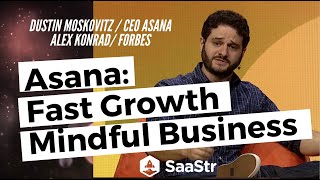
In a stage interview hosted by Forbes writer Alex Conrad and moderated by Brian Quinlan, Asana CEO and Facebook co‑founder Dustin Moskovitz discusses the company’s product focus, growth trajectory, and the intentional, mindfulness‑driven culture he has built. He frames the SaaS collaboration market into three categories—file/document collaboration, messaging, and work‑tracking—explaining that Asana’s “bread and butter” is work‑tracking, which provides clarity on tasks, ownership, and timelines. Moskovitz reports that Asana now serves about 20,000 customers and has recently hired a new head of global finance and a new head of global sales. He characterises Asana as being in a maturing, late‑early‑adopter phase with a massive untapped market of 500 million knowledge workers. The conversation shifts to culture: Moskovitz emphasizes that Asana deliberately built its values from day one, using mindfulness to avoid the burnout common in fast‑growing tech firms. He describes a balanced approach to intense work periods (sprints) and recovery periods (off‑sprints), flexible hackathon formats, and practical well‑being tools such as Pomodoro timers and “take‑a‑breath” desktop alerts. He notes Asana’s perfect Glassdoor scores for both the company and himself, attributing them to this intentional culture. Moskovitz also talks about hiring for mindfulness, self‑selection of employees who value the culture, and formal training in mindfulness practices. Diversity and inclusion are addressed through early‑stage rule‑setting, a dedicated D&I lead, and the belief that small early gains compound over time. Philanthropy is a major focus: Asana’s foundation gave roughly $200 million in the prior year, channelled through effective‑altruism organisations such as GiveWell and the Open Philanthropy Project, targeting global health, catastrophic risk mitigation, and U.S. public‑policy issues like immigration and criminal‑justice reform. The company also engages in political advocacy, exemplified by signing an amicus brief opposing a Trump immigration executive order, reflecting both leadership initiative and employee expectations. Finally, Moskovitz shares personal signs of burnout (irritability, reduced productivity) and practical mitigation steps (breaks, weekend unplugging, mindful breathing apps). The interview weaves together product strategy, growth metrics, cultural engineering, social impact, and personal well‑being, illustrating how a mindful approach can shape a fast‑growing SaaS business.
Chapters
Please welcome to the stage Forbes writer Alex Conrad and Asana CEO and Facebook co-founder Dustin Moskovitz.
All right, Dustin Moskovitz, this is your life. Guys, it's a pleasure to have Dustin here, obviously co-founder and CEO of Asana. Has done a few other things, most notably your foundation work, which has been the last 5 years, and then co-founding Facebook, which people here have probably heard of as well. So it's a really awesome chance to talk about mindfulness and how it can create a better business. I thought it would be good to just give everyone an update if they're not super familiar with what Asana does, where you guys are at in sort of your journey so far. Today?
Yeah, absolutely. So hopefully that video gave you a taste. But we really think about the SaaS collaboration market in terms of 3 big categories. So first 2, you guys are all really familiar with. So files and document collaborations, that's everything from Dropbox, G Suite, things like Quip. The second category, messaging and communications. So that's Slack, obviously a big deal this year. And things like Skype and enterprise social networks like Yammer. And then the third category is really our bread and butter. So we call this work tracking. So all of these are really essential to having effective collaboration. But work tracking really helps you get clarity about what your team needs to do to get results. So it helps you answer the critical questions like, what steps are left between now and accomplishing our next goal? Who's responsible for each of those steps, and when are they going to be done. So really, any team in the world needs that clarity to be effective. So yeah, to give you an update on where we are, so we just actually announced this morning that we're up to 20,000 customers. So we're really excited about that. And we're also announcing two key new hires. So we have Tim Wan, who is coming to us from Apigee, and he's our new head of global finance. And then we also have Oliver J., who's coming to us from Dropbox. He's our new head of global sales. So we're really excited about having them here to help us really take the business to the next step.
So you've been doing Asana for a few years so far. Would you say you guys are at sort of a hypergrowth phase or an adolescent phase, or where would you put Asana in sort of the overall arc of a company's journey?
Sure. You know, I think we're at a maturing phase. So, you know, again, we have 20,000 customers, so it's a very stable, real business. A lot of our growth is those individual customers continuing to expand and use the product more. But there's still a lot more to do. We're kind of, you know, if you think of the sort of crossing the chasm, we're sort of at the late early adopter stage. There's still a massive market out there. And we really think of our market as all knowledge workers. So it's 500 million people around the world, and most of them don't use any product in the work tracking category. So there's still a long way to go before everyone's part of this new collaboration world.
[Speaker:JASON M. LEMKIN] Now, is this a company where you can sort of be heads down and just work on improving the product one feature at a time? Or do you feel like you guys are in a sort of high-stakes, more stressful race? Or what would be sort of the atmosphere at you guys? Because as anyone who uses productivity software knows, there are a lot of very smart people working in this broad category.
[Speaker:RYAN BOYD] Mm-hmm. You know, it's a little bit of both, right? You can't really rest on your laurels. But, you know, again, the vast majority of the market doesn't use anything. They're still using the tools of 10 or 20 years ago— email, you know, large meetings full of status updates, just writing things on a whiteboard. So it's going to take at least a few more years for that to really develop. So we're really focused on just executing the strategy that sets us up for success in the long run.
So another thing I've always found interesting is when I cover the company, it's almost like in a lot of ways you and your co-founder, Justin Rosenstein, are interchangeable in terms of the buck stopping with you guys, but kind of taking different focuses. So I'm not sure how many companies here in the audience might have sort of a dual leader structure, but how do you guys make it work at Asana, and how have you kept that going for, you know, well over 5 years at this point?
Yeah, so we definitely complement each other's skill sets a lot, and I almost think of it even as a triumvirate, 'cause we also have Chris Farinacci, who's the head of business. But Justin's very much focused on the product and external communications. So we had an article in the Wall Street Journal this morning. He was the main person interviewing there. So he's very external focused. And I'm much more focused on execution and helping the company, helping make sure we have a great culture and a great environment. So much more inward focused, focused on things like process. And between us and then with Chris running marketing and sales and customer operations, we've got everything well covered.
So I'm curious, has anyone checked the Glassdoor rating for Asana lately? Anyone raise their hand? All right, well, if you guys go look on Google before it gets changed now, they have a perfect score out of dozens of reviews. And Dustin also has a perfect score as a leader, which is pretty phenomenal. You can really only go downhill from there. How'd you guys get there? And how did I just screw it up?
No, I am always worried about the sort of other shoe dropping there. But a lot of it has just been really being really intentional about how we build the business and using mindfulness. So I like to say that a lot of companies that grow quickly, they end up focusing almost entirely on the product, getting into the market. And then a couple years in, they're like, OK, we're still going to exist. We got to think about how the company is going to be, what our values are, what the culture is going to be. But it's kind of too late to change it at that point. Ben Horowitz likes to say that the— the book is basically sealed after 12 months. But we thought we'd be around for a while. So from the very beginning, we were intentional about how we built the culture. And we were reflective. And so when we saw things that needed improvement, we put our attention there and iterated and just kept turning that crank until we had every part of the company running really well. And the result is we have employees that are really engaged, happy, productive, and give us good ratings on Glassdoor.
Now, that was not really the case at Facebook though early on, right? I mean, I don't know if you guys have read this great blog post that Dustin wrote about a year and a half ago now where he talked about the work-life balance or lack thereof that you had in early days at Facebook. I think you wrote that you were subsisting on soda and energy drinks for a while, which I'm sure people in this room can understand. That happens. But you said that it didn't make you a more productive person to be kind of grinding that hard or stressing that much. So, so could you talk a little bit about when you realized that and sort of what you would have maybe done differently today?
Sure. You know, a lot of it, I think, was just how I was kind of pushing myself and, you know, some, some bad habits that I formed early on. But a lot of it also, I think, is, is just the culture of the tech industry and especially Silicon Valley, where you know, it's kind of romanticized to, like, just be working 24/7. You'll hear people say they were up 2 nights in a row, you know, finishing this project, things like that. And it's easy to sort of get this idea that that's the optimal way to work, that's the way to get the most done. But when you talk to people that are further in their career, if you look at any of the research that's been done about this, you get the exact opposite conclusion, where you really have to treat it much more like a marathon and really pace yourself and work in a sustainable way. So, you know, I started Facebook when I was 19, so you can do that for a couple years, especially when you're young, but eventually you're going to burn out. Eventually you're going to slow down. And so a few years in, I was starting to feel that, and it was starting to cost me. So the blog post I wrote is "Work Hard, Live Well." It's on Medium. And I just talk about, you know, better patterns for how to build, you know, sustainable habits. And it's at every scale of abstraction, right? You have to take breaks during the day. You have to go home and rest at night and sort of unplug. You have to use your weekends. You have to take vacations. And after a few years, ideally, you can take some time off between jobs or take a sabbatical. That's really the way to keep going. And a lot of the people, you know, that I've seen in startups or coming from Facebook, they didn't learn these lessons and they burnt out and frankly some of them stopped working for years at a time or just retired early. And so, you know, you really have to be intentional to avoid that outcome.
[Speaker:BRIAN QUINLAN] So when people defend hackathons or institute sprints, I often hear the argument in their defense that it's a way to sort of forge a culture really fast or kind of, you know, create a bonding experience for everyone to kind of suffer through where they come out more tight-knit. Maybe they have a good idea, maybe not, but it's like a shared experience there. Do you think there's any sort of value there that you lose if you don't do that, or what would be the alternative to maybe these kind of trial-by-fire type scenarios?
[Speaker:JASON M. LEMKIN] Yeah, well, you can still do those things for some period of time. So if we're going up to a big launch, like, yeah, we'll sprint and people will work harder than normal. But the key then is to, after you get to that launch, actually rest after. And for our hackathons, we've been pretty thoughtful about this. Yeah, the younger employees at Asana, they want to stay up all night and do that. So once a year, we'll try and have a hackathon that's more oriented around that. But other times during the year, we'll have a hackathon that takes place during the day or maybe across multiple days to give people a chance to participate in that creative process who can't necessarily stay up all night. Maybe they have a family, or maybe they just get tired at night. And so really creating that environment for multiple people. But it's not really an either/or thing for me. You can still have those intense experiences experiences where you bond, but they just shouldn't be the norm.
So I, for example, have FOMO so bad with just checking Twitter that I had to download an app that literally makes me take deep breaths before I can open Twitter.
Great.
That's how often I check it during the day, and it makes me breathe more the more times I've opened it. Yeah, I have no self-control. Yeah, how do you, how do you embrace people being excited to be at Asana, being excited to be working on these projects, but also needing maybe for their own health to step away more than they might, you know, expect to?
Yeah, well, you don't want to get in somebody's way. If they're really excited, you know, again, for a couple weeks at a time or, you know, a couple nights in a row, you can work like that. But if you see somebody doing it just day in, day out, they don't seem to have a life outside of work, you know, we'll talk to them about it. And, you know, that's really kind of on their manager and on their peers to just, like, say, "Hey, like, are you sure you're taking care of yourself?" Are you sure you're doing this in a sustainable way? And also building habits into the company. So we do orient our engineering teams around sprints. But in between, we do off-sprints. And sprints for us are really also just about focus, where you have fewer meetings, fewer other activities. But they are also a period of a little more intense work.
[Speaker:BRIAN QUINLAN] And hold on. I'm probably the least technical person in this room, so you have to bear with me. Could you explain a little more what an off-sprint would be?
So an off-sprint would be, uh, you know, catching, catching up on other things. Um, like, uh, a lot of people at Asana, they have those, their sort of primary responsibility with, uh, an engineering program, but then they have other areas of responsibility, um, which may be like cultural things, like, you know, values or like, you know, hackathons or something like that. So an off-sprint would be a time when you put more attention on that. Um, maybe go back and, and fix some bugs that, uh, you know, you created in your last sprint. Fill out some interview feedback you forgot to do, just sort of like catch up on things and sort of reset your patterns, and also reflect on how the prior sprint went and plan the upcoming one.
Now, is the sort of willingness to have a healthy approach to building software, to sort of going on this long-haul approach, is that something you have to vet for in the hiring process, or is it something that people can pick up and sort of reform when they arrive at Asana?
I think it's a little of both. I would say that people actually self-select for Asana in a lot of ways. So if they have this kind of personality where they're naturally into mindfulness, they'll see that Asana represents that and they'll want to work there. I also see people who realize they've been burnt out and have had bad patterns and they want to learn good habits, and they'll look to Asana as a place where they can learn those skills. But then, yeah, once they get there, we literally train people on mindfulness, and we have processes and patterns that make that the natural way to behave there.
[Speaker:AUDIENCE] So do you guys have the same perks and sort of catered meals that a lot of companies offer around Silicon Valley? Because we always hear the debate, if you're serving dinner at 8:00 or 8:30, isn't that just encouraging everyone to stay late? Is it a perk, or is it sort of a golden handcuff that's keeping people there? So where do you guys come down on sort of that balance?
[Speaker:BRIAN QUINLAN] We want to have a great environment. But again, it's in service of optimal productivity. So if you're keeping people till 8:30 or 9:00, Yeah, I would argue that's actually shooting yourself in the foot. Even though you're getting more face time, I got to assume that those hours, sort of 7:00 to 10:00 PM, just aren't as productive as the ones at the beginning of the day. So we do serve dinner. We serve it at 6:30. I think over time, there's actually kind of a long line right now. I imagine over time we'll shift that in a little earlier. And that's just sort of a compromise position. And maybe about a third of the company actually stays for dinner. And other people are going home before that. That's totally culturally OK.
Some of the feedback I saw on your blog post that resonated with me was actually took a response that I wasn't expecting about how this could actually combat ageism in Silicon Valley.
Yeah.
And actually encourage people with families, people who have been in the game for a long time to actually stay at a high-growth company like an Asana because they can actually think of a work-life balance as opposed to skewing just to young coders with with no kids to go home to. Do you see this ageism issue in other companies, or what do you kind of think is the response there?
Yeah, no, I mean, I absolutely see that at small startups. I think the saving grace is like ultimately those companies grow up, like literally. So the people who started at Facebook, they're now in their 30s. They have kids. Mark has a daughter. And so they need to kind of conform the culture to to make that possible. So most of the later stage companies, I do think, have sort of evolved in this way and are less ageist, though they may have some ingrained habits. But the startups, particularly when they're started by people in college, they tend to think like, oh, this is just what makes a good startup, and everyone else just has to deal with it. But yeah, it ends up having these byproducts.
So I guarantee you that there's going to be a large number of people here who are nodding along to everything you say and will go back to work tomorrow or Friday and work a 14-hour day.
[Speaker:JASON M. LEMKIN] Sure.
[Speaker:AUDIENCE] And I think it's so much harder to practice these goals. So do you have any sort of first steps or sort of very high-level fixes that people could actually think about implementing first to maybe move towards that culture that you have?
[Speaker:JASON M. LEMKIN] You know, it's tough. I mean, I imagine a lot of people here are the leaders of their company. So I would just make sure that you're aware that the best fix is just going to be you acting differently. And most of the other people in your company are going to be kind of at the effect of the tone that you're setting. So just make sure you understand you bear that responsibility. You can also just maybe, you know, tomorrow and Friday, just imagine me on your shoulder just like shaking my head if you're still there too late. But, you know, I think the easiest thing to do is also just the sort of smallest scale of taking breaks during the day. You know, some Asanas use, like, the Pomodoro method, just, like, literally have a timer. There's also, like, apps like yours for the phone that just kind of, like, remind you, "Hey, take a breath, pause." There's an employee at Asana that has something like that actually on his desktop, so, like, every 50 or 60 minutes, it actually takes over his screen. It's like, "All right, chill out, take a breath. That, I think, is the sort of easiest thing to do. And then building on, like, going home at a reasonable hour, you know, taking your weekends. And there's some great tools for that of just, like, turning off notifications. Like, Slack has a great sort of, like, active hours feature for this. So just, like, really taking advantage of those things and being intentional about it so you don't fall into these habits of, like, oh, I got a push notification. I got to respond to that right now.
Yeah, I mean, From what you've said in the past, it seems like you were facing some burnout at Facebook by the end. And now you've said that you take a day off, go for a hike, or sort of unplug if you sense the burnout coming back.
Right.
So what are the warning signs that you notice when you think, uh-oh, I'm starting to get manic, or I'm starting to— the old Dustin's coming out?
Yeah, the old Dustin. Well, for one thing, I get more irritable, and maybe just like— You know, I'm not as great in interpersonal conversations with people, and they'll reflect that back at me, and I'm pretty self-aware about it at this point. And also, I'm just not productive, you know. It's like when you're sitting at your desk and you're staying late because you still have work to do, but you're not actually getting it done, that means you're burnt out. So it's a lot more productive to say, "Hey, I need to actually, like, unplug.
I need to rest, and then I'll come back and do this in a much more time-efficient way." [Speaker:JASON M. LEMKIN] Now, I think another side of, like, mindful business is also having interests where you can make an impact that are maybe aligned with the philosophy of the company but are outside the company. You guys gave a lot of money through your foundation to a bunch of causes last year. Yep. Are we allowed to say how much you gave?
Sure, do you know?
Yeah, I think you told me it was $100 million all told.
I think we actually gave about $200 million last year.
Well, he downplayed it then. Yeah, sorry. $200 million. Some to— yeah, let's get a round of applause. How did, how did that become a focus for you? And I'm curious, how does being involved in causes that matters to you maybe help you stay grounded as also a CEO?
Sure. So, you know, how it became a focus, you know, I guess it just almost felt like a compulsion or a moral responsibility of, you know, I came into a lot of capital very, very early in life. And, you know, a lot of people in the tech industry sort of think like, well, I'll spend my career accumulating capital and kind of give it away at the end. But we really had this philosophy, you know, my wife and I carry that, you know, the good you do in the world also compounds. So to give earlier is a lot better. I also have a philosophy that the world will be better 20 or 30 years from now. So in some sense, like the opportunities will be worse for giving. So we really thought about, like, well, OK, maybe we should start early. And if we're going to start early, how should we do it? And ended up finding the GiveWell team. So they— I don't know if people are familiar with GiveWell, but they're effective altruists. And they really start from this premise that you should try and make every dollar count. So you want to be able to donate every dollar in the most leveraged way possible. And that means looking for categories and also nonprofits that are, you know, cost-effective and leveraged. They're working on tractable problems, and they also have a funding gap. So it's the ones that don't already have a lot of attention. And that's been— we've been able to develop some really great areas so far. And, you know, just to give you some broad strokes on that. So the 3 big categories right now, one is global health and development, and that's really GiveWell's bread and butter. And then we also have a new organization, Open Philanthropy Project, They're a little different from GiveWell in that it's less sort of like proven cost effective and more sort of like probabilistically cost effective. So you're willing to take risks. And the two big areas we're working on there, one is global catastrophic risks. So sub— subfocuses there on biosecurity and preventing pandemics and also risk from advanced artificial intelligence. And then the third area, which is really relevant to what's happening in the news right now, is we work on US public policy. So we've had a program for a couple years now working on immigration. Obviously, that's very relevant. And also— thank you. And also working on criminal justice reform is actually probably our largest program. That hasn't been in the news lately, but if Sessions gets confirmed next week or later this week, then it will become a big deal.
Yeah, so Asana was one of the tech companies that signed an amicus brief supporting the state of Washington against Trump's executive order on immigration. It seems like you have certainly positioned the company to be a voice for the tech community. Is this something that your employees are calling for? Is this something that as a CEO you guys kind of are setting this culture for the company? Or how do you end up in this position as sort of, you know, one of the leaders in opposing a policy that, you know, might have moral or business or both ramifications?
[Speaker:JASON M. LEMKIN] Sure. I think it's a little of both. Certainly, Justin and I, and Chris too, are just very quick to want to respond to these things. So when something happens, we're almost immediately discussing what we should do. But yeah, our employees at this point just kind of expect it. And if we go more than 24 hours without saying something, they're going to start to ping us. I'll also just point out, we're in really good and numerous company on the brief that you discussed. So there were 97 companies. Companies that joined. Um, little bit of background there, the deadline was actually pulled in, uh, and it kind of became a fire drill on Sunday, but there is another like 100 or more companies that were, that were meant to join and, and maybe will join later. Um, so there's really, uh, almost any company I could think of was, was in this giant list of, of everyone they had collaborating on it. Um, so I think it just seems like a consensus viewpoint at this point.
So you, you give tens of millions to causes that might kind of be related to the current political climate. You also, as CEO, have a great platform to speak out. For people who maybe don't have the personal wealth to give on that side, how would you recommend they leverage what networks they have or what impact they might have to make a difference more on that second side?
Yeah. You know, I think this is something we're all sort of still collectively figuring out, but the things that— immediately come to mind. So certainly just, just being active, paying attention to what's happening in the news. I think there's an instinct for a lot of people to kind of just like turn away because it's very upsetting, but being educated I think is a big deal. And also just like talking to the people in your networks that may feel differently, including some hard conversations with family. And then actually engaging with the political apparatus. I think we've got a lot of evidence that Calling your congresspeople is really effective, particularly if you live in red or purple districts. And I know people are here from all over the country and all over the world. But they respond to that. They want to hear from you. And I think that the pressure that the public is putting on their politicians is really helping.
[SPEAKING SPANISH] Yeah, I do feel like for some tech companies, especially ones that are even smaller than Asana, it's hard to figure out how much you want to watch the political climate and maybe get distracted or just depressed. And not feel like you can do that much versus sort of keep your head down and focus on creating jobs that way and sort of just doing, doing your company's business. Right. And so, so I'm curious if you feel like it's something where you— where there's a certain scale where it does make sense to be active, or if you would say it's healthy for any company to be sort of watching the news or trying to join a brief where maybe they don't get called right away because they're a smaller startup?
Well, you know, again, I think on this brief there were a lot— there were startups of all sizes and larger companies too. And, you know, I think that's a question that everybody has to ask themselves. But there's no sort of bright line for me where it's like you're too small to matter. And particularly when you're thinking about these sort of larger protests or engaging with politicians, the numbers matter. So like every voice counts, just like in voting.
I feel like we also need to ask about diversity. And how a mindful business approaches sort of including more underrepresented groups within your employees, within the customers you meet with, and basically just tackling that issue as another one that maybe people sometimes want to shy away from or wait for someone else to lead on.
[Speaker:JASON M. LEMKIN] Yeah, I mean, partially just because it's really hard. And there's a lot of things that require your energy and attention in a growing company. But like I said earlier, a lot of the sort of rulebook of how our culture works is sort of cemented in stone early on. So a lot of our attitude about it is just if you start early, it'll be a lot easier later on. When you're starting and you're already Facebook or Google or Amazon sized, and you say, oh, you have a diversity problem, you have to hire thousands of people to move the needle. And I think one of the things that's clearest about diversity is people from underrepresented groups want to work at a place that already has people like them. They don't want to be the first person in the door representing that group. And so if you just make a little bit of progress, again, that's something that'll compound and build over time. They'll help teach you about your biases and help you fix your processes and become more mindful about it. And then of course there are just some proactive things you can do, like, you know, unconscious bias training, thinking about your interview processes and how to set candidates up for success. And, you know, again, a lot of that is just the hard work. And I highly recommend having a person who's sort of, you know, fully focused on that. So we have a head of D&I, Sonja, and she's just been able to make a lot of progress in a short amount of time.
And you still do one-on-ones with a lot of employees on a somewhat regular structure, right? To get a sense of what people are thinking, sort of at even any level.
Sure. Yeah. I only have recurring set one-on-ones with a few people. But I also just sit down at lunch and breakfast every day and talk to people there. And, you know, just try and make myself available.
Great. Well, can we get one more round of applause for Dustin? Thank you.
More from Jason

Why Your Next Hire Should Report to an AI, Tragedy Apps, and Too Many AI SDRs? | The Agents #004

Our Agents Drove Our Salesforce Bill Up 80%, Marketo Hates Agents, and We Stealth-Churned Off Notion




Managing 20+ AI Agents: Lazy Agents, Our $500K AI Bill, Stealth Churn & the Death of 60% Solutions




