"Establishing an AI Council for Marketing Teams" with Jasper.ai and VMWare | SaaStr Annual
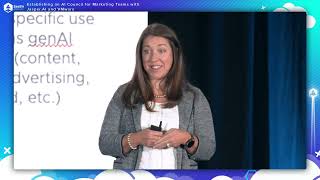
The recording captures a multi‑speaker SaaStr Annual session that begins with Samyutha Reddy (Jasper AI) and Jessica Ria (VMware) describing how VMware built a Marketing AI Council to govern generative AI use. They detail the council’s origin, executive sponsorship, cross‑functional charter, weekly meetings, evolving guidelines (e.g., prohibiting ChatGPT for publishing, allowing draft generation), education programs (newsletters, enablement sessions, foundational AI concepts), and a downloadable AI policy template from Jasper. The session then shifts to Marwa Sonar (AWS SaaS Factory) and Ian Hutchinson (DuploCloud) who share three hard‑learned scaling lessons for SaaS companies: focusing on unit‑cost reduction, cash‑flow discipline, and outsourcing non‑core work. They also discuss go‑to‑market tactics, product‑market fit discovery, and data‑security/compliance considerations. Harris Clark and Jenny Yi (GuideCX) present a retention framework emphasizing trust, transparent communication, and delivering on commitments, illustrated with anecdotes about over‑promising. Finally, Viviana Faga (Felicis) and Camille Ricketts (former Notion) explore how to build or enter a market category, covering the decision between inventing a new category versus competing in an existing one, the importance of a clear problem, specific audience, traction, storytelling, naming, continuous customer interviews, internal language adoption, and real‑world examples (Notion, Runway, Canva). The session concludes with actionable checklists and encouragement to take immediate steps.
Chapters
Please welcome to the stage Samyutha Reddy, Head of Enterprise Marketing at Jasper AI, and Jessica Ria, Head of Global Integrated Campaigns and Content Strategy at VMware.
Hi everyone. Welcome to our session on establishing an AI council. The title of this session and my introduction will focus on marketers and marketing teams But this content is relevant to anyone thinking about AI at their organization and how to put some guidelines in place to ensure that it's used responsibly. Before we dive into the meat of our session, my name is Samyutha Reddy. I lead enterprise marketing at Jasper AI. Jasper is an AI copilot for marketing teams. Our mission is to help marketing teams create content that performs better, not just that's created faster. Before I hand it off to Jessica, maybe you can introduce yourself.
Yeah, thanks, Amita. I'm Jessica Ria. I'm the head of global demand content strategy at VMware and the founder of our Marketing AI Council.
Nice.
Before I hand it off to Jessica to talk a little bit more about the AI Council, I'd love to take us all back in time. About a year ago, generative AI had just become mainstream. ChatGPT became a household name virtually overnight, and all of the media headlines, the Twitter gurus, the tech pundits, all they could talk about is how the marketing profession would be changed. It wouldn't be recognizable after AI came into the picture. Some of that has been true. AI has changed marketing irrevocably. But what I think marketers have done a really good job at is reclaiming our power within the generative AI narrative that we're victims. We're not victims. I actually think that we're stewards of generative AI within the enterprise because of all of the tools available to us, the strategies we choose, the pilot programs we run, largely determine how the organization thinks about AI as a whole. Fast forward to today. This is the state of AI in marketing. Any given marketer have— has hundreds of tools to choose from when thinking about how they're going to incorporate AI— incorporate AI into their strategy. But which tools are ready for enterprise use? What guidelines do we put in place to ensure AI is used ethically? Who makes those decisions? Jessica, an early customer of Jasper, was able to work through all of these questions and more at VMware through establishing an AI council. So I'd love to hand it off to her to talk through her story a little bit more.
Thanks, Samyuta. So we thought we'd share with you today how VMware established a marketing AI council. Our origin story, our inspiration really starts back last fall in a small pilot team with Jasper AI. We brought on Jasper on my team to pilot, uh, content. We create promotional content, bill of materials for our geos to execute in the field. We wanted to improve our content quality and speed time to production. We spend so much time back and forth with agencies and frankly waiting for agencies to get started on projects, that by the time it comes to us, we couldn't spend enough time really editing it and making it what we really wanted to be. We also wanted to cut agency costs by half. So that all was happening in the fall. And then in November, you know what happened, right? ChatGPT launched and we had some individual marketers across our large global marketing team, which is over 700 employees, start to really dive in deep on generative AI. We came back from our break in January, and I was starting to hear conversations, silos of swirl, I call it. We had some interest, some excitement, some intrigue, and some outright fear for their jobs and what was going to happen with generative AI. People were going to brand saying, can I use ChatGPT to create new content? Brand is trying to figure out what our point of view was. So I saw this happening and brought everyone together, and I call it this grassroots coordination of people in early February, and I called it the Marketing AI Council. But it was very, you know, is this a good idea? Are you interested? Do you want to be part of this? How often should we meet? And by the way, you know, here I'm going to throw up a draft charter. We should get organized around what AI pilots we want to prioritize. We should figure out what our point of view is on using ChatGPT or other tools. We should figure out what those guardrails are, and we should figure out how we want to educate our marketing team. So that was in February. We started meeting weekly and the team started growing. Initially it was about 8 to 10 people. In March, we established our first guidelines for using generative AI tools at VMware. And it was more about, you know, we— ChatGPT, by the way, is a non-starter for us at VMware. So in order, or in addition to telling people what not to do, we had to tell people what they could do along the way. So it was like, you know, don't use ChatGPT to publish content, don't, don't share confidential information, but do experiment in drafting content with publicly available information. And our guidelines continued to flesh out from there. And by the way, we iterated them on a weekly basis when we first started in March. That same month, we also hosted our first global marketing enablement session. We brought in Paul Raetzer from the Marketing AI Institute, CEO and founder, By the way, if you're not following the Marketing Institute, highly, highly recommend, very vendor-neutral approach. And they have a podcast every Tuesday. We live and breathe by on our council that sums up the past week's news. So we brought him on and started to talk about generative AI for the first time. And we've been having monthly global enablement sessions from there between February, March, and April. We were really still trying to figure out who our exec sponsor would be. And for us, I knew that we needed leadership's alignment. We needed the runway. We needed to make sure that we were driving in the right direction. And it was trying to figure out, is that strategy and operations? Is that global web and digital services, which is our MarTech team? Is that global demand, which is my team? But in May, we were lucky enough to confirm our CMO as our exec sponsor. And that really catapulted the visibility, the runway, the body of work that the council was able to get done. And we formalized this charter that you see here. So it's now a cross-functional team, over 30 people in our marketing AI council representing every single function across marketing as well as IT, legal, product marketing, and sales. And that's a really great tip that we learned along the way too. We brought legal in from the very beginning and were able to walk along with them hand in hand throughout, throughout the process. Our focus is really educating and empowering marketers. When our CMO came on board, It's not just about ensuring that marketing is leading internally, that VMware is leading externally, but that we're offering an opportunity for our individual marketers to upskill and take advantage of this transformational opportunity. Think about marketing before the internet and after the internet and how much has changed. What are we doing to make sure that our marketers understand the opportunity and can leverage that effectively? So We're really passionate about this upscale opportunity and offering that from an educational standpoint across our team and making sure that our marketers are using GenAI tools responsibly and effectively. What does responsible AI adoption mean? What is— what are your ethical principles? And that kind of comes down to governance as well. What are we focused on? You all have a brand, a documented mission and ethos, a North Star. What is that from an AI perspective? What is your risk tolerance? Are you ensured that your teams are using GenAI the same way you want them to be using it? Are you all on the same page and what does that look like and how will it iterate over time and who's responsible for that? From an educational standpoint, it's not just onboarding new tools and ensuring that our teams know how to use it because there's a learning curve, by the way, right? So you have to ensure that there's a really broad educational plan for those tools that you're using. But also it's really important to us, and I'm really passionate about foundational understanding of generative AI. What is it? Why is it different? How did we get here? What are the differences between traditional AI and ML? And what is generative? What does it mean to have predictive text? And why is that not plagiarism? And how are you looking at how tools and models are trained and understanding what, uh, how to spot bias in the outputs that are coming along, right? All of that makes you a better marketer, helps you understand, and experience in those tools creates understanding, and those two things really go hand in hand. So these are the responsibilities across our Marketing AI Council. Your Marketing AI Council, your group may look really different than ours. It may not be as large either, but all of these are aspects across the team that I think are really important. We have an AI newsletter. We had our first marketing leadership AI summit. We workshopped use cases, prioritized what was our second half roadmap going to be for the council and from an AI piloting standpoint, driving enablement, promoting those best practices and managing these work streams. I want to leave you with 4 key tips, takeaways. They could be in any order and I could do this presentation 3 more times with these in different order. So they're really all about the same from an important standpoint. Recruiting an exec sponsor. You may be the exec sponsor for your company, right? So supporting your team and getting this started and really prioritizing this grassroots opportunity. It's important to make sure that the people who are passionate about generative AI are the ones doing this because it's probably above and beyond their daily jobs. And you need to have a people who want to put in extra time and effort to figure this out. If you don't have an AI policy today, this is really where you need to get Most companies don't, but it's the first place you need to do— first place you need to start to get everybody on board and on the same page and really just getting started, taking initiative. Luckily, our friends at Jasper today have created an AI policy template that you can download here to get you started. It's great cuz it's on Jasper's value prop of getting past that blank page, allowing you to customize this template for your teams. The big takeaway here is to take action. And get started. And I know that in a conference full of SaaS startups, you all know how to get started.
Thank you.
Come see us at Booth 216. We're happy to answer questions and talk to you more about this topic. Please welcome to the stage Ian Hutchinson. VP of Sales at DuploCloud, and Marvey Sonner, Global Practice Lead, SaaS at AWS SaaS Factory.
All right. Hi everyone. Good morning and thanks for joining us today. So we will be talking about 3 scaling lessons learned the hard way, but first a couple quick round of introductions. My name is Marwa Sonar. I'm part of a team called AWS SaaS Factory at AWS. And in my role, I work with SaaS organizations of different sizes. So anything from early-stage startups to enterprises, and my team help those organizations to build and grow their businesses on AWS. I've been in the B2B software and SaaS space almost entire of my my career, and today I would like to share some of the learnings I had either experiencing firsthand or working with the SaaS organizations. And today we have, uh, Ian Hutchinson from Duplo Cloud with me co-presenting.
Awesome. Hi everyone, I lead the sales team at a Series A startup by the name of Duplo Cloud. Uh, we're in the cloud infrastructure and DevOps space. Uh, it's the third startup and third SaaS company I've worked for, and it's getting progressively easier and better each time, but it is hard. It is hard to build a SaaS company. It is hard to scale a SaaS company. I truly believe there are lessons learned and best practices that you can share with people that are at a similar stage to you, or maybe a year ahead, a year behind, so on and so forth. And that's really what inspired part of the, the, the talk today. Um, and so I'm gonna pass it back to you, Mary, to get, get into it.
Yes, so we will basically be talking about 3 learnings for different parts of your business. So we will start with your financials, then we will move on to your go-to-market, and then we will close up with your product data and data security and compliance. So let's start with the financials and doing more with less. So up until 18-20, 4 months ago, many of the SaaS organizations focused focused on growth, like acquiring new customers, growing revenue was number one priority. But as we move into the last couple of years, this has shifted. Now organizations are focusing on more profitable growth. It's more sustainable. They want to make sure they grow with, with some profits. So if you look at your profits, it basically comes down to two main things: your revenue and your costs. So as you grow, scale your businesses, it's important to optimize your cost so you can do more with what you have. And if you're a SaaS business, you probably have different types of costs like your infrastructure cost, R&D cost, your headcount, and all others. And as you grow your business and as you add new customers, your cost will increase. That's kind of how it goes. But hopefully the idea is your Your revenue should grow much faster than your cost so that your company is, is, is in a right path. So in order to do that, many of the organizations we work with, they are focusing on a metric called unit cost. And unit cost could be defined in different ways depending on your business. So it could be your cost per customer, cost per user, cost per feature, whatever makes sense for your business. But in the end, as you scale your business, you need to really look at a trend that is decreasing for your unit cost because that's how actually you scale your business. And even if your costs grow, you will be still profitable and your revenues will hopefully grow much faster than your costs. So once you look at that and focus on this unit cost and decreasing it, there are a couple of other things that you can do for cost optimization so that it's like that reaching to a healthy growth is much easier. So let's look at some of the examples how you can optimize and decrease your costs. So depending on which resource you look, between 80 to 90% of startups fail after a couple of years they were founded. And the number one reason why they fail is lack of cash. So they are out of money, they are out of business. So it's really very important important as a startup just to be conscious of what you spend and when you spend. And the number one area you could look at here is really your labor costs. In many organizations, labor costs could take up to 70% of your total business cost. So it's really important as a startup to understand when you hire and who you hire. And this should really go hand in hand with your go-to-market. So for example, If you are a product-led growth company, then probably investing in a sales team may not be your priority, or the other way around. So just be conscious of who you hire and when you hire, and make sure you optimize the cost you have. The second area that you can do to do more with less is actually outsourcing some of the undifferentiated heavy lifting. So this could be anything from outsourcing your server infrastructure management or outsourcing some of the business processes such as payroll, working with partners to build your products so that you can really focus on the core part of your business that provides the value for your customers. And finally, managing your cash flow. As I said, it's something that you cannot look over. It's, it's number one reason why startups, uh, go out of business. So many of the startups look for metrics like ARR, NRR, which are all important, but definitely keep an eye on your cash flow and make sure you are on the right track. Ian, over to you.
Awesome. I'm going to shift here and talk a little bit about go-to-market, which obviously plays a role in cash flow. Uh, in my career I've had several different like aha moments. And when I look back at these aha moments, I think back at the different stages. $0 to $1 million, $0 to $2 million ARR, you are not saying no to revenue. You are taking all of the users you can get, you are taking all of the cash you can get, and you should be doing that. But you should be going back to those customers and talking about what did you buy? Why did you buy it? How would you describe it to a friend? It's very simple tactical questions that you can ask to better understand understand your product-market fit. We grinded for 2 years at Vidyard before we got from $0 to $2 million ARR. We found out that the integration with marketing automation platforms that we built was this like aha thing that a lot of customers were saying, this is the why, this is, this is what we do. And it shifted the conversation from this huge billion-dollar fluffy TAM to being, these are the next 1,000 companies that we can sell to. It shifted how we did our sales process, it shifted how we did our marketing it shifted the features that we built. We then scaled from 2 to 10 in the next 2 years. So then when companies would come inbound to us and say, hey, I want to use, I want to use your product, we could say we're skeptical because we know our why. We have that product fit in the back of the mind, and it's a very powerful thing to do. Drupal Cloud, similar thing, but instead of interviewing the customers, we were actually looking at churn data. Our number one customer cause of churn was around a lack of adoption. The product— the customer's not using the product, which is common in SaaS. The number 2 was financial distress. We were selling to companies that were too early to really benefit from our product. You can solve this with price floors. You can solve this with, with discovery questions in the evaluation process. You can alter your outbound motions that you are now selling to the right types of companies. From here, I'm going to shift a little bit. You can spin your tires. On marketing and sales like I was talking about a little bit, but you want to build the right product. Now there is a whole bunch of things we could talk about in terms of how do you define the right product, how do you figure out what people want, what people need, so on and so forth. I'm going to talk about one lesson learned, more aha moments from Vidyard and Duplo cloud, and this one is really around data security and compliance. When we got to a significant size, when we found this sort of fit, we found our motion, we were getting buried in infosec InfoSec questionnaires. Why were we getting buried in InfoSec questionnaires? Because we were a B2B organization and companies store their, their app, their data in a ton of different places. DublCloud is 65 people. We use 65 different SaaS applications. Organizations need to be conscious about this and, and need to be thorough, which is why you see so many organizations getting their SOC 2 when they're very, very early, because they know they're going to be B2B and they know they're going to grow. So how does this affect you as you build your product? You should be thinking about what data you need to store and what data you don't have to store. Do you need to store payment card data? Do you need to store healthcare data? Do you need to store PII? When you're integrating with Salesforce, what data do you have access to? So on and so forth. Where is it? And, and ultimately, this will help you, A, with your growth. You'll be able to get into these larger accounts faster, and it would also help you with a remediation perspective. There won't be a lot of rework and a a lot of process on the product side that you need to look at. So in summary, be smart with the product you build, have a thoughtful strategy about who you sell to and who you don't sell to. And if nothing else, keep cash in the bank, 'cause that's a mistake you can't make. We couldn't go as deep into all of these topics as we wanted to in 10 minutes, but I will say a couple things about AWS. I've been working with them for some time now, They have amazing resources both on the technical side, of course, they're all free resources, but they also have a lot of resources on the business side. This QR code takes you to SaaS Insights. Their startup and SaaS blogs are amazing. Mary is going to talk a little about the program she's with, which is specific to SaaS organizations. It's called SaaS Factory.
Yes, so I definitely encourage you to check our SaaS service resources, which is over 200 right now. So you will find all the business and technical guidance that our team shares based on the learnings that we work with SaaS organizations. So definitely go check and hopefully you will see some case studies from your peer organizations as well. Thanks for joining and enjoy the rest of the SaaStr. Thank you.
We're going to hang out next door for a couple of minutes. If you want to talk go-to-market, if you want to talk tech, if you want to talk DevOps, if you want to talk security, we'll be right over here. Otherwise, have a great last day. Cheers, guys.
[Speaker:JASON M. LEMKIN] Thank you.
Please welcome to the stage Harris Clark.
Chief Operating Officer at GuideCX, and Jenny Yi, Customer Success Manager at—
All right. Oh, thank you. Thank you very much. Jenny, let's head back down.
That's it.
Yeah.
Thank you.
Appreciate it. It's great to be here with you. My name is Harris. This is Jenny. Just by quick way of introduction. Introduction. If you are a CSM or you care about customer success at all, I highly recommend you connect with Jenny. She's fantastic at what she does and very generous with her time and advice. We want to talk about the top 3 lessons we learned in 2023 about retention. I'm sure it's been a super easy year for everyone, just like it has been for us. We're— one of the reasons I think we were asked to speak about this is because the dynamic at our company— we, we provide an onboarding software, so we work with customers and their customers. So we've seen a lot of different trends about what's happening in terms of retention throughout the space. And everyone knows this, but we think it bears remembering that we rely on retention, right? No amount of new revenue is going to fix a leaky bucket. So we wanted to share with you the things that learned this year.
So we all know as providers and as clients, because we are actually using software that's available to us, as well as our clients who are using us as providers. So as a provider and as a client, we know that the, the business turmoil that's confronted us in 2022 and 2023 is still still apparent. We see companies changing, we see business models evolving, and the key thing here is what are those things that we can practice to retain our clients and to keep them happy. So the 3 things that we typically see as key motivator, key things that are critical to keeping our business afloat, is being able to retain our customers. How do we do that? We want to make sure that we are nurturing the relationship, we're building the trust with them, we are delivering on our commitments. And also, least but it's pretty important, is what's the value to them with our deliverables, whether it be a software or whether it be a service.
Exactly right. So let's dive into the first one. I hope it does not is a surprise to you that developing trust with your customers is critical to retaining your customers, but we want to talk about how to do that. Something that I believe deeply is that we cannot let the B2B world make us forget that we're working with people. It may be B2B, but at the end of the day, your client isn't Nike, your client is Jessica at Nike, right? Your You're working with specific people at specific companies, and finding ways to build trust with them is paramount. Too often we, we try to automate so much that it becomes hard for customers to connect with us and hard for them to really know us. So one thing that we try to do and one thing that we have seen help a lot, not only with our retention but with our customers and their customers, is find a way to be available. If a customer really needs to speak with you, find a way to make it possible, whether it's through a chatbot, a phone number, whatever the case may be. Make sure that your team is available when the customer needs you and find ways to make genuine effort to understand their situation and what they're doing.
Right.
And so some of the things that we've highlighted here are key points that we've all those— we've noticed as a provider, what are those things are really, really important to our clients that'll help us retain them. One is when they encounter a challenge or an issue, they want to be able to be kept abreast of what's going on. They want to have a quick response. If I've actually reported an issue, am I going to be waiting a month to find out whether this bug got fixed or whether the issue has been resolved? No, they want to be able to be kept abreast. So key thing here is keeping them— having a team that that's quick in response and being very proactive in communicating where they're at with the issues. The next thing is also making a genuine effort to understand what is the challenge, what is the problem that you're encountering? And by doing that, you're basically building that trust, building that understanding, so you better understand what you're trying to solve, not what you think you're trying to solve, okay? And all these components that we've highlighted on the presentation itself all tie together. It's building the trust, building the relationship, and having a strong communication and transparency to the problem you're trying to solve.
Who here has ever jumped to a conclusion? Oh, just a few of you, like me. So yeah, I just— I want to highlight there's a book called Measure What Matters by John Doerr. I'm sure a lot of you have read it or heard of it. If you haven't, it's fantastic. And there's a quote in that book where John says, "Transparency seeds collaboration." If you can show people what's happening behind the scenes, if you can help them understand what you need from them, and also if you can get transparency, it will help you build trust a lot better. So when we talk about building trust from the very first interaction, making a genuine effort to understand And those things go quite a long way. And they go a long way to make sure that you're delivering on commitments. I had some work at my home done recently. I don't know if anyone here has ever worked with a contractor. It was a very pleasant experience. It was very smooth from start to finish, except for one part where the contractor told me that they'd be finished with our flooring by the end of the week. And I thought, okay, great. We were actually staying at my in-laws, which was fine, but wonderful, we'll be back in at the end of the week. Except at the end of the week, they weren't done. So I called and they said, "Sorry, you know, some things got backed up. We'll be done by the end of next week." So okay, like a little frustrating, but that's fine. You know, we'll rearrange our plans and take care of— I have 4 little boys. I said, "Okay, we'll, you know, figure out school and whatnot." Except they weren't done by the end of the next week. And this went on for 10 weeks. And I told the guy at the end, I said, if you had told me that this would take 10 weeks, I would have planned accordingly. Maybe I wouldn't have been thrilled. I'm not trying to say it would have been no big deal, but I would have planned for that. But your failure to give the right expectation led to a terrible experience for me. Whereas if you had told me, hey, it's going to take me about 10 weeks, I would have been able to plan and prepare for that. So a huge mistake that we see lead to churn is overcommitting, thinking to yourself, well, I bet the customer feels like this has to be done right now, so I'm going to commit to having it done right now, but then you fail to make that commitment. So be as transparent as you can, like John Doerr says, to seed the collaboration and get that person involved in the process, and then make sure that you're following up on and meeting those commitments.
Yeah, and so So on delivering commitments, which is typically something I have to do a lot because I'm working with the product team, communicating when the, what the roadmap is, enhancements you're requesting. So the key thing here is setting the expectation up front. If it's gonna take a whole quarter, let them know it's gonna take a whole quarter so you as a client can plan accordingly. It may be critical to you, but if the product team the quality of the product is going to be delivered and it is what you expect it to be, which is working, and with as less bugs as possible, we're going to have to take the quarter. So our advice and what we basically practice is communicating with realistic dates, realistic expectation. And also, in order to maintain that communication with your client, it's critical to have a regular cadence because you have those touch points. Reaching out once a quarter, reaching out once a year doesn't develop that relationship, which goes back to the number one thing that we talked about. I think the, the critical point here is that relationship is built over time. It's not a one call, two call. It's the consistent understanding of your client, how you work with them, and building that trust with that network that you have with them and understanding what things they're going through, what problems they're going through.
Yeah, really well said. And it's why in our product, we have a customer onboarding product, and we wanna make sure there's a forecast of when you'll be complete. So similar to package tracking, right? If you have an idea of what's happening next, then you're on the same page with that company you're working with. Last thing we wanna talk about is that value is not black and white for everyone. There's a difference between your value proposition and your customers' value expectation and what they hope to get out of your software. So find ways to understand what is value to them, right? If I take my kids to Disney World and I think, hey, there's a lot of fun stuff there, but the only thing they care about is Space Mountain and that's closed, then they didn't have a great time. So it's the same thing with what we sell, our services, our products. We think, hey, it's Disneyland. We built the greatest thing ever, but there are gonna be things that you offer that really represent value to them. So making sure that you understand that value is critical.
Right. And the definition of the value is varied from company to company, from individuals that you're working with. So we typically, as I work with my clients, I try and understand what is the value? Why did you buy? Why did you purchase? Why are you engaging with us? What's the value that I'm delivering to you that you expect to be able to accomplish? That is something we review over and over again on our weekly calls, on our bimonthly calls. What we're trying to do is establish that the value that we are delivering meets the expectation and meets the value of why you are engaging with GuideCX.
And like I said, Jenny is phenomenal at her job. It's a matter of asking those blunt questions. Be clear. It's not a secret that there's a commercial relationship here. Make sure you understand why somebody is working with your company. Those are the takeaways. That's what we've seen, not only with our customer base, but with their customer base. Find ways to build relationships and develop trust. Do that by being responsive and available. Ensure that you're delivering on commitments, but also set the right expectation with commitments. So that your customers have a clear understanding of what's happening. And then remember that your value proposition is not going to be always the same as their value expectation. So do the hard work to figure out what that is, document it, make sure it's clear on renewal time, and we will see retention rates soar again following these practices. So good luck to everybody, and thanks again for being here.
Come visit us at SG202. We're in the West Last hangar.
That's right.
Please welcome to the stage Viviana Faga, General Partner at Felicis, and Camille Ricketts, formerly Head of Brand Marketing at Notion.
Hi, everybody.
You did the wave. I love it.
Hi.
Hi, guys.
Great to see you. Thanks so much for coming.
Great. Well, thank you so much for coming. We were excited to have this conversation today because both Camille and I are former CMOs or heads of marketing. And one of the questions that we get a lot is, how do I build a category? What does that look like? And so when you think about a category, the way to think about it is you're really creating space in people's minds for what your solution is and why they need it.
Yeah, you essentially want to explain to them in a way that's gonna be really sticky and really easy to visualize. Just like, what is it that we're doing? Can you actually see it? Can you actually understand how it's gonna apply to your own lives and your own work? Okay, so whether you should be creating a new category or an existing category, I think that this is the central question in a lot of ways. You can either say say, okay, we want to make sure that we're owning what it is that we're going to do from the very start. So let's come up with new verbiage, a new noun to describe what it is that we're doing. So some examples might be the Smart Workspace, Data Cloud, Business Intelligence. If you make it, you can own it. But at the same time, it's extremely hard to break through because a lot of people might not implicitly understand what it is you are doing. And then of course there The other is entering an existing category, and that has a lot of benefits as well. You immediately are understood. All of the user education is already there. Your customers can, in fact, visualize right off the bat what it is you're doing. And you can win big by making it clear how your particular solution is going to be superior. At the same time, if you're in a crowded category, you're gonna have to compete really hard. So what is the—
what exactly is required when you're building a brand? Brand new category, okay? Camille and I talk about this a lot. This can feel quite a bit harder than plugging into an existing category, but if you're building an entirely new one, first things first, you have to have a very clearly deeply felt problem. This is not a nice to have. It has to be like there's a massive pain point here. Next, you have to take a step back and say, what's my audience? And it has to be a very specific specific niche first. We'll give examples later in this with this respect, but it has to be extremely focused. You have to have solid traction. You can't just like create a new category and hope that people will show up. You have to see some of that traction already. The market's pulling you and saying this is something totally new, never seen this before. And then the final point is one that like Camille and I talk about a lot. There's some— as an example, there's a founder that I'm working with now who is building this incredibly new product and says to me, you know what, I don't have time to write blog posts, talk to reporters. And I look at him and I say, but this is your job. It is your job to tell the story. You are cheerleader number one, and no one's going to get there if you're not willing to do it.
So then let's talk about why you might want to build in an existing category. And this is something that is near and dear to my heart because I really feel like that was the Notion story. And I'm happy to talk a little bit more about that origin. But what are the things that are going to indicate to you that that's the thing to do? The first one is that incumbents that are currently in the category are faltering. They're letting customers down. You're starting to hear that people are unhappy with the solution. Maybe they're really frustrated. So that's a good signal to you that maybe it's time time for something new, a 2.0 solution perhaps in the space. You can see that there was a B2B solution, but maybe there's a B2C component about it as well. Felt is a really good example of this. Who here is familiar with Felt? It's the new mapping software that is sort of replacing Google Maps. You should all know about it, but they're the ones that are entering that existing category.
[Speaker:JASON M. LEMKIN] I don't know.
I don't know. [Speaker:SHANNON YOUNG] Because they saw a B2C solution, and now they are offering a B2B solution on top of that. And then maybe you can have— introduce new mechanics into an existing solution space. So if you think about Notion versus Google Docs, there are different ways that you interact with Notion in order to build documentation, build wikis, manage projects that Google Docs didn't necessarily extend into. So there was a chance there, there was an opening. And then lastly, you can ride a wave. So we're thinking about AI right now, there's obviously all of this momentum. There's an in-existing categories, but also incumbents who are not riding that wave. And so you have a chance to get out in front because that momentum is so strong.
So what are some of the common pitfalls and misconceptions that founders make when either building a new category or living in it within an existing one? So I want to talk a little bit about about a company called Walnut that I invested in. And you want to go to the next slide? I'll just go into that one. What was so fascinating about Walnut is that at first blush, when you looked at their category, it was about giving, you know, making sales demos much easier. And we said, but actually the category is much larger than that. It's not just about sales prospects, the demo platform. Everyone is a prospect. Everyone that wants to buy software And so they launched this campaign called We Are Prospects, right? And that was their way of making their category much bigger than maybe it felt when you were first flush.
The other big misconception is that you can run a positioning exercise or a categorization exercise in a 2 to 3 week period and then call it done. Say, hey, we did it, we named our new category, we figured out what our noun was. Uh, that is not going to be the case, I would say, in 99% of situations, nor should it be the case. This is not a one-and-done exercise. It's something that needs to be done over time and then also needs to be done in concert with as many people inside of your organizations that are stakeholders in this process as possible. So I have a few Notion document examples, so forgive me, I promise I'm not trying to plug Notion too much. It is an excellent piece piece of software for this particular task. But being able to center in on what is it that you are building, who is it for, what are the primary value props that you are trying to enable for those people, how are you different from the competition, and what is that sort of precise expression of the differentiator. You want to codify all of this and make it a living document that is is not only going to be revised over time, but accessible to everybody on your team to reference.
It's like an organism. That's how I would look at it, because your category, as you're creating it, is going to evolve as your market expands.
To continue on this, you don't actually need a noun immediately. You don't need to say, let's come up with some clever verbiage for describing what it is that we're doing. You can borrow. You can borrow, especially if you are building in an existing category. I even recommend it a little bit. And just to give you a sense of how important this was for the Notion story, at the very beginning there wasn't really vocabulary to describe what it was doing. It was very hard to sometimes get people to understand what it was going to look like, what their interactions were going to be. So we actually would use words like, hey, it's It's kind of like Asana and Todoist and Evernote and Google Docs and Quip all in one. Uh, and that was okay. It was sort of like being inside of a pool and being able to push off the sides of the pool in order to anchor people and get them to understand what we were doing. And as soon as we would use sort of that triangulation of description, they'd be like, aha, I've got it.
Yeah.
And so sometimes it's a really good starting point of like, what is the mental model to get me there. For Notion, it was— there's some existing products around it, um, and now, and now we land on that. That's great. Absolutely.
And then the other, the last one I think that we'll go over, or one of the last ones, is that this categorization only has to come from you. I think a lot of people put pressure on themselves, say like, this has to come from within, we all have to have believed in this brand new idea or thought out there, when actually there's a lot of people are people who can help you with this naming process. There are analysts out here, and I have an example of the Magic Quadrant and Forrester Wave that are creating these categories all the time so that people can sort of understand what's going on in the industry. Keep an eye on those things. Same with these review sites like G2 and Capterra and Trustpilot. They are all coming up with this vocabulary all the time, and there can be real benefit to innovating inside of them because then they help amplify what it is you're doing. Same goes with user interviews. We'll talk a lot about user interviews later. But you really want to start integrating the vocabulary that other people are using out there, not just feeling like you have to invent yourself.
And you don't have to pick it right away. Like, you can use different words with different customers, and they're going to, like, tell you, oh yeah, that word worked, or that one doesn't feel right. And so keep taking all of that in. And, you know, it's not required for success. There's plenty of great companies that didn't have to take and, you know, build something completely new, right? We talk about Canva, even though, like, Canva is also Felicia's portfolio company, but they really expanded the universe of design, right? Mom-and-pop shops wanted to be able to design, but it is an existing category that was typically only meant for, like, designers who had gone to RISD, right? And so it's a different universe, same category, but expanded that universe.
So I guess the big thesis here is don't put pressure on yourself to figure this out immediately. I feel like between us, we talk to so many companies that say, can you help us with our categorization process?
Just tell me what my category should be.
Yes. And it just— it doesn't have to operate exactly that way.
Living, breathing, organic. All right. So let's talk a little bit about how to get it right. This is going to be interesting, but I think Notion is a good example of this where like you gave, you gave them a mental model, like how do we get people there? It's sort of like this. And what was the example you always use? The digital workspace?
Yes.
Okay. And she'll go into that a little bit later, but you're going to start to get pulled. So you'll start to see people talking about you and they're saying, gee, I use We use Notion for this. And you'll see the market just starting to tell you what it is. You get inbound and unprompted evangelism. People are gonna love you. They're gonna talk about you at events. And you're just showing up in other people's feeds. So it's, the market will start to tell you this is where they want you to go.
[Speaker] Yeah, and I would say that especially if you are gonna run a new categorization exercise, it's very important to wait to feel ready. This type of momentum. Otherwise, I think it's time to sort of wait and watch and learn.
Definitely.
The next thing we would say is set up regular customer interviews. And when we say regular, we say make it a habit for your organization to do this on a continuing rolling basis. You shouldn't just say, oh, we're going to do this sprint where we are going to talk to 25 customers over this month, and then we're going to distill what they told us, reflect it back. It needs to be continuous, whether that's doing one interview a month. Set it up, put it on the calendar, remind yourselves, just make it muscle memory. And then make sure that you're exposing more people than just the small core of folks who are maybe building product or running marketing to customers. Invite them in, assign them interviews on a rolling basis, and then make sure you're not just asking about the product. I think that there is a penchant for for going into these customer interviews and really getting into the nitty-gritty of how the product is performing and the feedback that they have for it. But you also want to make sure that you're using that time to get the marketing right. So can you ask them these questions about how they're seeing the solution, how they're seeing the problem space, how they're discovering new tools that are somewhat similar to yours, what type of media they're interacting with, how much time they have for it. Make sure you're allocating some time for that so you can get this type of verbiage right?
Aim for ownable language. This is really important because I think sometimes when the founders are building a new category, they'll say things like, oh, well, gee, I want to create something so new that like it sounds so cool, but then no one understands what you're talking about. So a good example of that is Salesforce, where like Marc in the early days— I spent 7 years at Salesforce pre-IPO— and in the early days Marc was talking about Salesforce as online CRM, and nobody wanted to write about online CRM. Not a single person was interested. And it wasn't until he met with a Wall Street Journal reporter that said, oh, it's like what you're talking about is the end of software. And then that is what catapulted the company, you know. But Marc was maniacal about a message. He said, hey, great, now that we have the thing, you know, the end of software, the mantra, I'm going to create 7 core slides, and I'm going to repeat it, and I'm gonna make every single employee memorize it. And that is the job of a founder when they're starting, when they're creating a new category.
So how do you know if this is feeling right, if you're doing everything according to this plan? This is the type of interaction that you should start to see out there. What are you using for your CMS? At some point in time, there was no terminology CMS. Somebody created that category and then a bunch of other folks came into it. So if you are inventing something or if you're deciding to enter into a market, this is the type of interaction you want folks to have. What are you using for this so that they have the opportunity to recommend your product because they know exactly what it's going to do for them and the types of results that it's gonna produce.
So what does it look like when you're on the right track?
Track.
You're seeing a marketing impact. You're getting leads into the funnel that fit your ICP, your ideal customer profile. I'm gonna make a big assumption here, which is that you've defined this because if you wanna build a category, you definitely should have done this, but that's a whole other session. You're seeing community impact. Every, you know, people are, are kind of aware of you talking about you. There's a revenue impact. You're starting to see that ARR number get better. So that's— you're starting to feel again that pull, um, and it's magical, but it doesn't happen overnight. It's sort of slow and then it just, it can catch like wildfire. But as an example, Notion, you know, was building for 5 years until it really took off. Figma, same thing. It took them a bit. So, um, and then it just takes off.
So we wanna share some examples out there in the wild with you, and it's gonna be no surprise that the example that I'm gonna focus on is Notion. So thank you for queuing that up. Uh, so Notion is a great example of a company that started and then built in an existing space, but then I would say over time was able to turn it into a new one by becoming that category leader. So here's a little bit of, you know, the history of how we started. Uh, like I said, we would definitely play off of other companies that we knew we were in a similar space to, whether it was Google Docs or Asana or Quip, etc. Uh, and we kept finding ourselves using the words, you know, it's all in one, it's all these things all in one. So that became the initial positioning, the initial categorization that Notion used. And then we followed our customers, and this is a big point, but it didn't happen overnight. And I don't think that anybody here should feel like it needs to happen overnight for them. So really do take courage from this example. Early sales— we have an early salesperson here in the back. I see David Apple right there. And this is something that he did. Early sales ran jobs-to-be-done interviews and really surfaced a ton of the material that we ended up using to understand how we needed to pivot the language, how we needed to pivot the way the way that we were describing what it was that Notion did. We brought together a bunch of ambassadors and champions in a community. We actually used a Slack instance, really like pretty low-fi here, but really tuned in to how those people were talking about Notion, what types of words they were using, what they wanted from the product. We gave them early access to features so that they could then give us feedback, give direct feedback to the product team, to the marketing team, so that we iterate accordingly. Our customer experience team also doubled as UX researchers out there. It was a very small team, but every ticket that came in through that channel, we would tag a certain way to understand what that ticket was about. And the folks who are working in CX really went the extra mile to say, what do you wish this would do? What do you want to use this for? And then channeled all that learning back into the product team and the marketing team. And then that also enabled a lot of quantitative intuition for our product builders because they could literally go through and be like, well, how many queries were tagged this? Oh, that means that maybe we should explore building in that space. And the product team was able to interface directly with a lot of these folks who were giving us this type of input, which I think was hyper valuable. And so over time, and this is something that actually happened after my time at Notion, but with all of this learning, we were able to center on this new language around connected workspace, which really was a little bit of a departure from what we had initially assumed. The hypothesis being that people wanted an all-in-one solution for project management, docs, wikis, etc. But really the new, the new conception was that folks wanted to be able to connect all of these tools that they were using out there, all of these many tools. We all talk about the too many tool problem. Problem into the same space. It didn't necessarily have to be a space that was inventing all of this itself. And what did this sort of category creation, category exercise unlock? To anchor to what Viv was sharing, the marketing impact. We were able to have stories told about us like this. The fact that TikTok Teens' Latest Fashion is Enterprise Software. I really, I don't think that I think that could have been a better needle-threaded headline, honestly.
I mean, all of you, I'm sure, want to be on TikTok. This is probably a unique exception, but you guys really tapped into this excitement that you found in the market.
Yeah, it was, it was very interesting, especially stemming from students and customer segments you wouldn't necessarily double down on. But this is kind of the marketing halo that was able to be generated around this categorization. The community impact we just we hit a million members. This is actually several months back, but around 50 countries people are talking about Notion. You know, we were seeing things like the Facebook group in Vietnam topping 250,000 folks. Uh, and then the revenue impacts. I think that the customer base for Notion kind of speaks for itself, but the fact that the categorization was so clear, the value being articulated for enterprise customers as well as for consumers, allowed us to bring these types of companies into our orbit. So that's the Notion story. I'm happy to talk more about it after this presentation out in the hall.
And I'll give a quick example on a company I invested in called Runway. It's a generative AI suite. And what was so fascinating about this company was that video production has been around for a very long time, but it's typically— it was created for a very small group of creators. And so When, when I looked at this investment, it reminded me a lot of the Canva investment that we made in the past. And it was, you know, the question was, can you expand the universe of creators? And that is what the founder Chris really wanted to do. He wanted anyone to be able to produce movie-quality videos, not just the movie studios. And so the team, you know, worked on Stable Diffusion, led the research behind it. Various folks did, but they were part of it. And this was something that where they took a step back and said, there's no way we can— what we're doing is so different, we cannot anchor to what exists. We have to build something new and we have to position as advancing creativity in general, leveraging AI. And so this company, you know, as an example, what it unlocked for them is huge marketing impact, right? The brand, the visuals. If you haven't downloaded the app, mobile app, it's incredible. You can take like an existing image, superimpose it. I think I did that like when I got the beta version, I was testing it for a while and I uploaded a picture of like my daughter eating a cookie and then superimposed her as Superman. And she was 10 and couldn't believe it and started immediately like messing with it. And that's when I knew like this product is gonna grow like wildfire. There's viral videos. If you go on their Twitter, you will see movie, you know, movie editors, movie creators that like live in São Paulo, Brazil and have no budget. And they're now producing what feels feels like movie quality videos. And there's a massive revenue impact as well. So you're starting to feel this, this new creative, this new category being created in real time. And so to take on that momentum, the next thing that they did was launch this AI Film Festival. They said, okay, film festivals have been for a while, and we had the question, do we want to just go participate at Sundance or do we want to create something new? And they said, look, we've got to create an AI Film Film Festival. They had Darren Aronofsky there in New York. We just announced the new dates in May, another one in LA. So it's a real— it's, again, this was a conscious decision. We can sponsor Sundance or we can do something new. And for now, we want to do something entirely new that we can own.
So we've shared a lot, but we do want to tie it all together and offer some really actionable tactics here at the end that hopefully everybody here can take away and apply to their own situation. Motivations.
All right. So there is a quick checklist for all of you. So what's important? One, clear, holistic, deeply felt problem. Find that. Have your ICP. Well-defined audience that knows you super well. Solid traction before you go upon this journey. You can't just create a category and then hope that the product will get you there. It's the inverse. Create the product. Watch the market, build the new category or take off upon the existing category. Strong storytellers and spokespeople. I cannot emphasize this enough. You can have the best product, but if your CEO, if your executive team isn't willing to tell that story, it's, it's gonna be really tough to make the impact that you want.
And then speaking to existing categories, I think that there's so so much pressure when we talk about category to select a noun, to honestly be like, this is what we're— this is what we are. We are blank that does this. But if you're operating in an existing category, your noun might already be there, and it's not worth your time, necessarily your energy or attention early on to try to replace it with something that's just gonna confuse your consumer. So in that case, I'd really love to recommend to folks that they focus on the adjective. Like what is it that you're doing that's different, that's superior, that's going to be your wedge, and how can you distill that into a word that you put in front of the noun that describes the category you're operating with. So these are just a few examples that I pulled from real life. Obviously the connected workspace, you know where that comes. The multiplayer design tool, I think probably most of you can discern who that's speaking to. Developer-first payments, Unified business intelligence. So maybe it's that. It's the adjective that you should be focused on. So if you're running these exercises, that's something to ask yourselves.
Pay attention to the words your most engaged evangelists are using. Words matter. The things that they say, how they talk about your product, it is a gold mine. They love you, so listen to them. What are What are they saying? What can I take? What can I reject? Ultimately it's up to you to decide. So customer advisory boards, focus groups, it doesn't have to be a huge lift. Call your 5 topmost engaged customers, ask them what's working. Call the 5 that are least engaged. Why is this not working? When you use the product, what's going on? Set up these regular interviews, stick to them, and then keep an eye out on your channels. A lot of folks are learning a lot both on Slack channels, Discord channels, Reddit and Twitter. Definitely less so Reddit. Probably for the folks that I invest in, it probably worked for Notion, but, um, and Canva, but less so for some of the other companies. But those are all really, really important levers.
And then internal marketing. I think that sometimes when we talk about positioning categorization, it can feel like kind of this lofty nebulous exercise. Where it's done, maybe it lives on your wiki after the fact, but it's not actually integrated into your day-to-day life. It doesn't actually change the way you make decisions or operate in your particular role. So just a few tips here for making sure that whatever you end up with out of this categorization conversation makes its way into the, the everyday, the daily operations, the how the habits that you build, the muscle memory that you have. So here are just a few examples that I think you can use. Once you feel like you've arrived at a category description that you're happy with, make sure that you not only announce it in a first all-hands and make a big deal out of it, but also then mention it at all subsequent head— all-hands. You can say, hey, as a reminder, this is what we're building, and then go into the rest of the program. I've seen that be used in really strong way. Slack and wiki— make sure that you're just repeating, repeating, repeating across all of these channels in which you're really communicating with the people who are on your team who could really benefit from having this language and having the anchor of what your category is meant to provide. And then quarterly planning— as you're thinking through, okay, what's our roadmap gonna be across product, across our people team, across marketing— can you kick off all of those efforts by first reminding people of what it is that you're trying to do with the category.
Remember, you win when people start using your language. So that's when you get those, like, that feeling when you're like, wow, okay, this is working. Everyone's talking about us the way we want them to talk about us. But that is very deliberate, very intentional process, and it requires work. And, you know, Camille and I were joking, there's probably a whole other session we could do on competition, position because what will happen when, when you're like folks who are using your language is your competitors will start to copy you. And that is a very interesting dance that you have to play. And we'll, maybe we'll talk about that next year. But, uh, thank you guys so much for the time. This has been fantastic and hopefully this helps you as you're building your category.
Thank you so much for being here. We really appreciate it.
More from Jason

Why Your Next Hire Should Report to an AI, Tragedy Apps, and Too Many AI SDRs? | The Agents #004

Our Agents Drove Our Salesforce Bill Up 80%, Marketo Hates Agents, and We Stealth-Churned Off Notion




Managing 20+ AI Agents: Lazy Agents, Our $500K AI Bill, Stealth Churn & the Death of 60% Solutions




