Fireside Chat: Jyoti Bansal, harness.io & Dev Ittycheria, MongoDB
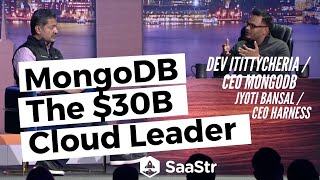
Jyoti Bansal of Harness interviews MongoDB CEO Dev Ittycheria on fundraising, sales scaling, and monetizing developer products. They discuss hiring early leaders, balancing open-source adoption with paywalls, and why going public isn't the default path for every company.
Chapters
Please welcome David Acharya, CEO of MongoDB, and Jody Banzel, founder and CEO at Harness. Hey, how are you?
How's everyone doing? Great. All right, let's get started here. And I feel like a talk show host doing this in this kind of setup. So I've known Dave for a long time. When I was founder and CEO of AppDynamics, Dave was in our board and I worked with him long time. You know, I still remember the very first time I met Dave back in 2011 and I was this engineer turned first time founder CEO running the business and we were like less than $10 million ARR. And business was doing very well. And I met with Dave and I was telling him our business was doing very well and he was, but do you, and he asked me, why is it doing well? And I told him like, you know, we have a good market, we have a good product and we are, you know, because the product is good, that's why our business is doing well. And then we started talking about sales and Dave, during that breakfast, he convinced me like, you know, if you can marry the right kind of a sales scaling and execution, then you, you know, that's when your business will really, really take off. And I think the lessons I've learned from him as I, you know, as we were building AppDynamics and kind of how do you bring scaling and how do you execute at a much higher scale, I've learned a lot from Dave and we'll talk about some of those topics here today.
Thank you.
So first thing, Dave, is I know you started as an operator running, you know, a startup company, took it public, and then you became a VC and then you became an operator again, now, you know, running MongoDB as CEO. So what's— why that journey? And you know, it's a pretty unique journey going back from a VC to being an operator.
Yeah, so obviously I was fortunate to have some success with my last company and then actually saw a bit of scale. I ended up— we were at BladeLogic and then we got acquired by BMC and we ended up running the distributed business, which was about a $1.4 billion business. But after a while, that started losing its luster, and then I took some time off and couldn't find anything really interesting to do. And then Greylock approached me about being a partner. That ended up being a really fun experience. The reason I contemplated doing it, because I really want to be involved in cutting-edge technology and work with smart people. And actually, Jyoti and I met before the Greylock experience. In fact, we met when I was just trying to figure out what I was going to do next.
And—
but just meeting people like Jyoti was something I found really interesting and stimulating. And so I thought also when I looked at my board previously, the most valuable board members were the people who actually had been there and done it and who could help me anticipate the next set of problems, the next set of challenges for the business. I don't believe that there's a compression algorithm for experience. I think you really have to go through the experience to really know intimately what are the next set of challenges that a company has to go through. I was in some ways trying to play that role for entrepreneurs like Jyoti who, you know, were starting out and building really interesting businesses. And what I was looking for was just working with smart people who had a really innate sense of market opportunity, whether it was in the new market or a better alternative to an existing market, and just, you know, were also frankly coachable, adaptable. I know I've met a lot of founders who feel like, you know, and obviously they're all, you know, reasonably smart, but The best ones, I think, are very adaptable and listen well. I think this might be the mutual admiration society, but I think one of the things Jyoti does incredibly well is listen very, very carefully. Now, he won't always take all the feedback, but he will listen very carefully. I think that's one of the lessons learned for me is just knowing how to listen well and learn from people's experiences so you can kind of— while you can't completely compress the experience algorithm, you can try and shorten it as much as possible.
So since you have been on both sides, on the investor side and as a VC, and also as running a company and raising capital, what's your advice to the entrepreneurs here who are looking to raise capital? What's the right way to pitch to VCs?
Well, I think the VCs really, I mean, it is really back to the fundamentals. I mean, and I may, at the risk of stating at times the blinding obvious, they're very, you know, You know, they really care a lot about what is the market opportunity going after, right? You can have the great product, a great team, but the market is small or very nichey, then the outcome is obviously a function of how big the market is. So one is, are you going after an interesting enough market? The second one is, you know, is, is, is the team— obviously depending on how early you are, the team has a huge factor because you may be so early in your journey that there's nothing else to point to but the track record of the team. So as a VC, you're trying to say, what does this person or this team know, or what unfair advantage do they bring to the table that really gives them a leg up over everyone else? And the third thing is, what is it about the product or the business model that they're, you know, basically contemplating that gives them a very defendable technology advantage? And so those, you know, depending on the stage of company, those have, you know, varying factors. Obviously, a little later stage, market is much more well-known, and now it's all about like, can you really scale and execute? Obviously, valuation plays a factor in terms of that discussion. Those are the kind of things you look for. In some ways, even though I've been a VC and operator, in some ways, as an operator, I'm just now investing my time, not my money. When I looked at opportunities to pursue, whether to go back into an operational role, a lot of it was around how big is the market opportunity, how defendable is the technology or the product or the business model. And is it a team that I really want to work with? And do they— is this someone that I feel I can really take this company to its full potential? So I think it plays on both dimensions.
Yeah. When I was starting as a first-time entrepreneur in 2008, I got rejected by a lot of VCs. So I've learned the hard way. I got rejected by at least about 20 VCs before I got my first offer. And it's really— my thesis evolved into it's only 3 things to look for. Convince someone how big the market is, that could this really be a billion-dollar company if everything goes right? And then what's your unique advantage as a company, as the team? And then some track record of execution, either as the new startup or in the past. And if you get those 3 story points right, that's what you would normally get people to be interested.
Well, Jyoti's being pretty modest. As some of you may know, I mean, he's obviously— I call him the $4 billion man because he sold AppDynamics for nearly $4 billion to Cisco. So the question I actually have for you is, now that you're starting Harness, what lessons have you learned and what are you careful about, mistakes that you want to avoid the second time around?
That's a good question. Starting a company the second time and running it second time, it's a bit easier on a few things. Fundraising is easier. I don't have to go to pitch. Pitch to 20 VCs to get an offer, you know, 20 VCs do come to me to invest in the company now. So that's easy. Recruiting is easier. But the things that don't change are, you know, customers don't care. They don't care like, you know, you had a successful company or not in the past. You have to still find the right product market fit. You have to build a good product. You have to service the customers. You have to compete in the market. None of that changes. So I think the lessons that I have learned from the AppDynamics experience building it is, Number one is that, you know, don't, don't, it's kind of the cliché that it's a marathon, it's not a sprint. You know, when I was doing the first time, I was just running as fast as possible all the time. And it takes a long time to build a company. So this time I'm more careful, like, you know, that you just have to keep that in mind early on that it's, you have to figure out the right balance. I've also learned like it's better to hire Leaders earlier than you think you need because then you can delegate, you can trust. And you know, at AppDynamics I was hiring leaders only when, you know, it felt it was already late. Like I should have hired someone in some role like 6 months ago, a year ago. So this time I want to be a bit more careful about that. Another thing I've learned is just try to keep things simple. If you try to keep things simple, then it scales better. And you know, you remember from AppDynamics, we had a lot of complexity in the business on licensing models and all sorts of different things. And it works when you're smaller, but then it becomes too complex. So the more you keep things simple and straightforward, the better it is. So definitely some lessons I've learned that I'll bring in as I try to do a company again.
Well, one of the things in the venture world that VCs worry about is when they're backing an entrepreneur for the second time, obviously to the point you always get the benefit of doubt, but there's one lingering doubt is that will the entrepreneur be just as good hungry the second time around. And actually the track record of second-time entrepreneurs is not as good as you would think, because you would think this person's been there, done it. So you almost like have more certainty of a good outcome, and actually the inverse is true.
So how would you— I think that's a question I ask myself all the time as well, because it's very easy to get complacent. And it's very easy to also get, let's say, impatient. 'Cause you've seen, let's say, you know, I've gone through a certain scale and I want to get there really fast and that's what's, but you, and you start taking shortcuts, you start taking, you know, some of you, you won't get some of the basics right. When you're doing it the first time, you don't have the luxury to take a shortcut because you have to go through the, you know, you have to go, you have to walk every milestone of the path. And if you try to skip things, that could be a problem. And you know, I tell our team that we have to make sure we don't do that. But that could be a challenge. Yes. Let's switch topics to sales. In this conference, that's an important theme. As companies start, they start getting a product market fit. How do you build a sales organization and how do you scale a sales organization? And you have a tremendous track record of doing that. I've learned personally a lot from you there. So maybe start with the basics on like, you know, what do you look for when you have to hire someone in a sales leadership role? What do you look for?
Yeah, so before I answer that question, I would just say the other thing I've seen with being a VC here in the Valley is that a lot of founders almost view sales as like this necessary evil. Like, you know, obviously most founders are pretty technical and they have this, especially in B2B businesses, is that this misconception that the product will really sell itself. I can assure you, you know, whether it was 20 years ago or today, that is not the case. And the reality is that trying to sell into a large complex organization with people who have different agendas, different, you know, biases, and frankly their own insecurities and issues, as well as just the organizational inertia, is not a trivial task. And so if you think, sales is this necessary evil that you only do it, you know, and spend, you know, just a little time on it and really focus all your time on product, you're, you know, you're, I think, doomed to a suboptimal outcome. With regards to your question, I think the first thing for a leader is their ability to recruit. And frankly, it's, I think, not just for sales, but for anyone. And I would make the statement that, you know, there was never a great leader who could not recruit, because by definition, the leader needs to be able to attract people who obviously, you know, want to believe in the mission and want to believe and want to be part of the journey. And they also need to obviously know how to recruit for the time and place and the stage of the company. You don't want to hire someone who's looking to do, you know, 7-figure deals when you're right now trying to land a bunch of pilots and get some early traction in accounts. The second thing I think is really important is someone who's got a much more of a process orientation, like, You know, sales is a science. It's not— there's obviously some artistic tendencies, but sales is science. You can break down the sales process quite clearly, and someone who really understands sales is science and can break down what it means to really understand customer needs, what it means to really identify what their pain is, identify who the influencers in that organization, and then how to prosecute a deal and and also know how to qualify a deal in terms of when will that deal happen, will happen this quarter or next quarter, and roughly what the size of that deal will be is incredibly important because you can't run your business if you can't forecast your business. And so the sales leader needs to have a process orientation and an analytical framework by which they kind of think about the sales organization. So that, that's to me is, is really important. They also, you know, need to understand that they can't just, what I'd call, cut and paste from their last job, right? So a lot of sales leaders come and say, I did this at my last company, I'm gonna do the same thing here. Well, every company has different customer buying behaviors. Every company has different competitive issues. Every company obviously has had different product challenges, different competitive dynamics. And so if they just try and cut and paste what they did in the previous company to this company, that's also a recipe for disaster. Someone who can really understand— and the head of sales, at the end of the day, there's a lot of people who know how to take a playbook and then go execute it, but the head of sales actually has to write the playbook. And so if they've never written the playbook before, then, you know, that's a real— you know, it could be a real issue for them because it's very easy to take someone else's playbook, and that's where they do the cut and paste. But they really need to be very thoughtful, work with the CEO and the rest of the management team to really understand to understand the nuance of the business and really also then know like, what is the kind of profile of salespeople I need? What is the size of transactions I should expect now versus later? What is the cycle time that we should expect those deals to happen? How do I train my sales force in a way that makes them productive as quickly as possible? These are all things that are just not cookie cutter. And so, you know, those are things that I would encourage you to think about when you're contemplating recruiting a sales leader.
Yeah, that's a very good point. You know, one thing I've— whenever I have made mistakes in sales leaders, that's the one mistake I've done is it's people who can't create a new playbook because every company is different. Every market is different. Someone who has been really, really successful before in some market and they've tried to use the same formula would fail. And another thing is that the markets, even as the same company market will evolve.
Yes.
When what sales motion you need today and what you need 2 years from now and what you need 4 years from now is going to be different. And people who can't change the sales playbook would struggle there. Definitely. That's the most important role to get right for B2B companies. You know, that's the right sales leaders. You get your product right, you get your— the market is big enough, you get your sales right, you get the primary basics right. So that's really good advice on what to look for. What do you look for as CEO as the key metrics when you are measure, like, you know, how is your sales organization doing other than the top line numbers?
Yeah. So one of the things that I think is a very telling metric is sales productivity. And you may say, you know, and that's not just for sales, but for the entire business. Again, I'm talking about a B2B business because sales productivity is really a measure to some sense of product market fit. It's a measure of your overall go-to-market business or functions. And it's a measure of, frankly, of the value that customers perceive of your product. And so it doesn't mean that you have to sell a big product. You know, you could, you could smell, sell a product that has a low ASP, but just sell a lot of it and you could have high productivity. Or your business could be, you know, our average deal is a 6, high 6-figure, you know, maybe a 7-figure deal. But it's all about sales productivity. And to me, that's a metric that's, you know, really gives you a clear correlation to the health of the business. And, and it's something to track, uh, over time. And so as you see the trend lines, if things are going up and to the right, that's good news because that means your organization's getting better. Uh, but if they're plateauing or they're going down, then something is wrong. And then the question is why? Is it a product market fit issue? Is it the fact that you're, you know, really tactically selling and not really selling the strategic value of, of, of your products and services? Um, you know, is it, The competition's underpricing you and you have no way to differentiate your product or services. And so it's really important because that's a very telling metric. The other thing I look at is broad-based performance across the sales force. So you could have a great sales productivity metric, but if you have 5 salespeople and 1 person blew out their number and compensated for the 4 other people who maybe missed their number, that's not a healthy sign. So you really want to see a high percentage of your salespeople hitting their numbers, not 100%, but it shouldn't be, it shouldn't be 50% either. So it should be somewhere, I think like the ideal mix is somewhere in the two-thirds to 70% range where if you can point to roughly, you know, 6, 7 out of 10 people making their number, then you feel like, okay, you know, things are going pretty well. And because if 10 out of 10 are making the number, then maybe the targets are too low. And obviously if, 3 out of 10 are making money, then you got something else going wrong. So I think that's another healthy metric in terms of the health of your business.
So a lot of people struggle with open source markets, and MongoDB is one of the great success stories in the open source space. How do you get sales productivity to be high, or how do you monetize effectively in open source space?
Yeah, so actually that was one of the questions I had when I did my diligence, was like, how do we— because as a VC, I still look at a lot of these open source businesses, and the challenge was, where do you put the paywall? Like, if you give away too much of your product, then it's hard to monetize. But if you don't give away enough, then you have very little adoption. So it's this classic tension between adoption and monetization. And so one of the things that MongoDB had that's pretty unique as an open source company is a very different licensing licensing model. And rather than the traditional Apache license model, we have what's called the AGPL licensing model. So that's much more restrictive in terms of what customers can do with the technology, or frankly, what the cloud providers can do with your technology.
So Amazon just can't take your product and offer it?
Exactly. And that's a real issue. Like, if you're building a product with an Apache license model, they can take your free version, plug it into their cloud, offer it as a service, and not have to pay pay you one red cent. So I, I would argue they've done a better job of monetizing MySQL than MySQL, Sun, or Oracle ever did. And so, um, um, AGPL almost gives you all the benefits of open source, the mindshare, the virality, the adoption, but also a way to kind of capture value intelligently. That's point number one. Point number two is really qualifying people who are kicking the tires versus the people who are really trying to solve real business problems. Frankly, that's a thing you have to do even if you're running a company like AppDynamics or Harness or any other company. You have to qualify who are really trying to solve a business problem versus are just enamored with the technology. While you want to obviously get buy-in and get people to use technology, you really want to spend your time with people who are trying to solve real business problems. We have a saying, "If people are not buying, it means that there's not enough pain." You have to go find that pain and saying, "Is is the pain deep enough? Because if it's not painful enough for someone to solve a problem, they're not going to spend money doing so. So when we look at our adoption, we try and find out what are the problems that they're trying to solve, and then make sure we devote our energies there. The third thing I would say is, in our business, obviously developers are an important constituent, in fact, the most important constituent. But developers don't always have the right to say yes, but they always have the right to say no. So they can kill your deal if they say MongoDB won't work for us. But they will not— that doesn't mean that just because they say they like MongoDB that you're going to get a deal. So you also need to know how to sell high to the economic buyer, and obviously that person is going to care a lot about the ROI that they're going to get through this investment. So the tricky part is knowing how to sell low to get adoption and kind of usage, but also sell selling high to kind of really communicate the economic value of making an investment in MongoDB.
Yeah, and it's anyone selling to developer markets, which I've done at AppDynamics, you do at Mongo, you have to give them something to use without talking to a salesperson. Yes. You have to implement a sales force and a sales process, and eventually that's how you will do business. And I was a developer before, I can tell you, if I can't touch the software, I can't try the software without having one or two sales meetings before, I won't use it.
Exactly.
So it's a must, and you know, it's, I've seen companies doing very well with when it's not open source and do a freemium kind of model. It's at least easier to monetize, but you compromise on the adoption and the virality. It's lesser on freemium. Do you think at MongoDB when you look at freemium, it's, or the open source strategy is really an extension of a freemium kind of model?
Exactly. So, and actually that decision was made before I got to MongoDB, but the founders realized that there will never be another new commercial database because the open source alternatives are too good. So they made a decision to outsource, but they didn't make the decision to outsource because they wanted to leverage the community to make the product better. They made the decision to outsource to make it a very frictionless way to use the product. And in some ways, I remember in the early days of AppDynamics, you were very focused on making it really easy for people to download AppDynamics and get real value quickly, which puts a high burden on the product teams because the product has to be immediately very easy to use and there can't be any real bugs because if there's a bug that the user, in this case, in our case, the developer will stop using it immediately. So it puts a lot of pressure on the engineering teams to really make sure the product is rock solid before you releases it.
It's kind of ironic that the bar on a free product is much higher than the bar on a paid product. Because on a paid product, you have a sales engineer involved or someone involved.
You can curate the experience.
Yes. In a free product, it's got to work. It's got to work in 5 minutes, otherwise you lose them.
Exactly.
So in my experience, I would rather wait to launch the free product until I have more customers who have refined the product. It's interesting what you described on the kind of like you have to go to the developers in these markets, but you still have to go and go to the economic buyer. I've started calling this the sandwich model. You go from the bottom and you go from the top, and you have to do both. Otherwise, if you don't go to the bottom, you don't get the adoption, you don't get the mindshare. If you don't go from the top, you don't get monetization. You can't get larger deals, you can't go into larger enterprise.
Yeah, and actually the irony is when I was a VC in the early part, post the 2008 crash, A lot of people said, "Hey, we want to get away from these expensive sales and distribution models because we want to go with a high-velocity kind of sales model that's cheaper and easier." I would argue actually the sales challenge is even greater today because developers and users have so much more power today than they ever had. In the old days, you could sell to the corner office, take them out to some nice dinners, maybe take them to the Super Bowl, and you got your deal. Now you really got to drive, and that deal decision could be kind of, you know, mandated top-down. Those days are long gone. You have to be able to get adoption at the user level, no matter what product you're selling. Then you also need to be able to sell high and obviously frame the value proposition in economic terms.
[Speaker:JASON M. LEMKIN] Let's talk about scaling an organization and the management and leadership lessons as you've gone through it. What are the most painful lessons you have learned?
So I've made my fair share of hiring mistakes. And so I would say like anyone who thinks they can hire perfectly, you're either hiring way too slow or you're delusional.
What would you call a good success rate? How many out of 10 you get right and it's a good success rate?
Obviously the penalty for a senior level hire failing is much more impactful to the business than, say, a mid-level or a junior employee. But I would say, you know, if you can be kind of batting, you know,.600,.600,.700 on hiring, you know, I think you're doing quite well. So, you know, you can't wait too long because, you know, you have the pressures of the business and, you know, you need to kind of hit timelines. So you got to hire, but you also got to be very judicious about who you hire and make sure you, you know, qualify their skills, experiences as a fit to what you're trying what you're trying to do. I would say in terms of the— one of the big lessons I've learned is that every person has a fit for the stage of company, right? So I've made the mistake of recruiting people with a big brand and the big background, maybe they came from a large tech company, but they completely didn't understand what it took to be part of a small company. At BMC, I had, you know, 4,000 people reporting to me, and everyone says, oh my God, that's such a big organization. The dirty little secret is I think it's actually harder to manage 40 people than it is to manage 4,000 people. Because when you manage 4,000 people, you're really managing about 8 to 12 people. And so, and there's obviously a lot of momentum in the business because you and I have got to 4,000.
You can mess it up really fast.
Yes, yes.
With the small one, you can mess it up really fast.
A couple bad hires, you know, change the culture, all of a sudden the dynamics change. And so I think it's really important to make sure you're hiring The second one I think you alluded to is hiring leaders early and almost leading with leadership because, you know, a lot of people feel like they need to be involved in every decision. They need to micromanage every decision. But if you hire good people, you know, the dividends pay back, you know, in multiples. And I would argue that a leader really has to do 3 things well. They have to recruit well, they have to develop their people, and then they have to get their people to execute. If you do a really good job on recruiting, the other two become very easy. If you do an average job in recruiting, you can spend all your time on development, you know, making them, training them, coaching them and all that, but you'll only have a mediocre outcome. So if you can really, really hone your skills on really recruiting the best people, um, and then the other thing I look for is like, uh, passion and motivation, motivation of the person, right? So sometimes I look to hire the, the number 2 person in a role who may not have been given the chance, whether it was a VP of Finance who wants to be a CFO, maybe a Director of Engineering who's never been a VP because they never got the opportunity, but you see the hunger, the passion, and then you qualify, you know, do they have the skills, experiences to really make a difference? So finding those people who really have that burning passion is to me, you know, half the battle because that, you know, if they have the passion, they're smart, they'll figure it out. And they'll ask for help. And so those are the kind of things. The other lesson I have learned is bad news travels very slowly up the organization but very quickly down the organization. And for people who are maybe now, you know, got, maybe you were, you know, you didn't have a managed large team before, but now you started a company, you may have 20, 30 people in your team, you know, you will underestimate this point until you live through it. And what I mean by that is like, imagine when you have to tell your boss bad news. You typically will couch and say, Hey, Jyothi, you know, this is a little customer problem, you know, we're trying to figure out, but you know, it's everything we're taking care of and you're like, okay, that's great. Meanwhile, you're saying, oh my god, it's a freaking disaster, you know. And so, and so a leader can get very easily inoculated from the real what's happening in the business because information is always managed up. And so I have a rule, whenever I see something bad, I automatically assume two things. One is far worse than what people are telling me and And two, I'm just seeing the tip of the iceberg, that there's a much deeper problem. And so obviously I can't be involved in every meeting and every issue or every discussion, but I try and kind of do a lot of sampling of what's going on in the business. Whenever I see something bad going on, then I'll start peeling back the onion and really digging deep, and invariably the issue is much worse than what was being presented to me. And so that's, I think, a very important lesson.
Yeah, I would say like, you know, for me, the— The scariest part when AppDynamics was growing was the first day when I was in elevator and there was this guy and we were like maybe 70, 80 employees and we just had a new hire and he was too scared to talk to me. And I was like, wow, this is, it was kind of a scary moment for me because when we were small, it's like everyone would tell me everything. People will be, hey dude, this is wrong. Like no one would be, people won't be hesitant in talking about things. But as the organization grows, it's a big challenge. You don't know what's going on. And I like to say, we can fix anything. The only thing we can't fix is things that we don't know. And it's very hard. It becomes harder and harder as you go.
[Speaker:JASON M. LEMKIN] So the cultural implication for the business is you've got to get people to share bad news early. And the point you say is, if you share bad news early, then we can actually do something about it. At the 11th hour, then there's pretty much nothing you can do. A customer is gonna churn on you, or you're gonna have a big product delay that you didn't plan for, or, and maybe you're thinking of using that customer win or that product release to drive your next round of financing. So that can really have huge implications downstream.
[Speaker:JASON M. LEMKIN] Great. So one last question. I know we are getting on top of our time here. You have the unique advantage of taking two companies unique honor of taking two companies public. So what do you think about like, you know, when people talk about like, should we go public or not? Then, you know, it's like for a lot of companies these days, there's a lot of private capital. So people are debating, is IPO the right path or remaining private is better? What are your thoughts on that?
Yeah, so I've actually been involved in five IPOs, one as an employee, one as a Section 16 officer, two as CEO, and One as a board member. I think that's 5. And so— and some of them did not go well. So— and so I would say if you want to take your company public, you have to make sure your company is ready on 3 dimensions. One, operationally. You know, can you do what you say and say what you do consistently? Second is fiscally. Do you have the financial profile that public investors would consider you an attractive investment? and, you know, I think it's been said in this conference, you got to have a certain level of scale, a certain level of growth, and so forth. And then the third one I would say is culturally. Are you prepared to be a public company? And what that really means is you have to really balance short-term with long-term. And, you know, public investors tend to be very quarterly driven, but there's some investors who also are betting for the long term. In fact, they're probably paying a price because they're expecting an outcome, you know, on expectations of the next, say 4 to 6 quarters, but you have to be able to balance short-term with long-term. You can't be so short-term focused that you're just managing quarter by quarter because you'll hit a wall, but you can't just ignore the quarter and say, like, you know, I'm just focused on, like, you know, what's going to happen at the end of '18 or in 2019. So that's the issue that you have to really think through, and not every company needs to go public, you know, and obviously companies today are now waiting longer to go public. And, but, you know, it is not like the natural outcome for all companies. It's very reasonable and rational to get bought. And obviously that was a decision that AppDynamics went through. It was, you know, actually contemplating going public for a couple years. And at the 11th hour someone swooped in and, you know, with the benefit of hindsight, that was the best decision for not only the investors and the employees, but everyone. And so, but not every company needs to go public. But I— and so if you do go public, the third thing I would say is you need to be acting like a public company almost like 12 to 24 months before you go public in terms of how you close your books, how you manage your numbers, how you hold yourselves and your team accountable to hitting those numbers. Because what you don't want to do is go public and then have a shock to the system, say, oh my God, I never realized I had to deal with all these issues. And that's where people kind of hit a wall. And so that's— I think really important, and it's good training because it's kind of like when you're a founder and you're just bootstrapping the company, it's just you, yourself, and your team. You talk, but then you get an investor and all of a sudden the investor wants board meetings. Like, oh my God, this is a pain. But that's just an act of growing up. A board meeting forces you to assess the business on a monthly or quarterly basis. What's going well? What's not going well? Where do we need to focus? Blah, blah, blah. Going public is like another form of maturity. Now we have public investors we have to worry about and make sure that we understand what their concerns are and also take stock of where the business is. And the one slight nuance is public investors also tend to care about metrics that you may not actually manage the business by. One example of that will be billings. Billings is a financial metric that probably you don't really worry about today as a private company. But that's the reason public investors care about that is because bookings is not a GAAP metric. So billings is their way of trying to get a sense of, you know, how the business is doing, because revenue for most subscription software businesses is a lagging indicator, not a leading indicator. So the only way they can get a sense of how healthy is the business is by looking at billings. But that, you know, there's implications like, does it count if the customer pays you upfront? That helps billings. If they pay you over time, that doesn't. So these are all things that nuances that all of a sudden you have to really have your arms around because the street is going to have some expectations. And there have been a couple IPOs that went public last year, MuleSoft and Cloudera, who did fine on the revenue line but then missed their billings number and the stock dropped by like 30%. So these are things that you do need to worry about as part of a public company.
Okay, so we are at the top of our— I want to thank you, thank you for for a great conversation here. It was a pleasure talking to you. Give a big hand to Dave here.
Thank you.
More from Jason

Why Your Next Hire Should Report to an AI, Tragedy Apps, and Too Many AI SDRs? | The Agents #004

Our Agents Drove Our Salesforce Bill Up 80%, Marketo Hates Agents, and We Stealth-Churned Off Notion




Managing 20+ AI Agents: Lazy Agents, Our $500K AI Bill, Stealth Churn & the Death of 60% Solutions




