Guidewire: From $0 to $6B, The Biggest SaaS Success Story You've Never Heard Of
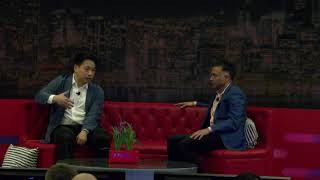
Marcus Ryu built Guidewire from 2001 startup to $6 billion by targeting the unglamorous property-and-casualty insurance market. He paired software engineers with insurance experts, spent years on credibility, lost the first customer, fought a decade-long patent lawsuit with Accenture, and grew to $500M+ revenue. Ryu argues similar deep vertical opportunities exist for patient investors willing to skip the glamorous spaces.
Chapters
[FOREIGN] Well, thank you, David. It's great to be here. It's great to be with Marcus. I've had the pleasure of getting to know Marcus over the last couple of years through another great founder, Raj Dada, who's the founder and CEO of BloomReach. Marcus has imbued our board meetings with quite a bit of wisdom from his incredible journey with Guidewire. I was joking with David ahead of time that Guidewire is probably the largest SaaS company that most people at this conference have never heard of. And, you know, but I thought I'd share a few statistics about the wonderful business that Marcus and his team have built. You know, the company was founded in 2001. Today they have north of $500 million of revenue, projecting $600 in the coming year, 20% profit margins, nearly $100 million of free cash flow. They've had 27 straight quarters of meeting or beating their expectations. And for all of this, Wall Street, certainly as of Monday morning, was rewarding the company with a $6 billion market cap a revenue multiple north of 11 times, and this is despite having a third of the revenue be services revenue. So really just a remarkable business and a remarkable journey. But I thought for today's session, what would be most interesting is really starting at the beginning, the early days. Most of the founders in the room here and at this conference are in the early days of their startup, and that's where I thought we'd focus. Today's session. So Marcus, take us back, 2001, you were young, had worked a little bit at McKinsey, had spent a couple years at Ariba. You and your co-founders were looking to start a company. Why property and casualty insurance? How'd you decide on probably the most unglamorous space in the universe? Tell us about how Guidewire got started.
Sure, so if we could reach our minds back to that era, It seems like a long time ago. It's been a long journey for me. This is year 17 for me. Like many entrepreneurs, I'm sure like many in the room, we wanted to be entrepreneurs first and specific businessmen serving a particular need second. And like everyone of our age and every entrepreneur, I think you're conditioned by your experiences. And so for us, we had just passed through this incredibly— like —some could call it dynamic, some would say call it chaotic era, in which money seemed free and everyone was going to be a billionaire, and there was a lot of chaotic and frenetic energy. And of course, that all came to a very abrupt end, punctuated by the worst terrorist attack in the country's history. And so the era, the times were very somber, and I think while it was a counterintuitive time to try to start any kind of company, we saw that as, as we say, a feature, not a bug. That the fact that it was going to be difficult, the fact that, you know, that we were now entering a kind of nuclear winter in venture funding, the fact that there were a lot of, you know, people in the tech world kind of dazed and confused and wondering what happens now, all of those were actually attractive attributes to us because we wanted to create first a company that solved a really difficult problem and also to create a kind of culture that would be focused on the long term. And so in the way that kind of teenage rebels do, we said, let us be the opposite of everything that we've seen before, that has come before us. And so we kind of took as a blueprint all of the things that were conventional wisdom in, you know, at the peak of 2000 or 2001, and said, let us just do the opposite. So instead of trying to invent a new market space, let's try to solve a well-established problem. Instead of trying to do something really glamorous, let's try to find the least glamorous thing that we can do. Instead of fetishizing the cult of a CEO that'll lead everyone to the promised land, let's be a community of radically collegial equals that will solve problems together rationally. We had all these very high-minded principles, and then we said, well, there's a fine line between 6 guys who are going to change the world in writing a constitution and 6 dudes with a PowerPoint presentation who are unemployed. And so we had to find a problem to solve, and we said, well, the core thesis was, Look, it's very difficult to come up with another horizontal enterprise software category, but the big dark matter in the world, and I still think this is true today, incidentally, are on very industry-specific, mission-critical problems that are difficult for the largest software players, you know, the Microsofts, SAP, et cetera, to address because they don't have the domain expertise, they don't have the patience, and the market size on the surface may not be obviously appealing. and so let's find something that's unglamorous, let's find something that's substantial and vertically specific, and let's find an area where really quality software engineering can create definitive economic value. And that led us more or less like a beeline straight to property and casualty insurance.
And were there other verticals you looked at? Was there sort of— did you go through some exercise where you said, okay, put them all on a spreadsheet and let's evaluate 10 different verticals?
We considered a few briefly. Actually, as a brief digression, I'll tell you that we also considered and discarded a couple of ideas. One was what was now Dropbox, another was which is now LinkedIn, and then a third which looks remarkably like Salesforce. So we don't get any credit for that, but all of those we discarded as there's no way you could build a business out of them. Those are too simplistic. We have to do something much harder. We're gonna build property and casualty core transactional systems. That's obviously going to be a much better business than Salesforce. And so that's what we set out to do. The thing that was particularly appealing about P&C was that, and I'll just have to sketch a little bit of the industry for you. You have, it's about a $2 trillion industry in terms of total revenues, and they pay out about 60 or 70% of that every year in claims. That's what they do. They intermediate risk and then they, they pay out to claimants. And there's an asymmetry between the fact that the average claims worker is paid, you know, maybe $40,000 a year, but is writing out checks for $2 or $3 million a year and doing it in 1980s COBOL mainframe systems and buried in paper with all kinds of manual processes, et cetera. And our thesis was that these individuals, as hardworking as they may be, were making systematic errors that were causing deadweight economic loss. —so it's not just that better software would make their lives more ergonomic and productive, that they would actually prevent errors that were deadweight loss to their owning companies, and that there would be a very compelling economic value proposition there. And that piece has more or less come out.
Let me interrupt you there. So going back to 2001, were you or your co-founders domain experts in insurance? And if not, how did you go about building that knowledge, coming up with those insights?
Right. No, we were— by DNA, we were much more enterprise software guys. None of us were insurance people as such. The closest we could claim to that was my own brief tenure in the insurance practice at McKinsey, which allowed me to spell property and casualty correctly, but that was about it. So we had a lot of education to do, and we recognized that one of the first things we needed to do was to marry two very disparate skill sets: people who understood how to build mission-critical software with people who actually understood the P&C domain. And on top of that, we then had to layer people who understood how to deliver large-scale enterprise transformation projects. And over the last few years, we've had to add people who understood data science as well. And those are quite different strands of DNA. And the cultural challenge has been, well, first, how do you recruit those individuals and how do you unify them in pursuit of a common goal and make them feel like they're part of one organization?
Makes sense. And I want to come back to culture in a second, but I think when most of us think about property and casualty insurance, and particularly going back 16, 17 years, it must have been daunting to think about trying to sell a mission-critical system. This isn't like build a piece of software in 2 weeks, put it up on the web, have some people download it, and start showing a chart with customers and revenue up and to the right. Like, how did you go about this? I mean, I think it was years, right, before you got a product and customers and— Yes. —talk more about that, that process.
So, yeah, it would be hard to find a company that was more antithetical to the conventional venture capital wisdom about what a company should look like. There was no possibility of experimentation. There was no viral adoption. There was a profound asymmetry between the negotiating ability on the part of 6 dudes with a PowerPoint presentation and a vision for a product and a multibillion-dollar enterprise. So everything was wrong in that equation. What was right, however, was that we actually addressed exactly the market need at that moment. And, you know, there was one bit of wisdom that maybe I'll impart to you just because it's— I get no credit for it, but it's something that I've thought about many years, over the years, was an entrepreneur advisor of ours early on said, look, you're going to start a company. It's actually not what I would advise you to do because risk adjusted, it's a poor way to spend your career. But if you're gonna do it, recognize this, that in the start you will have no assets. You will have no product, you will have no brand, you will have no employees, you will have no market credibility, you will have nothing. But you will have— except for one thing. You're going to have one thing that is more precious potentially than all of that, and that is that you have the potential to hit the head pin of demand exactly at the right angle. You can exactly know what the market wants, and if you get that right, that can solve for all the other problems. It's obvious, but I think a profound insight that I've reflected on a lot. So we had that right, but the go-to-market was incredibly arduous for us. It was uphill both directions in the snow. There was a lot of that, but the hardest part was that it was not enough merely to persuade our interlocutors, our prospects, with the fact that we had the right ideas and that we were smart and capable and determined. We had to persuade them that the company was going to survive and we— that it was a sensible career risk for them to take. And as it turns out, it was not rational for any of our early customers to buy from us. And we being rational guys, or at least fancying ourselves to be that, knew that. So it was very, very hard. And so what we had to do in the early days was find— just to keep ourselves from despair, was to find other ways to measure sales progress other than a sale. And one of the ways, you know, so we kept score for how many conversations have we had, how many people have we known, how large is our tree of network, our network of potential influencers and well-wishers, how large has that gotten, and tried other ways to instrument and feel good about the progress that we were making. And I was not the CEO in the beginning of the company. One of my co-founding partners was, and he had one very, very special quality, which was a kind of insane doggedness about these conversations. And he— I'll tell you another little story, a thing that he used to say. He said this actually the very first day we were together as a founding group. He says, I'm not the smartest of you guys. I'm not the— I'm definitely not the most insightful, but I am sure to be the hardest worker. No one here was going to outwork me. And when I was in college— I'm speaking for him now— when I was in college, there was a guy who managed somehow to date every beautiful woman who went to our school. And he was very ordinary looking and very average in every sense. And when I asked him what his secret was, he said, "I'm just the guy that asks the most. I'm going to be the guy that asks the most. And I have no problem being rejected." And he says, "I'm going to be that guy and we're going to be that company. We're going to be the company that asks the most." And so that's what we were. We asked every person we knew. Now, the P&C insurance industry employs like 2 million people, so there are a lot of people to ask. And most of them said no, but, you know, tiny probabilities multiplied over a large enough n is enough to generate that first customer and then maybe the second and so forth.
It's great. And, and so back then, as you thought about going uphill both ways in the snow, how did you think about funding the company, because venture capitalists are accustomed to— they want to back momentum, they want to see repeatability, they want to see all those things. And here you are, great vision, but years before the first proof points. And so how did you get through that?
How did you get through that period? I think objectively, one would question if we were a fundable company, because our minimally sellable product was took 2 or 3 years to build. The minimal functional footprint to even be credible for what we were promising was so large that it took years to build. And there was no way to buy 10% of it. There was no way to sample it. You just had to make a big transformation decision as a company and commit real capital, right? So I think the way that we solved that problem was finding investors to whom I will be eternally grateful because without them I wouldn't be before you today. But who may not have understood how hard it was going to be. And they— we were able, again, to use other metrics other than— and other evidences, other bits of evidence of our market traction besides actually having a customer that persuaded them that maybe we were on to something. But they, I think, did not fully appreciate just how daunting a sales challenge we had before us. And so we had some tense discussions over the years saying, like, is this going Is this going to go anywhere? And we had to remind them. I said, look, one thing that we were very truthful with you from the very beginning was that we're going to be— there are some businesses that no one has ever thought of that you thought, imagined in the shower and become explosive and everyone says, why didn't I think of that? There are other businesses that people don't imagine that have enormous economic value to them, but they're standing behind a huge barrier to entry. And there's nothing particularly technologically innovative of what we're doing, but we're going to climb this huge barrier to entry and get to the other side. And the reason that you don't see other companies doing this is because that barrier is so high. And if you believe in competitive markets, there's no such thing as a fantastic market with no competitors. So the reason that this market is not populated with others is that this barrier to entry is so damn high, and we're going to be climbing it for a long while. And, you know, we're 10% up the mountain. So some version of that message was what we used and that's also how we comforted ourselves when it felt like we had no shot.
Must have made for some interesting board meetings back then.
Yes, yes. They were difficult. But we had to put forward all these other indicators of success. That's right. And I think the key to getting through that both with our investors and for ourselves was that we were a team. Yeah. So we were a team of 6 founders. I had 5 co-founders, which is a pretty large group. The company would have failed without any one of us. I'm quite certain of that. And essentially we signed a blood pact at the start of the company, which is, look, we may fail at this, but one thing we will not do is second-guess our commitment to it for at least this duration of time. And we're just going to just absolutely trust each other and commit to pushing as hard as we can for this duration. And we'll— and then we're going to be rational to see if we've achieved enough progress to make it sense to re-up again. And it was that kind of commitment that kept me many times from saying this is an insane thing to do. And I know kept my partners at different moments from thinking the same.
That's great. That's great. So Marcus, as you shared in some of our board conversations, there are a lot of ups and downs through this journey. I mean, I think most startup journeys are not straight up into the right. And whether you call it the valley of death or the valley of despair, you guys had your fair share of those. Maybe share some of those stories because I think every founder here is at some point either now or in the future or in the past has lived through it. Describe one or two stories, how did you get through it?
Sure. I'll tell you a covering story first, which is something that another one of my co-founding partners who was the CTO, he told us, he told this story internally early on about this Chinese parable, which you can look up on Google. It's about a farmer and his son that— it's a farmer and his son, they were very poor, and they had a horse. That was their only asset. One day the horse runs away and the neighbors say, "Well, that's a calamity for you." And the farmer says, "Well, maybe yes, maybe no, we'll see." And then the horse returns, but it's brought with it a herd of wild horses. And so now they said, "Wow, you're rich," the neighbors say. "You should be very happy." And the farmer says, "Well, maybe yes, maybe no, we'll see." And then the The son is trying to train one of the wild horses and falls off and breaks his leg. And the neighbors say, of course, "Ah, this is a calamity for you." And he says, "Well, maybe yes, maybe no, we'll see." And then there's a war, and it kills all the young men in the village, but not the son because he didn't go to war, he had a broken leg. And the farmers say— the neighbors say, "Wow, how fortunate for you." And he says, "Maybe yes, maybe no, we'll see." And that story, right? And the incredible thing is my partner told us this story, in the early days and said, this is how we're gonna get through some difficulties. And then, almost like a movie, we had episodes of incredible good fortune and incredible disaster, each of which turned out in hindsight to have been the opposite of what it seemed. And so I'll give you a few examples. You know, we lost our first customer, um, very early on. They canceled the project. Uh, and it turns out that, um, we would have built the wrong product because they were— it was led by a very, very aggressive guy who wanted something other than what really the product ought to have been. And long story short, it would have— it really would have thrashed the product in a direction that would have hurt us, compromised us with our early customers. We had a very tense relationship with our investors for a spell, and they wanted to impose a CEO on the company, which we thought that was a bad idea, but there was a moment where we relented. CEO was imposed on the company for about 9 months. It was a disaster, but which we thought was— we nearly ran out of cash. But it turns out that that then sort of transformed our relationship with our investors where they were a bit humbled by that, whereas if that had happened, you know, another 3 or 4 years later, it would have been much more damaging. And then there was an episode where we were sued about 9 years in by our primary competitor, it was Accenture, on essentially a couple of business method patents. And we were actually nearly put out of business because our customers, insurance companies, said, Well, it's not about the merits of the case, it's just you have a litigant here who has the determination to prevail and you could be out of business before this is resolved, so we just can't buy your software. We can't spend $50 million on a transformation project and be enjoined from using the software. So for a year our sales were paralyzed and I had discussions with my wife and I know my partners had with theirs saying maybe we threw away our career, there will be nothing to show after a decade. As it turns out, how did that turn out to be such a good thing? Well, it distilled the energies of the company into this white-hot rage in those days where we said maybe our— and this is one of my proud moments in the company where I said, you know, we thought that we were starting a company that was going to achieve all this and maybe make us wealthy, et cetera. Well, maybe our destiny was to create a company and just to stand up to this bully. That's like— that's all— that's our existence. That's our purpose. And I'm here for that. I mean, who's here with me? Because I sure as hell am not going to capitulate now, and we're not going to let this win. And from now henceforth, we're not going to call them Accenture, we're going to call them the enemy. And to this day, there are people in the company who will say, you know, so what does the enemy think about this? Or I just saw this press release by the enemy. And we are going to fight. And as it turns out, it also delayed our IPO by a few years, which was an incredible blessing because we were that much more prepared. At the time. And the people who were with us through that moment were bound to the company and its mission and its identity with such emotion that we're a much more resilient company for it. And I wouldn't trade that for the world. So I'm not one to say, look, everything happens for a reason. I think only feeble-minded people believe that. There's a lot of random things happen to good people, to bad people. I just would suggest to you that sometimes the real significance of an event, positive or negative, is not obvious at the moment that it happens. And that it's important as an organization to have the equanimity to cope with both the highs and the lows. And now that I've observed a few companies, especially ones that have had a lot of breakout success in the early days, sometimes I caution them that maybe the success is the worst thing that could have happened for it to have come to you this fast because it's It's going to send a wrong signal, set the wrong expectations, attract the wrong people. Not that you can always control these things, but that's been my experience at least.
That's great, great story. Hard to imagine a bunch of insurance software engineers in a white-hot rage, but clearly it happened, it worked. Yes. So, you know, back in 2001 when you decided to pursue P&C insurance, you know, if you read the analyst reports currently on Guidewire, they're projecting your business will be $1 billion in revenue over the next several years. Did you know it was gonna be this big, that the opportunity at that moment in time was this massive to build one of the largest vertical SaaS companies in the history of software?
Yeah, I think if, well, that's more grandiose characterization than I would use, but I think we can be the best at what we do in our space, and one thing we did validate in the very earliest days was that the basic arithmetic on how much economic value we could create and therefore how much we could reasonably ask for and therefore how large a company we could build around that, that that all kind of penciled out in a sensible way. So if you have a $2 trillion industry and you persuade the industry to— you build a solution of adequate value that you can charge some number of basis points on that, as it turns out it's around 30 or 40 basis points on that premium, then, you know, that's a multibillion-dollar opportunity. And then the question is how much of it is it realistic to hope to capture yourself? And again, I return to this this barrier to entry theory that we had, that it's gonna be incredibly hard to get over this summit, but if we actually get there, we're going to find a lot of market without terribly competent competition. And, you know, without declaring victory, which I would never do, that has sort of played out, right? And that there is actually a lot. And another phenomenon, of course, is that this was— this tied to our original belief that if you're solving a mission-critical enough problem, right, and in our case, we are the transactional system of record that defines what it is that an insurance company is, namely, you know, holds legal contracts that indemnify people against risk and the like. If you have that, then almost everything else you do as an insurance company that's not horizontal or, you know, G&A in nature ties to that system in some way. And so that you become the natural consolidator and partner of choice for even other partners who want to add value into that process. and that's a position of great advantage to have. Now you have to earn it, we're still earning it, we're still early days, believe it or not, but that was an attractive attribute. I said one thing that we would never want it to be was just a feature, right? We wanted to either go for something at the heart of it, however hard it would be, however long it would take, and then be in a position to, you know, to be that strategic counselor to our customers, and I'm grateful for that chance.
That's great. And were you ever, you know, daunted at all at the time by history. And I'll share a story. When I was at Trilogy Software back in the mid-'90s, we had decided a key vertical for us would be insurance. And one of our venture capitalists said, pounded his fist on the boardroom table and said, in the history of venture capital, there's never been a successful insurance software company. And that was always the view on insurance, that this was not a great category, not a great market. Did that weigh on you at all, or you saw that as the real opportunity?
Well, you know, to our mindset at the time, you know, we embraced every— the more negative people were on it at the time, we said, well, those are— these are all features. This is just fantastic, the fact that it's so difficult and unglamorous. I think we had a sensible thesis, and I think we had an argument for why there was such profound dissatisfaction with the technology incumbents that we were competing with. We said we can definitely build better software than this. and we could also saw the way that they had become all kind of custom development organizations instead of building a true product. We said by maintaining greater product integrity, we can prevail maybe where these organizations haven't. But it's true, there's a graveyard of dead software companies, none of whom you would likely have heard of, that serve the insur— that tried to serve the insurance industry. In most cases, they either ran out of capital or they did not capture enough market to be interesting companies in the long run. The final thing I'll say is that, you know, in that era perhaps when that table pounding was happening, the idea of building a vertical software company was definitely counterintuitive, right? It wasn't a big enough market, it was hard to sell to, whatever it might be. I think, I would like to think that Guidewire along with a few other super examples like Veeva, who's a more successful company than Guidewire, have proven that if you solve a deep enough problem, that's, and those deep, those very deep problems tend to be industry specific, and you do it in a sufficiently general fashion to capture enough, enough market space, you actually can create an interesting and independent software company. Um, and so I'm, I'm very gratified that we were able to prove that in our own little world.
That's great. So let's move to, to current day. So, you know, really a two-part question, which is number one, do you think Guidewire-like opportunities exist today? You know, 20 years into the cloud movement, you know, and, and, and, and SaaS and so forth. And then the second question is, do you think you can pull it off today? Investors are more short-term minded. People want to see quicker success. We live in a recurring revenue model. Early days of Guidewire, my guess is you got to take advantage of upfront licenses and help fund the business, so you're very capital efficient. How do you think about trying to do Guidewire in today's environment? Advice for entrepreneurs that are going after these kinds of opportunities. Opportunities?
[Speaker:JASON M. LEMKIN] Right, well, with my n of 1, I offer the following observations, which is, first, there's no question that there are very deep, vertically specific market opportunities out there. I think by their nature, they're not ideas that you can think up in the shower. I think they're ones that require really getting into the traffic and understanding and talking to people in the industry. We did that in our case after founding the company, but the first year and a half of the company was without salary, was really without customers, where the job of half of us as founders was just to talk to as many people in the industry as possible so that we could speak the language and have an acute understanding of the problem we were trying to solve. And these things, a lot of it's very unglamorous and technical and specific, but that's, it takes that kind of legwork, I think, to know what that opportunity is. And again, they tend to be things very specific to the industry that even supposedly verticalized companies like SAP and Oracle are really only at the most superficial level of understanding of, right? So emphatically yes, there are major opportunities of that type, I believe. Now as for getting it funded and getting it underway, extremely difficult. But I think if you find an investor that requires and is expecting some kind of explosive social networking kind of growth, it's just not, just not there, right? But I think it is a radically easier time to be an entrepreneur in that you have so many more thoughtful investors that are willing to bet on more complex kinds and more intricate kinds of theses for where the value will be created as opposed to those saying, well, if you don't look like Siebel or Oracle, it's probably not an interesting software company, right? And I think it may take a little more time to find that investor that aligns with it, but I think you have many more choices than ever before. But it does take patience, and if I have one criticism of the current entrepreneurial environment that I witness, It's the lack of patience on the part of employees, on the part of entrepreneurs and investors. I don't want to be the old curmudgeon who just says things are much harder than you whippersnappers understand, but my observation is that things are always harder than they seem, and the attitude that it has to be explosive and financially explosive right up from the start I think is just a very dangerous expectation to go with. To go in with, and it won't allow you to solve a certain category of very interesting problems. Makes sense.
Makes sense. Let me ask you one last question here, which is Silicon Valley. A lot of entrepreneurs here are outside of Silicon Valley. Many are from Silicon Valley. Any final parting thoughts on the good and the bad of the Valley, and particularly in today's era?
Well, we're a Silicon Valley company and proud of it, but we are kind of aggressively diversifying away from it. And it turns out We had this ethos that, well, look, we're in Silicon Valley, the smartest people here who know how to build software. Very smart people here. There are smart people elsewhere in the world too. And we have a fantastic team in Poland, one in Dublin, one in Exton, Pennsylvania, one in Toronto. And I think there is a kind of dangerous ivory tower, inward-gazing, self-regarding kind of ethos that is also dangerous, I think, in the Valley. I don't— I would say now I don't find any overwhelmingly compelling reason why the best software companies must come from within these few square miles. I think there are plenty of other places that can happen.
Great stuff. Well, Markus, thank you so much. Congrats on the amazing company you built.
More from Jason

Why Your Next Hire Should Report to an AI, Tragedy Apps, and Too Many AI SDRs? | The Agents #004

Our Agents Drove Our Salesforce Bill Up 80%, Marketo Hates Agents, and We Stealth-Churned Off Notion




Managing 20+ AI Agents: Lazy Agents, Our $500K AI Bill, Stealth Churn & the Death of 60% Solutions




