How Evolving to Consumption-Based Pricing has Accelerated Companies with BCG
BCG consultants Courtney Dong and Matt Krop explain why B2B SaaS companies are switching to consumption-based pricing and how it can unlock 20-25% ARR growth. They cover the shift from subscription models, the mechanics of tiered pricing and volume discounts, and seven principles for building a consumption model that balances customer predictability with revenue alignment.
Chapters
Great. Thanks all for taking the time to join. We're from BCG, a strategy consulting firm that works not just with the biggest companies in the world, but also with companies that many of you in the audience here represent. The disruptors, the innovators, through our Growth Tech Initiative. My name is Courtney Dong, and I am an expert in growth tech at BCG. I'm joined here with my colleague, Matt Krop.
Hello, everybody. My name is Matt Krop. I'm a managing director and partner in San Francisco in our pricing practice. We have a very strong practice that focuses on B2B and technology, and, and in particular, we do a lot of work in SaaS pricing model design. So happy to be here with you today.
Great. Yep, as Matt mentioned, we consult with growth techs on a variety of different topics, from helping them figure out how to scale their organization and operating model helping them expand to new adjacencies and markets, and most relevant for today, helping them think through how to maintain and boost top-line revenue growth through pricing and packaging. As many of you may be aware, over the last few decades, there's been a shift in how B2B software companies have been measured and evaluated. Historically, the Rule of 40 was how software companies were evaluated to understand what the burn was associated with growth. That number was calculated as ARR growth plus profit margin, and the target you wanted to achieve was to have that number hit above 40. Now there's been an increasing emphasis on ARR growth— or sorry, net dollar retention for growth techs, which is really a measure of how companies are able to retain and expand ARR per customer. So net dollar retention has now been a big focus. And that number is calculated as beginning of period revenue, plus upgrades, minus downgrades, minus churn, divided by beginning of period revenue. And best-in-class companies, typically, we like to see them hit about 120%. Related to this, there's, there's really when we think about revenue expansion, there's really 4 levers that we think about in terms of how to increase ARR. One, first and foremost, is price increase. Then there's volume expansion, product cross-sell expansion, as well as upsells. I'm going to hand things over to Matt, who's going to talk about some of the levers around price increase and how pricing metrics have changed over the last few decades. Matt, you want to take us away?
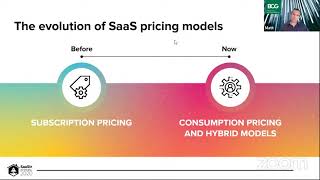
Thanks, Courtney. So we're talking today about how to improve your pricing strategy and to leverage pricing and packaging and some of the changes that are happening in the pricing world. And we will have some, some time at the end of this for questions, so please add your questions to the chat. We'll come back to that. So we do a lot of work in pricing strategy, and we see pricing and packaging as a major revenue lever. As we work with companies in the SaaS space, where we're undergoing a change in pricing model, we can see typical changes of 20 to 25% increase in ARR growth just out of driving a different pricing model. So that's, you know, quite a powerful lever that companies pursue. And then companies that are in the growth phase, so Series B, Series C, maybe some of you are in that space, often find themselves at an inflection point. So very often these companies are still operating on the pricing model that they found, you know, at the beginning, so that's worked since they found product-market fit. And they're growing, they're growing, you know, aggressively. They have really good uptake in the market, but that they're on that growth path to $1 billion and the pricing model becomes a drag. And so really thinking about how you get that model right is important to accelerate ARR. I would certainly encourage all of you on this call who are in the SaaS space, don't wait too long to rethink and reinvent your pricing model as you go. So we're going to talk today about consumption in particular, but the pricing in the software business has changed quite a lot. We've gone from on-prem perpetual plus support license model to subscription being really the key model for the past number of years, but we're now seeing more and more consumption as a key pricing model. We did a recent survey of 100 IT buyers and looked at their preferences and their expectations about how they were going to buy software. Going forward. And subscription is still dominant as the pricing model. So this is a monthly or an annual fee per user or per instance, can be per capacity. But that preference from IT buyers is shifting. And so there's really a strong growth in starting to look at consumption pricing as something that they want and something that they expect. So we'll talk about that in a bit here. I should say first, you know, subscription's not dead. So when you think about designing your pricing model, the most fundamental tenet that we think about is that you want your price and your pricing strategy and your pricing model or pricing architecture to allow the price to scale with how the customer perceives the value that they receive to scale. Meaning, you know, as the customer uses your product more, as they generate more value for their business or for them personally, they can see that your price goes up in line with the value that they're getting. There's a fundamental component of pricing is that it needs to be perceived as fair. And so, you know, you shouldn't be taking more than, than your fair share of the value. So there are a lot of places where a per user per month or per user per year subscription pricing scheme aligns very nicely with the value customer receives. You know, think about your personal Netflix subscription. You know, we enjoy the ability to watch as many shows as we want without thinking about the price of each one. It's— that's a— that's an inherent value of Netflix is that I can, you know, I can consume all I want. My wife leaves Netflix running, you basically 24/7. So we like the fact that we can just pay per month. But there are more and more places where a subscription is no longer a good way to line up price with value. So if your product is one where automation or AI or RPA is really starting to grow, that's a, that's a worry, you know, if, if you're in particular, if your product actually makes your customer more efficient so that their user— they need fewer users because your, your software enables their users to be more powerful. If you price per user, that's just a recipe for, for declining revenue. Indirect access is really growing. So think about APIs in particular, where the user access actually bypasses the UI. So just as software is eating the world, as Andreessen said, APIs are becoming the new software. APIs are really eating the world. So more and more products, and many of you probably are there, are exposing significant functionality via their API. And if your customer can replicate what your UI does by building on top of your API, charging per user is definitely not going to be capturing the value that they're receiving. So really, you know, think carefully as you roll out APIs, how the customer gets value through that API and how that may cannibalize your per user pricing. But also, you know, how can you really leverage that, that growth and use of APIs to, to drive, you know, generate more revenue for yourself. Some products really need flexibility to support growth or to support seasonality. So if you have a subscription that's an annual subscription or a per-month subscription, and your customers have really spiky usage profiles, that can be a problem. So think about like a payment solution or logistics services near the end of the year. When e-commerce spikes, you may have a real big increase in usage. And if your pricing model is sort of flat, you're either too expensive the rest of the year, or you're not capturing the upside during the time that the usage is spiking. And then the whole shift of all of our workloads to the cloud, to the public cloud, has really changed customer demand and a need to align with consumption patterns. So you think about the cloud vendors, AWS, Azure, GCP, are pushing everything to be elastic. In fact, everything to move to serverless, elastic compute, where it is entirely consumption-based. If your product layers on top of those services, your customers are going to expect that your licensing or your pricing is also flexing. Up and down with the use of that elastic compute. So the AWS and the other hyperscalers are really the ones who are driving the growth of consumption models. And they're really pushing all of their services as fast as possible toward consumption. And so then many others are following them. So think Databricks, Snowflake, Fivetran. Et cetera. And as many of you may have applications that are based on top of Elastic Compute, your costs are also flexing with it. So companies are needing to find a way that they can have their pricing scale with the costs that are underlying. So consumption pricing has a lot of benefits. It aligns with value captured, as I was saying. CEOs often see it as a way to really reinforce commitment to driving customer value. So, you know, in a sense, you only get paid if the customer uses your product, and only when they use it. And so it really forces an organization to optimize around driving customer usage. So think, you know, getting really good at customer success, thinking, you know, really good at, you know, expansion, driving expansion, and really helping customers get the most out of your products so that they consume more, so that they pay more. And then using a consumption pricing model is really effective for building a land and expand path, you know, because customers can start to use the service often with no upfront cost. In a lot of cases, again, think your AWS account, you may get a bunch of initial trial credits. So it's not only free, you sort of are paid a certain amount to start using it. That no commitment and free or low-cost entry point makes it very easy for new customers to come in and just start using the product. And then if they find it useful, they start to adopt and consumption ramps up. And as you see with your AWS service, You know, it can get quite expensive as they start running more and more, consuming more and more. So it's a very powerful way to have a low entry price point and then have that price scale to be very large. So, but there are a couple things you have to think about when designing a consumption pricing model. Probably foremost is consumption pricing is very unpredictable, or can be very unpredictable for the customer. So it can be difficult for them to budget when they don't know what their usage is going to be. We certainly heard new stories in the news about companies being hit with unexpected AWS bills this last year as COVID really ramped up usage. So you want to be thinking about, A, how do you make sure that when you're selling to your customer, you can communicate what they're going to expect in terms of cost? But then also think carefully about how you handle unexpected increases in usage and therefore unexpected bills to your customer. One approach is rather than to say, I'm just charging you per actual consumption, to set up tiers of consumption or t-shirt sizes, small, medium, large, extra large, where the customer's prepaying for a certain amount of usage. That then allows you to have different ways to treat overage. So on the most accommodating, some companies will allow customers to overrun their prepaid amount by a certain sort of, quote, fair use amount so that they have some flexibility. On the most aggressive side, you can come in and say, you know, there's an overage charge where actually it's a higher rate per unit than the rate per unit that they're buying in terms of the overall capacity. And then there can be mixes in between. Another example is, you know, you sell them a certain amount, if they overrun it, you ask them to re-up, or you use it as an opportunity for your sales team to go out and upsell them to the next tier of consumption. The other big design choice that's important for building a consumption model is understanding how your price scales with volume. So customers typically expect, as they buy more and more, to get some kind of a discount, so a volume discount as they buy more. It's really critical if you have a service that has big differences in customer usage. So there are a lot of cases, you know, think like ETL kinds of plays, like a Fivetran, where one customer might have a billion times more consumption than another. In that case, you can't just scale your price linearly. If you did, your smallest customer would either pay very, very little or you'd be priced out of the market on the high end. So you end up having to have a discount curve that as they buy more, they're paying less per unit. Typically, we, we want to implement a logarithmic discount curve, which basically provides a discount usually in the range of 15 to 20% for every 10x increase in usage. And that, that typically gets you to something that, that matches with what customers expect. So if you're thinking about designing a consumption model, I want to leave you with 7 key elements you should be designing for. And they're here on the slide. First, is it measurable and transparent? Is it easy to track? Second, is it aligned with sales or with your channel? And are they— do they have a way to actually sell it? Third, as I've talked a bit about, does it scale with value and really scale with the way that the customer perceives value to scale? And does it differentiate willingness to pay? So do you have those big customers and small customers paying different very different amounts. Do customers see it as fair? Very important. Is it predictable and simple? So can customers plan for it, budget for it? So do you have some way of accommodating that, you know, view of what, what the consumption is going to be? Is it aligned with your cost to serve? So, you know, you make sure that you don't have customers that consume huge amounts and really rack up costs for you where the price isn't scaling. And then is it aligned with competition? So do customers see how your pricing as being somehow consistent with your competitors? So let me leave it there. We have a few minutes for questions, but hopefully that's been a bit helpful as to how to think about consumption pricing.
That's great. Thanks, Matt. There's a lot of good questions coming in here from the audience, and feel free to add more questions. As topics come to mind, there is one question here around it. Can the per-unit price be higher in consumption-based pricing versus subscription pricing? In other words, could your net ARR be higher?
So absolutely. And, and sorry, since we're going to run out of time, my email address is up on the screen, and I'm happy to take questions. Always love to hear from people about their problems in SaaS pricing. So please go ahead and send those questions to me and I'll respond. But yes, you You can actually drive up the per-unit price in consumption. You think about it, the consumption pricing is actually a very flexible pricing scheme. And so customers do value that flexibility and you can then claim that as value to yourself by pricing higher. A perfect example here is AWS is actually quite expensive. If you compared it to spinning up a server and putting open-source software on it and running it on your own internet connection, much more expensive to buy from AWS, but what they give you is an incredible amount of flexibility. So you have to find that element of your solution that really benefits from that flexibility and use that as a way to claim more value. Maybe probably one more question.
Yeah, there's a theme here around how do you get comfortable either as an investor or a CEO around switching to consumption-based pricing, you know, are you gonna get lower multiples? Like—
Great question. And I'll answer it very quickly because we're out of time. Switching to consumption can really drive scaling and growth. And so it's fantastic to drive valuation, but you do have this sort of trough you have to go through because, you know, you're in a subscription model, you're getting paid upfront. And in consumption, often you're monetizing on the backend. What's critical is to communicate to your investors how you're going to make that change and model out what's going to happen to your revenue line. But what we've seen, even with public companies, when they communicate very clearly the benefit and the fact that they're going to be able to scale ARR faster in the consumption model, investors are quite willing to accept that sort of trough in revenue for that payoff of growth.
More from Jason

Why Your Next Hire Should Report to an AI, Tragedy Apps, and Too Many AI SDRs? | The Agents #004

Our Agents Drove Our Salesforce Bill Up 80%, Marketo Hates Agents, and We Stealth-Churned Off Notion




Managing 20+ AI Agents: Lazy Agents, Our $500K AI Bill, Stealth Churn & the Death of 60% Solutions




