How Product Leaders are Building the Future of Enterprise Software with Atlassian, Slack & Miro CPOs
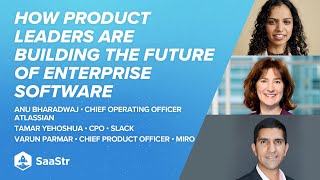
In this 2021 panel hosted by Harry Stebbings of The 20 Minute VC, the Chief Product Officers of Slack (Tamar Yehoshua), Atlassian (Anu Bharadwaj, COO), and Miro (Varun Parmar) discuss how the post‑pandemic shift to remote and hybrid work is reshaping enterprise software. They share data from internal surveys (e.g., 93% of knowledge workers want flexibility in when they work, 76% in where), and describe how their product roadmaps have been reprioritized: Slack launched audio‑first Huddles and video recordings; Atlassian is embedding a writing‑first culture in Confluence; Miro is focusing on higher‑quality, playful product experiences. The conversation then moves to the rise of the builder/creator economy—low‑code/no‑code tools that let employees automate workflows—and the resulting governance, security, and admin‑control challenges for large enterprises. Both panelists stress the need for visibility, audit logs, and SaaS‑management tools, and highlight marketplaces (Atlassian Marketplace) as a way to certify and distribute creator‑built apps safely. They contrast product‑led growth (PLG) with traditional sales, explaining how PLG demands larger product‑marketing teams, tighter product‑analytics loops, and a shift in sales roles from hunters to farmers. Varun outlines Miro’s “AMP” (Analytics, Marketing, Product, Engineering, Design) model and how granular product analytics feed roadmap decisions. Throughout, the panelists balance optimism about empowerment and bottom‑up adoption with caution about chaos, security, and enterprise governance.
Chapters
Alrighty, let's start this. I think we're good to go, so stop it, let's start. I'm so excited for this panel. What an incredible group of people we have. So I'm Harry Stebbings. I'm the founder of the 20 Minute VC, which is one of the largest media assets in venture. We get about 20 million downloads a month across our different media properties, but you're not here to listen to me. And so I wanna introduce our panelists today. We have first, Tamar. Tamar is the Chief Product Officer at Slack. We're also joined by Anu.
Anu is the new COO at Atlassian.
And then we are joined by Varun, Chief Product Officer at Miro. And then we will be discussing these fantastic topics, which we will probably stray off topic on because that's the way that the best discussions take place. But there is a great form of guidance for our discussion today. Now, I do want to start— I always love a little bit of context. And I think it's really helpful, especially in this conversation, if we just do a minute or so each on each of us and how we came to our prospective roles today. Why don't we start, Tamar, with you, then Anu, and then Varun. And then we can dive into the discussion. So, Tamar, over to you.
It's so great to see you again, Harry, and thanks for, for having me here. So I am, as Harry said, the Chief Product Officer at Slack. I joined in January 2019, the week of the filing of the S-1, and has seen Slack through the IPO and now the acquisition. And I can say that now I am an employee of Salesforce, and we had our first Dreamforce with Slack. And prior to that, I was at Google, and previous to that at Amazon, and several different startups. Been around the Valley for longer than I'd like to say. But it's been an exciting ride and great to be here.
Anu, over to you.
Awesome. Thank you so much for having me here, Fabian. It's wonderful to be on this panel. My name is Anu. I'm the COO of Atlassian. I run our enterprise and cloud platform businesses. And the operations part of my role is that I also run our Corp Dev strategy operations and our remote work programs. I joined Atlassian 7 years ago, and I have a product pedigree. So I used to be doing product roles at Microsoft for 10 years, building out tools for developers through the Visual Studio product family before that. Fun fact about me, I joined Atlassian 7 years ago, but I've only worked for 6 out of those 7 years. In 2016, I took an entire year off as a sabbatical, and I went to Africa to work with the lions, to rehabilitate them, chase cheetahs across the desert, to fit GPS collars on them. And then I went to New Zealand to work with birds, reviving birds that were thought to be extinct in a bird sanctuary. And lastly, in Antarctica, to go work with penguins on conservation projects. So that's me.
Varun, we expect a great fun fact now. No pressure.
Yes, Harry, that's what my takeaway is, that next time I'm on a panel with Anu, I have to go before her because it's hard to beat lions and penguins and birds. But it's great to know that, Anu. So it's great to be on the panel with all of you. Super excited. Like Harry mentioned, I'm the Chief Product Officer at Miro. For those of you who don't know about us, we are a visual collaboration and whiteboarding platform. And for obvious reasons, the past 18 months, have seen some really explosive growth, you know, over 20 million users on the platform. I'm relatively new to Miro. This is month 2 for me. And prior to Miro, I was the chief product officer at Box for several years. I got there through an acquisition of a startup that I had. I was a founder and CEO. So I've done both startup 0 to 1 as well as large companies. And prior to Box, I worked for Adobe for 7 years and EMC as well, which is a large enterprise data storage company. And I like to say, like, I've been in the collaboration space for a long time, so literally 20 years now and counting in the collaboration space. So there's good and bad about my story. I know collaboration really well, but that's the only thing I know. But looking forward to the session today.
And Varun, you're saving your fun fact for the end, I hope. I was looking forward to that one. But I do want to start on the topic du jour. As you know, we heard that collaboration, we heard remote work from Anu, obviously Tamar with Slack. You know, we are all at the very crux of probably one of the biggest topics today, which is the element of remote work and offices and office HQs. So Tamara, if we start with you, bluntly, really unfair and direct question, will teams and people go back to their offices?
Not 100%. I think some people will go back, but we've been doing a lot of surveys of knowledge workers in Slack's Future Forum, and people want flexibility. 93% of people want flexibility in when they work, and 76% want flexibility in where they work. And only less than 20% 20% want to come back to the office 5 days a week. So there's— we're also finding there's a disconnect between executives and individual contributors. Executives, a lot of them are like, we're going back to the office. And a lot of the, the workers, the individual contributors say, I like this whole flexibility, working where I want to work. And that's why we see a lot of people shifting jobs to places where they can work where and when they want to. So I think Work has changed, and we have to figure out how to make it as effective as possible.
Anna, you're at the very frontier of kind of remote work itself. I'm really intrigued. How do you think about this, given your incredibly unique perspective?
I agree with Tamar. As we've done internal surveys ourselves, and as I've seen how our customers are experiencing it, for sure, we're not going to go back to a world where everyone goes to office all of the times. Some of the ways that I've seen it pan out, not only for our own company but for our customers, is companies are experimenting with different modes. But the danger with experimenting with a hybrid mode where you make certain rules of some people have to come to the office X percent of time is that it's really hard to strike the right balance between what works for a large majority of the company and what does not. So as a company, we've tried various things. Some have worked, some have not. For example, we tried opening up offices in different cities as and when social situations allowed it, health situations allowed it, and had people come in. For instance, some of the younger demographic want to come into work because it's hard for them to work from home, perhaps with shared settings, shared homes, et cetera. But also, we retain the flexibility for people to be able to work from home, but that called for a conscious adoption of a set of remote-friendly working practices, which were not very— natural for a lot of people. So for instance, we acquired Trello, who happened to be a remote-only company. And they were really responsible for teaching us a lot of new ways, even simple things like on a Zoom meeting, if two of you are in the same office, you still have to dial in into Zoom separately rather than both of you sit together like Tamar and I together in one window versus both of us dial in separately makes a big difference.
Varun, I'm really intrigued. Miro is obviously a tool that allows so many to collaborate so much more easily when remote. Like, how do you think about some very strategic and deliberate things that have been done maybe in your customer base or maybe in Miro itself that have really allowed the transition to be more seamless than it otherwise would have been?
Yeah, you know, so I was actually reading this article in The Atlantic over the weekend, Harry, and it's all around sort of this soft work and hard work. And sort of the point that the author makes is that to get hard work done, you don't need to be in the office. However, the use case for all the product people on the call It's actually offices are meant for soft work. And essentially it's like, how do you build trust? You know, how do you build working relationships so that it becomes easier for people to get the hard work done? So it's interesting, you know, we've got 11 locations all over the world as a business, and half of them are actually open and employees can come in. And it's a soft launch, and it's up to the employees if they wanna show up in the office or not. And right now, I'm in Amsterdam, and I've been going to the office for the past 2 weeks. And what we are realizing is that if you really think about it, we basically made humans into 2 things. One is a pixel. The other one is a voice frequency. So every human right now is a combination of a visual pixel and voice frequency. And people are just not able to build relationships and trust and the soft work that is so important for cross-functional teams to get work done. Is just not happening. So when it comes to Miro, our philosophy is that the offices are going to be open. And to what Anu and Tamar said, we believe that the world is going to be hybrid. But every single employee is attached to a hub. And they're going to show up like x number of days. And depending on the role, that x can vary. But it's essentially thinking long and hard about how do you make sure after 18 months of us being in back-to-back Zoom calls, that people can actually meet humans and actually have a little bit of a de-stress environment. And there are a few things as a company that we are doing to make things a lot more fluid because the thing about hybrid work is that people are part of teams, and you'll always have one or more members on the team where that person is not in the same location. You'll have one or more people in the team that they are not in the same time zone. So there are certain best practices, rituals like Anu was saying in terms of who's in the office versus not that we are instituting And a big part of that is we're just learning. Like we walked into the office and we are observing things that just don't work, right? Like we've invested like millions of dollars in terms of all of this modern video conferencing infrastructure and stuff, and it just doesn't work 'cause not everybody is in the same location. And so I think we are learning and we're adapting as an organization to make sure that there is a quality of experience across the entire employee base.
You need to use Slack more, Varun. This is the secret. Yeah, Tamar right here for the product placement. Now I do have to ask that, you know, we mentioned this kind of kind of seismic shift in terms of how people are working and it not being entirely office-based. In terms of other changes that it brings about, Tamara, I'd love to go back to you and say like, how has the last 18 months impacted product direction and go-to-market when you look at the products that you now represent? Has it changed product direction in particular? I'm interested.
It's so interesting to hear Anu and Varun and how they've been thinking about this, 'cause it's the exact same way, the type of things that we've been thinking about at Slack. But the things that's different at Slack is that our product is designed, like Miro, to help people through this. And so we took a very hard look at our product and things that were on the roadmap anyway, we shifted them, accelerated them, changed them to make sure that hybrid work was something that would work with them. So things like we recently launched Huddles, audio-first communication, and we recently launched video recordings because we needed it. We wanted to work more effectively remotely. And we knew that the product was helping, but Not everything. And the biggest thing that what Varun and Anu talked about is normally after the pandemic, we're going to be in a hybrid situation because people want to get together face-to-face. And this 100% distributed isn't natural. But what you really miss is being able to tap somebody on the shoulder and be able to talk to them. So we said at Slack, how do we recreate that? How do we recreate that in the product and make it easier for people? So we really took a hard look at what was in the product that we could help our customers and ourselves to make this distributed work, work better. And it's about flexibility. It's about optionality. You want to be able to communicate in text or in audio or in video. I don't know about you all, but I am tired of being on video all day. And I get a lot of value out of just an audio call. And to be able to easily do audio first, where you don't have to worry about looking at yourself, and you get— you're almost more focused in the conversation if you're just listening. There are pros and cons to video. Sometimes videos better, sometimes audio. But having that ability to say, oh, I have another tool in my toolbox. So that's what the product— how the product roadmap changed.
I mean, that's some pretty big changes. Anu, I'm intrigued for you. Did it change product roadmap for you? And how did you think about product prioritization and the roadmap itself, given the societal changes that we've had?
Yeah, for sure. So the way I think about the last 18 months is if you look at it in two separate lens, one is more of the immediate impact that Tamar described. Users of Huddle too. I love just being on an audio call and being able to do the quick tap someone on your shoulder. We use Confluence a whole lot inside our company and a lot of our customers tend to use that mostly as document sharing. So traditionally that was used very much like a Google Drive, for example, to share files and to do handoffs across people. But internally we use it because we have a heavy writing culture. And as we've shifted more to a remote, remote mindset and more people working remotely, Confluence has been more of a cultural beacon for us. So in many ways, we've had to rethink our product roadmap to say, how does Confluence help facilitate more of a writing culture where everyone that's working remotely feels like they're being treated equally? Everyone has access to the same kind of information and they don't have to go searching for it. It's largely available that you can serendipitously serendipitously discover content, very similar to serendipitously meeting somebody at the water cooler when you're working in an office in person. So in that way, our products, because they're predominantly collaboration products, we've definitely taken many of those aspects of remote work and tried to build it back into our products. But going back to the longer term, when we look at it, personally, I'm maybe a little more optimistic than most people in terms of of how effective it is to build community, to build trust, build deeper relationships just remotely. I mean, just as a personal example, I have never met Tamar in person, but I have gone to her with some of the most profound problems of my life and career without ever having met her in person. And I believe it's possible to build those relationships. And as products, how do we actually facilitate building of that trust, building community, is really the set of things that we think about weekly.
Can I ask an unfair question? But you mentioned the writing culture that you have. What makes a good writing culture? Do you, is it like agenda notes? Is it post-meeting notes? How do you structure the writing that takes place within the organization and what makes great?
Yeah, that's a great question. Meeting notes, sending out agenda, those are the tactical aspects of writing culture. The more strategic aspects, the more central aspects of a writing culture is typically if If somebody is working on something or has an idea, for instance, let's say I thought of an idea of how we can do project management in a completely different way. And I read a couple of books or spoke to somebody. I just wrote down a page. We call that a page in Confluence. Think of it like a note. So instead of saving that note in Apple Notes on my computer, I actually put it out open by default. So I put it out on my Confluence space. And I've had this happen to me as I moved from Microsoft to Atlassian. This was a big culture shock for me. I was used to doing my work in private, putting a certain amount of polish on it, and then revealing it to the outer world as, here, this is the finished product. Whereas Confluence kind of forces you to think of it in the reverse way. You put out your thinking very much in the early stages, nebulous ideas out there, and somebody in the company looks at it and says, hey, I have a similar idea, and they spark collaboration automatically on that page. Initially, when I came, I have to admit personally, I found it a bit annoying. I was like, who's this person sitting somewhere there in Poland commenting on my page? They don't know who I am or what I was working on. But I was clearly wrong because the amount of useful input that it drives and easy formation of teams and easy connection with people really overcomes the noise aspect of it.
And Varun, yeah, please, after you.
Yeah, no, I was going to just add, Harry, like, yeah, I think the one additional thing actually plus one to everything that Tamar and Anu just mentioned. I think the only thing I would add is that from our perspective, the other thing that we're focusing on is the product experience. So it's not necessarily like functionality, like which is quite deep and thinking about the use cases and the way people are interacting, but it's more around raising the bar in terms of the product experience. Because what we are seeing is that customers are demanding a higher quality for the product and things that back in the office they would be fine with, 'cause they could tap on the shoulder of a coworker. There was an IT support rep that they could actually go talk to down the hallway. Right now they're all working on their own. So, you know, their expectation from the product is increasing. And then the second thing is, you know, just to bring a little bit of joy and happiness in their life, we're actually focusing on making the product experience a lot more playful. So a specific example is that we've added reactions to our product where, you know, if you're in an interactive meeting, or conducting a workshop, you know, people can actually express themselves and it's a very nice animated way of balloons, you know, bursting on the screen. And, you know, it's just like brings like a little bit of a smile on people's, you know, faces. And I think it makes the experience a lot more better. And, you know, we've been focusing, you know, the product team to basically, you know, make the overall experience much better.
I mean, speaking of that kind of very individual user experience there, one thing on the kind of frontline user that's changed a lot is the rise of kind of the economy within enterprises. Tamara, if we go to you on this one, how should we think about the explosion of builders in the enterprise of— in the enterprise— in the context of enterprise organizations, workforces? What does that mean?
Oh, it's such a rich question. And before I get into that, I just wanted to say thank you to the Miro team for the reactions you added, because we used Miro for an offsite and it was just so much more fun. Being able to add the reactions to the different cards. Anyway, the builder economy, I— if you think about what's happening in enterprise, what Varun talked about is increasing and raising the bar in the user experience, adding more ability to add videos and audio clips. It's really what was happening in the consumer world. It's what was going on in consumer world coming to the enterprise world. And if you think about the builder economy in the consumer world, before you had to have a bit of video production to upload a video, and now YouTube came And then YouTube came along and anybody can, can upload a video. So a lot of the consumerization is happening in the enterprise world. And so people are demanding more. They're demanding more from their software in the enterprise. Now couple that with what happened in the pandemic, where, as Varun said, you can't go to IT. It's much harder. So you want to automate some simple workflow. You're an internal comms person and you want a workflow for your Q&A, or you're a lawyer and you want a workflow for your approvals. It's much harder to find the IT people to do that for you, and you're used to being able to do more on your own, so you want the tools. So these low-code, no-code tools are becoming much more prevalent in the workplace because they— people want it. People want that automation. And as they're in a distributed world, they want to be more effective and more productive because they're sitting at their desk all the time. So we're seeing this real drive to want more, um, to want more autonomy and to want more independence and to want more empowerment from the bottom up. And I think it's a real bottom-up movement.
Can I ask, with that recognition of the builder economy becoming more and more prevalent, Anu, like, how do companies respond to this? Are they entirely in favor of it? Are they against it? Is it ambiguous? What's the reaction from them, do you think, from your perspective?
This is one of our favorite topics for our customers. Every time I talk to a customer group, I like to ask, please raise your hand if anyone has an IT department that doesn't have enough work to do. And so far, nobody has raised their hands. So just in terms of the macro trend, so everything is getting digitized. More and more companies that never really saw themselves as technology companies are now becoming technology companies. So the IT teams for each of these companies, the amount of load they have is just growing exponentially. So how can we, as people that build collaboration tools, actually help those customers? That's really the angle that we take at Atlassian. So when I see customers think about creator economy, typically they fall in a couple of camps. There's one camp of traditional large enterprises, where sprawl of these apps, like Tamar was saying, low-code, no-code, these apps tend to grow pretty fast. In my previous career at Microsoft, I was building out ASP.NET editors and.NET SDKs where it was— I was having a front seat to see how the apps, app numbers can just explode. As soon as you make it easy to create, it grows exponentially. And for large companies to maintain control over those apps is really hard. So typically large enterprises, CIOs of those tend to look at it from a perspective of how do we enable our users to be able to create these apps, yet maintain threshold levels of security security, control, and administrative governance over them. And as the number of SaaS apps explodes, we are seeing year over year as we do surveys across our customers, the number of SaaS apps used by a typical enterprise is growing multiple-fold every year. So now this really just becomes a question of how do you govern, how do you manage across a Cambrian explosion of SaaS apps and apps that your own employees create for A second camp would really be—
Sorry, sorry. Can I dive in just there and ask like, okay, I'm a large enterprise. How do you advise me? I have no idea. I've never had to navigate this problem before. What should my visibility, my controls be? Anu, you are the rockstar here. What should I do?
Sure.
So it depends on what stage of the company you're in. So typically that question gets asked by companies that have already crossed the threshold of a lot of users because of the consumerization of IT have taken matters into their own hands. Hands and have created apps or started using a number of apps. And we benefit from it ourselves at Atlassian because of organic growth of these products, where somebody doesn't have to go ask the CIO for permission to use an app. In those cases, it's important for the central person managing this to have visibility first. So one, you really want to be able to say, OK, what exactly are my users using? So there's several SaaS management tools that are available even for free where you can just look at, OK, what's the current state? And second, there are basic security and administrative practices that we recommend where you can secure your user base using an IDP, for example, and you can apply common sets of security policies to administer who's using these apps, what kind of data is going in and out. This area is going to become more and more important in my opinion as we go forward, because today the capability to do that That varies across different tools and kind of applies to specific groups of tools. But in my opinion, the world's going to go to a place where they'll no longer be restricted to a suite. I don't think customers are going to say, great, I'm going to only trade with this particular company and use everything that they produce, because it won't even be practical to do that. So the ability to really look across a swath of different tools enable customers to use best of breed software, that'll be key to answering the question you asked.
Like any good VC, I will take someone else's intelligence and leverage that for my own investment. So thank you for that, Annie. Varun, I am intrigued. We mentioned that kind of actually moving away from that maybe single provider product suite. When we look at Miro, which is maybe very much more targeted and it's not like a product suite like a Microsoft Save the World or you name it, how do you think about about that in context and bluntly how large enterprises should think about the visibility, the controls.
Yeah, I think first of all, I want to just echo what Anu said where we also believe that the future of work is best of breed versus a monolith stack. You want to make sure that you have the best tool for a particular use case and scenario that you're providing to your employees. And that is what's going to eventually drive a massive amount of engagement and productivity for them. Having said that, we obviously then as an application provider want to make sure that integrations with the best of breed stack is the number one priority for us. So if an end user inside of an enterprise is trying to use Miro with Slack, that we have pre-built integrations. And thanks to the team at Slack under Tamar's leadership, we built a very deep integration which starts off with notifications and then there's unfurling. If you have a link link to a Miro board that's been put in Slack. So, you know, the end user experience is great. We've actually done the same thing with Atlassian where you can actually have a Jira board, epics or stories that can actually be brought into Miro and you can interact with that, you can collaborate, and then one click sort of publish it back to Jira. And the key here, again, sort of echoing what's already been said by Anu here, is to make sure that from an IT administration perspective, from a security compliance an account administration perspective, that they have the necessary controls where they can sort of turn it on. And once it's turned on, that they have visibility into it. And the visibility can come through audit logs. Those audit logs can integrate with the SIEM security and incident management systems where they have a single pane of glass where they're monitoring multiple SaaS applications and they have certain unique behaviors that are being monitored. So from our perspective, it's making sure that we make the self-service experience that Tamar was mentioning very, very seamless, very intuitive, very discoverable. And then on the IT admin side, making sure that they have the necessary controls where they can turn on and off, but once they've turned it on, that they have full visibility in terms of what's happening. And, and that's, that's what most enterprises or Fortune 500 companies expect.
Tomar, incredibly unfair of me to throw this one at you, but, um, I'm going to, going to, going to try. Um, are they pushing back? Have you seen resistance from large enterprises? That's what they should do subsequently. Do they push back or do they embrace?
Oh, they absolutely push back. And they, they do both. They push back and they embrace. A lot of the pushback is pushback of the unknown. And so if you think of the empowerment of the employee base, there are two sides of the coin. There's like, wow, they can be much more productive on their own. And the other side of the coin is chaos. And if everybody creates a workflow and the workflows are different and somebody creates it and then they quit the company, and now you got a lot of people relying on it What happens? So a lot of people are afraid, rightfully so, of that chaos. And if we as SaaS providers don't provide the right tools, so as Ana talked about, we need transparency of what are all the workflows that everybody is using in the organization, who owns them, and making sure that this situation of the fearful situation of I have an engineer who built an internal workflow, left the company, nobody knows where the code is housed, for example, you have to make sure that that can't happen. Because these are very legitimate fears. So you have to go through and make sure that you build in the tools for that control that administrators use. And so some people, some large organizations decide to turn off the Workflow Builder, for example, very few. And then we work with them to explain to them why, how they can still have control if they do that. So they're not going to create the chaos that they're afraid of. And you, and there's, you just have to have a lot of a lot of options for people. So some people don't want to be able to share files over Slack Connect, for example, because they're worried about, you know, about data loss prevention. And so you have to just have the administrative tools need to be very rich and you have to understand your customers and their real needs. And sometimes there are things that aren't going to be right for your product and then you're not going to do that. And that customer weren't turned on that feature and that's okay. You're not going to meet the needs of everyone.
The thing I think is that there's like two customers really, because there's like the builder economy, absolutely. And you know, anyone can use the company credit card and get this great SaaS app. But then if it's going to turn into a company-wide or function-wide adoption of the product, you do have to sell to someone else. How do you think about bridging that gap between the transition from like builder economy, signed up and going, to I'm going to get the— name your CTO, CPO, whatever, signed up for entire adoption across a functional area. How do you think about kind of that transition?
You have to do both. You have to, you have to make sure that your product works. Everything Varun was saying works really well, no friction, anybody can use it. So you can get the bottoms-up adoption. But when you want to go wall-to-wall, you need to be working with the C-suite. And you need to make sure that they buy in and that they are comfortable with the security that you have, that they're comfortable with the compliance options. If it's financial services, that you support FINRA and you support whatever certifications they need. So you really— I mean, the answer is you have to, if you want to do the bottoms up, then you have to do both and be able to sell to the, the C-suite and be able to speak their language. And their language is, why is this effective? Why is your employee base going to be better off? What value are you creating for everyone? And why is this going to be better for the bottom line? The CFO making sure that that if they're signing a big check, they understand why.
Yeah, no, I totally agree with you in terms of speaking to both personas. Can I ask one, Annie, which is like very front and center for me when I think about, you know, bluntly Slack, Miro, and Atlassian is, you know, we have quite horizontal products in a lot of cases that cover a lot of different types of buying personas. How do we think about product marketing challenge when you do have a very broad set of customers that are buying and you have to kind of sell to them all at once, but also you don't wanna sell to no one. How do you think about that product marketing challenge? Because I constantly think about it and I never have an answer. So.
That's a great one, Harry. And in fact, I might actually just add on to something Tamar said earlier and perhaps throw the question to Varun, because Miro does an outstanding job of doing horizontal marketing. And I'd love to follow up after that if we have time. But just your previous question that Tamar was answering, here's an inverse lens to look at it. From the perspective of customers, the way we bridge it is large customers want to know that what they're purchasing has high trust and has the ability to be deployed wall-to-wall without putting them in danger. And creators, the people who power the builder economy, really want to be able to get their creation out into some kind of concrete manifestation and be able to sell it and get to some kind of monetization. It doesn't have to make them billions, but at least it has to get them into a a virtuous loop to start with so they can explore that area more. So how do we bring the two sides together? One really effective vehicle for that is through a marketplace. So what we do, for instance, in the Atlassian marketplace— and Atlassian is just one of many companies that does this— but through a marketplace, the builder economy is able to be centralized at one place where the builders can then go submit all of their apps. And the marketplace takes the responsibility of saying, Hey, I will put you through a set of checks to make sure that you're really enterprise-grade and ready. So when customers come to the marketplace, so for example, for us, because we sell horizontal products, like you mentioned, a lot of customers come in with a long tail of use cases that Atlassian will never really solve all of them. But we have a bunch of creators who are solving those. So we are able to say, here's the core product and here's a bunch of other apps that our creators have created. And we take the guarantee and we say that, hey, we've actually looked at how they're doing data hosting, how they're doing data egress, et cetera, and we are able to certify and say this is safe for use. So that brings the best of both worlds where customers can actually have the trust and confidence to buy and creators have the ability to really just be able to go list on a marketplace and the marketplace runner, in this case, Atlassian, for instance, we also take care of commercial transactions. So as a developer, I don't have to worry about 'How do I bill Harry and his team there in UK? And I'm also selling to Tamar, who's living in the US.' All of those difficulties get abstracted away. And going forward, I think more and more marketplaces will come to the fore simply because of what I mentioned previously, just the Cambrian explosion of SaaS apps. You need a way to consolidate that and be able to sensibly interact with those sets of apps.
I totally agree. And I love it from the marketplace perspective and what that allows in terms of being able to cater to so many more. Varun, I am hoping that you're going to solve my product marketing question and give me the secret silver bullet.
Yes, yes. So I think a couple of thoughts there, Harry. I think one is sort of organizationally, how do you think about product marketing and some of the other functions? So at Miro, we have something called as AMP, like amplify. So —so 5 different functions coming together. A stands for analytics, M stands for marketing or product marketing, P stands for product, E stands for engineering, and D stands for design. And I think the first sort of fundamental organizational tenet is that you have a lot more product managers in product-led companies. And I can just compare sort of my previous employer, Box, which is an enterprise-scale company, and the product management team I had. There. Compare that with Miro, which is a PLG motion, and the number of PMs it takes to actually succeed in that. It's an order of magnitude bigger. Not like a few more, but it's like orders of magnitude bigger. So that's fun. The second thing is if you subscribe to this sort of model of having an AMP as an atomic unit, where you have a one-to-one mapping around product marketing and product management, it actually now takes a lot more product marketing folks compared to some of the other places that one might be familiar with to actually run display. And the reason why that's important to basically call out is because as product managers, you always build for a beachhead persona. So even though the feature is very horizontal, you know, somebody is going to write a spec which says a user that looks like this, you know, you know, what's your beachhead persona? Is it product, engineering, design, analytics, marketing, whatever that is. But a product manager always starts with a persona and the problem. And what happens is that oftentimes A lot of times the product marketing people in a PLG company proxy up as product managers. They understand the user problem, the use case, the beachhead persona as well as the product managers, because they're not trying to peanut butter their efforts and energy across a multitude of projects. And because of that, they are able to talk about the product, its value proposition, the problem it solves, solves in ways that other companies that don't have that immense amount of focus cannot. So I think like it literally sort of comes down to how you think about your organization, how do you think about investing in it? And sort of the obvious question here is that, well, if you're gonna have a lot more product marketing people that are aligned with product managers, where does that incremental investment come from? And this sort of goes back to first principle. If you're PLG, then sales as a percentage of your revenue is lower than what you would find in a typical enterprise SaaS company. Which means that those dollars that are being freed up from an OpEx perspective are actually getting routed to R&D, and you have a lot more folks who are actually focused on those user journeys and optimizing those flows. And that's where you start to see the magic happen. That's where you start to see the virality loops happen, and you start to see some of the organic bottoms-up growth.
This is such an unfair question, but in a world of complete product-led growth, is there a need for sales anymore, sales teams?
There is, I mean, it goes back to like what customer segments are you targeting. So if you're going after the SMB or the S in the SMB or maybe the lower end of the M in the SMB, then definitely you can get away and you'll get some great traction. But at some point you start dealing with companies that have IT departments and IT departments have, in our case, productivity teams, you know, those productivity teams have central specialized budgets that they might be doing a chargeback model, but they actually have a big say in terms of what tools are being used. And to earlier points that Tamar and Anu made, like they, you know, their job is to make sure that they're protecting the intellectual property of an organization. And they want to make sure while bottoms up is great, but at some point you hit a trigger point. Like it's like, wait a second, 60% of my organization or 50% of my organization is using this tool and I don't have insight and visibility into what's happening. And what people are using these tools are around the intellectual property of an organization. An idea when Anu was the Chief Operating Officer, you know, for Atlassian shares her ideas around corporate development and how she's thinking about her 5-year strategy over Slack, it's intellectual property and IT is involved and security teams are involved and so on and so forth. So I would say when you're targeting the higher end of the market, you're going after enterprise customers, you need to have a sales team, but the job of the sales team is very different. They're not typical OBRs, they're not outbound reps that one would think about, they are more folks who act like farmers than they do like hunters. So there's this whole PQAs, product qualified accounts, that basically leads to hand raisers where people are contacting customer success or support. And then the job of the sales team, which is in orders of magnitude smaller than what you would find in a typical enterprise company, is to then quickly convert them, right? So it's like, okay, there's a team that is using, maybe there are multiple groups of teams using, you know, how can you convert it into a single corporate account? Around and show the value to IT that there is additional administrative controls and security and compliance you can deliver. So I think the role, the focus of the sales team changes. However, if you're going after the Fortune 500, Fortune 1000 that all of us on this call are going after, you still need a sales team, but, but the personas are different.
Now I'm getting nudged to go into a Q&A, and we have one around this, which is what considerations or approaches are to building a product-led growth motion into an existing enterprise SaaS go-to-market? And how do you sell that to the C-suite? Obviously we didn't plan for the Q&As, so I have no idea who wants to take this first. If there is someone who wants to raise their hand and take this one first into how you can build it into an existing enterprise SaaS go-to-market. Anu, great, let's do it. Thank you.
It's a question I hear often when I talk to other companies. Just as context for the place I'm coming from, though, I just thought of this quote when I read the question. There will be those who think that those that dance are crazy, because they are the ones that cannot hear the music. So when Atlassian 20 years ago decided to go with a PLG model, we received a lot of flak saying, this is never going to work. How are you supposed to be doing enterprise software without an enterprise sales team? So to your previous question, Hari, we kind of did that for a good 10, 12 years, and we then added on a sales team, to Varun's point, as more and more large companies came and said, "60% of my company is using your product, so give me a way to interact with you one-to-one rather than 20 separate people buying from Atlassian separately." So from the very beginning, we had a PLG model. Going in the opposite direction is harder. Rather than starting from a PLG model and then overlaying an enterprise sales team, because then it's an additive model. If you started off with cold call, a kind of traditional sales model with enterprise SaaS, adding on a PLG model will require a bit of a rebuild across all parts of your company. So it's not just that, great, you can throw a bunch of more resources at your R&D team and say, do PLG. On your product team and suddenly it starts working, you'll have to retool pretty much all parts of your company. So the question's great in that how will you convince different people in the C-suite. So for the CPO, CTO, like Varun mentioned, you need to be okay with investing more in R&D because that's where it's going to take more energy and more power to build up a product that people naturally like and pulling from you rather than you having to push through a sales team. And typically lots of companies tend to spend less on R&D. At Atlassian I think we spend the most of any company I know, we spend over 40%. But somewhere on that spectrum you need to draw that further to say I'll spend more on R&D. So that's the pitch to the CPO and CTO to say we'll expand this but so are your responsibilities expanded. To the CMO, I would say we don't do a one-to-one like Varun mentioned. Our marketing and sales team still is below 15% of overall spend. So we have a very small marketing team. So the marketing team pretty much hands off a lot of their responsibilities at the top of the funnel acquiring leads to the product team. So they have to start measuring conversions rather than just landing and acquisitions for the marketing team. It's a bit of a culture shift. And for the finance team, it's, it's a big shift because the predictability that comes with a sales model— typically at the end of the quarter there is a flurry and you land deals and you make the numbers, etc. In a PLG model, it's all smoothed out. So that's good news for the finance team. That's a great place to get to, but it takes a long while to get there. And if you're trying to back into the PLG model, The finance team needs to be comfortable with saying, hey, there is going to be a slight dip before it goes up again in terms of our operating margins or profits or whatever you're measuring in your SaaS company. Because introducing things like free or freemium models where you expand the top of the funnel and you initially spend more to get more, that can be an uncomfortable proposition. And of course, lastly, the sales teams— I think Varun mentioned it really well, described it really well. Rather than outbound, they shift from hunters to farmers. So now their job gets easier, but also very different in that now they have to go convince customers more like customer success. They have to be vested in the long-term interest of customers rather than just sell a deal and move on to the next customer. They really have to farm, they have to stay there and make sure the customer is doing well. So it involves retooling all aspects of your company.
Tamar, can I ask you, in a world of product-led growth, What do you think the ideal relationship is between product and sales? And that could be the teams more generally, but also the CPO and the head of sales. What's that ideal relationship and communication style?
That's a great question. And backing into the answer to that, first of all, there's so much similarity in what Anu and Varun said in the farmers as the salespeople. Almost all of our enterprise sales, there are people using Slack within those companies. It's almost 100%. You'll have like 5 teams of 10 people using Slack or 20 people using Slack across the company. And then the enterprise sales comes in and brings, like brings it together into one sale. And so you have advocates within the company. And the other thing I want to add to Anu's incredibly great answer to that question was that when you do product-led growth, you need a different type of product manager because when you have a product that's sold by enterprise sales, you usually, there's an implementation phase. You're, you're, it's not something that somebody would take off the shelf and just use. Usually there's a pretty long implementation phase before somebody can use it. Where product-led growth, you have to be able to download and use it immediately. So your whole product philosophy and how you build the product changes. So you have to hire different type of people and it's more of a consumer mentality for building products. Now on the on the relationship with sales, that doesn't really change that much because as a product manager at all levels, the CPO or PM, you should be meeting with customers all the time. So you should either be meeting with customers that are small companies that are using your product through the self-serve funnel or the, as they're growing or the enterprise customers who are using your security and compliance features. So you need to be meeting with customers, everyone, all of the product managers in the organization should be meeting with customers and doing that together with the salespeople. So they really get the customers, because I think that's one of the biggest risks of working too— in too isolated away. And you need better tools. Like, we use Slack to communicate with our customers so that we can actually talk to our customers on the product and not have to— well, obviously we don't fly there anymore, but have to be on a call directly. So we— you should have a really tight relationship and you should understand what the objections are, and especially what the competition is, and that your salespeople are hearing day in and day out.
I totally agree with you in terms of hearing that day in and day out. I think final one, but it is one that I do want to touch on, and it's actually a brilliant one. How— and maybe Varun, or we can open it up— but how do you use product analytics to help with product roadmap and improving customer outcomes and even increasing your own sales? How do you think about that?
Yeah, I think that's a great question. So I think like going back to sort of this AMP model that we have at Miro, you know, one of the key pillars of that is having product analytics. And again, it's going back to a 1:1 ratio and, you know, sort of the investment and focus that you have. So oftentimes, you know, when we are doing reviews of sort of enhancements to our core platform, or product managers are pitching sort of new initiatives that they want to focus on, they're all driven through data-informed hypothesis. And the great thing here is that we have very clear sort of lines of separation that exist across all of these roles where the analyst team is constantly, constantly trying to figure out what are the insights that are coming out of the existing usage of the product, which is then one of the data points that's feeding into the roadmap roadmap that the PMs are managing and prioritizing for their customers. But because of the fact that there is someone that is actually exclusively focused on a particular part of the product, like let's say there is something around a workshop experience and the workshop experience has a bunch of capabilities. There is a voting app that's part of the capability. There is a timer app. There is frames and presentation optimizations in terms of how content is presented. Somebody actually in a very nuanced way understands what are the flows that work or don't work, what are sort of the trend lines in terms of where the different demographic and firmographic information on your install base is coming from. They're also trying to map that over to some of the use cases research that product marketing is doing. So when you actually look at that analysis, it's very deep and comprehensive in terms of, in a very nuanced way, way, understanding what the customer pain point is. And it's actually informed heavily through the analytics team that's actually providing this information. And in many cases, you could think of this team in sort of two parts. So in our case, we have two different teams. There's one that's actually focused on growth. And to Tamar's point, in PLG companies, some of the product people are different. I would say the second differential around that is when you think about the analytics, there's actually two types of analysts as as well. There's one that actually is the growth hacker analyst that's actually thinking about like small optimizations. A 0.1% tuning here can actually result in like a $20,000 ARR increase on a monthly basis. And there is the other analyst that's actually thinking about product flows where they're thinking about like, hey, the drop-off rates, but like much more deeper from an enterprise capability perspective and so on and so forth. So there's actually two sort of genres or personas of analysts as well, you know, that we think about.
Team, listen, I think we're gonna have to wrap it here. I think I'm supposed to put up a thank you slide, but I think it'll be too finicky for my brilliant intellectual ability. So I want to personally say I've absolutely loved doing this, really. Thank you so much for putting up with my wayward questions. It didn't exactly stick to schedule, but it's been such a pleasure to do. So thank you so much. Thank you. Thank you.
More from Jason

Why Your Next Hire Should Report to an AI, Tragedy Apps, and Too Many AI SDRs? | The Agents #004

Our Agents Drove Our Salesforce Bill Up 80%, Marketo Hates Agents, and We Stealth-Churned Off Notion




Managing 20+ AI Agents: Lazy Agents, Our $500K AI Bill, Stealth Churn & the Death of 60% Solutions




