How to Build a Great Product Culture that Scales with Nextdoor's CPO, Tatyana Mamut
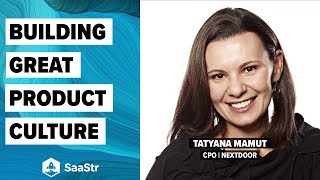
Nextdoor's CPO Tatyana Mamut identifies five culture risks that kill scaling companies: hiring only people like you, letting teams develop separate sub-cultures, losing leaders at growth inflection points, redesigning systems at 40, 150, and 500-1,500 employees, and drifting from real innovation to optimization. Culture is a CEO and CPO job, not HR's.
Chapters
cultures are self-reinforcing. They can be a source of advantage or disadvantage, right? And this is why I really urge CEOs, chief product officers, founders to not leave the question of culture in the hands of HR, but to really drive this conversation at the entire executive level, bringing the entire executive team together around it. Because this is where the competitive advantage will come from as you scale and in the long term. Okay. So moving to, you know, now hopefully you're convinced. If not, drop some questions into the chat, or if you have any questions about, okay, how do you make space for thinking about culture, you know, please kind of inter— you know, ask those questions. But I also wanted to just say now get into these 5 culture risks because healthy organizations, as you look out to your future, as you look out to scaling your organization, there are 5 culture risks to really get on your radar and start seeing them, start measuring them, start looking at them, and then start planning for the future. So these are the 5 culture risks that, you know, leaders, top leaders, founders, CEOs, heads of product need to be measuring and managing. So, here are the 5. I'll go into each one of them. And the first one is scaling risk. So, scaling risk is probably of all the culture risks. And that is to say that usually when we think about how a startup scales, we imagine, you know, a trajectory that's like up and to the right, right? We've all seen the pitch decks, right? It's like, it's up and to the right in a smooth line and smooth sailing. Well, in fact, that's not how it really occurs. It— true, like, scaling is a lot more like this, right? It's a series of bumps and starts, times when you're accelerating, times when you're decelerating. There could be times when you're starting to sort of lag, right? And so this is really much more what an organization that's scaling looks like and especially feels like. When you're a leader. And I've worked with a group of Stanford professors that have studied how startups scale, and especially scaling up excellence. So Bob Sutton wrote a book called Scaling Up Excellence. And he and I talked about this. And there are certain inflection points on your path to scale that are fairly repeatable. The first one— is at around 40 employees. That's when you start to really see the first inflection point where you need to really re-examine your cultural operating system. Because when you're under 40 employees, you have a very distinctive culture, right? Usually everybody is kind of sitting in a room together. You're kind of going back and forth. You're making decisions very collaboratively. You are, you know, everybody's kind of a generalist, right, and pitches in and rolls up their sleeves to do anything that needs to be done. And when a new opportunity pops up, the CEO literally kind of stands up, especially during pre-COVID times, scans the room, and says, okay, who's the best person who can take this on, right? So that's a very distinctive culture. At around 40 people, that starts to break down, and you start to really need to recraft your cultural operating system away from generalists. When you have people now who are specializing, you probably need to bring new people in. We'll talk about that in a minute. And kind of have a new operating system in terms of what you're doing. That 40-person number, actually, I don't know, right? Because there hasn't been a lot of research on does that number change with all the people working remote. It'll be really interesting a year from now to really understand, right, how companies that have kind of hit an inflection point, at what number does that start to change, right? It could actually be even smaller in a time of COVID because you don't necessarily see everybody in one room, right? You might— people might be a little bit more tribal, right, in who they kind of— who are their go-to people. But I don't know, so, is the answer. OK, the next inflection point is around 150 people. This is kind of the number of personal relationships that any individual can kind of hold in their heads. And so you kind of, at 150 people, now you need to shift into managing from, you know, like people, right, and cultural and relationships with people, to really having a culture that it's really more about functions, organizations, right, lines of reporting, those types of things become really important at that inflection point, right? Because now the CEO and the founders can no longer hold all the personal relationships and all the capabilities of the people that work in their company kind of in their heads, right? And then the next one is— and this one is much rougher, much looser— is around 700 people. And at that point, you need to think about enterprise scale, right? You need to think about really questions of, you know, sort of spans and layers, you know, how many people are reporting to whom, what is— are we functionally organized, are we organized by business units, all of those questions start to really become very important at around 700. Again, that's give or take. It's anywhere between like 500 and 1,500 in reality. But that really starts to be very, very, very critical. To really kind of start to organize as an enterprise, right, with multiple kind of owners owning big pieces of the business. All right. So that's scaling risk. And that kind of, as you'll see, kind of frames a lot of the other risks that we'll be talking about. So the next one is fragmentation risk. So fragmentation risk is most often talked about when you have a particular company culture, for example, a group of engineers that have a particular culture, and then you bring in a sales team, and there is just, you know, a wide disconnect between the culture of one group of people versus the culture of the other group of people, right? There's a Silicon Valley episode about this, right, where the engineers, just a small group of engineers, they have their own way of working, and then the salespeople come in, and it's just like night and day, right? You really want to look out for, How, when you bring in new functions and new capabilities, how do you make sure the culture does not start to fragment? Because if the leadership is not taking care of that and not attuned to that, it's very, very, very important to kind of focus in on that because otherwise things can go awry and it can really set you back significantly in your scaling. OK, the next one is attrition risk. And this is related to one of the questions in the chat, which is that all scaling startups experience attrition. And in my experience, and the research shows, that there are waves of attrition. And those waves feel very painful to the founders and to the executive team. But they are perfectly normal, and they are very healthy. The people that you need to manage through the next phase of growth have a very different, you know, not just skill set, but also very different set of expectations around the company culture than what you need in the next phase of growth. And it's absolutely fine to allow those waves of attrition to happen, and not just happen, but to actively organize them, plan them, and plan them around those inflection points, right? Because when you know you're going to make a culture shift, right, into the next phase of growth, you want to make sure you have the right leaders in place and you want to encourage as quickly as you can the ways of attrition so that you can get to the next level, right? All right. The next one is conformity risk. And in here, we're going to have another little interactive exercise in a, in a minute. And I'm just going to ask you, does this look like any organization that you know? Does this look— does this org chart look at all familiar to you in terms of if you just zoom out and think about who are the people in the organization? You just answer yes or nyes. All right. So, One of the reasons why it looks— sorry, one of the reasons why it looks so familiar to us is because oftentimes the people at the top, especially at the C-suite and the board level, don't quite match, right, who— what the people at kind of the bottom of the organization, the frontline workers, look like, or what the customers look like, right? And so is this a problem? Well, there has been increasing research that shows that it is a problem. But let's talk about first why this happens. I'm going to ask you another question here. So you have 3— you have 2 job openings, right? You have a team of 2 that you're hiring for. They are product leaders. And you have 3 candidates. And you have— you created a set of 10 questions. That are absolutely the skills that are required in order to do this job in a really great way. Okay, so I'm going to just tell you Candidate A answered 8 out of those 10 questions right. Candidate B answered 7 out of the 10 questions right. And Candidate C answered only 5 out of those 10 questions right. So you can get to hire 2 people. Who do you hire? So just write in the chat, you know, B and C or A and B or A and C. Let's see who you would hire. I wait for 10 out of 10. Okay. A and C. Okay. What else? Who, who thinks the, uh, okay, it depends. Who's now, does anybody feel like, well, the natural inclination since we're in a meritocracy is to hire A and B, right? Like they're the ones that scored the highest, right? Whoever gets 10 out of 10 covered across both. Look at other factors. Okay. So for the person who said it depends, let's dig in a little bit more. Hire for culture before experience. Okay. So let's take a look at what their answers actually were. Okay. So here are the 10 questions. Candidate A, as you remember, answered 8 out of those 10 questions right. Candidate B answered 7, and Candidate C answered 5. Only 5. So now who do you hire? Okay, so A and C. Depends on the questions. Okay, so these are like basically the questions that are required to build a great product a great product, let's just say, okay. So who— let me ask you another question. Who is the most valuable candidate? Who is the most valuable candidate out of these three? Remember, you can only hire two. C. C. Right. And Lem or Allison, if you could maybe write in the chat or unmute yourself to answer why C. Why is C in this scenario the most valuable candidate? Because they answered the questions correctly that the other two candidates got incorrect. That's exactly right. A and B are fairly interchangeable, right? You can hire either one of them, and, and as long as you also have candidate C on the team— so yes, they have new knowledge. Lem said they have new knowledge, right? They have— candidate C has knowledge that the vast majority of the organization, or at least in this organization, would not have, right? And so that idea of hiring for, you know, to really understand where do you have gaps in knowledge, where do you have gaps in experience to build a great product, is what product leaders really need to think about when it comes to conformity risk, right? Because if we just hire the people who get the most number of answers right, We are likely, as leaders, as we scale especially, to keep hiring more As and Bs, right? And we just— and we keep missing the opportunities, right, that come out of answering questions 9 and 10 right. But here's the problem that we face as leaders around conformity risk and why it feels so hard for us to tackle this issue. The reason why it feels so hard is because when we hire a candidate C, C, and, you know, and we bring them onto the team, and the team is filled with As and Bs, how do the As and Bs feel? They normally feel like the people who are Cs are not very smart because they didn't even answer questions 1, 2, and 3 correctly, right? Everybody else knows these things. They don't know them. Right? They must be unqualified for the job. Right? And so this is why we tend to get the same conformity and why it's so hard for people with new knowledge, for people with different knowledge, for different people with points of view that are not currently present on our teams to be fully integrated and succeed. And so it's our job as leaders to really, especially as we start hiring more people into product management, design, and product decision-making roles, to really watch out for those candidate Cs and make them— and it's your job to make them successful, right? Because they cannot make themselves successful. Their teams will— are highly motivated and incentivized not to make them successful. And so it's the leader's job to make them successful. So Brian asked, what advice do you have for a candidate C? My advice is to make sure that the CEO and the chief product officer are really aligned with valuing the knowledge that you bring uniquely, right? And because this has to come from the top, right? This cannot— candidate Cs can't make the organization value them. The value needs to come from the top. So, okay, moving on. So, is this true? Well, you know, this very, you know, socially progressive company called McKinsey did a study. I believe this was last year, 2018, 2019. And they basically found that diversity especially at the executive level, highly correlates with profitability, especially around gender and ethnic diversity. And the studies again and again and again show this. And so the question is, so why don't companies do it? And I think the reason why we don't do it is because it is so hard to really value that unique experience, right, more than we value the experience that we know and recognize, right, and the knowledge that we know and recognize. All right. And then the last risk is stagnation risk. So stagnation risk is when a company becomes, you know, so unable to innovate and so unable to kind of do anything new, truly new, that it just tries to kind of recreate the same success. And when they build new products, you know, they just think of like the same box, in a different color, slightly bigger, right? Like, that's innovation to them, right? And so, the problem with stagnation risk is getting the organization sort of out of optimization, out of optimization types of frameworks and just delivering product optimizations and really starting to explore new ways to innovate. Most startups don't have a problem with stagnation risk, but some, especially as they start to scale, it's under kind of especially fast growth, it's really hard to not just respond to what your current customers want more of, right? And this is where like the customers love the box, but they need it to be bigger and, you know, a darker color, right? And that's what customers want. And so you just start, you just start building based on customer needs and sales objections, as opposed to true product innovation. It's really important to get past that risk. All right, so the last one is, now that we know that we have to keep an eye on these 5 risks as we scale, just to ask you, which risks do you have a good handle on? Which risks do you need to address? And what risks would you like to kind of talk more with other product leaders, with other CEOs about? So feel free to answer in the chat. Also unmute yourself. I think we're almost just right at time. And so I'll, I'll let you guys also kind of either kind of answer in the chat or start to talk within your organization
More from Jason

Why Your Next Hire Should Report to an AI, Tragedy Apps, and Too Many AI SDRs? | The Agents #004

Our Agents Drove Our Salesforce Bill Up 80%, Marketo Hates Agents, and We Stealth-Churned Off Notion




Managing 20+ AI Agents: Lazy Agents, Our $500K AI Bill, Stealth Churn & the Death of 60% Solutions




