How to Build Top-Performing Sales Orgs with OpenAI's GTM Leader Maggie Hott
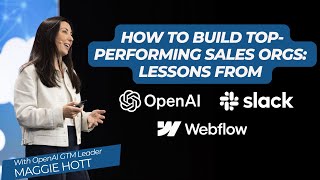
Maggie Hott, who built GTM teams at Slack and OpenAI, breaks down hiring A-players, building teams that move fast, and scaling without breaking things. She covers the "logo trap" that kills growth, why premature promotions sink orgs, and how ChatGPT Enterprise actually launched.
Chapters
And at OpenAI, we held and we always hold the line, even when it slows us down, because one exceptional hire is better than three average hires, and exceptional people tend to know other exceptional people that they can refer in. Hiring mistakes early on are incredibly costly. A mishire can cost over a million dollars. And this is because if you think about it, it takes time to hire them, time to ramp them, time to get them in front of the customers, and then probably not close deals, and then you have to start all over again to hire. So let's look at some of the common hiring pitfalls that lead to mishires. The first one that I recommend is avoid the logo trap. Don't confuse a big company brand with startup readiness. You need to understand if they were at a big company, what did they do?
Hey everybody, SaaStr.ai is coming to London December 2nd and 3rd. It's Chris and SaaSter, and thousands of the best in AI and B2B will be there. The biggest names, the best networking, and most importantly, the best playbooks to scaling in AI and SaaS. Early adopter tickets are selling like hotcakes. Use my code JASON20POD for exclusive savings. Get your tickets now at podcast.sasterlondon.com or just use JASON20POD at checkout. Hey everybody, the best.coms are taken or overpriced. I was literally looking for a domain name the other day, it was $10,000 just to make an offer. So you settle on a workaround domain for your website. Don't compromise. Get a clean, sharp.tech domain that instantly says it's a tech startup. Grab yours at get.tech/saster. That's get.tech/saster. Or on domain registrars like GoDaddy. Stop compromising. Get the domain you need.
Tech. Please welcome GTM leadership, OpenAI Maggie Hodd. All right. Hi, everyone. Thank you so much for being here. I come to SaaStr every single year, and it has always been a career goal of mine to be speaking here. So being up here on the main stage is a little bit of a pinch-me moment, but that's not what we're here to talk about today. What we're going to talk about is how to build top-performing sales orgs. I have had a really lucky and fortunate pleasure of working for 4 different unicorns, helping to build their sales team at all 4 of them. I started my career at Eventbrite as the second SDR, spent 5 years there scaling it until about 2015, and then I made my move over to Slack as the very first sales hire out of headquarters, where I spent 6 and a half years in a variety of different roles. Then I made my way over to Webflow, where I was director of sales overseeing sales dev, SE, SMB, mid-market enterprise, helping to take the company from $40 to $140 million and a $4 billion valuation. Couple years ago, I made my way over to OpenAI. They hired me on to help build out ChatGPT Enterprise. So what I am going today to do today is to take as many of the lessons that I have learned from scaling these companies over the past 15 years and distill them into a tactical playbook for you. My side hustle is that I run a small venture fund alongside 7 other amazing women, and we have collectively invested in over 30 founders, and these are some of the top founders of this next decade. So I'm also going to take all of the lessons that we've been learning from mentoring and coaching them and distill them. So this entire talk is meant to be no theory, but all tactical. We'll cover 4 key areas. The first one, hiring. How do you build your A-team? The second one, how do you build teams that thrive? So you've got your A-team, but how do you create alignment and accountability? Then we'll move into scaling. Scaling is one of the hardest things that a company can do when they're going through hypergrowth. So we're going to look at some sustainable growth strategies. And then finally, we're going to wrap it up with a rapid-fire playbook. Of some of the most common mistakes that I see founders making as they build out their companies. I'm excited to jump in. You'll be able to take all of these takeaways immediately. And a small disclaimer: these are my personal views, not those of OpenAI's. Let's jump in on how to build the right team as fewer things matter more. It was early 2023, and OpenAI had just released the fastest-growing consumer app the world had ever seen— ChatGPT. We were about 200, 250 people, and we had reached a pivotal moment. We had to scale quickly. We had to end the year at somewhere close to 1,000 people. And this wasn't just growth for growth's sake. We needed to meet the demands of our market, and quite frankly, we needed to service our customers. Sam often says that hiring is the highest leverage thing that you can do, and great companies will always have great people. But for us, it wasn't just about finding the great people, it was about finding and hiring the right people. So let's look at 3 key principles that we follow at OpenAI as we hire. The first is to hire for clear, measurable objectives. A mission alone isn't enough. You need people who can explain exactly how their work and their skills will help you achieve that mission. So we looked for candidates who could clearly articulate how their skills would move us closer to our mission, which is to create AGI, artificial general intelligence, that benefits all of humanity, not just those who are excited by the vision. The next is it's important to build teams, not just talent. You can have 50 top performers, the best 50 people out there, but if they can't collaborate and they can't work together, you're going to get bottlenecked and stuck. So the most simplistic way to think about hiring teams is to think about them as a puzzle. You need multiple different pieces that will all fit together, and everybody will have something they bring that is distinct and complementary. Their skills, their roles, and culture all need to fit together because trust and collaboration matter just as much as individual excellence. And then finally, and maybe most importantly, and one of the hardest things to do, especially in hypergrowth, is maintain a high bar. When you are growing fast, I know it's tempting to compromise. I know it's painful because you just need a body in that seat. Sometimes it feels like a warm body would be the best and quickest possible outcome. That is not the case. And at OpenAI, we held and we always hold the line, even when it slows us down. Because one exceptional hire is better than three average hires, and exceptional people tend to know other exceptional people that they can refer in. So, these three principles help to scale with clarity and conviction. So, let's shift gears a bit. Let's get right into the tactical and what I think will probably matter to many of you, go-to-market hiring. Hiring mistakes early on are incredibly costly. A mishire can cost over $1 million. And this is because if you think about it, it takes time to hire them, time to ramp them, time to get them in front of the customers, and then probably not close deal— deals. The cultural disruption that a mishire brings, then you have to pit them, then you have to severance them, and then you have to start all over again to hire. So now you're looking at about $1 million and probably a year of wasted time. So let's look at some of the common founder hiring pitfalls that lead to mishires. The first one that I recommend is avoid the logo trap. Don't confuse a big company brand with startup readiness. I'm not saying that you shouldn't ever hire someone that comes from a big company because big companies have great people, but you need to understand if they were at a big company, what did they do? What did they build? What did they scale? So that way you can really understand if they can bring these skill sets over to your thriving startup. You don't need someone who can just operate the machine. You need someone who can build it. The next one that I see founders do very often is they promote too early. Your first AE is very likely great, but that doesn't mean that they should be your first head of sales. You must give them mentorship, but you also need to be thoughtful about how and when you level them up. And to go on this a bit further, what I often see is founders, if they end up promoting someone who doesn't have management experience, they will have to spend a lot of time coaching them, which is just time they don't have, or they will not spend the time coaching them and this hire will flounder. So neither of those are great outcomes. On the flip side, I also see founders trying to hire someone who's senior way too early. They come to me and they say, Maggie, I have 2 AEs. I think it's time for a CRO. No, it is not time for a CRO. You need to make sure that you have clarity on how the repeatable motion works. They need to make sure there's strong playbooks in place, otherwise they will be flying blind. So founders, you are the head of sales until you have a repeatable motion. You must own it until the motion works, and then you can hire to scale. So essentially a repeatable motion means that a non-founder can sell and close. You know your ICP, you know your pitch, you know where your leads are coming from, and you know that they can move predictably through the funnel. No one is going to sell with the same urgency and conviction that you do. So you need to make sure that it is possible for you to hand off the sales cycle to someone else before you go build out a sales team. So let's look at what we should be looking for. I love to hire what I call chaos translators, or people who embrace the chaos. These are basically people who just thrive in ambiguity. You can throw them on a renewal, you can throw them on an outage, you can throw them on a crisis, and they're gonna take it with a smile. These are the builders that you want to hire. I also love to prioritize generalists early days, someone who can wear a lot of hats. So that's a versatile generalist that can jump in right away. Also, early days, you want to avoid lone wolves. I actually love lone wolves. There's a time and place for lone wolves, but that time and place is not your first hires. You want folks who are deep collaborators, not people who are just gonna put their heads down and sell. You must be meticulous. Do deep interviews, backchannel thoroughly, and trust your gut. Off is usually off. So let's take a look at some interview questions. Founders often ask me, How do I interview salespeople? They all seem like they are great at interviewing. I think that the easiest thing to do is to distill it into two clear buckets. Look at tactical and look at behavioral. So when you're looking and asking for questions that are tactical, you're really looking for skills and experience. What did they build? What process did they invent? How did they mentor and train others? How did they help hire and scale the team? When you look at behavioral, you're really looking for mindset and you're looking for character. Asking questions like, describe a painful deal that you lost. What did you learn? Is going to show, do they take accountability? Do they have a growth mindset? It's also really important to understand who were their closest cross-functional colleagues. Early days on in building a sales machine, or just a company machine, people have to work very closely together. So you want to make sure these folks are strong collaborators. Let's take a look at some red flags to watch for that tend to come up during sales cycles. And if I see these, I am always an immediate no. The first is blaming others for failures. You want to make sure that somebody can take ownership of the mistakes that they've made, or when things don't go wrong and they don't just blame others. The next is frequent job hopping without progression. We've all seen those people that seem to have a year at a whole bunch of different companies, maybe a more senior title at each one. But what you really want to look for is growth within their current company. People who are primarily motivated by titles or money. Look, we are all financially motivated, but it is so important to make sure that if you hire someone, they're not going to jump ship if somebody comes along with a $20,000 higher offer. And finally, a lack of humility or unwillingness to make mistakes. We've all made so many mistakes within our careers. And so it's so important that you find someone that can admit to these mistakes and most importantly, learn from them. Early hiring is high stakes. Hire mission and objective aligned talent, folks that have the skills to get you to where you want to go. Never skip interview steps. Interviewing is so painful, but what's more painful is cleaning up a bad hire later on. Trust your gut early. Off is usually off. Act quickly on mistakes. You will make hiring mistakes. It's just part of the game, but the best and kindest thing you could do for yourself, your candidate, and your company is to move fast on that person. And finally, don't go it alone. Leverage your network, leverage your investors, leverage your advisors and people who have hired go-to-market before. At Twenty Sales, one of the most common things that we do is we help our founders look through who should be their first sales hires, and we even help them interview. So make sure that you are leaning on people that can help you guide through this process. So I'm gonna leave you with a piece of advice from OpenAI's CFO, Sarah Friar. She fundamentally believes that if you get the right people and you really let them fly, and that involves giving them a lot of autonomy, encouragement, and tough love, then the A team with the B idea will always beat the B team with the A idea. I hope this section helps you build your A-team. So, let's take a look at how to build teams that thrive. You've hired the right team, you've gotten your A-players. Now let's talk about how do you set them up to succeed? It was March 2015. I walk in the doors at Slack, first sales hire out of headquarters, ready to jump in. Slack has just become a Silicon Valley darling. We're about 50-ish people at the company. I walk in and all of a sudden the tension in the room is very obvious. It feels off, it feels weird. My then boss pulls me into a conference room and says, "I have bad news. Slack was hacked and it could be crippling for the company." That afternoon, Stewart stood up on a desk, again, remember we're like one small room, and he addressed the whole company and he says, "This is going to be challenging, this is going to be tough," but we will make it through this, but it is going to take hard work from every single one of you. The trust and respect that the employees had in Stuart was so clear, and this was really the first time in my career that I had seen what it looks like to have a culture of accountability. So fast forward 4 days later, and we decided to let the world know about this hack, and they put me on the phones for every single person who was hacked, basically got an email that said, really sorry, you were hacked. Call this Thunderbird. So that was me on day 4. It was trial by fire at the very best. The lesson here is that alignment isn't tested in the good times, it's revealed in the hard ones. And I bet most of you probably don't remember this breach, but what stuck with me wasn't the crisis, it was how the team responded. This moment reinforced 3 powerful lessons. The first is that authentic leadership matters. People follow leaders that they trust, especially in moments of uncertainty. Culture is your strongest defense. A unified culture will empower teams to navigate even the toughest challenges and emerge stronger. And finally, alignment drives outcomes. When teams rally around shared goals and values, they move faster and they deliver more. So with these 3 things in mind, let's get practical. How do you actually build alignment, accountability, and speed into your day-to-day? First is that you need to encourage real debates. You need to make sure that every single person in the company feels comfortable speaking up from the SVP of marketing all the way down to the SDR. I'm a big believer in no meeting after the meeting. Avoid those side chatter conversations. Once you've decided on something, move forward and you can always revisit with intention. Second, make priorities obvious. Founders and leaders, this one is on you. You need to set clear priorities and ownership. You must use async transparent communication to connect everybody's daily work to goals. Our CPO, Kevin Weil, at OpenAI, every single Monday morning does a post to the entire company that tells us what's coming up for the week. What are we launching? What are the key things to be aware of? And that's how we've helped to build this culture of alignment. And then finally, speed up decisions. In this world of AI, you don't have time to wait. Empower decision-making at all levels. In just the last year, I had an AE come to me wanting to test out a new vertical, another one wanting to test out a new pricing strategy, another one wanting to test out a pilot motion. We did experiments on all three. All three were wildly successful, and they've changed how we sell today. I am a big believer that those who are closest to the business have the best ideas, and that's typically the ICs. So frontline managers shape your team's daily experience. They are essentially your organization's pilots, and you wouldn't get on a flight with an untrained pilot, right? I hope not, at least. Yet, unfortunately, this is what happens in most companies. They underinvest in their frontline manager leadership and development. I also like to joke that frontline managers are also untrained therapists because it's so common that they are shouldering the weight of those that are reporting to them. So you must overinvest in their leadership development, in executive coaching, in emotional intelligence training. Equip them to manage not only people, but conflict and culture. They are not just managers, they are your cultural backbone. Customer obsession is everyone's job. Success isn't just on sales. Every team owns the health of the customer. You must build this mindset from day one. We actually did this really well at Slack. At Slack, we took our largest customers and we assigned non-sales DRIs, directly responsible individuals, to be in charge of each customer. So our VP of engineering, Michael Lopp, was in charge of VMware. Our CTO, Allen, was in charge of Nike, and so on. And all of a sudden, we started seeing the customer feedback start to come into our roadmap a heck of a lot faster. We also at Slack, Webflow, and OpenAI have built out customer wins and customer losses channels. If you don't have these, go build these immediately. The customer wins channel is awesome. It's a feel-good channel. Everyone loves to see the new customers that are coming on board, but the customer losses channel is really where it's at. As soon as that thing lights up, everybody swarms in because they want to know why we lost the customer. I often see our COO Brad in there jumping in, offering support, asking questions, trying to learn from what we could have done better. Bake customer obsession into your DNA. So this picture that you see up here, that is OpenAI's go-to-market team about 2 months ago. In 2 years, we have gone from 10 to 500 people, and we are going to keep on going. And the reason that this is working today, while it hasn't be easy, is we are built on transparency, trust, and accountability. We invest in our leaders so they can grow with the company, not out of the company. And we embed customer obsession into every single function. Do these things well and your teams will thrive even in the toughest of moments. So we've hired the right team, they're all swimming in the right direction. Let's now jump in to how do we scale without breaking. Let's dive in. In 2016, Stuart Butterfield came to the sales team. At Slack and said, "We're going to hire an SVP of sales, Bob Fratty." Many of us, myself included, raised our eyebrows and we wondered why a thriving startup needed a hotshot corporate executive. We were completely wrong. Bob came in, he brought structure, he built scalable systems, he helped convince and teach our executive leadership why enterprise and sales mattered. He brought in seasoned judgment because he had seen the movie before by scaling Salesforce, and he mentored and elevated internal talent. He didn't just replace us. The result of this is Slack grew from $50 million to a billion. We went public, and then we had an outcome of a $27 billion acquisition by Salesforce, one of the largest acquisitions to date. And I honestly shudder to think what life would've been like without Bob. Without his external expertise, we probably would've played it too safe. We would've stayed a modest growing consumer app, and we probably would've never been the enterprise powerhouse that we became. The lesson here is that sustainable growth comes from internal momentum and external perspective. And this is why for founders and senior leaders, it is so important to give away your Legos. Giving away your Legos, which is one of my favorite terms. It's coined by Molly Graham, essentially means to hand off parts of your job or your full job with— as you scale. At OpenAI, we've done this really well. In just the last year, Sam has brought in a new Chief Product Officer, Kevin, a new CEO of Applications just announced last week, Fiji, and an amazing CFO, Sarah Friar. And what this does is it unlocks bigger impact. Rather than the CEO managing everything, they're able to give away parts of their job to these seasoned leaders who can run it wholly. This is all about scaling impact, not about losing control. You must build repeatable systems and then hire someone who can elevate them. And I've got two tips for giving away your Legos and how to think about this. The first is you must give them away. This is not about loaning your Legos. You cannot hire someone and then micromanage them. You have to give them away. And then secondly, the first Lego to give away should be the one that drains you the most. So, let's say you've built that repeatable motion in sales, but it's draining you. Now hire on a head of sales or a CRO, and you can focus on other areas. This is how you grow and how you help the company grow. So, we've just talked a lot about how great it is to bring in external executives, but it's also really important to talk about how to blend external and internal talent. Your internal talent is the people who got you here today. And let's be real, they know where the bones are buried. You don't want to lose your internal superstars. So you must balance both of them. Internal promotions create cultural continuity, loyalty, and retention. But when you are layering and bringing in external hires, it is important to be transparent. It's always going to be painful to be layered. No matter what. So share the why, share why you're excited about this person and what you expect them to bring the company to help reduce the friction. And finally, prioritize clear career paths. Growth drives retention. I stayed at Slack for many years post-vesting because I saw a strong future ahead. Take care of your early believers because they are the ones that built your foundation. Help them grow with you and not out of the company. Companies rarely use compensation as a strategic lever, and I genuinely think it is one of the best things that you can do for motivation. And I'm going to give you some hot takes in this one. I believe the entire company should be on a bonus plan, not just the sales team. They should all be aligned to your core metrics and your north stars. We did this at Slack. We put every single employee on a bonus plan and we tied it to ARR and customer adoption. All of a sudden, the product team saw if they launched EKM, we could get, you know, another X millions in revenue. And lo and behold, those features shipped a lot faster. It's important to rally everybody around the same goals. But let's say you're an early-stage startup and maybe you don't have the funds to put everyone on a bonus plan. That's okay, but it means you really need to lean into recognition. Recognition matters. If you are a CEO and you see someone grinding late at night, Send them a $50 DoorDash gift card as a thank you. That little amount of money is going to mean so much to this person that their CEO sees them and acknowledges them. For early sales teams, I am a big believer that you should always start them on full salary. We did this at Slack, Webflow, OpenAI, and I know many other greats have done it, like Calendly, New Relic, and Airtable. I actually have a whole LinkedIn post on this from a few months ago that went a bit viral if you want more takes. On this, but the main reason for this is you want the sales team to be acting in service of the company and the customer, not acting in what they need to do to be able to make the most money. Your early sales team is also effectively user researchers. Have them focused on building and scaling, not focused on their paycheck. It will emphasize strong foundations, mentorship, and great process. And if and when you do introduce in commissions, Think about the behaviors that you want to drive. For example, at Slack, we wanted to drive new logo adoption. So we centered 75% of our comp plan on new logo versus existing customer upsells. And lo and behold, the tide shifted and we started seeing a lot of new logos come in. So use comp intentionally to drive the behaviors that you want to see. Sustainable scaling isn't about growth at all costs. It's about thoughtfully blending external and internal talent. Those who have seen the movie before and those who have got you to where you're at today. It's about clearly defining career paths. Keep those people around and keep them growing. And it's about intentionally aligning incentives. Getting people to follow exactly the way that you want them to operate can often be dictated by compensation. So this next and last section is intentionally punchy. It's a rapid-fire set of the most common go-to-market mistakes that I see founders make or ask us about. Think of it as a practical checklist to help you avoid missteps and accelerate what's working. It was early 2023. OpenAI had hired me in to help build our ChatGPT enterprise go-to-market team from scratch. Our early team at OpenAI of our, our sales and go-to-market team was less than 10 people. No SDRs, no SCs, no CSMs, no sales ops, rev ops, marketing enablement, and not even a working Salesforce instance. We had about 6 account directors and 1 technical success partner who— they were all on fire, but they were focused on selling the API. And we had the hypothesis that ChatGPT would have a distinct fire and a distinct sales motion different from our API. So we made a deliberate choice to build a dedicated go-to-market org from scratch. That approach gave us speed, clarity, and deep customer focus during a critical window, and it worked. OpenAI already had the fastest-growing consumer application in history, and then this brand-new team that we built, we believe, launched the fastest-growing enterprise application in history. But despite this success, we saw an opportunity to go even further by evolving our structure. So, earlier this year, we basically collapsed both of these orgs. We took 500 people, most people who had only been at the company for a few months, and we brought them into one single unified go-to-market org. Everyone had new roles, new workflows, new managers, and every single person had to learn a new product. They had to learn the opposite product they weren't selling. This was a hard change, but ultimately it drove faster execution, less duplication, and most importantly, a better customer experience. The key lesson here is that old playbooks don't always apply in AI. You need to design around orgs and product, not around legacy structures. So an example here might be, let's say you're releasing a new AI product at your company. An old way of doing it probably would've been teach and enable everybody how to sell it, and then everyone kind of bolts it on. Maybe the new way to do this might be create a small dedicated tiger team to really go focus and launch that product. Move fast, be willing to make mistakes and bold, uncomfortable decisions, and they will pay off in the long run. Great execution isn't just about moving fast. It's about knowing when to pivot. One of the most important leadership muscles is the ability to change course early before pain compounds, just like how we did at OpenAI. I really love Amazon's one-way versus two-way door model. Essentially, a one-way door is something that's obviously really hard to reverse back from. And a good example here might be a large-scale pricing change. That's a really hard thing to measure right away and to also roll back from on your customers. But I'll tell you, most things are two-way doors. So for example, a reorg, while maybe painful to roll back, is absolutely doable. And if you think it's the right move, you should do it quickly. Don't delay on change to avoid discomfort. I very often see sales leaders wait to make changes only once a year. They wait till the end of the fiscal year. This is a really bad idea, especially in the world of AI where things are moving so quickly. Explain, and then finally, it's important to explain the why behind these changes. Look, changes are, no matter what, going to be disruptive, but if you explain the why behind the tough calls, you will usually get people bought in because trust will follow transparency. It was early 2015, and Uber came to us. This is with Slack, and they were maybe about 5,000 or 6,000 people, and they said, look, we want to buy Slack. And we knew at that time that we could handle maybe 2,000 people max. Our largest customer was about 1,000 people at this point in time. So we decided, let's compromise. Let's offer Uber a small pilot so they can test out and see if Slack is the right move for them. Well, they decided they did not want to listen, and overnight they brought on 2,461 users and our systems went down. The crash here of being taken down actually didn't really matter. What mattered is the reputational hit and damage that Slack took on, where we had to spend the next 3 years convincing enterprises that we were in fact enterprise ready, despite what had happened with Uber in 2016. And this is why it is so important to rarely start with the enterprise. When founders come to me and they say, I want to go after Walmart, Nike, you know, insert large enterprise logo. I will 10 out of 10 times push back and say no. And I know enterprises are tempting, big logos, big ACVs. They look great on investor pitch deck. But the reason that you don't want to start with the enterprise is threefold. First, they typically have really complex hierarchies and lengthy decision cycles. It is rare that an enterprise is going to do a deal in anything less than 6 months. And as a startup, revenue is your lifeline. They're also going to have deep customization needs. They're going to ask for things that are not on your roadmap, and then you're going to have to make a hard call if you want to veer off course. And then finally, they are pretty typically risk-averse buyers. Most enterprises are not going to be the first one to buy a new software. So instead, what you want to do is define your ICP. Your ICP is your ideal customer profile, and then create your target list. So basically take a look at the customers who are already using you and work well on your platform. Understand why they bought you, why they're thriving, and why you won them over the competition. So for example, maybe Mural is one of your customers. You might want to look at Miro and Figma because they're very tangential in the spaces that they have. Find these shared attributes and pain points and understand why they chose you, create that list, and then Go outbound. Outbound starts on day one. Once you have this ICP and target list, this is on you as the founder to start outbounding. You cannot outsource product market fit, and you need to know that you can sell outside of your investors or your warm referrals network. Warm intros will not scale. You must sell to strangers first. As a data point, I have had 3 personal angel investments go under. All 3 amazing companies, but the one thing they had in common is they could not find go-to-market fit fast enough. So avoid spray and pray. In the day and age of AI, I see about 95% of the outbound that I get is absolute spam. There's no reason this should be the case. So be that 5%, be personal, be relevant, be helpful. Run pilots that actually close. Run pilots like real sales motions. Last year, we decided to put together a dedicated pilot team. We wanted to see what the impact would be if we treated our sales cycles like they were real customers. And we found that by doing long intensive pilots, our deal sizes went up by about 5x, which is pretty incredible. But pilots take a long time to convert and they are very resource intensive. So if you are going to do pilots, which I think everybody should, obviously, um, there's 3 key things that you want to follow. The first is you want to secure explicit customer buy-in upfront. This means if you do the pilot and it works well, they will have budget. They will be able to convert. The second is you must define clear pilot roles and responsibilities. If you're going to lean in and do this pilot, you need to make sure the customer is also leaning in. The same way. And finally, and probably most important, the execs at the customer must know that this pilot is happening. If the execs are not aligned or aware of this, doesn't matter if it's a great pilot, it's very unlikely the deal will get done. Treat pilots seriously. They're a high leverage conversion tool. Customer success should be a core strategy, not a side function. I know there's some vibes in the industry right now that we don't need customer success. This is to me shortsighted and absolutely the wrong way to think about it, especially for hyper-growing startups. A deal is not won when the deal is signed. A deal is won when you have deployed and you have a happy customer who is singing your praises. And it costs 5 times more to acquire a new customer than it does just to retain an old one. Yet companies are not focusing enough on customer success. And churn is so much more than lost revenue. It's also brand damage, like in Slack's Uber example. Prioritize adoption, prioritize retention, prioritize long-term value. Build these tight feedback loops, get the voice of the customer. Product executives, everyone should hear it and should act on customer insights. Obsess over customer success early, and this will compound. Which leads me into storytelling as a superpower. You must capture stories early. Nobody wants to be the first. Prospects want proof. They don't want promise. Get these customer wins, get the logo rights, get the case studies. An example here, when OpenAI launched our partnership with Moderna, and we estimate that we can help them reduce time to FDA approval for cancer-treating drugs. All of a sudden, that lock unlocked credibility in the life sciences industry. When we launched our partnership with Morgan Stanley about how their wealth advisors can have happier customers and take on more work, that unlocked credibility in financial services. Internally, people also love customer stories. Think about your engineers and your product managers that are working so hard to build this product. They love to hear how people are using it. And then externally, these customer stories will build credibility and momentum. You need to prioritize storytelling from day one. Product-led founders, this one is for you. I've built my career working for 4 product-led companies, and there's been a pretty common theme when you have founders who are typically technical and product kind of minded in nature when they don't have deep go-to-market experience. They often forget to think about the sales upgrade path early on. PLG drives early adoption and virality. I love PLG. And then you bring on a sales team, which is critical for upmarket strategic deals. You must plan for both from the beginning, even if you don't plan to hire a sales team right away, but you need to be thinking about how the product will evolve and leave room to eventually differentiate. We actually did not do this very well at Webflow. Webflow was around for about 7 years before we built a sales team, and we built a killer self-serve product. It was so good, and I'm biased, but I think it was the best in the industry. Yet when we decided to hire on a sales team, there wasn't enough product differentiation to sell. So it took us a good year to 2 years to truly build out an enterprise product, and that was a lot of time that was wasted. So the takeaway here is to design with sales in mind from day one. So the bottom line is that execution is everything, and execution is the sum of many well-run plays. Avoid starting with the enterprise. They are live, long sales cycles. They're risk-averse buyers. Maintain customer obsession always. The customer should be front and center of every decision that you make. Use storytelling strategically, both internally and externally. No one wants to be the first. And then thoughtfully combine PLG and sales-led growth strategies. 4 years later, we won Uber back. This is a big moment for us. It took time, but we earned it when Slack was ready, when the product had matured, when the infrastructure could handle the scale, and when we were ready to staff them, and the timing aligned for both sides. The right customer at the wrong time is still the wrong fit. Wait until you can truly deliver. So to wrap it up here, I just want to say thank you all for joining me for this. When I— oh, thank you, Alfons. When I set out to build this presentation, I was actually on a flight on my first mother-daughter trip with my 5-year-old Logan. And I sat down and I said, what do I wish someone would have told Maggie 10 years ago before I just went through all of this stuff? So I tried to distill as many lessons as I could. And if you can take away one thing to help you scale better or hire faster, I will consider this entire session a win. Have a great rest of your SaaStr, and I'll see you all soon.
More from Jason

Why Your Next Hire Should Report to an AI, Tragedy Apps, and Too Many AI SDRs? | The Agents #004

Our Agents Drove Our Salesforce Bill Up 80%, Marketo Hates Agents, and We Stealth-Churned Off Notion




Managing 20+ AI Agents: Lazy Agents, Our $500K AI Bill, Stealth Churn & the Death of 60% Solutions




