How to Leverage Pricing and Packaging to Drive Revenue with Miro, Loom, OpenAI, and Splunk
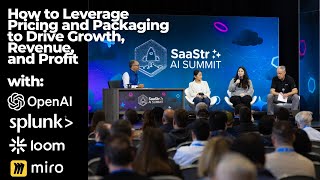
Pricing leaders from Miro, Splunk, Loom, and OpenAI discuss how to structure pricing and packages for SaaS growth. Akshay Sharma frames pricing as a product feature tied to business goals. Karsten Holm warns that changing pricing after launch is hard. Allison Harmon describes OpenAI's rapid price cuts to drive adoption, though most markets can't move that fast.
Chapters
I think to add to this is there's no silver bullet in pricing, right? So there's, it really depends on what the objectives are, right? User adoption, value extraction, you name it, and you gotta adopt or you gotta change and customize your model towards that. And that's, I think it's the main thing here. The other aspect I, and I'm gonna talk about it a little bit later as well, is like really zeroing in on the metric and what is capturing customer value. The numbers you can play with, the metrics, things like that are really hard to change after the fact. So being clear around how you want to capture value and having it a fair value exchange, meaning the customer agrees that is also the way to capture value and reflects how they derive value from a product is one of the, probably the hardest parts of this whole exercise.
Please welcome Akshay Sharma, Head of Pricing and Monetization at Miro. Kirsten Holm, VP of Pricing and Monetization at Splunk, Janie Li, Head of Product at Loom, and Allison Harmon, Head of Growth at OpenAI.
Hello everyone. Thank you for joining us. We are here to talk about pricing and monetization, how you can use it. We'll get started in a second. My name is Akshay Sharma. I'm Head of Pricing and Monetization at Miro. And then in addition to pricing, I'm the guy who really likes the product, so go telling people how to use it. Even when they don't want it. That's me. Let's just hear my co-panelists introduce themselves.
Thanks, Akshay. Hi everyone, my name is Janie Lee. I lead product at Loom, which is now part of Atlassian.
Hi, I'm Allison Harmon. I lead growth at OpenAI.
And finally, Carsten Holm. I'm heading pricing monetization at Splunk. Super excited to be here. I get to talk about what I love.
Great, thank you. Welcome. So we're gonna talk about pricing and packaging. And I have a confession to make first off. I got into this accidentally. When I was a consultant, I loved data and I knew about semiconductors and there was a project which needed someone who knew those things and they couldn't find someone who already knew pricing, so they brought me in. But what that did was it got me amazing mentors who helped me learn about this, learn the ropes, showed me how to think logically about it and how to apply data thinking outcomes and that kind of thinking to do pricing. And I loved it, haven't looked back. That's also the basis of what we are doing today. We are gonna talk about what we have done, how we have thought about it, and the hope is that we can help you see behind the curtain a little bit and help you see how you can apply this in your own context. So it's help you learn how to price rather than giving you a blind formula to follow. Hopefully it's fun. First off, I wanna try and make you reset your mind about what pricing is. I call it, it's another product feature, and just like other product features, it changes what your customer's behavior is. And so you should think about it the same way and use it intentionally to drive growth, revenue, whatever else. But think about it more than something you set it once and forget it. It's an active part of your product and you have to evolve it just the same as you do with other products or product features. And then pricing is actually also much more than the price level. There's the value metric, and if you're here at SaaS, you all understood identifying the best value metric is important, but there's a lot more things out there and you should pay attention to it and think about them as well as you think about pricing. The underlying thing why you should think about it is my mental model saying Hey, this complex math, which my geek side wins out every now and then, forget it. But there's the left side, the green side. What benefit would a customer expect? And then the right side, which is the cost side. What is it going to cost them? And the customer's expecting that the green side should be much more than the red side. And when the red side, there's one part, the expected cost, which pricing influences in one or more ways. So as you change the green side, your product, your features, go-to-market, your marketing budget discounts, you have to change the pricing side appropriately so that you can achieve the goals you want. And that's what brings me to my next one, which is how do you price? And we debated this internally in the group. The simplest version we came to was you have to figure out why you are doing it. What's the outcome you're trying to achieve? and a different outcome would lead you to a different pricing choice or a pricing model choice. If you're trying to drive user growth, you want the least friction. If you're trying to maximize revenue, you have to find the revenue maximization point. And there's a lot of tricks and trials that you do to figure out these things, but this is the mental model. What's the outcome? Am I doing the right things for that outcome? I'm gonna give you one example. This is one which is less commonly used. When Miro was an early product, the outcome that we are trying to achieve was make sure the users love the product. And they figured out that user love happens when a lot of people come together on the Miro board and collaborate. That's when users get enough value. And so the first choice that was made was minimum 5 users in a paid plan. It seems counterintuitive. It wasn't to try and maximize revenue and force people who were a 1-person team buy a 5-people team. It was to set that threshold high enough that people, when they actually buy, they're getting value. It was a conscious choice because the outcome was users need to love the product. That would help get to product-market fit. As the product matured, there were larger teams which are coming up and they wanted more security, they wanted more features. And again, here it was to— the goal was to scale the revenue in a healthy way. We wanted to make sure that the customers who need it get it. And so when we introduced the business plan, which had security features like SSO included in it, we set another threshold. We said 20 users minimum for the business plan because if you were smaller than that, you could pay us the higher price, but maybe you weren't getting all the value. And so you shouldn't be pushed into that. And that allowed product sales, customer success also to align with the customer benefit. It was choices which were not short-term optimal, but were the right goals for the company. And then as Miro grew and we were scaling up, we wanted the product to be available to everyone. And then we did experimentation and we figured out, hey, we can now reduce the limits down to one user without actually hurting any of our key metrics, and we can make this product available to everyone. And we already know the product is good, so that made sense. So this is how you can see as goals changed, we took the same metrics and we changed what Miro did with our minimum user count. And this is not a very common thing that you think about, but you have to think about a whole package of pricing and then you can figure out how to achieve your goals a little bit better. That's the starting, and I wanna open this up to my co-panelists. Hear how they use pricing. Maybe Allison, you have something to share.
Yeah. So I think the key theme here is just the value exchange of pricing and then what your success metric is. At OpenAI, certainly our success metric at the moment is just like growth and adoption of the platform. The AI space is new and we want as many customers, companies as possible to try it out. And so we, as many of you probably know, have set this track record of releasing something really intelligent and then even as we improve it, lowering the price. And the goal of that is as we get more efficient at serving that, it yields more adoption within a company and across companies because they can serve that to even more people, which is a bit counterintuitive because you think as we increase value, you should increase price. But really it's while we're trying to ignite the market and just get as many companies exposed to AI as possible. That's what's made sense for us. That by no means always makes sense for every company. But in the same vein of you scale and move your value and pricing levers with your different company goals.
Yeah, I think to add to this is there's no silver bullet in pricing, right? So there's, it really depends on what the objectives are, right? User adoption, value extraction, you name it, and you gotta adapt or you gotta change and customize your model towards that. And that's, I think it's the main thing here. The other aspect I, and I'm gonna we'll talk about it a little bit later as well, is kind of like really zeroing in on the metric and what is capturing customer value. The numbers you can play with, the metrics, things like that are really hard to change after the fact. So being clear around how you want to capture value and having it a fair value exchange, meaning the customer agrees that is also the way to capture value and reflects how they derive value from a product. Is one of the, probably the hardest parts of this whole exercise.
Let's move on to another topic, which is very fun. Katie?
Sure. So, I will spend a little bit of time getting into the brass tacks of, you have a sense of what pricing and packaging you actually want to implement or might be good for the next stage of your company's evolution. How do you actually validate if it is the right decision or not? And I often get asked, how should I experiment or roll this out? And is you think about this question. I think the first question I ask back is, what are you trying to get out of it? Are you trying to validate if a completely new product or package that you're introducing has some product market fit? Are you trying to de-risk a really big change to an existing popular package that your customers already love? And I think what you do and whether you even experiment at all will be really dependent on what that question is. I think the second thing to think about is just the maturity of your product and your company. The reality is it's really, really hard to have enough volume so far down the purchase funnel to actually run an experiment that gives you really precise results. And even if you do, it'll take you a really long time to get enough data on things like churn that actually will give you the precision that you're looking for. And if you're really enterprise or sales-led, that volume is definitely not going to be there. And so really helpful to think about what that looks like. Something else that's important is also to understand what is your risk profile. The risk of rolling out a new product or a net new package is very different than changing limits or pricing on a package that the majority of your customers are on. When you're rolling out a completely new product, worst case is no one buys it, which is obviously really bad, but you're not actually detracting from your bottom line, whereas if you're changing an existing package that you already have the majority of your customers converting on, any little move there can really change the bottom line of your business instantly. And so, really helpful to think through what all of those answers are, and that'll help you determine if you should be experimenting, period. And so, I think these are just like very wide generalizations, but typically when Product teams, pricing teams, PMM teams are trying to get a holistic range of outcomes. They often use surveys and there are a variety of surveys that you can run. I think at scale, or if you have the budget, people will hire third parties. We've also worked with PMMs, our research team. Sometimes PMs have bootstrapped surveys to just get a sense of what might people's willingness to pay be. And this gives you a range of outcomes you might expect, and depending on your risk tolerance, your goals, you can decide what you may wanna roll out. For things that have really high risk and where you say, we can afford to wait 6 to 9 months for an answer, we have enough volume and this is so important to our business, we want to roll out as an experiment. We rarely are running experiments like on a quarterly basis on pricing. These are really reserved for our highest impact, biggest risk changes. We'll do something like an experiment. And finally, something else that we've also really done is use betas. Sometimes we have a hypothesis of a product that we're building, who the ideal customer segment might be, but the honest answer is like other customers might find value or use it in a way that we might not expect. And so, we've also rolled things out as beta without pricing and packaging, even though we like to think about it upfront and that allows us to get an understanding of what is the natural usage of this product, who is using it, and how when we decide to GA, does that inform the pricing, the packaging, etc. And if after all of these considerations you decide to experiment, I just call out a few things that are incredibly important outside of the metrics that we just talked about and really being clear on what matters most. I'd say be really clear on what the guardrail metrics are as well. I think with pricing and packaging, you often expect if paid for— paid conversion or revenue goes up, this is a wild success. I think across the market we've seen a lot of examples where later down the line you might actually see it's been a bad decision for your product or your company long-term because it's hurt engagement or actual user growth in an unintended way. And so I think outside of knowing exactly what you're optimizing for, knowing what are the highest risk things, um, that we need to know ahead of time to, to make that trade-off is really important. And then finally, I'd say the other just key principles in terms of de-risking any experimentation is first, keep it simple. I think with pricing and packaging in particular, it is really easy to go down the rabbit hole of what are all the things and edge cases I need to control for. We often like to think about where is 80% of the impact that we can get if we just learn whether it's geo-based or segment-based. The second is do right by customers. Being on the receiving end of pricing and packaging experiments can be really frustrating if you find out. And so we've had a philosophy of, hey, if someone finds out or if someone is really unhappy, how do we just give them the most generous version of our policy to make sure that there isn't any negative consequence and I think negative potential brand impact. And then I'd say finally is the cross-functional partnership is really important. Making sure that your support teams or your sales teams are equipped to have these conversations are just as important as how you actually roll out these experiments when you do pricing. So those are some of the just high-level thoughts, but would love to hear a little bit more about how others have, you experimented with pricing or maybe avoided it altogether?
I think, uh, on the, it's a, it's an interesting point, right? Because you never really know what you're getting into, right? You have a new product and you really know the value. You think you know what the value is. You haven't, you did some customer interviews, you got some feedback, but you don't really know. So on some level, experimentation is important, but at the same time, you also gotta de-risk it. Pricing is one of these things. Once you have it out there in the market, it's really hard to roll it back in, right? It's like a one-way door, right? Once it's out there, tough to reel it in. So how do you do that? The less transparent you can be in what you're doing, and I'm, my background at Caviar does enterprise sales. So enterprise sales is generally not super transparent when it comes to price lists and things like that. but that helps do it in certain markets or geographies where it doesn't matter, right? Back in the days, way, way back when doing enterprise ERP pricing and we did all the experiments in South Africa. Why? English-speaking country, UK language version. If it goes south, no one will ever hear about it, right? We may not have that opportunity here, but What are those? What's your South Africa, basically? Where can you do it where if it goes south, nobody finds out about it. At the same time, you learn, you, you have the right market and you can get the right insights out of this.
In my past life, we always used to use Australia, which is a similar type of market. I feel like there's general growth wisdom, which is don't test something you wouldn't ship. And I think that's really true with pricing and packaging, but the contrapositive or inverse is also true, which is don't test something you wouldn't roll back. Genuinely, if you're testing to learn, you need to be willing to roll it back, which means you have to put in guardrails like we talked about. Probably not roll it out to just 50/50 split of your entire audience. Probably pick a segment that you want to learn the most from or focused on and really have a good customer comms plan with your support teams, your sales teams on what they're going to say and how you'll migrate customers if you end up not shipping it. I've personally done those and it is very hard but achievable, especially if you take a long-term customer-centric view, be willing to let customers stay on legacy pricing, give them incentives, things like that. So if the learnings are worth it, it's extremely valuable, but I think you really have to ask yourself if you're equipped to invest the time.
Yeah. And I think one of the things you have to de-risk is your own mindset. Experiments fail very often and you'll get lots of unexpected results, good and bad both. One example at Miro was GIFs were very popular and there was a limitation on free plans to play GIFs. Putting a paywall there, we thought would convert a little bit. The conversion was very big. It was 15%. That kind of uplift was way more than the team expected. But the other also happens and the failures happen much more often. The most popular features, which were the drivers of conversion from starter to business plan, They said, let's pick those 2 or 3 features and allow starter plan users to test them out and they'll see more value and they'll upgrade. The reverse happened. The users thought that's all business plan is and this is not good enough for me to pay the extra bump. So the conversion rates fell drastically. And this is very common when you experiment. The de-risking is, as a leader, assume the mindset that failures will happen and all of the de-risking and insurance you're doing that helps you continue doing experiments and learning, that's more important than the success of any given experiment. Let's jump onto one more topic. Karsten, you wanna tell us a little bit about packaging?
Yeah, packaging and price level. So let me pull it all together. Couple things here. When you think about packaging, right? They're like all this, hey, you've gotta do good, better, best, or you wanna do some bundling or whatever the case may be, right? And if you peel back the onion, the thing you really wanna do with packaging is ultimately you wanna segment your customer base. And you do that because different customer segments have different willingness to pay. And different willingness to pay means like different price points and different value realization. And that's the real goal here, right? When we talk packaging, it's all about custom segmentation. It's all capturing willingness to pay and value extraction, which is the paradigm number one for pricing in general, in my mind. And we did, or we're doing something super interesting at Splunk. For those of you guys who are not familiar with Splunk, Splunk is a data analytics platform. You put in a bunch of machine data and you can search on it for whatever you wanna search for, right? It's super flexible. And the typical use cases are enterprise security, cybersecurity breaches, you name it. Or IT Service Intelligence. Hey, are my servers up and running? Do I have some early, early warnings on things going down? And so we are selling basically a bunch of products. We are selling the Enterprise Platform, the Splunk Platform, and then we have add-on sales, Enterprise Security, and we have a different price point for each of them. So as a customer, if you want to buy IT Service Intelligence, you're gonna buy the platform and then you buy the add-on sale. So it's two line items. Adds quite a bit of friction to it in the sales process. And over time we figured out as people adopt these use cases, expand these use cases, they end up buying more platform. You're using this new product, but you also in the process of it need to buy more of the underlying platform. So at some point it being questioned, I was like, hey, should we really charge for the individual product or should we do a drive-in, uh, in indirect monetization model effectively? Package it all up, roll it all into one kind of like entire suite, if you will, and say, hey, Mr. Customer, if you sign up for this like super user add-on, you quote unquote get it for free. You don't, you never really want to talk about getting it for free because you want people to have skin in the game. You want them to commit it and ultimately monetize it on the platform level. And so we're, we're running some interesting pilots there. That ultimately showed two things. A, user adoption was much, much higher because people felt like they can experiment without any real risk and commitment, number one. And number two is the ASP for the platform actually went up. So in those deals where we, where we sold the bundle or positioned the bundle, we were actually able to, uh, to realize a higher average sales price for the underlying platform. And that's just one example that really shows like, hey, how packaging can really help change the game and also how like new, somewhat less obvious packaging approaches can help change the dynamic of it. The other thing is price level. At the end of the day, we can talk about the academics pricing all day long. Sooner or later, you gotta have a number. And there's a price list and there's a product and you gotta have a number you gotta put on, on the price list. And so that's where we struggle with all day long. Again, caveat here, I'm talking about enterprise sales. By and large, it's much easier to lower price points, prices than raise prices, right? It's much easier if you have less transparency, if it's rather opaque, if you don't publish your price list for everyone to see. Gives you much more flexibility and options. And then last but not least, in my experience at least, we all have done some econ class one-on-one, talk about price elasticity and find your optimal price point and all of that stuff. In enterprise sales or enterprise software, it's not super elastic. That's the bottom line. Splunk may be one of the more elastic enterprise products than others, but you're not going to wake up one more, one day and say, oh, let's buy a bunch of Oracle today. Oh, it's half price. Let's buy twice as much. It's not, that's just not going to happen. And as a general rule of thumb, it's probably better to start higher and give yourself option value. You can always discount it away. You can always lower price points down the road than trying to like circle the drawing on finding the right perfect price point. Sorry, let me take a stop.
Another thing I would say about price point is I feel like there's a lot of general wisdom of you shouldn't change pricing more than once, twice a year. OpenAI has certainly done that many more times than twice a year. We typically launch a model and then weeks or months later launch another version of it that's even better and lower the price and then lower the price again. I think that really speaks to the speed of the AI market and innovation and as we pointed out, they're always lowering the price. We are always lowering the price. We've yet to do a price increase. And so I think that that kind of flew in the face of the wisdom that I had coming into this role where I was like, ooh, we can't touch pricing that much and learned like we actually can, but in a way that's delightful and value creative for users. But for the average company, I would still caution like not thinking that pricing and packaging is something you can change all the time, even if you are lowering. Like most markets aren't moving as fast as the AI market is.
Yeah, and I think to successfully on the inverse increase price, it is really important to demonstrate and articulate what that value is that they're getting associated with it. I think when you see examples of price increases gone bad, it's because of the messaging or lack of value that they're communicating. And so I think when you're increasing prices, a few questions to ask are, How do you actually let customers experience that increased value that justifies the pricing? I've seen really successful examples of trials, whether it's time-based or usage-based, that allow customers to see how much has the product improved and what is the incremental value that you're receiving. And so I think on the other hand, there are successful examples of price increases, but what value that they're getting needs to be clear within, call it, 2 2 seconds to make sure that there isn't that immediate negative reaction from the customer in the market.
I have one more question for you. You guys mentioned don't change pricing too often. How often should they look at pricing and change it?
I think on one hand, at least from a product perspective, we're thinking about pricing all the time. Whenever a product is being built, a new feature is being launched, the first question we ask is who are we building it for? And which package should it go on? And so on one hand, we're thinking about it constantly at a feature-by-feature level. And then I think on aggregate, we are thinking about it all year, every quarter, even if we're not changing it. I think there needs to be something substantive that's changed in either the value, the customer base, and I think that looks different depending on the market you're in and how quickly that market is, is changing. And I think some are changing much more quickly than others. And then second, I think it's what is the nature and context of your business? Have your goals changed? And I think between answering those two, I think you land somewhere between very frequently quarterly to like maybe once a year at, at most.
Yeah, I'll give an overly opinionated answer that I'm sure people can disagree with, which is I feel like you can make tweaks and small or medium changes as frequently as you want and as your business commands, but I wouldn't change your packaging, add a SKU, overthink something more frequently than every 1 to 2 years. I think that's when your goals actually change. Your customers might be changing. The product really changes. Even for us who really iterate really rapidly, ChatGPT Plus has been our ChatGPT subscription for over a year now. And so that's an example of something we haven't changed that I think I'm proud of and we've been thoughtful about. Where and when we'd change that, but it has stayed the same in the market, which I think is the right call personally.
Yeah, I'd like to echo that, right? We have made some minor small price changes and changes to monetization models, but it was usually driven by some form of like external event, right? Where, hey, the market has shifted. Market dynamics are different now. Hey, people don't want to buy on whatever events monitored, but they are really more like buy security, a user in your SOC, whatever the, the reason may be. And they made sense at the time, but every single time that it's a, it's a trade-off, right? Because whatever you change to, there's no linear correlation to the old model. So there are always gonna be some winners and losers in this. The winner's gonna take their wins. They're not gonna give you the excess value they generate and, and pay more. And the losers are not gonna pay more because you change your pricing model, right? So at the end of the day, every time you make a change, there is a little bit of friction and you better be sure to make it up in volume at the end of the day.
Okay. And finally, for me, a lot of important decisions like what value metric how to set up your pricing structure are made too early in your journey where you don't have a dedicated pricing expert. If you're at that stage, go find an expert who can help you look around the corners. It's worth going that extra mile to get that advice early on so you don't make mistakes which you have to unwind later on. All right. Thank you so much for being here and thank you everyone for being an awesome audience.
More from Jason

Why Your Next Hire Should Report to an AI, Tragedy Apps, and Too Many AI SDRs? | The Agents #004

Our Agents Drove Our Salesforce Bill Up 80%, Marketo Hates Agents, and We Stealth-Churned Off Notion




Managing 20+ AI Agents: Lazy Agents, Our $500K AI Bill, Stealth Churn & the Death of 60% Solutions




