How to Train Your Sales Leaders with Michelle Benfer, ex-CRO Bill and HubSpot
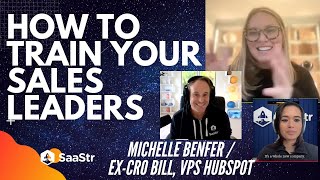
Michelle Benfer, ex-CRO at Bill and HubSpot, discusses how to build world-class sales manager teams. She shares a study finding coachability is the strongest predictor of rep performance, and outlines three pillars: consistent learning, rigorous measurement, and intentional culture. The ideal manager-to-rep ratio is 7:1.
Chapters
And then, yeah, going into your new role, I know you're at a new PE firm. Do you want to share a little bit about that and maybe what you guys are looking for, or maybe just your quick, you know, quick, quick thoughts on, on PE and venture and all that?
Yeah. So, so it's— I've been at my new role for only 8 days now, but I'm working for Francisco Partners Consulting, which is an arm of Francisco Partners, which is a private equity firm based out of the Bay Area. And it's an interesting pivot for me. I really love the kind of work that I did. I've been a revenue leader forever. And now in this new role, I'll be working on strategy execution as well as executive coaching across the portfolio companies at Francisco Partners. So I'm excited. It's a different pivot. It's looking at businesses through a little bit of a different lens and at a higher level. So yeah, I'm looking forward to the, to the, to the work.
Cool.
Um, can I ask one question before, before Michelle starts? Just a meta question before we— I really want to save the time for talking about frontlight sales managers, but HubSpot to Bill Hub, and I may have this a little bit wrong, but HubSpot, we're talking about there's bigger customers, but $10K, $11K, $12K customers on average, right? The M and SMB, as Brian used to say, or likes to say, right? Bill's got a lot of tiny customers. Yes, tiny. Like, I don't know what the average ACV is, but it might be $1K or something like that, right? On average. Right. So if you had to summarize all the differences between selling to $10K and $1K, what resonates with you? What are your big— how different are they? What are the biggest differences that come to mind?
Yeah, great question. And I'll tell you, a lot of pattern recognition between the two businesses, Jason. HubSpot, when they opened the aperture to go to a freemium motion, we got a lot of those, you know, lower end of the market customers. And so I think, and to be honest, the pattern recognition even extends back to when I was at LogMeIn, which had the product Join.me. It had Rescue. They merged with GoToMeeting, became GoTo. But I think any, any company that is working in that micro small business space really has to delineate where do we put resources and investment and how do we create more of a PLG motion in order to continue to, to create that moat and that volume and improve those conversion rates downmarket in order to free up time, resources, space to really capture if it's lower midmarket, if it's really the upper end of small business, But how do you segment and make sure that you have the right go-to-market motions across marketing, you know, sales execution and customer success? So, similar. And when I started at HubSpot, I ran the small business sales team for 2 years there. So, a lot of our customers were below 10 employees. So, yeah, similar, different, but similar.
And just one last follow-up and then I'll, then let's do frontline sales managers and ask more questions at the end. But if you had to summarize today, there's been inflation, the world has changed.
Yeah.
Where is the line where you can have human in the loop in sales and when you just can't? When can you afford it in 2025? What's the line, you think, if you had to, if you had to draw one at an exact ACV?
Oh, that's a good question. Well, to be honest with you, Jason, I, I would have to say it depends on where the company is in their growth trajectory and where you are in your learning curve about your ICP. And so, you know, if you know your ICP down pat, a $5K ACV and below, I would 100% try to figure out how do you get as much of an automated process to engage?
Okay.
Yeah, that would be my perspective.
Yeah, it's good. And do you think you can offshore that or go to Latin America or Eastern Europe to drive it down, or do you think that strategy doesn't really work?
I personally haven't worked on that strategy to offshore acquisition. Yeah, I've seen it done really well at HubSpot when it came to using either chatbots, but really humans in chat converting the starter customers, the lower-end customers. I think the bigger play is how do you make sure that you are landing and the expansion is the real play, especially if you have multiple products. And so if you can have a lower cost acquisition, but you have your expansion right, and from a timeframe, from a motion, in my view, that's where the special sauce is.
Cool. 5K is a great one. Okay, let's, let's talk about frontline sales managers. I could ask you a lot of other, I could ask you other questions later or another time, but this is great. Thanks. Thanks for kicking it off.
Yeah, yeah, you got it. So listen, so, you know, Jason, you pinged me. I think I had a post of some kind on LinkedIn. I usually do this while I'm waiting in line, my LinkedIn post at Tate, which is my coffee shop nearby. And you said, hey, let's chat about this on SaaStr. And frontline sales manager, you know, I've run the full revenue organization at Bill. Bill was $1.3 billion in revenue, publicly traded company. I had about 500 people under me. At HubSpot, I was head of of revenue for the Americas. I had about 800 people over me, but I have a real special place in my heart for the impact that frontline sales managers have. And I have to say, and this is from my own experience, as we take a look at the investment constriction that we've all had to endure over these last few years, one of the first areas that we decided to not invest, which to be honest, I think was a mistake, and by we, I mean, also me in terms of prioritization was in frontline manager enablement. And it— there's real impact. So what I'm going to walk you through today is lessons learned from my own perspective and where not in investing in the strength of the frontline sales managers, where that can have downstream impact into the business and some best practices that I've learned along the way. So So let's get into it. Why are frontline managers so important? So listen, I'll tell you, you know, I go into almost every new fiscal year. Some of you, that's gonna start January 1st. For others, it will be other times. And I always go in with this, you know, glass half full excitement that this year is gonna be different. We have the right strategy in place. We have the right goals in place. We're gonna execute better than we ever have. I'm signing up for higher, uh, sales productivity because we're gonna implement these new tools. And I, I'm always so excited as I move into the new year. But as you actually practice and go through the motions of achieving your goals, it's the tactics that can fall short. Sure, the strategy can fall short, but every single year any company I've, I've been at, you start with the mission. This one's usually pretty fixed. You know, you have the vision, whether it's for the year or the next few years. Then you have what are the overall objectives, the strategy that we're going to take, and in the end, it's the tactics. And when we take a look at the frontline sales managers, you know, this is a group that is responsible for delivering and executing against the tactics in order to reach your goals and your overall strategy for the year. And I'll tell you, this can, uh, fall short. And for me, I had at HubSpot, for example, you know, over 100, uh, frontline sales managers under me. And what's great about, you know, high volume, um, sales and large teams like this again is that kind of pattern recognition. And so when I looked at, uh, what are some teams that are doing things really well, what are some teams that aren't? A lot of it came down to the manager. And what I saw was everything from one manager's team sold more of our enterprise SKUs. One manager's team had super high volume, but it was, but it was low ACV and they missed their number a bunch. Another one might be that one manager kept churning reps out. And so you start to see at scale where some of your tactics that you thought you just execute against falls short if you don't have the foundational strength of your frontline sales managers. So in my view, this is what, uh, the benefit really is when you take a look at, uh, not just the impact of a sales manager to their team, but the impact that it can have within the organization. You know, first and foremost, they're hiring your next gen of top talent, and ideally they are hiring the next managers, the next directors. And so you really need to get that hiring playbook really tight and ensure that your frontline managers are doing a great job with their interviewing and who they're bringing on board, and that you're measuring the impact. We actually did a really interesting study, um, when I was at HubSpot, uh, with a graduate student from MIT, and this was actually Brian Halligan, the founder, had, um, asked us to, uh, do this research, which was, If we take a look at how we scored our hires, we had scorecards for everyone. We had characteristics and attributes that we were hiring on. We would give them a score of, you know, 1 to 5. We took a look at those scorecards and we looked at the attainment of those hires 12 months after they were on board, 18 months, 24 months. Is there anything we could glean from who we hired and what they scored highly on that translated to really top performers? And the number one aspect was coachability. And so I share that with you because ensuring that your frontline managers are hiring well and that you're going back and looking at their track record. Are there people who are treated too early? Are there people who, you know, they were just low performers, they weren't ramping on time? It's the frontline manager who really is the key to the success of all of that headcount in your revenue organization. So that's one of them. The other one is the sales manager by proxy of overseeing a team of, you know, 7, 9, you know, 10 reps, they have acute pulse of the customer as well as the macroeconomic environment. So give you a quick example. In early 2022, this is when you started to, you know, on the earnings calls of Salesforce and many others, this was the beginning of the sales pipeline halt, right? We had the post-COVID boom and then it kind of came to a bit of a halt. And what we started to hear from reps, but managers who are sharing this up is the CFO is now on the decision committee. We have to go to the PE firm or the board for approval. We started to see that the financial buyer was a much, much more important key stakeholder. So, you know, the point here is the customer, the access to the customer, you're going to first hear that from the reps and the manager. And so they play a really key role of listening to prospect and customer sentiment. Process. You know, they have acute awareness of what's working and what's not. One of the things that just came off a call with a bunch of portfolio companies, one of the things we were talking about is the importance of data strategy. And with that data strategy, you know, managers and reps, they're going to be the first ones to tell you we have bad data, we have duplicate data. There's one rep who's working at the same account that I am, the customer, the prospect, they're not happy about it. Managers are the first ones to point out there are problems in our overall process. So they can be a real key into making sure you're building for the success of the long term. Of course, they enable people. You know, they're coaches. Dare I say they're armchair psychologists. They are mentors, but they also are teaching the product, product positioning, pricing positioning. They're teaching the systems. They're teaching the reps about the ICP. Now, of course, you know, great companies, you know, have this through an enablement department. But the person who reinforces it and also makes sure that their reps are executing on what they've learned as effectively as possible, that person's a frontline sales manager. Of course, they're revenue drivers. They're the key to growing product acquisition, expansion, retention, and especially when you're rolling out a new product and/or go-to-market strategy for whether it's product expansion, if it is managing your current customer base, you want to make sure that your managers are in lockstep on the how. And if it's not working, that you're getting that feedback as soon as possible. So of course, that's a big one. And then finally, culture. I know everybody has heard this. People quit their man— their boss, not their company. I think that's a half-truth, but it's true. Bad managers, you're You're going to read it all over Glassdoor. And if you're not investing in them, that's going to lead to poor performance for the reps. That's going to lead to poor culture. And one of the things that I've seen very consistently in terms of being one of the biggest growth drivers at companies I've worked at, it's having highly tenured reps. Those reps are the ones that tend to have, in my experience, tend to have the highest in rep productivity. So you want to retain, you want to hire right, you want to retain those reps. And when you have the right leaders in place, they want to stick around and they drive higher productivity. So I would, I would say tell your CFO investing in the, in the above is worth the consistent investment. So you can probably, you know, get a sense for what the, the Flip side is, you know, on the talent side, if you're, if you're trading people out quickly, I've certainly seen this before. If you're not ramping people effectively, that's a real sunk cost. Customers feel it when reps don't know product. Jason, I'm pretty sure this is something that you've opined on time and again in many of your posts. It's just the importance of actually knowing the product. And if a manager is not there to enable and reinforce that positioning, when to go for the Enterprise SKU, when to go for the Pro SKU. Do you sell multiple products up front, or do you do a single product that you land with, then you expand within the first 90 or 100 days? You need the manager, um, to be listening and on those calls and analyzing the conversational intelligence to know if the quality of the conversations is there. So this is really important. As I mentioned, from prospect perspec— perspective, problems will multiply if they don't get addressed. Managers are the ones that are bringing those forward, often loudly. And then of course, you know, missed revenue goals, long tail of underperformance. And we already talked about the impact to overall culture. So listen, the impact of this really is sunk cost. And please take this as a warning from me. You know, I would say at various points when budgets were tight, the prioritization in my view was always enabling the reps, right? Even if there was investment in evergreen content, but if you were not investing in the managers to ensure that they can reinforce, there can be, there can be a real gap there, and it will be a hit to not just your revenue, but also to your overall investment strategy into your revenue team. So How can you build a world-class frontline manager team? So this is a lot here on the left. But as I was kind of thinking about this, I really think there were 3 components, maybe 4 truly, that play into really building an effective team. The first one is consistent learning. We're going to talk about what that can look like, both from great investment there and/or piecing it together. It doesn't have to be super expensive. It just needs purpose. The other one is measurement. Measurement all day long, everything. And I would say the bias for most companies is to measure reps who are underneath a manager. We're going to talk about how you can actually measure a manager and their effectiveness. It really packs a punch. And I've seen that if you measure the right things in managers against managers in the way that you measure, that can really elevate the entire group. So measurement's a big one. And then of course, culture. So we'll, we'll go into a bunch of these. A few I want to call out here on, on the left. Expectation setting, I think, is a big one. And, you know, there's never a wrong time to get this started, but Really making sure that you're purposeful in spelling out what is the expectation of a manager, what is the expectation of a rep, and having that written down for everyone to access and sign off on. And this, you might iterate on this once a quarter, you know, twice a year, but making sure there are clear expectations of what you expect of your managers. Repeatable, scalable frameworks. You know, if you can make things easy, I'll give you an example. We just I did a training when I was at Bill with all of our managers and Mike Weinberg. I don't know if any of you on the call are familiar with him. Highly recommend him. He did training for us. He did it at HubSpot as well. He has a super easy framework about pipeline analysis. It's called RPA and it's results pipeline activity. And it's just letting the reps know once a week we're going to have a call. That's all we're going over. What are your results? What are your pipeline? What's your activity. It's a super easy, quick framework. The more that I think you can have quick, easy frameworks that you can scale, I think, I think the better. You know, a culture of coaching, I think, is a big one. This, this is another one. Different companies have different perspectives on this. Some think the sales manager should be responsible for pipeline management and ensuring that they're in deal coaching. The other one is coaching on deal strategy. It's on, you know, how do you, how do you expand your average deal size? How do you sell multi-products upfront versus maybe just one product upfront? So, you know, a manager really needs to analyze the tea leaves of what's happening on a rep-by-rep basis and serve as a coach to help them improve their performance. The difference between good managers and great managers is good managers say, this is what you were doing. Great managers say, this is how you can do it better, and it's the how that makes a real difference. Manager career pathing. This kind of falls into that learning bucket. Does a manager know what they need to do in order to promote? And that's one of the things I did love about my time at HubSpot is we had automatic promotions, and so people were gunning to hit the numbers that they needed to hit in order to get promoted. So I thought that was a great one. And of course, you need to make sure that the manager is aligned with the company mission, vision, strategy, and goal. For those of you on the call who have worked in revenue, many of you know when you're, you know, know that certain managers are not aligned with the goals for the year. They're not aligned with the strategy. And if, if their friends who are managers know it, you have to imagine the reps know it as well. So how do you make sure that everyone is singing from the same hymn sheet. Okay, so this is on the, the setting expectations early. I just wanted to break this down on the, uh, align, uh, alignment. Um, let's actually start at the bottom here. Uh, I actually have this kind of numbered out of whack, but nonetheless, it all starts with the company goals, right? Does everyone know what we're going towards? Uh, clear understanding and ability to articulate the why behind the company goals. The director and/or the VP or head of sales should make sure that all of the managers can articulate back what are the company goals for this year and why, why do they matter? So I think that's actually a really good exercise. Culture and values, you know, is this person culturally additive? You know, are they demonstrating, you know, high expectations for the highest of standards? How do you know that? I mentioned this earlier, but really that clear expectation setting, a guidebook for the manager role. What are their responsibilities? What does success look like? I think in too many organizations, manager success means they hit their number or they didn't hit their number, and that is very rudimentary. And so there should really be some strong success criteria around that. And then what does it look like if they were progressing from a, you know, softer skill and/or they have mastery? You know, I think there should be different measurements that they are aware of that happen on a weekly basis, monthly basis, quarterly, basis. And some of those measurements should be qualitative and some of them quantitative and ideally benchmarked against their management set if you have multiple managers. And then finally, is there a consistent feedback loop? Is there a coaching culture to coach that frontline manager? What does that look like? What does that sound like? And do you have that in place for your organization today? So I think that's another really important one. So on the learning front, I think there's a lot of areas where you can strengthen manager effectiveness really easily. I really love when we did— I went through— we did a transition of what our pitch was at HubSpot, and everyone in the company, you know, on the revenue side, head of sales, every SVP had to record themselves giving the new the new pitch, and you needed to be certified, and you had a panel who listened, and they gave you a score, and they gave you feedback. Managers should go through this too. And, you know, at the top of the call, one of the things I had mentioned was sometimes we really push rep enablement, and the managers don't have to go through these certifications or these trainings. Highly recommend that there's a level of rigor, and you make sure that not only can your man— have they gone through the certification, but they can prove out that they can execute it really well, and they have an execution plan with their team. Situational leadership. Lots of companies do this through the HR organization. Sales methodology, some of them like, uh, Sandler or like mine, uh, Mike Weinberg, who his is on, um, manager effectiveness. They incorporate, um, manager training in that. But I, I think sales methodology training, I don't care who you are, uh, doing it once a year is helpful to absolutely everybody. There are always new tips and tricks on How to be more effective in the way that you engage and converse with others. I think this, one of them, holding effective one-on-ones, and I mentioned frameworks. There are a lot of them out there. If you just Google effective one-on-ones, there's a whole science behind how do you listen more? What's the difference between telling and guiding? How do you agree on next steps, action items? What are those deliverables? What's the method in which you track your one-on-ones? I think a lot of frontline sales managers, especially if it's the time they're doing it, they struggle with being liked versus being effective. And a lot of one-on-ones, you know, don't get recorded, or they're only recorded if someone's not doing well. I think the practice of effective one-on-ones is a really good one that I don't care what department you're in is really good. Um, one that is really inexpensive that I know my teams have loved in the past is when you bring in the CFO to talk about trends in the business, why the stock price might be going well, why it may not be going well, what are we hearing from investors, what role do they play in it. There are all sorts of ways that teams can figure out how they can get closer to the macroeconomic trends that are happening. And then some of these other ones, diversity, bias training, these are always really great food for thought as you think about building inclusive and diverse teams. And of course, radical candor. I think this is an area that I have seen managers struggle with, especially when they become close to their team and they've managed some people for many years. Those are the reps that they tend to not get a lot of feedback, or if they're one of the best reps, their learning can end at times with their manager. And so, making sure that there is this continuous feedback loop, that managers have the strength in delivering radical candor to tell someone, the path you're on is not the right one, let's get you on the right path, I think is really important. Then these last two, I think anyone who's manager level, even director level at companies, how do you influence without authority within the company and/or how do you effectively manage stakeholders internally and execute change? I mean, my hope is, So many of your businesses are high-change organizations because that means that you're growing. And these are all areas in which you can enable and improve your managers. And so many of these, you can just Google it. You can do a YouTube video. You can send a TED Talk. There are a lot of inexpensive ways as long as there is a strategy behind what are some of the skills that we want to reinforce for our people. This is the area that I geek out and, and makes me feel like I have real handle on what's going on in my business. This is the measurement side, right? So effective measurement is really effective management. So I would really implore you to think about how you analyze the impact of a frontline sales manager. So I talked about this before, daily, weekly, monthly, quarterly, you know, manager goals. Both companies, last few companies I've worked for, culture score, actually having a manager employee net promoter score tells you a lot about how the team is feeling and where the manager is effective. If you don't have that in place at your company now, a very simple Google form that says, what is Jason good at? What should Jason continue doing? What should Jason stop doing? Any other advice you'd have for Jason? Really easy way just to get some very quick, you know, feedback from the team. This one I really love. When I left Bill, this is an area that we really started to measure, but of the managers, we pulled this from Gong data. You know, how many calls are they attending? How many calls have they scored? How many calls have they listened to? That really goes to show coaching and engagement with coaching in the reps. We actually did an analysis when I was at HubSpot, and we saw that the managers who engaged most in Gong had the highest attainment. And so a little tip for those of you on the call. And then lastly, on the measurement side, just an area I recommend is a manager benchmark scorecard. This one right here, this first bullet is one of my absolute favorite ways to measure manager impact and effectiveness. What percent of their reps— and you can do this for last month, trailing 3 months, trailing 6 months, trailing 12 months— what percent are above 100%, you know, 110%, 90% to 100%, 80% to 90%, you know, below that. That, in my view, really gives you a good sense of what is the balance of strength of a manager. And so you'll have a manager who is crushing their number. They have a great territory, they inherited some of the best reps, but they really have 2 reps carrying them that have been, you know, banner reps for years and years. So when you take a look at the balance of health of a team, I will take a manager that, you know, is bringing people up and over 100% more of them than the manager who's crushing the number, but it's only from 2 people because that's high risk. So I really love that measurement. Rep attrition. This is another one. You know, you see a manager has attrited maybe 3 reps over the last 4 months, 5 months. You're going to think there might be something here. Overall rep productivity. How does that benchmark against some of the other manager teams? The amount of ramp time. Is the manager making sure they're, that they're getting the reps up and running quickly? And then the commercials, you know, what is their ACV? What's their product mix? What SKUs are they selling? How much is their discount? I've seen a lot of variance with manager discounts, sales cycle length. It's really, it's really interesting when you have so many managers at scale and this pattern recognition that you see. A lot of this differs manager by manager and it's not just reps. You see the change. And so a lot of this really is behavior that can be worked on and improved. And then this last one, which I think is certainly important for anyone who is a rep new leader or CEO, you want to make sure you have forecast accuracy. And so measuring that on a monthly basis, how accurate is the manager's forecast? You know, what is the variance? Is it plus or minus 5%? The ideal for me has always been within about 3 percentage points. 2 is really ideal, but that forecast accuracy is really important. And then we're getting towards the end here, but you know, I mentioned this before, direct managers are often the number one reason employees you know, stay or leave. So a best practice that I've seen with my teams is, you know, you start a new year, you know, having everyone on the team under a manager together define what should our team culture be, what should our team identity be, and spending the time to talk about where are we, how do we want to operate together, what are our guiding principles, and what do we want to hold ourselves to. Making sure that the company values are really permeated through everything the team is doing. And examples of that should be celebrated often. For example, humility, um, or accountability. I think those are great ways to showcase, you know, once a month someone gets a, a values award. Uh, team meetings. I've, I've certainly joined some snoozers of team meetings. They should really be to energize and align. And, um, in an interview process, you know, I would specifically ask frontline managers who are applying, What does a great team meeting look like to you? How do you galvanize your team? What do you do? What do you learn? You know, what do you bring to the table? Transparency, candor, high execution, psych safety, of course, is important. And just reinforcing the fact that managers really are that connection point from the company culture to the team culture. And we all know that unfortunately, certain people can get it wrong. And that makes a real big impact, and that one manager can impact 7, 8, 9, 10 people, which certainly is a hit to the culture. OK, real quick, internal versus external hires. This is a question I get a lot, and, and, you know, I, I think they're both great. Internal hires, it's going to be faster ramp time. It certainly bolsters the culture when it comes to reps and other managers seeing career progression. And that institutional knowledge at a company expands, right? There is a real immediacy to the impact that an internal hire can have. That said, you know, at a certain size and scale, you want people who have seen the film and can add new value, new perspective, new skills to the team. And so, if you're taking a look at your team and almost everybody there has grown up at the company, you might wanna think about bringing in a fresh perspective on how things can be looked at and executed differently. Differently. The, the second bullet here is, uh, especially for those disgruntled managers, you know, who are over the baggage of systems issues, data issues, process issues, um, bringing in someone fresh who can see everything from fresh eyes and being grateful to be at this new company with eyes wide open. Um, I think that can also bring a real boost to other people around them. So they're both, they're both good, um, needed for different times of growth. Common mistakes. This one I mentioned, investing in rep development and assuming that manager development can be lumped together. Lack of a consistent feedback loop on the manager's performance beyond hitting their number. Looking at manager attainment simply as a number, not as a holistic scorecard. And then the success criteria of what a really solid, effective, good manager looks looks like, you know, not being codified, whether it's through the expectation setting or during review periods. But some of the things that should be brought into view include, you know, are they effective at cross-functional collaboration, or do people that they work with hate them? Do they manage change well, or are their team laggards with change, or do they take change very quickly? So final thoughts and tips. Really make investing in frontline talent a priority and in every year line item, as I mentioned, there are a lot of inexpensive ways to do it, but it really should become a fabric in the way that you operate, having a continuous learning culture. I think you should think about and quantify the cost of getting it wrong. There are real, real costs to the business. Topline revenue, as well as, you know, just long-term impact if you don't get this right. And, you know, I'm happy to discuss some ideas on the many ways to enable and prioritize that outside investment in the short term in order to get that long-term ROI. And that's what I got. Jason M. Lemkin. Hand it to you, Amelia.
Yeah, go ahead, Jason.
No, no, do we have questions? I always can ask them, but I don't want to monopolize it.
We do. We have two people asking the same question, um, that I think you can both— we've written about it a lot on Fastr, but I think good to get both of your takes here live, which is, what do you think is the best sales comp plan structure?
Uh, it's a very loaded question. I, I don't think I have I don't think I can actually give an answer to that, and it's because different companies, you know, you might be at one company and it might be all new business, logo acquisition. It might be you need to get the deal size higher. There are a lot of variables that play into that. And so I, even on my own team, there isn't a one, one size fits all that I've seen. There have been different comp plans for different people, but the standard I see for SaaS reps 50%, um, salary, 50%, uh, variable. And, um, some companies have it where, you know, if the rep hits 110%, the company hits 100%. That's the HubSpot model. Some have it if the, if the company, uh, if the reps hit 90%, the company hits 100%. Uh, so they were all different.
It—
I, I don't think there's one best answer.
What do you think, Michelle, on the when you're trying, when you're talking with candidates, base versus OTE, what are the flags, um, and versus attainment, right? Because at the end of the day, base, if you're any good in sales, even if you're mid-pack, base is almost meaningless, right? Um, it's attainment and OTE. What are your thoughts on that? What are your thoughts on candidates that are obsessed about base? Um, what are your thoughts on the fact that I find most sales folks can't do this math very well.
Yeah, yeah, they can't.
They're obsessed. I need the highest OTE. I need $10K more OTE, but it doesn't matter half the time, right? So thoughts on that, that mix of, uh, that mix of, of pieces and the ability to explain it to candidates?
Yeah, I— so, uh, so I will say in my heart of hearts, you know, I've been in sales now for, uh, almost 25 years, 24 years, I have seen so many great reps leave companies, really good solid companies, because they got a higher base, higher OTE, and it never came to fruition. And so I think you're—
yeah, like never, right?
Never. And your question's a super valid one, uh, and/or also to chase a title, a big title, and they're not even ready for that title that is just being given to them. Um, so I would definitely say Go to RepView, uh, if, if you know, if they have, or Glassdoor depending on the company size. But it's always nice to see if they could talk to another rep or hear from other reps, you know, what percent is, are they actually making their number. Um, anything below 50%, I would just be a little wary of. Um, you know, this, the odds are much lower that you're going to hit your full OTE. I would also ask about things like accelerators. I would ask about clawbacks. I would ask about what is your retention. I know people get excited to get new jobs, especially if they're trying to get out of something that they're not happy about. So they'll forego asking those tough questions. It always bites you in the tush. And so you got to ask, you know, about accelerators, retention, clawbacks, overall rep attainment is my recommendation.
Yeah, let me bring on Ray. He's got a good question. Obviously, he's an Asper Superfan too. Hold on, let me add him to the— Add him in here. I can. Ray, do you want to ask a question while you're there? Oh, you're on mute.
Sure. Thank you, Michelle, for the session. It was great.
Yeah, you got it. Thanks.
Here's my question. How did the— so manager to AE ratios while you were at HubSpot, and you talked about like the importance of frontline management. What did you find was the ideal manager-to-AE ratio at HubSpot? And what— how would your answer change if you think about 2021 world and 2025 world going into next year?
Yeah, good question. So I will say the sweet spot— this is my ideal sweet spot— is always 7 reps to 1 manager based on, on, on where I've worked. I found, by the way, that's expensive. That's an expensive model. I've found even when at HubSpot we were a more of a single product company. So I started there in 2018. The sales product hadn't really, you know, busted out just yet. 2018, 2019 is when it really started to get its, its legs at scale. 9, 10 was just a lot. And it depends what percent of your reps are you ramping, what is the ramp time, how much enablement does the company invest in, how much does the manager have to do, how many products do the reps have to sell, what is the sales cycle length. And so the more complex the sale by nature of, you know, sales cycle length is how I would how I would measure that. And number of products is where I would err on fewer, fewer reps per manager in terms of the ratio. 7 is a real nice to have. That's a very choice setup. I would say 8 to 8, 8 is more likely. 9, I think, tends to stretch it.
And if you're in the squeeze right now, which a lot of companies are, I'm seeing a lot of companies squeeze that to 10 or 11. Like, you know, if, if you're kind of a stuck unicorn, are you seeing that as well?
For sure. Yeah. I mean, lots of guys, 10, 10, 11 is, um, like, again, if you're highly transactional, single product, one call close, I can see that working. Um, but what you need to do is also make sure, do you have really, uh, strong evergreen content, reinforced enablement? If you have a system and an engine in place, you can get those ratios right. You just have to make that investment upfront in order to be less reliant on headcount for your linear growth.
So if you were getting squeezed on headcount, but you could get buy-in for an additional investment and enablement, you could make the argument that, okay, you can push higher ratios if you invest a bit more here and align the unit around that.
Correct.
Yep.
I mean, I think everyone's got to be looking at what do we invest in today that's going to pay us back in, you know, the next 24 months, 36— how are we building our foundation for tomorrow? And investing in that evergreen, uh, automated enablement, I think, is a home run.
Um, if you want to be less reliant on headcount, probably wouldn't be reasonable to push you super high and then say also no enablement for you either, right? On the other side, that probably wouldn't be reasonable. So you'd probably wanna fight for that.
I would agree with you.
Cool.
Thank you.
Yeah, you got it.
Oh, Jason, you're muted.
Sorry, you touched on this in your presentation, but for those managers, those directors, RVPs, managers of those teams of 7 and 8, do you have a rough sense of what percent should be internal promotions? I made up a 50-50 rule a long time ago, but it was more to your slide to challenge you to one, promote your top your top folks, but also look outside, right?
Yeah.
But I made it up, the 50— there's literally no source of data for that 50/50 rule. Do you have— what are your learnings on that ideal ratio of who to— where to source them versus promote them?
Yeah. I, I, I, this answer, it, I would say it was different for different times. And so, for example, at, at HubSpot, when there had been a big, like, expansion of headcount and we needed to grow teams really quickly, You're going to pull your talent inside unless— and one of the things we saw there was when you hire an external manager, their ramp time just took a while. And at times their reps suffered and their reps got real frustrated that I'm stuck with the manager who came from the outside. They actually can't enable me. They don't know what they're talking about. So, they're going to other managers and there's a real tax. And so, I think you have to take a look at how intensive does manager ramp time and coaching need to be. So at HubSpot, our small business group, that was the first place where reps started. You went from BDR to small business, small business to mid-market. As you go up, you don't need as much, you know, deep coaching from the manager in terms of skill set and how to do your job. You need more deal coaching, right? What do you do with this next deal? How do I remove roadblocks for you? So those upmarket roles is where I would say, you know, let's go a bit more external. Whereas if you can hire quickly and get that faster ramp time for the volume, I think that's a good internal view.
Yeah, I remember actually, I forgot. I remember in the old days, you know, Salesforce, I mean, I'm dating myself, but they used to have 8s, right? 8, 8, 8 AEs would report to an RVP. And I think there were 8 RVPs would report to a VP or whatever the title was, right? But there was a 9th. I don't know if this ever happened, and she or he would just sit there for 6 months being trained so that when one of them went down on the field, quit, or was fired to the 8th, immediately you didn't have to hire anybody. But I remember I interviewed with the 9th and he's like, I'm just sitting here in my cube in San Francisco for 5 months. I'm the 9th. I'm the 9th RVP in my pod.
Yeah, and we've had to— one of the things I saw is as a lot of companies extended their parental leave policies. So first it was—
Oh, that too, right?
Yeah. The leave of absence used to be 3 months for women. Now it's 6 months up to 5 months— or sorry, 4 months up to 5. Then they gave it to the non-birthing parent. And so then you have double the number of talent who are out on leaves of absence. That's where Jason, that 9th, right? Or get bringing that add-in. That was over the last few years. That's been a real tough thing to plan for, and that can really bite you if you have a team that happens to be in that parenting, parenting timeframe of their life.
Yeah, it's like, how do you be super supportive? But as a smaller org, how do you handle it? It's a complicated topic, right? Everyone wants to be more supportive, right? But lose one manager, sometimes it feels like the world's ended.
It's—
and it's 6 months is forever for a startup. Maybe for HubSpot you plan around, but it's forever. 6, 9 months. It's like it's a whole— it's a whole new company.
Yeah.
And I— both HubSpot and that bill, getting the leave projections right really made a material difference because you had the headcount to support the departure.
Yeah, Michelle, you've gotten a lot of really good questions, so we'll try and just hit a few more before we hit the top of the hour here. One you've gotten that I'll ask for the attendee is, what's your advice for frontline managers to manage a high performer, but maybe a high performer that bends the rules a little bit? Like, how do you What's your advice here? I think it's a good question.
Never met one like that.
Yeah, it depends on the bending of the rules. I would say someone will always unlock the loopholes of a comp plan, the loopholes of the rules of engagement. And the good news about that is that means you have savvy, clever people. And I hate— as long as it's not unethical, but they found the loophole, they found the loophole. It just is what it is. You close the loophole. So, you know, I think there's gradations of bad behavior versus bending the rules. You know, I think each manager has to make sure that their people are operating above board. If they found a loophole, that once you find it, you got to close it up. So that's what I would say. My biggest piece of advice with top performers is how do you continue to engage them? And get them to be learning in ways that they haven't mastered yet. And what does that look like? There's some good articles on Harvard Business Review about managing top performers and that I'd recommend.
Yes, sometimes a niche topic of the decay of your top performers, right? They get so dialed in to what works, right? When the world changes or just when they have to work differently or harder, They don't always make the transition. Sometimes your top performers aren't a top performer around year 3 or 4 when it's not the same HubSpot.
Totally. Yeah. And, and I've also seen, uh, it's sometimes the newer performers who do well are the first ones to adopt new product launches, try new things. Um, so, you know, we're all creatures of habit. You know, some of us are just more, you know, change positive than versus change averse, you know.
Yeah, I want to try to get to one more from Anjay here. I know there's— sorry, I don't think we'll get through all the questions today, but let me, let me try and add him real quick. He's got a good question. Do you want to come off mute?
Yeah, thanks, Amelia. Michelle, thank you for a really great presentation. So I know there's Gong and Chorus and all of these tools that help you get insight. But I haven't really found a really good way to synthesize the insight across all the calls, all the interactions, and then finding that frequency. So I, I was wondering if you have any suggestions or techniques that you've used to assimilate all of those insights, and then what's the frequency with which you then collect it and disseminate it? What's the structure look like?
Hmm.
Uh, that's a good question. I haven't done that in a while. I'll tell you what I did do, but I think it was because it was Gong's early days. So we partnered with them early on where we would give them our, um, uh, attainment list, right? Here are our reps, this is their attainment. And then we would append it to these reps' behavior and we would take a look at what are, what are they saying? How much are they talking? What are those nuggets? Of the top performers and how do we make sure that we share that out with all the performers in order to raise the group. I think HubSpot— I know we had kind of a data sync issue that we had to do all this manual offline, but I do think that Gong does that today when it comes to aggregating some of those insights Otherwise, haven't done anything outside of that, AJ, in terms of aggregating like more intelligence on the conversational intelligence that kind of wraps it all up in a bow, if you will.
Got it.
Thanks.
Great. Jason, any last ones before we break? We're reaching time here.
You know, I got a lot. One, we should, we should break. You know, there's just one, one, just going back to the core Maybe I'll have to pick one of these two. Um, I'll do the second one for fun. Radical Candor.
Yeah.
So, um, I think high-performing leaders love the idea. Um, 2025, I find most mid-pack people resent it.
Yeah.
No one wants feedback 4 years after that bug went around. That's not a high performer. Learnings. How do you, what level of feedback? A mid-pack. And sales is great cuz it's so human-focused, right? You're mid-pack B, B rep. And we want, all wanna hire 10s and As, but the truth in sales, it's impossible at scale for that to be true. Right? You could debate it, right? How much feedback to your mid-pack rep that's okay, that you wouldn't cut, but that's just above the line and, and probably doesn't want to improve? How do you handle that situation when in a TikTok age?
Yeah, so, um, so listen, I'm, I'm from Boston. I don't know anything other than being direct, and I can be direct and still say it nicely, but it's just, it's my way. So I understand not everyone is like that. Here's what I would say has— I've seen work even with people that are not as open to direct feedback. If you start the year as a team and you go through everybody's why— Jason, what is your personal goal this year? What is your professional goal this year? How do we as a team help you achieve that? And you put it all out on the table. You're always, as a team, saying, how are you doing progressing towards that? Is it working? And it's that mutual shared accountability. Once you have all that on the table, as a team, you can always go back to, you know, Jason, you said you wanted to buy a house, you want to propose to your girlfriend, whatever it might be, uh, and this is how I'm going to get you there. So that's, that's one, that's kind of qualitatively. Quantitatively, use the data. Jason, this is how many calls you make. You're making more calls than anybody else, you're sending more emails than anybody else, and you're not hitting your number. Would you prefer to work less but have better results? Would that be beneficial to you? Yes, all day. I'd like to work less but actually have better results. Let's walk you through how we can do that. And when you use data, it's not as personal. You're taking it away from I'm judging you to let's take a look at this set of information, let's analyze it together. And do you want to get on the path to hitting your goals? Yes or no? If you don't, that's a different conversation.
Data certainly helps for sure, right? Yeah. Good, good coaching. Cool. This was great, Michelle. Thank you very much. Amelia, we got anything else to wrap up?
Yeah, we have a few others. I don't think we can get to them all because there's like 5 more in the queue. So, Michelle, for— yeah, we're out. We've already done— we've taken an hour of your time. So if folks do want to reach you though for advice, what's the best way for them to do that?
Right on LinkedIn. Michelle Benford. You can find me right there and appreciate anyone who reaches out. And thanks for listening.
All right.
Awesome.
Cool.
Thank you, Michelle.
More from Jason

Why Your Next Hire Should Report to an AI, Tragedy Apps, and Too Many AI SDRs? | The Agents #004

Our Agents Drove Our Salesforce Bill Up 80%, Marketo Hates Agents, and We Stealth-Churned Off Notion




Managing 20+ AI Agents: Lazy Agents, Our $500K AI Bill, Stealth Churn & the Death of 60% Solutions




