How we did it: Gender Equality, Equal Pay, and Racial Equality with Salesforce
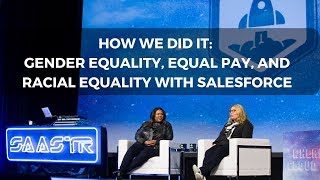
Leyla Sekka and Molly Ford describe how Salesforce built an equality program from scratch, starting with a 2015 Women's Summit and hiring Chief Equality Officer Toni Prophet. Annual pay audits found $3 to $8 million in disparities over three years, which they fixed without cutting anyone's salary.
Chapters
Please welcome Salesforce EVP of Mobile, Leyla Sekka, and Salesforce Global Equality Program Senior Director, Molly Ford. Good morning, everybody.
Good morning. Good morning. We are very, very sorry that we are late. Traffic in the Bay Area is a bit of a beast. What can we say?
Absolutely.
Hi, I'm Leyla Sekka. I'm the Executive Vice President of Mobile at Salesforce. I've worked at Salesforce for 11 years. And this is?
Molly Ford. I'm the Senior Director of Global Equality Programs at Salesforce. I've been there about 7 years, and our function of equality is about 2 years old. And Saastre, you're in for a treat today.
Yeah, so Molly and I, we were actually on Twitter last week. Molly did a TED Talk earlier last year, and I was tweeting about that, and Jason sent us a note and asked us to come here and chat with y'all. We thought we'd tell you sort of the story of how equality came to be at Salesforce, because it's a pretty interesting saga, right?
Absolutely.
So let's start back about 5 years ago. I was running what we call the AppExchange at Salesforce, which is like our app store. And I got a new job running a business unit called Desk.com, which is customer service for small business. And Molly was my PR lead. So we worked together all the time.
Absolutely.
So I'd been working at Salesforce for a while, and I'd always— I grew up in product. I was a product manager for the lion's share of my time. And even before Salesforce, I'd had this feeling that the men were getting paid more than the women. It was just sort of a sense, like when we were around the water cooler, they were talking about things they were buying. And I was like, meh, I could buy a Tesla, but that would be so stupid given how much money I make. And they were doing this. I had been talking about equal pay for a while, and Molly and I were on a train.
Yes, we were on a train ride going from Boston to New York for some Salesforce events, and I had this great presentation or an idea, and it was about 2 years old. It had been some PowerPoint slides, and I basically said, envision this, you're at a conference, and then one day all of the sessions, all of the panels, you look on stage and everybody's a woman, right? Whether you're talking about AI, leadership, anything, and I had this idea for about 2 years years on my laptop. And I said, hey, we've got some downtime on this train ride. Leila, I have this great idea. Do you want to see it? Do you want to hear about it? And I started to show her my slides. And she said, make some changes. Do some things a little different. Send it to me.
Right?
And when I talk about this at women's conferences, people go, oh. You gave your idea away. You gave it to someone. And little did I know— I'll let you have the rest of the story.
So Molly and I were on this train, and she had this great idea. And now a women's conference doesn't sound so outrageous, but back then it was a pretty outrageous idea. So I had been thinking about equal pay. I'd been working with our head of HR, who's also a really good personal friend of mine, Cindy Robbins. And she and I had been playing around with the idea that something we wanted to sort of approach equal pay. And then Molly came with this great idea for a women's summit. And we'd also been sort of talking about a mentoring program for women inside of Salesforce. Cindy had a one-on-one with Mark, and she invited me, and we got all ready, and we went to the one-on-one, and we sat there. And, you know, the crux of the conversation was about equal pay. And it really was us sort of saying to him, hey, you know, we think there's an issue here. And his response was funny. He was like, no, no way. We would never have that. That's not our culture. That's not our company. And I was like, yeah, but nah. And Cindy was like, yeah. And then we said to him— Cindy said to him, look, if we look under the hood, if we pop the hood open and see, like, there are equal pay issues, we're going to have to address them. And he said, OK, let's do it. Let's pop the hood and see what we have. And then I very quickly was like, oh, and by the way, we want to do a women's summit. And we wanted to do this mentoring program. And he had said yes to the mentoring program. And then I said, we want to do this women's summit. Molly Ford has this great idea to do a women's summit. And he did a funny thing where he was like, yeah, yeah. And then I was like, okay, so budget. And he was like, yeah, yeah, go find it. But, you know, do it, make it happen. So I called Molly. Well, first I called my mom because she was super fired up about it.
No, I think I got a text that said giddy up.
Oh, right. I sent you a text.
Giddy up.
I sent you a text that said giddy up.
Right.
Right. So we got the approval to do it and then sort of began the real work. And Molly did the lion's share of that.
But the point I want to call out here is when we talk about mentorship versus sponsorship, Notice what Layla did for me. She actually took my idea into rooms that I wasn't in. You know, it's about having that seat at the table. I wasn't even in the room, but more importantly, she kept my name on my idea. So it's about advocating for people when they're not physically in that room, taking their ideas forward and keeping their name on it, right? And making sure they're getting the credit for what they did. And then that Women's Summit, 2015 Women's Summit, Jessica Alba, Susan Wojcicki, Gayle King, Patricia Arquette, all these powerful women on stage. And again, today we know conferences struggle to get women there, but to think a whole day of programming and you're just seeing women business leaders, that's phenomenal, and it doesn't happen as much as it should, right?
So this is a big deal for Salesforce. You know, we stood up for equal pay, we did the Equality Summit, we did a lot of things on this, and we sort of, as we like to do as a company, started flexing our muscle around this. And in the flexing of that muscle, which Molly, Cindy, myself, all of us were a I was a big part of, the notion of hiring a chief equality officer sort of came to fruition. And Molly, why don't you tell the story of how that came to be?
Yeah, so I was doing my little PR job and hustling on the side doing diversity work, and that work started to be noticed that I was the person behind some of our narratives, writing, kind of helping tell those stories. And so Marc Benioff reached out to me and said, hey, what do you think's happening here? But the very first question Marc asked me was, What's your experience as a Black woman working at Salesforce? That's a powerful moment because not enough leaders are asking their employees, we talk about culture, but what's your experience with your identity? How are you moving through the company culture? And that kind of led to, we were going to do a big equality project or diversity project, and that led to the hiring of our first Chief Equality Officer, Toni Prophet, someone who had been in our ecosystem, but also doing some equality things in his day-to-day life and job. And that kind of led to becoming an actual official equality team.
Which Molly was the first member of.
Absolutely.
And you know, there are lots of stories around allyship and equality. I wanted to tell you one other thing around this, and that is when Tony came on board and Molly and Tony sort of formed the Office of Equality at Salesforce, which has now sort of become a core part of everything we do at the company, We have employee resource groups, which most of you do have, or as your companies grow, you will have. And these are groups where people identify and self-identify and gather together to share experiences and to have different types of events. And we've always had them at Salesforce for a long time, and we were looking for executive sponsors for those groups. So Tony called me and said, I want you to be the executive sponsor of Boldforce, which is our Black employee resource group at Salesforce. And I called him back and I said, hey, that's cool, but I'm not Black. So don't you think I should maybe be like in charge of the women's group or some, you know, I am one, I'm a woman. And he said, no, no, we talked about it. We expressly want you to be the exec sponsor of BoldForce. So I said, yes, of course, you know, I'm happy to do anything. And then I sort of did a very similar type of thing where I spent a lot of time listening to, the Black employees inside of Salesforce. How does it feel to be a Black employee at Salesforce? How does it feel to be a Black person in technology? How does it feel to be a Black person in America? All things I cannot understand, but I can try really hard to have compassion and understanding around. I know what it feels like to be a woman in technology, and I know how hard that has been at moments. So, you know, I can consider how difficult it would would be to be even more different than everyone else. And Molly has this great thing she says, which is the onlyness.
Yeah, we talk about onlyness at Salesforce. When you're the only person of color on your team, you're the only woman in a room, it's the loneliness of being the only. We call it the onlyness, right? So one of the messages that we're really clear to not just preach, but also execute at Salesforce is this community of allies and allyship. So Layla saying, yes, I will be the executive sponsor, That means I'm mentoring, I'm sponsoring the careers, I'm leaning in for Black employees. And she's saying, I'm doing that as an ally. And we're very clear that we're like, allies is not about hero worship or great white savior, you know, like the movie Blindside. That's not what we're asking. It's like me as a straight woman, how am I an ally for the LGBT community? How are you leaning in for other people, right? That's really what it's about, building this community of allies that we're asking folks. And then I want Layla to talk about language, right, and why language is super important and kind of some flack she received because the hard part about being an ally, well, let me stop and say, what does an ally look like at Salesforce? We have 4 steps to being an ally. Ally is actionable. It's ask, ask people about their journey, right? What's it like to be a Black woman? Listen, listen with empathy and respect. Show up. So when there's a South Asia Force Diwali festival, show up, right? Enjoy and learn about their culture. Show up to a Boldforce meeting if you're not Black. And that last one is, Which is super important is speak up. So if there's that racist joke, that blonde joke, and in this era of #MeToo, you have to speak up. So it's not good enough for men to say, well, if I never open my foot, my mouth, I never have to put my foot in it. Being on this ally journey means you may mess up, you may say the wrong things, but you ask the questions. And so tell them about like the language, like people aren't armed with the language for equality right now or diversity.
Right, so one of the first things I did when I became the exec sponsor of Bold Forest is I asked them, what do I say? Do I say African American? Do I say black? Like, what word do I use here? Because I'm confused. And they said, we've self-identified as black. That's the word we use. That's the word we want you to use. And then, no, that was great. I was listening. And then I was in an exec meeting. You know, these are good people. These are like some of the best people in the world I've ever met. We're in an exec meeting and somehow it came up and I started talking about Bold Forest and I said, you know, the Black employees, whatever I said. I said something. And I finished saying it and then we had a break and we were all like walking to the loo or whatever and maybe 4 or 5 different people who are my friends, who are people I love, came up to me on the way to the bathroom and they tap, tap, tapped me and they said, "Hey, Leila, you can't say the word Black." And it was such a moment for me because all I could think was, my word, if we don't have the vocabulary to have the conversation about how we need to change, how the hell are we ever going to change, right? And so with that, I, you know, I really thought a lot about that. That was like a real moment for me. And to Molly's point of like, you You can't get in trouble if you don't open your mouth. Like, those days are over, okay? That type of leadership where you stand back and are like, "Hmm, I'm going to see what happens," you won't be a leader in 5 years if that's the way you decide to do it. Like, you have to play in this. And if you are a white person, my God, if you are a white man, which I love white men. I'm married to one. I made two. I'm down with it, right? I like them. But you have the most important voice in this. Because no one expects you to say anything, right? You can just stand by the wall and be quiet. I don't agree, but I'm not, you know, I'm not getting involved. That's the definition of privilege, ladies and gentlemen. And in this day and age, can we stop and clap? Yeah, I agree. I mean, I do think that that's the definition of privilege, and I have a lot of privilege. I'm well aware of how much privilege and luck I've had in my life. I'm not sitting up here acting like I'm perfect by no means. Means. But I do think that in the day of Me Too and in the day of diversity and equality— this was not a topic 5 years ago. We were weird in the corner being like, we got to do something, something about this is wrong. Like, and she's a black woman and I'm a white woman, and we work at a really amazing company that's on the edge and thinks about things a little bit differently. But like, this wasn't normal. Like, by the way, I'm old, but cloud computing It wasn't normal 10 years ago. I spent like most of my career telling people it was okay to put their data in the cloud. Now we act like that's normal, right? It's the same thing with diversity. 5 years ago, we were talking about this on a train in hushed voices back and forth. Something's wrong, and how are we gonna do this? And now we're sitting on stage in front of all of you, like the leaders of Silicon Valley. You are building the companies that will be the next Salesforce. So as the leaders of those companies, how are you gonna show up for people people that don't look like you. Like, how many of you are mentoring a person of color? How many of you are actually sponsoring a woman? Like, standing up in the room and being like, "No, she should get the job. No." I don't mean to sound preachy, but I just think we've hit a point in our collective history as the technology geniuses that are changing the world in which we need to take a look at the world we're actually creating around ourselves as well. I got preachy. Absolutely. But you know how it is. Thanks. I think it's important. I just don't— and you know what, being an ally wasn't easy. I'm not going to sit up here and tell you that that was always easy to be the one standing up and saying things that were not necessarily the easiest thing for other people to hear. And I took some hits, you know, definitely took some hits with all of this stuff. This is not work you do without understanding that some people are going to have a feeling about it. But if you're not doing this kind of work, work, you're doing a disservice to your company and your employees.
Right? And I also want to say, don't look back, don't sit up here and think, well, they're Salesforce, they've got amazing tower, they have a megaphone and a CEO that's Marc Benioff. Our message really for you is to start early and start soon, right? It's easier to right a ship when you've got a couple hundred employees, to do that equal pay audit now, to think about diversity in your hiring and your recruiting recruiting practices now versus, oh, let me fix things when I'm 40,000 employees in.
And Mark says that, right? I mean, Mark is the first one to say, you know, when we started, he started the 1-1-1 model, which was giving back, you know, percent of our equity, percent of our time, percent of our product to nonprofits, which has sort of changed the way corporations think about their social responsibility inside of communities. And he will openly say, if I'd known, I would have done this in the beginning I would have done equal pay and equality, and I would have had a chief equality officer. The second I hired the chief philanthropy officer, like, he— I miss Marc Benioff, like, the legend sitting there saying, "My one I would have done over is I would have started equality at the beginning of my company." So, I mean, I think for me anyway, and I think Molly too, we're here because we often can't believe we did that. Like, that was an idea on a train that two people were just just sort of fed up with the way the situation was looking, decided to take on, and we changed not just our lives, but we changed the face of our company. We changed the face of our industry. We changed the dialogue. I remember saying to Mark, I said, "If you say equal pay, like if you just say it as a white man, billionaire, amazing person that you are, if you say it, people will not be able to hide from it." And boy, was that correct, right? Imagine what you could say. Imagine what you could say in your team meeting or your company meeting or in your community or in your family or wherever it might be. Imagine a stance you can take that will shift the way you are perceived and your perception of how things should be equal or considered equal is. This is not an equal world, right?
And think about it, there's no, "Hey, happy Equal Pay Day," right? This is not a positive thing. So it takes a lot for a company to say, hey, we had a gap. And we're not bragging about that. We're saying that because we need other companies to take on this banner, to take on this. Studies are showing us that women bring a gap with them throughout their career, right? So if every major company says, you know what, I'm going to do equal pay for equal work. I'm going to have an annual audit and processes in place that this doesn't happen, then we can get rid of this, right? So we need others to come along on this journey.
Well, and an important point on that, so we did the equal pay audit the first year, and we found about a $3 million issue. And then we did it the second year, and we found another $3 million issue. And then we did it the third year, and we found another. I mean, it's north of $8 million now over the last 3 years. But it's important that you note that we found an issue every year. Now, we bought companies, and we did different things, and you buy hiring practices, you buy a lot of stuff. Stuff when you do that, but the simple fact is this is deeply embedded in the fiber of our society. So to change it requires all of us to lift our voices up and say no more.
And let me put in two more points of specifics. That first year we did the audit, we almost paid as many men as we did women to balance the salaries, and no one actually gets a pay cut. So don't be going, wait, they cut my salary. No, no one gets a pay cut, right?
But I mean, I think also that just shows you that like this is not a one and done. You can't be like, oh, I went to the BoldForce meeting, I went to the Martin Luther King march, I did one pay audit, we're equal. Like this is something that you decide to commit yourself to and commit your company to. And honestly, Silicon Valley needs this. We are a very, very homogeneous group of people making a lot of decisions that are affecting the entire world. I think that we would make those decisions much better if we had different people. I don't know what I would have done without Molly, okay? Like Molly gave me the confidence to stand up and say things that I didn't think I could say because I thought about Molly. I wasn't thinking about Layla. I was thinking about Molly, you know? And Molly, we have now done that for many more people. Like you have so much more power than you think you do. You can be the CEO. Yeah, that's awesome. But you can be someone huffing PR, someone like huffing, customer service software, whatever we were doing, what we did that was really interesting is outside of the jobs we were being paid to do, we took on a job that meant more to us than anything. And really, like, I mean, it's changed my whole life. I mean— Absolutely.
And I got a new job out of it. And I love driving equality. And it's a formal practice. It's woven into who we are as a company and what we do. And now we're trying to figure out with every practice we have at Salesforce, How do we make sure equality is woven into that? Whether that's an event, whether that's manager training, whatever it is, how do you lead with equality? How do we influence our culture? And it's a company value for us. So we always have a North Star. We know what we should be doing, how we should be acting as employees to drive our culture.
And just, you know, as sort of a final thought, we are not perfect. Salesforce is not perfect. We have a lot of work to do. So does everyone, right? What we are great at is we are trying harder than anyone I know to do the right thing. And I think if we all, as a community, as like, you are the future of Silicon Valley, you are building the next Salesforce, I will work for you, I will not work on Mondays and Fridays, I want a lot of money, just kidding, kidding. I was like, is she trying to get a job? But if you are committed to working on this, we all are gonna work with you too. Salesforce as a company, and just in general, we can make a much better Silicon Valley. So we're really sorry we're late, but we really enjoyed spending the time with you. Molly, you want to say anything?
Absolutely. Thank you so much, Sastra, and let us know if you have any questions.
Yeah, we're here. And, you know, go do your equality journey. Go fight for someone that isn't yourself. You will like the way you feel at the end of the day. Trust me.
Thank you.
Take care, y'all.
More from Jason

Why Your Next Hire Should Report to an AI, Tragedy Apps, and Too Many AI SDRs? | The Agents #004

Our Agents Drove Our Salesforce Bill Up 80%, Marketo Hates Agents, and We Stealth-Churned Off Notion




Managing 20+ AI Agents: Lazy Agents, Our $500K AI Bill, Stealth Churn & the Death of 60% Solutions




