Intelligence wins: How to build a data informed company with Chartio, Fishtown Analytics, DataRobot
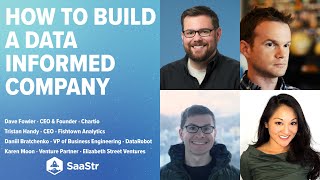
Dave Fowler, Tristan Handy, and Danil Rachchenko discuss how SaaS companies become data-informed. Hire your first data person at 20-40 headcount, keep the team at 2-4% of total staff, and build toward self-serve analytics so employees can answer their own questions without waiting for analysts.
Chapters
here, but I will be on mute. All right, we are now broadcasting live. I'm going to count you down from 5, 4, 3, 2, 1. Hi everyone, thanks for joining our workshop on how to build a data-informed company. Our panelists collectively work with thousands of top-tier clients on their data strategies, and we're really excited to share case studies, tactical ways to inform your strategies, and then also, you know, what the future of business engineering looks like. So I'd like to— I'm Karen Moon, and I'd like to welcome our panelists. We have Dave Fowler, CEO and co-founder of Chartio, Tristan Handy of CEO of Fishtown Analytics, an open-source platform, and DDT. And also, Danil Rachchenko, VP of Business Engineering at DataRobot. So to start, oops. So why is it important to be a data-informed business to begin with? Dave, let's start with you. You know, I think what I love about Chartio's visual approach, you know, visual approach to SQL is how intuitive it is. And even some of your clients like DoorDash and New York Times, you know, provide access to everyone in the company. So that's pretty cool. Like, can you share a case study of how your solution has helped one of your clients become truly data-driven and what was that journey like?
Yeah, so our whole thesis as a company is that the more informed your business is, the more everybody knows what's going on and can experiment and iterate and improve, the more competitive you are, the more you're going to win. And so one of the biggest obstacles we see to that of people being informed is there's kind of the people who know the context of the business, the people running everyday, day-to-day marketing operations, sales, product, people needing the data. And then there's the people who know the technical parts of the data, and there's a gap there. And so how do we bridge those together? And so we built a product Chartio that really, really is part of the stack of improving that, and we obsess over that. And so we get to work with all kinds of really great businesses that are very data-driven. One of my favorite kind of stories there is AllTrails. You got— if you're not using AllTrails, you should be right now, especially during COVID It's the best way to find great trails. And go hiking. It's a great app for that. And they, from the beginning, were so data-driven. The CEO fully adopted Chartio, and every group in the company had a bunch of dashboards and just clear KPIs of what they were tracking. And because of that, they could experiment and learn more things than any of their competitors could. It was kind of crowded. And one of the great examples— they did a lot of great SEO examples of, like, they found things that worked. And right now, if you search for AllTrails, they, they come up as the first or second result for like every trail out there. Um, and they also found that for the longest time they thought ads didn't work. If they bought something on an Apple, you know, on the, on the Apple App Store, they thought it didn't work because what the data was reporting for the App Store, they didn't get that many downloads. But they did an isolated experiment, and, and I think the first company they chose was Germany, and it had like pretty flat growth. In app downloads. And then they ran some ads just in Germany, and they found all of a sudden it skyrocketed. And they were able to choose a few other countries and replicate the same thing. And they found out that they were getting almost an order of magnitude more downloads than the App Store was telling them that they did. So they were getting it other ways, so that their ad dollars were really a lot more effective than they thought. And so they could use that channel, and they really, really used that. Won with it. So that— there's all kinds of great examples of that in data. And the more that people are informed and can experiment like that, the more you find these competitive advantages that win.
Great, thanks for that. And so, and Danielle, within DataRobot, you know, you design how to optimize business functions, whether it's recruiting, marketing, product development. Can you share a success story with us?
Sure.
And for context and this question in general, so most business functions, especially in software companies like ours, and like I think many people who are present, are like— those functions are actually information processing machines. So if you think about it, like, people see that— most people see that as their laptops, they consume information, they produce information, then there is software on those laptops and on servers that also consumers of information, produce information. So this whole thing is just giant information processing machine, like company. And my job and my team, what we do is we build and optimize those machines. They all like— that's why it's pretty important to be informed because all we deal with is information. And in regards to successes, it's hard to single out one that is more successful than others. But I'll talk about one example. It's what we call events machine. So trade shows, conferences, they are a very big part of our marketing and our sales opportunities. And back when we started, it took a team including our CEO, a team of few people, a couple of months to to organize, to go to the event, to collect information, to follow up, and so on. And just before the COVID hit, we were doing something close to 60 events per month, which is 2 events per day including weekends. And doing event is not just going to event, it's promotion before the event, it's collecting information during the event, it's follow-up after the event. On some weeks, we had close to 5,000 pieces of contact information we had to follow up with. So this is a pretty large information processing machine and it all was run, like this whole thing was run by just a few people, few event coordinators basically, and each, like each person includes dozens of steps that need to happen for this whole thing to work well and we build it and it's like a success of it was that as things was scaling, was growing faster than company on average, which is I think it was impressive for us. And another cool thing about it is that when COVID hit and physical events became not a thing, we were able to repurpose most of it to virtual events and webinars because we just changed inputs to this information machine. We changed some items inside and the rest of it just keeps working as it worked with physical events.
That's cool. So it sounds like there's a lot of best practices from each area that just kind of flow into the next. Amazing. And so Tristan, I think, you know, it's so easy to think about democratizing data as a positive thing, but there's some pitfalls. And you mentioned, you know, there can be internal chaos. Can you tell us a little bit more about what that means and how a company can avoid that?
Let me unmute for my 2-and-a-half-year-old real quick. The— I don't want to come across as like anything about the topic that we're talking about is negative. Like democratizing data is like absolutely 100%. Like this should be a goal of everyone on this call. The challenge is that the modern data stack— so broadly, I refer to the modern data stack as data ingestion tools, data warehousing, data transformation, business intelligence, so like the stack of tools that like allows people to get value out of data with very high velocity today. To a certain extent, we're— since Redshift came out in 2012 and kind of unlocked all of this, we're a victim of our own success. Now, it is dramatically easier to create data assets than it has ever been. And as a result, there are a tremendous number of data assets, tables, dashboards, whatever, that are floating around in organizations. And this problem was experienced first by the hyperscale tech companies. And many of them have internal tools to manage this chaos. LinkedIn makes a tool called Data Hub. Spotify has one called Lexicon. Netflix has one. Like, all of these hyperscale tech companies have internal data governance tools that help people at the companies find the relevant data set and know that it is trustworthy, and then understand, like, who is using what dashboards and that they are also trustworthy. So this, like, what should I trust is is, I think, often going to be the next problem that companies face as they become more and more capable of producing these assets.
Yeah, that's super interesting. I could see that happening in a lot of companies. So you kind of need a single source of truth, right? So we have a lot of members and attendees in the audience who are building awesome companies. And as we think about going— just starting out and going from $0 to $100 million in ARR, you know, would love to like shift gears and talk about tactical next steps and building data-informed processes and culture. So Tristan, I want to start with you. You know, Fishtown has helped several companies like Casper and like really like cool companies build their internal analytics competencies when they are early at Series A all the way through hypergrowth. What do you suggest when starting out? And at what stage at a company's lifecycle does it make sense to build a dedicated team? What is the right time to level up? Proxy tools.
Yeah, for sure. And it's funny, I wrote the blog post that this chart is from, this graphic is from, back in 2017. And I didn't actually realize that I was going to be hitting on some nerve, but that post in the past 3 years has been read, I don't know, like 75,000 times. And it was kind of our roadmap. Before we became a product organization, we were primarily focused on building an open source tool called dbt today. But we started as a business, as a consulting company that helped venture-backed startups build and scale their analytics functions. The hardest thing about that is not actually like, what's the right thing to do? The hardest thing is like, what's the right thing to do for me right now? Because if you try to do what Airbnb does, and you're a B-round funded startup, that's absolutely the wrong answer. I published this series of recommendations. The short answer, because I'm being being very long-winded, I apologize, is that I think the right answer to when to hire your first full-time data person is in the 20 to 40 headcount range. And then we did a survey as far as how you should grow that team over time. And generally, we find that companies at all stages, they keep their data teams between 2% and 4% of headcount. So that if you're looking for like at the most broad level like guidance, like that's what I would say.
That's super helpful. Dave, you know, what data pitfalls do you see in the clients that you work with? I mean, you work with a variety of different kinds, like what do you suggest as companies scale?
Yeah, so yeah, this is kind of our diagram that's that's a similar kind of framework to Tristan's, but this is a little bit more about the— less about the team and how you implement it. And so we've been working for almost a decade now with hundreds and hundreds of companies, and we see a lot of pitfalls. And so Chartio sits kind of on top of the stack, and we help you explore and visualize and collaborate on that data. And it really depends on what do you got underneath. If it's all really, really messy, things are going to be difficult. So we actually collected just tons and tons of best practices that we discovered that with working with our customers, we wrote a whole book on this. So actually you can go download the rough copy. It's going to be in print, a much better version soon, but you can download it for free on dataschool.com. And we talk about these 4 stages we see companies go through with sophistication. And, and that's the first one. You're really small. You're just working directly with the raw sources, maybe your Postgres data. Maybe your Salesforce, then you go into a lake stage where you put all that data into one spot, uh, into a warehouse like a Redshift or Snowflake or BigQuery, and then it's— then it's one spot, it's easy to work on. Then you go to the warehouse where, you know, it's all in one spot but it's really messy still in the lake stage. The warehouse, you kind of make these views on top and clean up that data source so it's a lot easier for that single source of truth, as you were saying. For people to work with. And then as you get even more sophisticated and you want to democratize across different teams, maybe you know that warehouse might have 300 to 800 to 1,000 or more tables in it, and you might want to say, actually, let's, let's break these down into marts. That this is, this is a smaller set of data for the sales team, this is the data that the marketing team is going to care about. And so you can make more isolated datasets that are easy for them to explore. And so that's how we kind of see the stages broken up that companies go through. And I would say as far as like pitfalls, the toughest stage for people these days is kind of getting from that lake to warehouse stage. Getting a lake set up is pretty straightforward, but how to set up that warehouse is pretty tough. I always recommend Tristan's company dbt. It's the best tool for doing that. You can see the logo spread all around in this image. Making a bunch of SQL views to make that clean source just goes a long, long way for empowering the business. If a data team can really focus on that and get a really, really nice, organized single source of truth, that just super amplifies the company.
Yeah, and the thing I forgot to mention is all of you guys kind of work with each other and offer different parts of the stack, which is kind of cool to bring that, like, integrated lens to the audience. So, you know, as we switch to DataRobot, like, you know, this— you're a company, Daniel, of, you know, large scale. You guys have raised over $400 million, have over 1,000 employees in offices around the globe. You know, but one thing I thought was interesting is that you mentioned it operates not just as one big slow company, but as 100 aligned startups, you know, and working together to achieve a shared vision. So how do you balance, in your role, engineering high-functioning machines for each of these business functions, but still allowing for creativity and autonomy throughout the organization?
Yeah, the answer is probably very typical for startups. It's customer focus and full-stack teams, except in our case, customers are people inside the company. And full stack in our case means everything from understanding how business works to implementing technical and organizational changes to improve it. So we work— business engineering and data about works in small teams. Each of those teams is focused on specific area of the company: customer acquisition, customer success, people, whatever. And each of those teams has all the skills you need to improve business, to build those processes, to build informational machines from engineering, obviously, data analytics, process engineering, product management, change management, and so on. And, um, yeah, so each of those teams works very closely with their business stakeholders, and usually it's more than one team, and iterate very fast. And that allows us to both have robust, scalable, like automated processes and also change them very, very fast as company grows. And of course, like this conversation is mostly about data. I just want to point out that like just doing data would not work for us. Like if we had data team, would probably would not work. So each of those like business engineering teams that does something with data, they have both people who know data but also people who can operationalize this data and to collect this data and also to set up business processes that use that data. I think data team makes sense for dedicated data teams that just does mainly data. Makes sense for larger company, but not for— well, I consider us still a relatively small company, so not for us.
Amazing. So, as we wrap up, there's been so much evolution and change that technologies allowed for, but also as organizations shift. You know, you guys have always been at the forefront of this. I'm curious to know what you think the modern data-driven business will look like 5 years from now, and how are each of you staying at the forefront?
Yeah, so I really think we're seeing this trend exponentially right now, but the amount that data really matters in everyone's job is increasing. And so that gap I talked about in the beginning of the people who know the context of the data and then the people who know how to work with the data, we have to merge those together. And so we are obsessed with making it, you know, really, really trivial, as much as possible anyway, for people in marketing and sales and product to explore the data themselves and get data literate. Unless they can really read and explore the data themselves, they're not going to really know it or understand or be able to answer things. So I think that will continue to be a trend and actually make some headway. I think we're still, you know, at a stage where maybe only 4 or 5% of a company can really like go and answer a question that they have from the data right now. And I think that's got to get up to like 40, 50, 80% of a company. You know, Excel's been around for almost 30 years now. Sorry, over 30 years, almost 40 years. And anybody can work with Excel, uh, and— but as soon as data gets bigger than a spreadsheet, you gotta learn SQL or complex data stack and BI thing. And, and, and so we really, we really think, uh, that it can be as easy as Excel, um, but a lot of things have to come together, uh, for that.
Um, thanks for sharing, Tristan. Danielle, do you have any final thoughts you wanted to share?
Yeah, I think what I said, they've said, like, you, you don't go to IT to set up new application on your laptop, right? So I think in the future you will not go to analytics team to get your answer from data. You will just get it yourself in most cases. And as they mentioned, like, the problem now, like, right, so those people, 80% of company will not learn SQL. But they need some interface to interact with data and no one knows right now what this interface is. And someone will figure it out eventually and will become a big, big company. So maybe it will be Chartio.
I want to pivot off something that was said earlier that I really think that right now, so this picture up on the slide right now is kind of a perfect illustration here. The arrowheads are fairly small but you can see that all of the lines go from left to right. And that's kind of the end of the process. Like what happens next really is that like, you then go to a dashboard and a human looks at the dashboard and like the human processes things in their brain. And that's the next step to like go back to the systems on the left here are the operational systems that actually effect change in the world of atoms. And I think that one of the things that's going to happen, and it is actually starting to happen today, but it's not common practice yet, is that this, this diagram will have an arrow that draws back around to the sources. You'll be able to automatically feed this, this information back so that, like, information that comes from Shopify can be loaded directly into Zendesk after a bunch of processing has been done on it and can trigger automated workflows or just get in front of customer support agents. And so I think that that's going to really meaningfully change how we think about this data stack. It's not just going to be for analytics. It's going to be like the nervous system that runs the entire company.
I think that's such a good point. So we are up for time, but there's a lot of great questions that we unfortunately can't get to. But Tristan, Dave, and Danielle are really amazing source of information. So definitely please reach out to them if you want to learn more about what they're doing. It's pretty cool. And as we look at SaaS companies, obviously data is at the core and the heartbeat of maintaining a competitive edge and consistently having high growth. So I would love for you guys all to reach out if you have any questions or want to learn more. Thank you so much for joining us. I really loved hosting you guys. And thanks to our panelists.
Thank you.
Thank you.
More from Jason

Why Your Next Hire Should Report to an AI, Tragedy Apps, and Too Many AI SDRs? | The Agents #004

Our Agents Drove Our Salesforce Bill Up 80%, Marketo Hates Agents, and We Stealth-Churned Off Notion




Managing 20+ AI Agents: Lazy Agents, Our $500K AI Bill, Stealth Churn & the Death of 60% Solutions




